Table of Contents
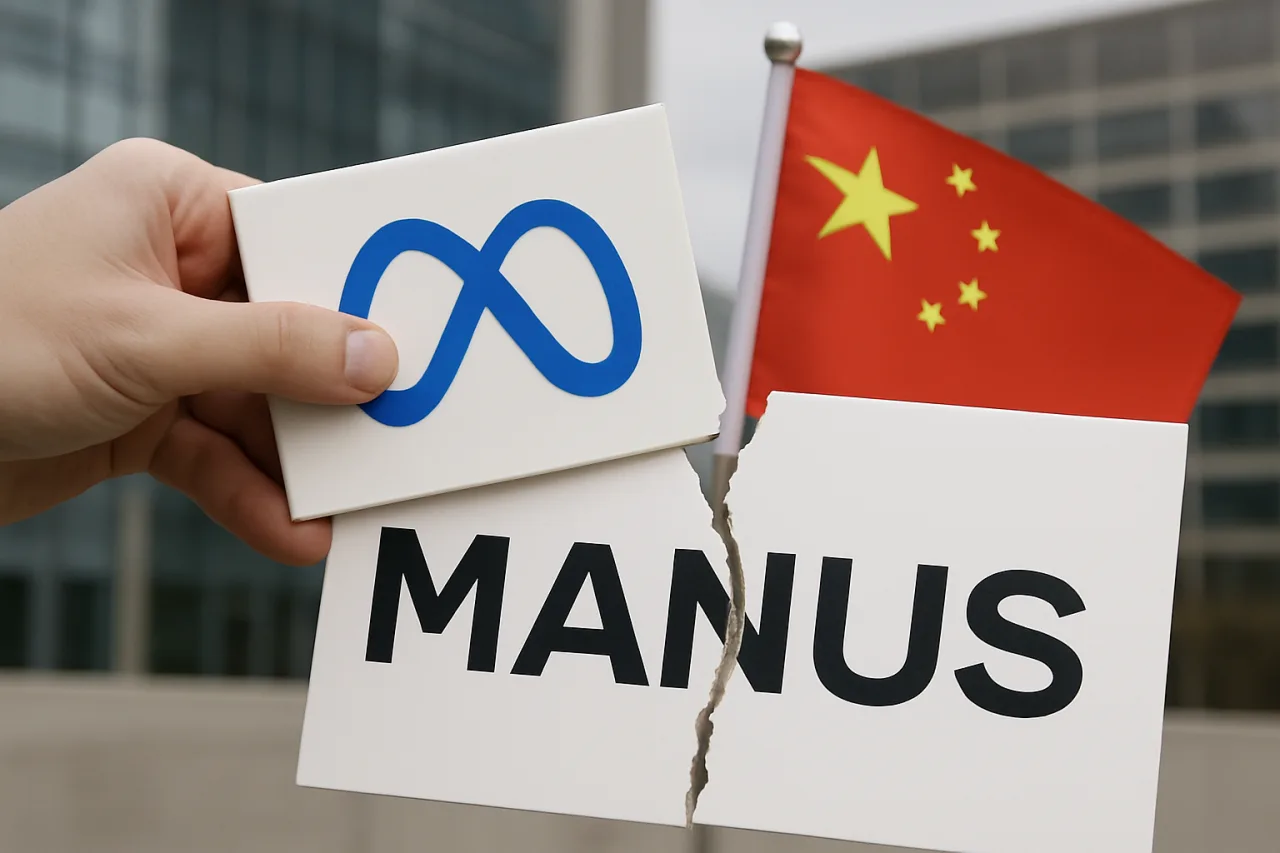
Manus Meta split is now complete. On August 11, 2026, Manus announced it would “soon resume operating as an independent company,” unwinding the $2 billion acquisition by Meta that closed on December 29, 2025. Beijing ordered the deal reversed in April 2026 under China’s foreign investment security review mechanism — an unprecedented move that set in motion the intricate process of unraveling a completed acquisition. On August 23-24, 2026, Manus began deleting user data generated on or after December 29, 2025, to comply with regulatory requirements in certain jurisdictions. Users had 12 days of notice to back up their work before it was permanently deleted. The Manus Meta split is the first mass-market case where geopolitical AI regulation has landed as a consumer backup deadline — and it reveals how AI companies are now geopolitical objects, subject to the same national security scrutiny as defense contractors and semiconductor manufacturers.
Key Takeaway
- 💸 $2 Billion Deal Unwound: Meta acquired Manus for a reported $2 billion on December 29, 2025. Beijing ordered the deal reversed in April 2026 under China’s foreign investment security review mechanism — the first time a completed AI acquisition was forced to unwind.
- 🗑️ User Data Deleted August 23-24: Data generated by affected users on or after December 29, 2025, was deleted between 08:00 SGT on August 23 and August 24, 2026. Users had 12 days of notice to back up their work.
- 🇨🇳 China’s Reason: Beijing tightened tech export controls on cross-border deals involving strategic assets. Chinese regulators cited security concerns and classified the Manus acquisition as a strategic technology transaction that could not remain under US ownership.
- 🔄 Tencent Steps In: Chinese gaming and internet company Tencent has been in talks to become Manus’s largest shareholder after the separation from Meta, according to Reuters.
- 🌐 Geopolitical Precedent: The Manus Meta split is the first completed AI acquisition forced to unwind by a government. It establishes a precedent: AI companies are now geopolitical objects, and cross-border AI deals can be reversed after closing.
Timeline: How the Manus Meta Split Unfolded
The Manus Meta split followed a compressed timeline that moved from acquisition to forced unwinding in less than eight months:
- December 29, 2025: Meta completes acquisition of Manus, a Singapore-based AI agent startup, for a reported $2 billion. Manus becomes part of Meta’s AI division.
- April 2026: Chinese regulators order the deal reversed under China’s foreign investment security review mechanism. The order is unprecedented — no completed AI acquisition had been forced to unwind before. As CNBC reported, Beijing “tightened tech export controls on cross-border deals involving strategic assets, as the US-China tech race intensifies into a contest over talent, hardware and data.”
- June 2026: Meta completes an operational split, ordering its employees to stop using Manus tools for internal projects while blocking Manus staff from accessing Meta’s internal data systems.
- August 11, 2026: Manus announces it will “soon resume operating as an independent company” and notifies users that data generated since December 29, 2025, will be deleted.
- August 23-24, 2026: Data deletion window opens. Affected user data is permanently deleted. Account restoration begins August 25.
Why China Blocked the Deal
China’s decision to block the Manus Meta acquisition reflects a broader strategic posture toward AI technology. As Reuters reported, the reversal was carried out under China’s foreign investment security review mechanism — the same framework used to block transactions involving defense, critical infrastructure, and strategic technologies. The classification of an AI agent startup as “strategic technology” signals that Beijing views AI agents — autonomous systems that can execute tasks across digital platforms — as national security assets, not merely commercial products.
The Manus Meta split also reflects the intensifying US-China tech race. China has tightened controls on the export of AI technology, talent, and data. The decision to force Manus back to independence ensures that a Chinese-origin AI agent platform remains outside US corporate control. Tencent’s potential role as the largest shareholder post-separation aligns with Beijing’s preference for Chinese ownership of strategic AI assets. As The Next Web reported, “Beijing refused to let the acquisition stand, and Meta chose not to fight it.”
What This Means for AI Agent Users
The Manus Meta split has practical consequences for anyone using AI agent platforms. Manus, which was one of the fastest-growing AI agent startups before the Meta acquisition, provided autonomous AI capabilities — booking flights, managing calendars, automating workflows — across digital platforms. Users who built workflows, agents, and automations inside Manus after December 29, 2025, had their data deleted on August 23-24.
The incident highlights a risk that all AI agent users face: your data, your workflows, and your automations live on infrastructure controlled by companies that are subject to geopolitical forces beyond your control. When an acquisition is unwound by a government, the user data caught in the middle is collateral damage. For more on AI agent security risks, see our OpenClaw security crisis analysis and our AI agent security guide.
For Filipino developers and professionals using AI agent platforms, the lesson is straightforward: always maintain backups of your AI workflows, agent configurations, and automation scripts outside the platform. If the platform changes ownership, gets blocked by a government, or shuts down, your work should survive independently. This applies to Manus, OpenClaw, and any other AI agent platform that stores your data on its servers.
The Broader Pattern: AI Companies as Geopolitical Objects
The Manus Meta split is not an isolated incident. It is part of a pattern where AI companies are increasingly subject to national security scrutiny, export controls, and geopolitical maneuvering. The US has restricted Chinese AI models through infrastructure — as we documented in our coverage of OpenRouter’s Chinese model usage, where Chinese-origin models captured 46% of US enterprise token traffic. China is now restricting US ownership of Chinese AI companies. The result is a bifurcating AI ecosystem where companies, data, and technology are increasingly divided along geopolitical lines.
This pattern has three implications for Filipino professionals and businesses:
1. Choose AI platforms with geopolitical awareness. If you are building a business on an AI platform, understand who owns it, where it is incorporated, and what jurisdictions have authority over it. A platform subject to US export controls may be restricted in certain markets. A platform subject to Chinese regulation may face data handling requirements that affect your users. For more on choosing AI tools, see our AI tools pricing comparison.
2. Data sovereignty matters. The Manus Meta split demonstrates that user data can be deleted by government order, not just by company policy. If your business relies on AI agent platforms that store data in jurisdictions subject to geopolitical disruption, maintain independent backups. For practical guidance on writing AI workflows, see our AI prompts guide.
3. The AI agent market is consolidating — and fragmenting. OpenAI acquired OpenClaw. SpaceX acquired Cursor. Stripe acquired OpenRouter. Now Meta lost Manus to Chinese regulation. The AI agent market is simultaneously consolidating (Western companies buying Western companies) and fragmenting (China forcing independence of Chinese companies). For Filipino developers, this means the platform landscape will continue to shift — and the safest bet is to build skills that transfer across platforms, not loyalty to any single one. See our guide to free AI tools for Filipino students for platform-independent options.
What Happens Next for Manus and the AI Agent Market
Manus faces a challenging path forward. The company lost the financial backing of Meta, one of the world’s largest technology companies. It must rebuild its infrastructure, re-establish its brand as an independent entity, and compete in a market that has become more crowded since the acquisition. Manus said it is “preparing a series of new features that will push the boundaries of what’s possible for general AI agents once again,” but the question is whether an independent Manus — without Meta’s resources — can match the pace of OpenAI, Anthropic, and SpaceXAI, all of which have access to substantially more capital and compute.
Tencent’s potential role as the largest shareholder changes the competitive dynamics. Tencent brings capital, WeChat ecosystem integration, and deep experience in AI through its own investments in AI research and development. But Tencent’s involvement also means Manus will be perceived as a Chinese-aligned platform, which could limit its adoption in the US and other Western markets. The same geopolitical forces that unwound the Meta deal may also limit Manus’s global reach.
The Manus Meta split also sends a signal to other AI startups considering cross-border acquisitions. If you are a Chinese-origin AI company acquired by a US tech giant, your deal can be reversed by Beijing. If you are a US company looking to acquire a Chinese AI startup, you now know that China may not allow the deal to stand. This reduces the acquisition market for Chinese AI companies and may push more Chinese AI startups toward domestic investment — further bifurcating the global AI ecosystem. For more on how this bifurcation affects Filipino developers, see our analysis of the OpenClaw story and how OpenAI’s acqui-hire of OpenClaw’s creator contrasts with Manus’s forced independence.
The Data Backup Lesson: What Every AI User Should Do Today
The Manus Meta split turned a geopolitical regulatory decision into a personal data loss event for users. Here is what every AI agent user — Filipino developer, OFW professional, or student — should do today to protect their work:
- Export your data from every AI platform you use. If you use Manus, OpenClaw, ChatGPT, Gemini, or any AI agent platform, find the export function and download your conversations, workflows, and configurations. Store them locally on your own device.
- Maintain a version history. If you build AI workflows or agent configurations, use a git repository or a local backup system to track changes. This ensures you can restore your work even if the platform deletes it.
- Read the terms of service. Understand what happens to your data if the platform changes ownership, gets acquired, or is forced to unwind an acquisition. The Manus case proves this is not a theoretical risk.
- Diversify across platforms. Do not build your entire workflow on a single AI platform. If the platform disappears or is blocked in your country, you should be able to switch to an alternative without starting from scratch. For platform-independent options, see our guide to free AI tools and AI translation tools.
Frequently Asked Questions
What is the Manus Meta split?
The Manus Meta split is the unwinding of Meta’s $2 billion acquisition of Manus, a Singapore-based AI agent startup. China ordered the deal reversed in April 2026 under its foreign investment security review mechanism. Manus resumed independent operations, and user data generated since the acquisition was deleted on August 23-24, 2026.
Why did China block the Manus Meta acquisition?
China classified the Manus acquisition as a strategic technology transaction under its foreign investment security review mechanism. Beijing tightened tech export controls on cross-border deals involving AI, talent, hardware, and data. The decision reflects China’s view that AI agent platforms are national security assets that should remain under Chinese ownership.
When was Manus user data deleted?
User data generated on or after December 29, 2025, was deleted between 08:00 SGT on August 23 and August 24, 2026. Users had 12 days of notice to back up their work using Manus’s backup tool. Data downloaded before the cutoff could be restored starting August 25.
Is Manus still operational after the Manus Meta split?
Yes. Manus resumed independent operations after the separation from Meta. The company said it is “preparing a series of new features that will push the boundaries of what’s possible for general AI agents once again.” Tencent is reportedly in talks to become the largest shareholder.
What should AI agent users learn from the Manus Meta split?
Always maintain independent backups of your AI workflows, agent configurations, and automation data outside the platform. AI companies are now geopolitical objects subject to government regulation, export controls, and forced unwinding of acquisitions. Your data on any AI platform is subject to forces beyond your control.
How does the Manus Meta split affect Filipino developers?
Filipino developers using AI agent platforms should diversify their tool stack, maintain data backups, and build skills that transfer across platforms. The AI agent market is consolidating in the West and fragmenting along geopolitical lines. Platform independence — the ability to switch tools without losing your work — is now a professional survival skill. See our DeepSeek V4 guide for a platform-independent AI model option.