Table of Contents
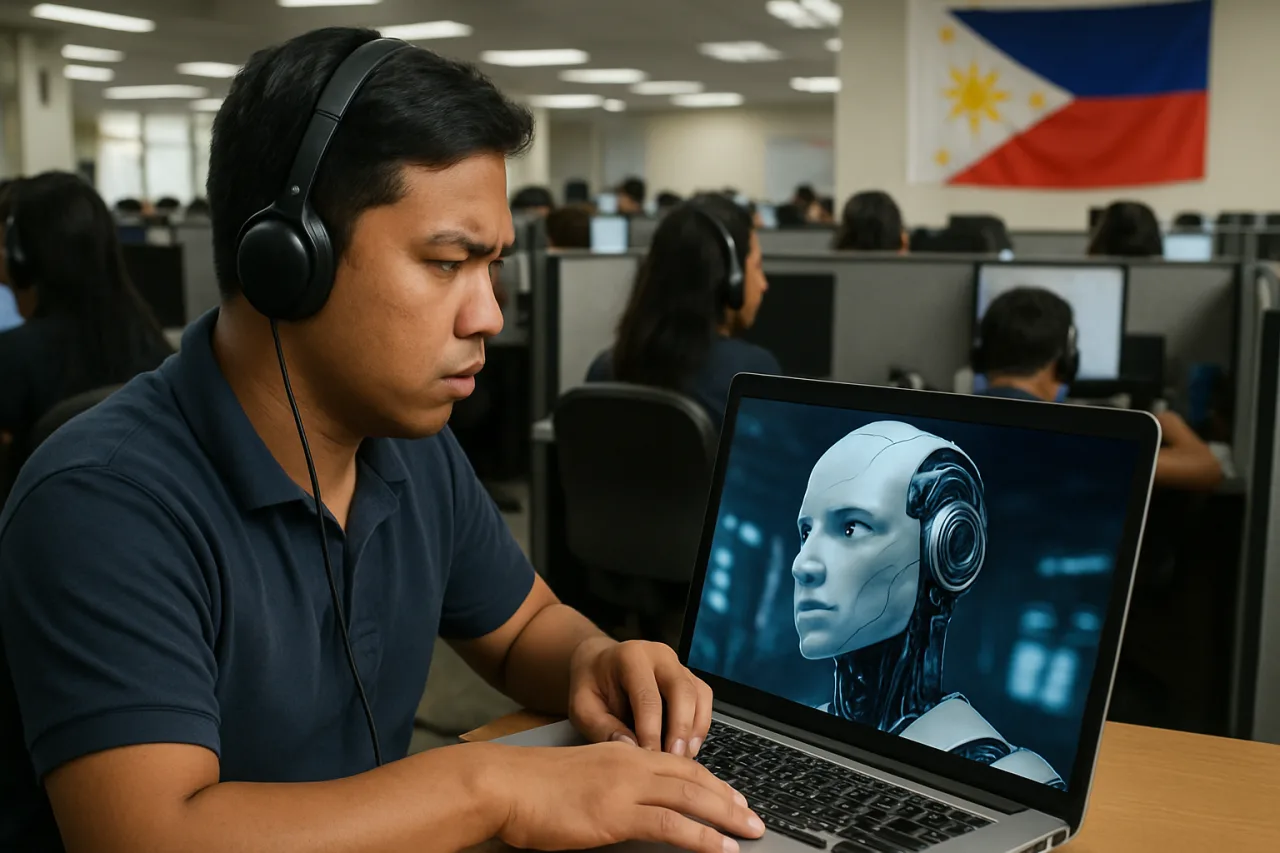
The IT-BPM AI 2028 target cuts announced by IBPAP on July 15, 2026, represent the most significant recalibration of Philippine employment expectations in a decade. The Information Technology and Business Process Association of the Philippines slashed its 2028 revenue target from $59 billion to a range of $43.3-50.5 billion — a reduction of up to 27%. Employment projections dropped from 2.5 million full-time workers to 1.85-2.14 million. But the most important change is not the numbers. It is the framework. IBPAP no longer talks about “full-time employees” — it talks about “AI-enabled workers.” That single phrase change tells every Filipino BPO professional what the next decade of their career will look like: the industry will still hire Filipinos, but only Filipinos who can work alongside AI.
Key Takeaway
- 27% revenue cut: IBPAP’s original 2022 roadmap projected $59 billion by 2028. The revised roadmap projects $43.3-50.5 billion. The downgrade reflects AI adoption, slower buyer decisions, and competition from South Africa, Egypt, Poland, Vietnam, Colombia, and Costa Rica.
- “AI-enabled workers” replaces “full-time employees”: IBPAP’s new framework measures success not by raw headcount but by workers who can operate alongside AI systems. This is the single most important language shift in Philippine employment policy in 2026.
- Jobs are not disappearing — they are transforming: IBPAP President Jack Madrid confirmed that AI has affected some entry-level jobs, but affected employees have been redeployed rather than laid off. The threat is not job loss — it is skill obsolescence.
- Philippines is still #2 globally: India remains #1. The Philippines remains #2. But the gap is narrowing as competitors improve their English proficiency, infrastructure, and government incentives.
- 2026 remains strong: Despite the 2028 cuts, 2026 projections are $42.3 billion in revenue and 1.96 million workers — up from $40 billion and 1.9 million in 2025. The industry is still growing. It is just growing slower than originally planned.
The Numbers: What Changed and What Didn’t
To understand the IT-BPM AI 2028 target cuts, an investor or worker needs to see the original and revised projections side by side. The comparison reveals not just how much was cut, but where the industry still expects growth.
| Metric | Original 2022 Roadmap | Revised 2028 (Best Case) | Revised 2028 (Downside) | Change |
|---|---|---|---|---|
| Revenue | $59 billion | $50.5 billion | $43.3 billion | -14% to -27% |
| Employment | 2.5 million FTE | 2.14 million AI-enabled | 1.85 million AI-enabled | -14% to -26% |
| Framework | Full-time employees | AI-enabled workers | AI-enabled workers | Fundamental shift |
What did not change: the industry is still growing. In 2025, the IT-BPM sector generated $40 billion in revenue and employed 1.9 million workers. For 2026, IBPAP projects $42.3 billion and 1.96 million workers. For 2027, $45.3 billion and 1.99 million. The industry is not shrinking — it is growing slower than the original roadmap assumed. The difference between “growing slower” and “shrinking” is the difference between a recalibration and a crisis. IBPAP chose to be honest about the recalibration.
But the honest assessment has a sting: the original roadmap assumed the Philippines would add 600,000 new BPO jobs between 2022 and 2028. The revised roadmap assumes 240,000 to 540,000 new jobs — roughly half to two-thirds of the original expectation. For a country where the BPO sector has overtaken OFW remittances as the biggest growth engine, fewer new jobs means fewer Filipinos lifted out of poverty by the industry that has been the country’s most reliable employment engine for two decades.
Why IBPAP Cut the Targets: Three Forces
IBPAP President Jack Madrid identified three forces driving the target cuts. Understanding each one is essential for any Filipino whose livelihood depends on the BPO industry.
Force 1: AI Adoption
The most discussed force is also the most misunderstood. Madrid said: “In the past three years, the world around us changed. This thing called AI emerged.” But he also said: “I think AI is a real development, but I think we have not really seen it scale yet. It has affected some jobs, but based on all the members we’ve talked to, the entry-level jobs that some of the AI trials have affected, those employees have been able to be redeployed.”
What does this mean in practice? AI is not yet replacing Filipino BPO workers at scale. What it is doing is changing the nature of the work. Customer support agents who used to handle routine password resets and account inquiries now handle more complex, emotionally nuanced cases — because AI handles the routine ones. Data entry clerks who used to transcribe information now verify and correct AI-generated outputs. The jobs remain, but the skill requirements have shifted upward.
The IT-BPM AI 2028 target cuts reflect IBPAP’s assessment that this shift will accelerate. As AI handles more routine tasks, the industry will need fewer entry-level workers and more mid-level workers who can manage, verify, and optimize AI systems. The “AI-enabled worker” framework is IBPAP’s way of saying: the industry will still hire Filipinos, but only Filipinos who can do what AI cannot.
Force 2: Slower Buyer Decisions
Madrid noted that global buyers are taking longer before deciding to invest in offshore operations. “All the macroeconomics, all the geopolitics caused many of our buyers and investors not to stop, but it made them make their decisions slower on where to make the investments,” he said, as reported by the Philippine Daily Inquirer.
This is not a rejection of the Philippines — it is a hesitation. When the Middle East conflict raises oil prices, when US tariff policy shifts, when the Sara Duterte impeachment trial dominates headlines, global companies delay expansion decisions. They do not cancel them. But delays compound: a company that would have opened a 500-seat facility in Manila in 2024 but delayed to 2026 creates a two-year gap in employment growth that the original roadmap did not account for.
For Filipino workers, slower buyer decisions mean fewer new job openings each year. The industry still hires — but the hiring pipeline is slower. Workers who would have been hired in 2025 may not be hired until 2027. This does not show up as job losses in the statistics, but it shows up as fewer opportunities for new graduates entering the workforce.
Force 3: Global Competition
The Philippines is still the world’s second-largest IT-BPM destination, behind India. But Madrid identified a growing list of competitors: South Africa, Egypt, Poland, Vietnam, Colombia, and Costa Rica, according to BusinessWorld’s coverage. Each offers something the Philippines must compete against.
South Africa and Egypt offer lower labor costs and favorable time zones for European clients. Poland offers nearshoring for European companies with EU data protection compliance. Vietnam offers lower costs and improving English proficiency. Colombia and Costa Rica offer nearshoring for US clients with Spanish-language capabilities.
The OECD Economic Survey of the Philippines 2026 identified high electricity and telecom costs as structural disadvantages that make Philippine BPO operations more expensive than competitors. When a BPO company in Manila pays more for electricity than a competitor in Ho Chi Minh City, the cost advantage of Filipino labor shrinks. The IT-BPM AI 2028 target cuts reflect IBPAP’s acknowledgment that the Philippines can no longer compete on labor cost alone — it must compete on labor quality.
What “AI-Enabled Worker” Actually Means
The most important phrase in IBPAP’s revised roadmap is “AI-enabled workers.” This is not marketing language. It is a fundamental redefinition of what the BPO industry hires for. Understanding what it means is the difference between keeping your job and losing it.
An AI-enabled worker is someone who can do at least three things:
1. Use AI tools to do their job faster. A customer support agent who uses AI to draft responses, summarize call histories, and generate knowledge base articles produces more output than an agent who does everything manually. The AI-enabled worker is not replaced by AI — they are amplified by it. But the worker who refuses to use AI is replaced by the worker who does.
2. Verify and correct AI outputs. AI makes mistakes. It hallucinates facts, misinterprets context, and produces plausible-sounding but wrong answers. The AI-enabled worker’s most valuable skill is knowing when AI is wrong — and fixing it. This requires domain expertise that AI does not have: understanding the client’s business, the customer’s emotional state, and the regulatory requirements that AI may not know about.
3. Handle complex cases AI cannot. As AI handles routine cases, the cases that reach human workers are the hard ones — angry customers, regulatory disputes, technical edge cases, culturally sensitive situations. The AI-enabled worker is not a script-reader. They are a problem-solver who handles the cases where AI’s confidence should be lowest.
For Filipino BPO workers, this means the AI skills Filipino professionals need before 2027 are not optional career advice — they are employment requirements. Workers who develop these skills will be the ones IBPAP counts in its “AI-enabled worker” projections. Workers who do not will be the ones who fall outside the count.
What This Means for Filipino BPO Workers
For current BPO workers: Your job is not disappearing — but your job description is changing. If you currently handle routine customer inquiries, start learning to use AI tools to handle those inquiries faster, then use the time you save to handle more complex cases. The workers who become AI-enabled will be the ones who get promoted. The workers who resist AI will be the ones who get replaced — not by AI directly, but by colleagues who use AI better than they do.
For aspiring BPO workers: The entry-level bar has risen. Companies are hiring fewer pure script-readers and more workers who can think critically, handle ambiguity, and work with AI tools. If you are applying for a BPO job in 2026, demonstrate AI literacy in your interview. Show that you can use ChatGPT, Claude, or Copilot to draft responses, summarize information, and solve problems. This is now a baseline competency, not a differentiator.
For BPO team leaders and managers: The transition to AI-enabled work requires upskilling your existing team. Madrid confirmed that affected entry-level employees have been redeployed — but redeployment only works if the employee has the skills to do the new job. Managers who invest in AI skills training for their teams will retain workers through the transition. Managers who do not will face turnover as workers leave for companies that do train them.
For BPO investors and executives: The IT-BPM AI 2028 target cuts are a signal to invest in talent quality, not just talent quantity. The Philippines’ competitive advantage is no longer cheap labor — it is skilled labor that can work with AI. Companies that invest in training, upskilling, and AI tooling will capture the $50.5 billion best-case scenario. Companies that compete on cost alone will face the $43.3 billion downside.
The Bigger Picture: Connecting the Dots
The IT-BPM AI 2028 target cuts do not exist in isolation. They connect to every major economic story we have covered this month.
The OECD survey found that the Philippines needs 5% annual productivity growth to triple income by 2040. The BPO industry’s shift to “AI-enabled workers” is exactly the kind of productivity improvement the OECD is calling for. Each AI-enabled worker produces more output than a non-AI-enabled worker — that is productivity growth. The target cuts are painful in the short term, but they may be the mechanism through which the Philippines achieves the productivity gains the OECD says it needs.
The IT-BPM industry’s pivot to higher-value services is directly enabled by AI. When AI handles routine tasks, Filipino workers can focus on higher-value work — analytics, consulting, creative services, technical support. This shifts the Philippines from a low-cost labor destination to a high-value talent destination. The revenue per worker rises even as the total worker count grows slower.
The connection to whether AI will replace Filipino BPO workers is now clear: AI is not replacing workers, but it is replacing the jobs that workers who lack AI skills used to do. The worker who adapts keeps their job. The job that does not adapt disappears.
Frequently Asked Questions About the IT-BPM AI 2028 Target Cuts
What are the IT-BPM AI 2028 target cuts?
The IT-BPM AI 2028 target cuts are the revised revenue and employment projections announced by IBPAP on July 15, 2026. The original 2022 roadmap projected $59 billion in revenue and 2.5 million full-time workers by 2028. The revised roadmap projects $43.3-50.5 billion in revenue and 1.85-2.14 million AI-enabled workers by 2028 — a reduction of 14-27% in revenue and 14-26% in employment.
Why did IBPAP cut the 2028 targets?
IBPAP identified three forces: rapid AI adoption that is changing the nature of BPO work, slower buyer investment decisions caused by geopolitical uncertainty, and intensifying competition from South Africa, Egypt, Poland, Vietnam, Colombia, and Costa Rica. IBPAP President Jack Madrid called the revised projections a more “honest” assessment of where the industry is headed.
Will AI replace Filipino BPO workers?
According to IBPAP, AI has not yet triggered widespread job losses. Entry-level jobs affected by AI trials have seen employees redeployed rather than laid off. However, the nature of work is changing: AI handles routine tasks while human workers handle complex, emotionally nuanced cases. Workers who develop AI skills will keep their jobs. Workers who resist AI will be replaced by colleagues who use it.
What is an AI-enabled worker?
An AI-enabled worker is someone who can use AI tools to do their job faster, verify and correct AI outputs, and handle complex cases that AI cannot. This is IBPAP’s new framework for measuring industry employment — replacing the old “full-time employee” metric. The shift signals that the BPO industry will hire based on AI literacy, not just English proficiency.
Is the Philippine BPO industry still growing?
Yes. Despite the 2028 target cuts, the industry is still growing year over year. 2025 revenue was $40 billion with 1.9 million workers. 2026 projections are $42.3 billion and 1.96 million workers. 2027 projections are $45.3 billion and 1.99 million. The industry is growing slower than originally planned, but it is not shrinking.
How can Filipino BPO workers prepare for the AI shift?
Filipino BPO workers should develop three skills: using AI tools (ChatGPT, Claude, Copilot) to handle routine tasks faster, verifying and correcting AI outputs using domain expertise, and handling complex cases that AI cannot resolve. Workers who demonstrate AI literacy in job interviews and performance reviews will be the ones counted in IBPAP’s AI-enabled worker projections.
Does the Philippines still have a competitive advantage in BPO?
Yes, but the advantage is shifting. The Philippines remains the world’s second-largest IT-BPM destination behind India. The traditional advantages — English proficiency, cultural affinity with Western clients, and a large young workforce — remain. But the new advantage is AI-enabled talent quality. The OECD survey identified high electricity and telecom costs as structural disadvantages that must be addressed for the Philippines to remain competitive.
This article is for informational purposes only and does not constitute investment, career, or employment advice. Industry projections are subject to revision based on economic conditions, AI development, and competitive dynamics. Always conduct your own research or consult qualified professionals before making career or investment decisions.