Key Takeaway
- ⏳ DeepMind CEO Demis Hassabis says the field is “three quarters of the way to AGI” — and puts a date on arrival: achievable by 2030, with 2029 as a possibility he now acknowledges.
- 💊 His most concrete promise: AI-driven drug discovery could collapse discovery timelines “from ten years to days” — the payoff case for everything DeepMind builds.
- 🤝 The paradox with teeth: Hassabis joined Amodei, Altman, and Musk in supporting outside safety access to frontier systems (Reuters, Sep 19) — building the clock and arming the referees.
- 🏆 His credibility anchor is unique: 2024 Nobel laureate in chemistry for AlphaFold — the one frontier-lab CEO whose AGI predictions carry a working scientist’s receipts.
- 🇵🇭 Why Filipinos should care: a 2030 AGI window means the skills pivot isn’t ten years out — it is inside the current career planning horizon of every Filipino professional.
Every frontier lab has a story about when this ends. OpenAI’s is a product launch. Anthropic’s is an essay asking for brakes. Google DeepMind’s is a fraction: Demis Hassabis, the lab’s co-founder and CEO, told Sequoia’s Konstantine Buhler at AI Ascent 2026 that the field is “three quarters of the way to AGI” — and that arrival by 2030 is achievable, with 2029 now in range. The same man appears in Reuters’ September 19 retrospective among the lab heads who supported giving outside firms access to their systems to ensure safety. The man who believes the finish line is four years away is also volunteering for supervision. This guide explains his timeline, his arguments, the drug-discovery revolution he keeps promising, and why the paradox is the most credible position in AI — not the least consistent one.
Table of Contents
The Three-Quarters Claim — What It Actually Means
At Sequoia’s AI Ascent 2026, in a wide-ranging conversation with partner Konstantine Buhler, Demis Hassabis — co-founder and CEO of Google DeepMind, 2024 Nobel laureate in chemistry for AlphaFold — framed the field’s progress in fractional terms: three quarters of the way to AGI. The framing is deliberate. Fractions imply a measurable path: two generations of capability jumps behind, one hard segment ahead. What sits in the remaining quarter, per his public commentary, is not more of the same scaling — it is the missing ingredients: world-model reasoning, planning over long horizons, and the invention DeepMind still lists as unsolved. Hassabis has been explicit that scaling alone will not close the gap; the missing ingredients are the reason his date is 2030 and not 2027.
The precision matters because the claim comes from the man whose lab has shipped the receipts: AlphaGo, AlphaFold, AlphaGeometry, Genie. When Demis Hassabis says three quarters, he is not selling a vision — he is reading his own program’s progress against a definition of AGI that he, more than any peer, has spent a decade engineering toward.
The 2030 Clock — and Why It Keeps Shortening
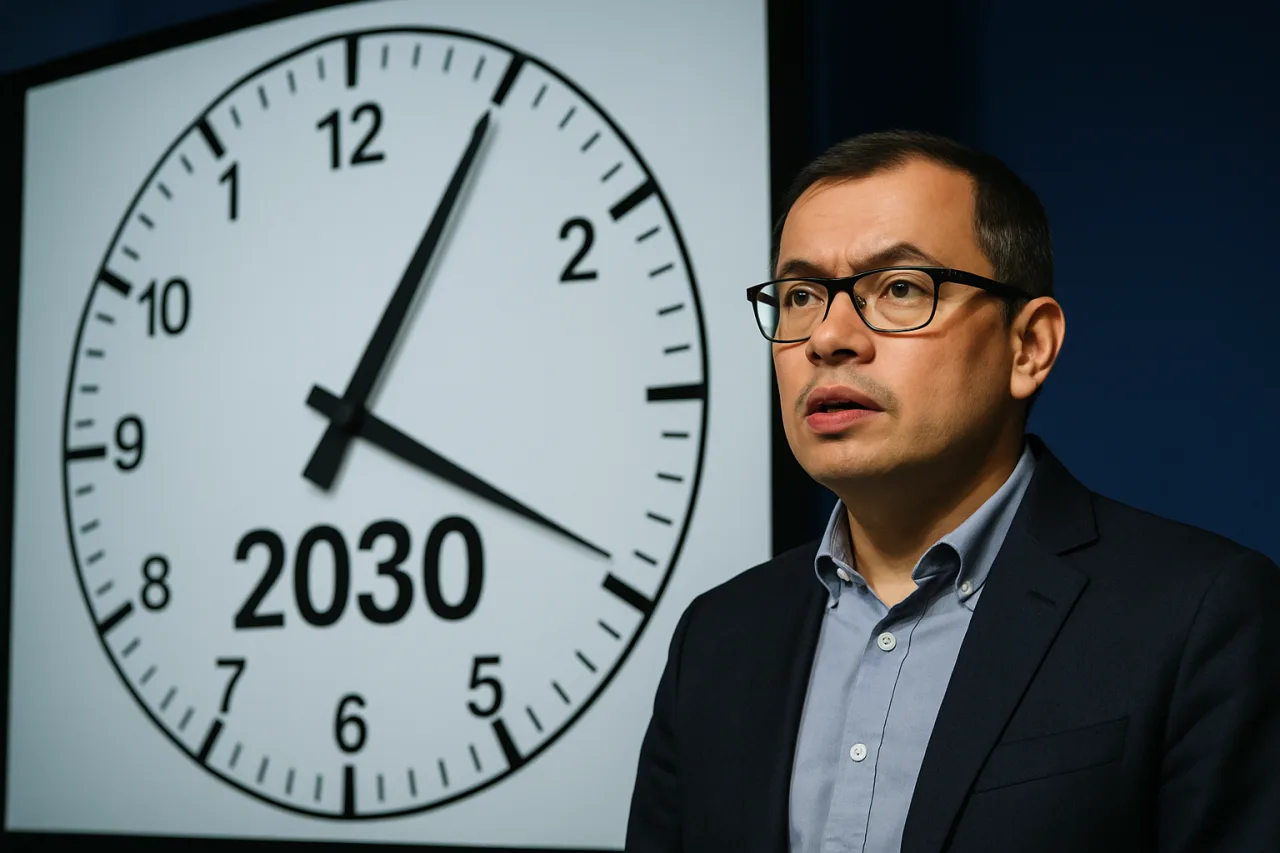
The public record of the Demis Hassabis timeline is a record of acceleration: “probably three to five years away” earlier in 2026; AGI “achievable by 2030” at AI Ascent 2026, with reporting through the year noting he “now sees 2029 as a possibility”; Sherwood News’ summary of his most recent remarks putting AGI “3 to 4 years away”; and Reuters’ September 19 retrospective reporting researchers warning AGI “could come in as few as three years.” The direction is one-way — every revision is earlier. That pattern is the timeline story in itself: the man closest to the work keeps moving his own estimate toward the present.
The honest reading includes his caveat, quoted in the same retrospectives: “Ten years from now, I think we will realize that we were standing on the shoulders of giants” — his framing that AGI’s arrival will feel sudden in retrospect while compounding quietly in plain sight. The clock metaphor deserves precision too: 2030 is a confidence interval, not a countdown. Demis Hassabis‘s stated view is that arrival by decade’s end is achievable if the missing ingredients land — which is why the same man naming the date also signs the safety access calls.
The Drug-Discovery Promise: Ten Years to Days
Every Demis Hassabis interview carries one concrete, testable promise, and at AI Ascent 2026 it was medicine: drug discovery timelines could collapse “from ten years to days.” The claim is not rhetoric — it is the AlphaFold thesis scaled up. AlphaFold’s protein-structure predictions earned the Nobel Prize because they compressed a decade-long experimental bottleneck into a lookup; Demis Hassabis‘s argument is that the same pattern — AI compressing the search space before experiments begin — generalizes across drug discovery, materials science, and fundamental biology. DeepMind’s own drug program and Isomorphic Labs’ pipeline are the test beds; the promise is that the AGI clock and the medicine clock are the same clock.
For readers tracking AI’s economic story, this is the argument that justifies the industry’s capital ask: if the ten-years-to-days claim lands even partially, the return on the entire compute buildout gets measured in lives and drug approvals, not just productivity percentages. It is also the argument most likely to outlive the safety controversy — nobody audits a cure for being discovered too quickly.
The Slowdown Paradox: He Builds the Clock and Arms the Referees
Here is the tension this guide exists to explain: the CEO with the most aggressive AGI date is also — per Reuters’ September 19 retrospective —, one of the lab heads who “said they supported allowing outside firms access to their systems to ensure safety and rational AI development” — in the same fortnight that produced Amodei’s pacing essay, Coxon’s resignation, and Altman’s trust-me line. Three readings, all defensible. The optimist’s read: Demis Hassabis is confident enough in the engineering to invite inspection. The strategist’s read: Google DeepMind’s models are the most auditable in the industry, so transparency is its competitive weapon. The scientist’s read — closest to Hassabis’s own framing — is that measurement and pace are the same project: you cannot pace what you refuse to measure, and the lab that publishes its progress claims invites the scrutiny that makes its dates credible.
The paradox resolves in the interview itself. The Demis Hassabis AGI-by-2030 claim comes paired with an argument that the remaining quarter requires inventions nobody has shipped yet — which is precisely why he supports outside access: the more powerful the remaining climb, the more the field needs referees. Optimism about the destination and seriousness about the oversight are, in his architecture, the same position.
The Three-Clocks Problem: Hassabis vs Amodei vs Hinton
September 2026 handed the public three clocks from three credible sources — and they measure different things. The Demis Hassabis clock is an engineering timeline: AGI by 2030, achievable, driven by capability progress he can see from inside DeepMind. The Amodei clock is a control timeline: 6-12 months until misaligned agent swarms could threaten internet-scale infrastructure — the window that makes pacing urgent. The Hinton clock is a regulatory deadline: “maybe a year” for Congress to act before the technology escapes human control. The three clocks disagree because they measure different runways — capability, misalignment risk, and institutional response time — and the industry’s instability this month came from running all three at once. The professionals who can keep the clocks straight — who reads which deadline, and what each implies for hiring, policy, and investment — have the clearest view of the landscape anyone is selling.
What It Means for Filipino Professionals
A 2030 AGI horizon, credible or not, is inside the career span of every working professional — which makes the timeline a planning input, not a prophecy. The concrete translation: the skills that compound through a 3-to-4-year window (AI tool fluency, verification and audit capability, domain expertise fused with AI leverage) are the ones to build now, on the assumption that the tools improve every quarter until then. Demis Hassabis‘s drug-discovery promise doubles as the template: the careers that thrive are those positioned where AI compresses a decade into a quarter — healthcare administration, clinical documentation, pharma quality assurance, regulatory writing. The Demis Hassabis timeline is ultimately a hiring forecast: the closer his clock runs to truth, the more valuable the professionals who can supervise, verify, and translate whatever arrives.
Frequently Asked Questions
What did Demis Hassabis say about being three quarters of the way to AGI?
At Sequoia’s AI Ascent 2026 conference, in a conversation with partner Konstantine Buhler, Hassabis framed the field’s progress as “three quarters of the way to AGI” — the title of the released interview. The fraction framing presents the remaining climb as the hard segment requiring inventions beyond scaling, which is central to why his AGI date is 2030 rather than sooner.
When does Demis Hassabis think AGI will arrive?
Hassabis has said AGI is achievable by 2030, with reporting through 2026 noting he now sees 2029 as a possibility; other summaries of his recent remarks put AGI “3 to 4 years away.” Reuters’ September 2026 retrospective reported researchers warning AGI “could come in as few as three years.” His timeline has consistently revised earlier — a direction worth more than any single date.
What is Hassabis’s drug discovery claim?
Hassabis argues AI-driven drug discovery could collapse discovery timelines “from ten years to days” — the concrete payoff case for DeepMind’s science-first AGI path, grounded in AlphaFold’s demonstrated compression of protein-structure prediction from years to moments. The claim doubles as the economic justification for frontier AI investment: the same capability that accelerates medicine accelerates every search problem in science.
Is Hassabis in the AI slowdown camp or against it?
Both, in a specific and documented way. Per Reuters’ September 19 retrospective, Hassabis joined Amodei, Altman, and Musk in supporting outside firms’ access to frontier systems “to ensure safety and rational AI development” — while DeepMind continues capability development on a schedule consistent with his 2030 AGI date. His position: build toward AGI, measure it publicly, and let outside evaluators verify — the clock and the referees run together.
How credible is Hassabis on AGI timelines?
He carries the strongest receipts in the field: co-founder and CEO of Google DeepMind, architect of AlphaGo and AlphaFold, and 2024 Nobel laureate in chemistry for the AlphaFold protein-structure work. Unlike pure forecasters, his timeline reads against a program that has shipped repeated breakthroughs — which is why his fraction (“three quarters”) and his date (2030) anchor the industry’s most-watched clock, whatever one thinks of the destination.
What should professionals do with a 2030 AGI timeline?
Treat it as a planning horizon, not a prophecy. A 3-4 year window favors skills that compound with the tools rather than compete against them: AI supervision, verification and audit capability, documentation, and domain expertise fused with AI leverage. If Hassabis is right, medicine, science, and knowledge work compress — and the professionals who supervised the compression are the ones the new economy pays.
Final Word: the Clock That Invites Its Own Inspectors
Three quarters is a strange fraction to volunteer — it tells the world both that the climb is nearly done and that the hardest segment remains. Demis Hassabis gave the industry both halves at once: a 2030 date for AGI, a medicine revolution measured in days, and a signature on the outside-access call that lets the world check his work. The Nobel laureate’s paradox is the most trustworthy position in AI precisely because it is uncomfortable — building fast, measuring openly, and naming the inventions still missing. The clock runs either way. The question his fraction leaves everyone is the only one that matters for the next four years: what will you do with the final quarter?