Key Takeaway
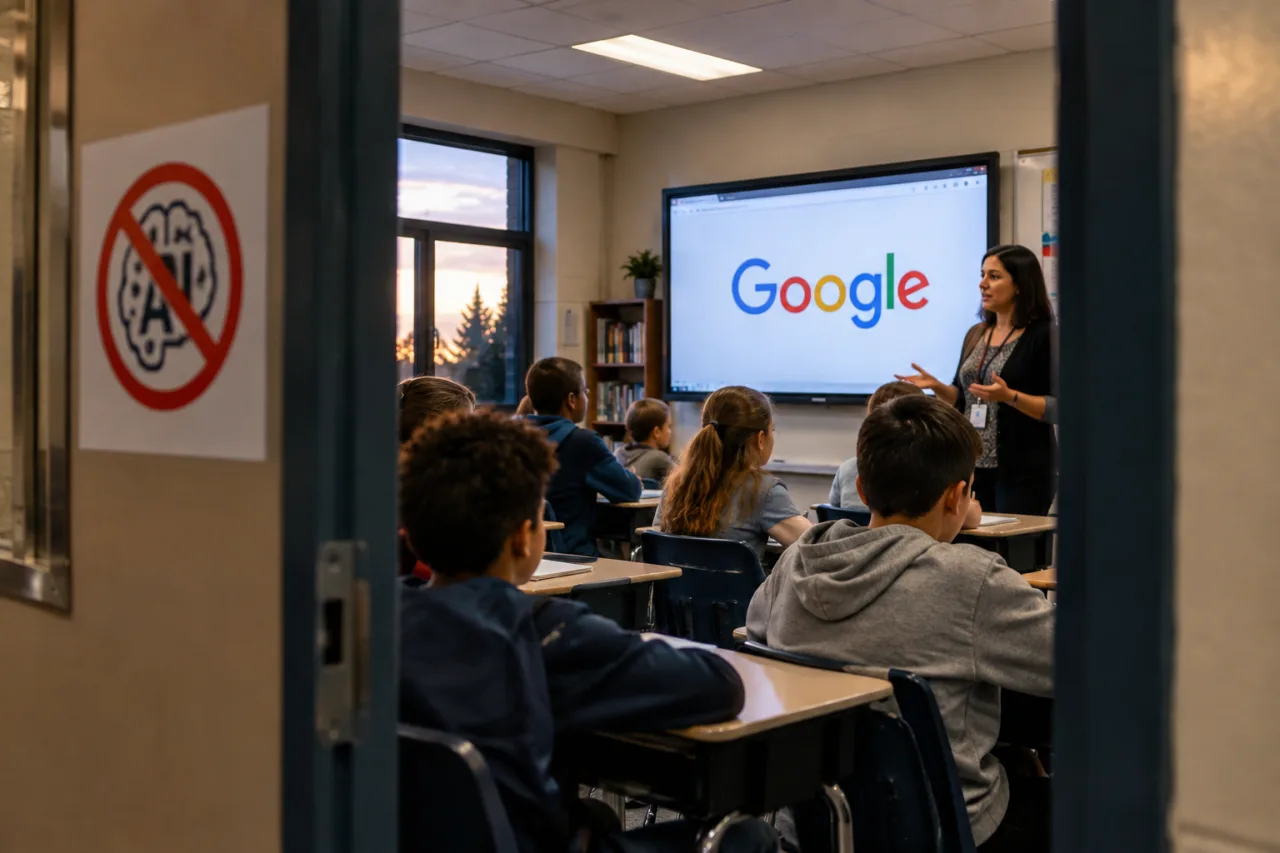
- 🚪 What Google confirmed: Google announced on November 3, 2026 that Gemini, Gemini Notebook, Gemini in Classroom — and Google Search — will be “entirely off for K-12 student accounts until school administrators explicitly turn them on,” and per its education VP’s statements to the New York Times, a school that bans AI outright will see students lose search access altogether: “they’ll see a message from their school that indicates it’s not available.”
- 🧭 What schools get in exchange: Guided Learning — Google’s study-tool mode — arrives in Google Search worldwide via a US pilot this month (detecting when a student wants homework answers and walking them through the concepts instead), and globally in Google Classroom the same day; the philosophy: “productive struggle,” not answer-vending.
- ⚖️ The constraint schools face, verified: administrators can disable the named Gemini products, but a school rejecting AI entirely also loses student access to Google Search; the educators pushing back on AI in classrooms (New York and Los Angeles both moved in September to restrict AI on school devices) now face a supplier that no longer offers Search without the AI coupling attached.
- 🧨 The monopoly fight it reopens: the criticism came the same morning — Lina Khan’s line (“Google is using its search monopoly to coerce schools into adopting AI”) frames the antitrust-shaped question: can the search monopolist condition an essential research service on AI acceptance?
- 🎯 What to watch: the rollout specifics Google promised (“in the coming months” before the changes), the US pilot’s educator feedback, whether districts accept the AI-on default or trade away Search access — and where the policy question goes next: regulators and courts.
Google has set schools a choice in which student access to the world’s default search engine is the deciding factor; the announcement, dated and explained. The official announcement landed Tuesday (November 3, 2026) on Google’s education blog in a post by Chris Phillips, the company’s VP and General Manager of Education, titled as responsible-AI-for-learning design: Guided Learning capabilities come to Google Search (a US pilot later this month) and Google Classroom (globally, the same day), and the school controls change — access to Gemini, Gemini Notebook, Gemini in Classroom and Google Search “will be entirely off for K-12 student accounts until school administrators explicitly turn them on.” The clause that set the news cycle: per Google’s own statements to the New York Times, a school that bans AI outright forfeits Search for its students. This guide carries the official record first, then the constraint, the product, and the dispute.
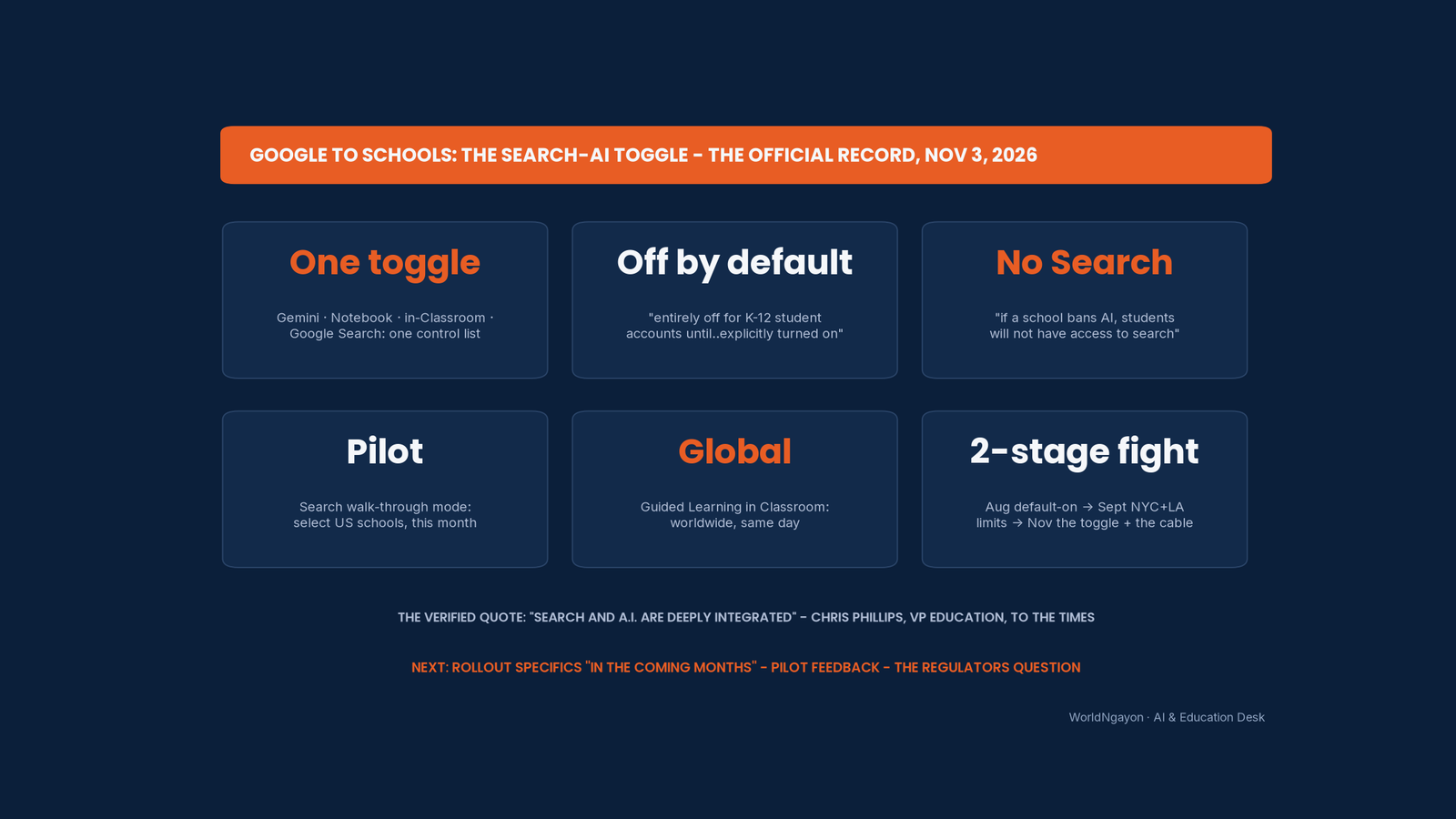
Table of Contents
The Google Search announcement: what the official blog says
The primary record, verified (the post itself, dated November 3): Phillips’s post makes three moves. 1 — Guided Learning in Google Search: for student accounts, Search will detect homework-style queries (“a student pastes a complex physics problem or asks for help writing a book report”) and respond with step-by-step prompts that “think critically and work through the concepts, without going directly to the answer” — starting as a pilot in select US schools “later this month” to gather educator feedback before a district expansion. 2 — Guided Learning in Google Classroom, globally today: teachers assign Guided Learning activities that act as one-on-one study tools anchored in class material, with real-time insight for teachers on where the class struggles. 3 — the Google Search controls change: “Access to these products will be entirely off for K-12 student accounts until school administrators explicitly turn them on” — Gemini, Gemini Notebook, Gemini in Classroom, and Google Search grouped as One control list. Google framed it as responsiveness: “After listening to schools, teachers, leading researchers, and policymakers… providing administrators with controls to help them manage their approach.”
What the blog does Not say, verbatim: the post promises “more specifics with schools in the coming months ahead of the changes rolling out” — it does not itself state the search-cutoff clause; that language comes from Phillips’s statement To the New York Times (an on-record interview), relayed by NBC, CBS, Futurism, Forbes and the Ap family the same cycle. The tiered read: the default-off and the bundling are In the primary source; the ban-AI-lose-Search consequence is an on-record company statement Outside it — both verified tiers, and the difference matters for how the policy gets challenged (the claims-ledger discipline applies to policy product posts exactly as to model posts).
the primary blog bundles Search into the AI control switch, and the company’s stated consequence for the off position is the story’s headline — both dated, both quotable.
The search-cutoff clause: what the blog did not say and the NYT statement did
Phillips’s statement, as the Times reported it: “Search and A.I. are deeply integrated,” and if a school bans AI, students “will not have access to search, and they’ll see a message from their school that indicates it’s not available.” The clause converts the announcement from a controls update into a take-it-all-or-take-nothing product: the choices available to a K-12 administrator are Search with AI integrated — AI Overviews-class results, homework-detection walk-throughs — or Guided Learning as the study tool; the third configuration (Search without AI) no longer appears to exist for the student-account class. Forbes’s framing called it the all-or-nothing policy affecting millions of students from next year; NBC reported the Tuesday-morning announcement with the same read.
The practical mechanics, as the coverage assembled them: a school’s administrators choose per product suite; if the choice is AI-off, the student’s Google Search session in school accounts shows the school’s not-available message rather than results. The integration premise is real technology — Search’s homework-detector and Overviews Are the AI layer Phillips referenced — and the policy’s leverage is exactly that integration: the essential Google Search service and the AI features now ship as a single control.
The separate reason the coupling clause matters: the integration itself is real (the product architecture merged); the policy consequence — bundling student research access to AI acceptance — is a commercial choice — and a negotiator’s move in the schools market, where Google Classroom holds dominant share. The platform-controls pieces and the browser era’s the AI-browser field explained carry the pattern: control of the default surface is the AI era’s real battlefield.
integration is the fact; the cutoff is the choice — and both now live in the same toggle.
Guided Learning: what the product actually does
The product, from the same blog cycle: Guided Learning is Google’s study-mode persona — open-ended questions and step-by-step breakdowns instead of finished answers (“productive struggle” is the post’s own phrase) — already in Gemini as an interactive study tool, now brought into Search (the homework-detection pilot) and Classroom (global, same-day). Google’s companion posts the same morning (the research post on Guided Learning’s measured “learning gains,” the UK/Japan rollout record) carry the evidence pack; the classroom product gives teachers the instrumentation (real-time insight into where students stall). The company’s framing: the AI the schools are asked to accept is not a shortcut tool but the Tutor-flavored version.
The gap between the framing and the educators’ concern: the objection to AI in classrooms was never only about answer-vending — it spans attention, dependence, data handling and the developmental questions (the September NYC/La restrictions responded to the default-on rollout of Gemini in Classroom, which Google had switched on for many K-12 students in August). Guided Learning answers the first objection (answers-first becomes struggle-first); the others (data, default-on, dependence) the controls change partially answers by making everything opt-in — except the price of choosing nothing.
The product design cuts both ways: a genuinely tutor-shaped tool is what educators asked AI companies for; making Guided Learning the only route to Search is what turned a product post into a policy story (the tool-verification and honest-pricing guides carry the review discipline to apply to the pilot’s claims when the educator feedback lands).
Google’s Guided Learning offers additional educational features, but the restrictions on Search access raise a separate concern about a school’s ability to reject AI.
The backlash: from classroom defaults to a monopoly argument
The two-stage conflict, dated: Stage 1 (August-September 2026): Gemini switched on by default for many K-12 students via Google Classroom (“backlash heating up” — the Ap/NBC frame); New York and Los Angeles announced September restrictions on AI tools for school devices; parents and educators made classrooms the loudest AI fight in the US. Stage 2 (November 3): the controls change — Google’s answer to the backlash is opt-in products plus the bundled Search consequence; the same morning, former FTC chair Lina Khan’s statement framed the counter: “Google is using its search monopoly to coerce schools into adopting AI. This highlights the danger of allowing an unregulated monopolist to control an essential service… Google is making clear it will punish those who don’t fall in line.” The educators’ groups and policymakers echoed through the day’s coverage (NBC/CBS/Futurism/Forbes).
The antitrust shape, plainly: a dominant search provider conditioning an essential educational research tool (Search) on accepting adjacent AI products (Gemini-class) is the classic tying-adjacent conduct a monopoly-fight reads without strain — whether regulators act depends on jurisdiction and on whether schools’ alternatives (Microsoft’s education stack, Apple classroom tools, or the open web’s library systems) are graded “real alternatives” in the education procurement market. CBS noted Google did not immediately respond; expect the company’s answer (and the DOJ/state AGs’ questions) to arrive through the coming months’ specifics phase.
The analysis: the schools fight is the AI economy’s distribution-power moment the crash and money-trail coverage keeps circling (the money-trail analyses): platform control converts product decisions into market structure — and markets structure-policy in one morning when the product is everyone’s homework tool. The quote frames the dispute; the substance to watch is whether districts can document viable alternative search providers in their procurement analysis.
the tie is the allegation; the alternatives are the evidence — the fight just got its cleanest test case since the browser wars.
The Google Search decision framework for administrators
The tree a K-12 administrator actually faces (as the announcement stands): 1 — inventory the dependence: what runs on Google education software (Classroom, docs, accounts, devices) and where the AI products sit in it (Gemini in Classroom, Notebook, Search’s AI layer). 2 — the three choices on the table: enable the suite (Guided Learning-flavored AI + AI-integrated Search — with the monitoring instrumentation Guided Learning brings), enable Partially (the product lists allow per-product toggles — the practical middle: Classroom’s tutor-mode on, some AI tools off, search stays), or the AI-off door (Search goes with it — the school must live on alternatives: library databases, the district’s own filtered stack, Microsoft-class suites). 3 — the governance layer: the controls change restores the Default-off position (the August default-on experiment reversed), which means the school’s AI policy — not Google’s — now sets the state; the decision’s weight moved back to the administrator’s desk, with Search attached to the pen. 4 — the timeline: specifics in the coming months before rollout — the decision tree is not yet live; the district feedback window is now.
The analysis: the partial-enablement path is the announcement’s unsung feature — the per-product toggles (the blog’s control list enumerated) allow exactly the mix most districts will want (tutor-mode AI, minimal default AI, kept Search). The all-or-nothing frame belongs to the ban-AI corner, not the whole map — the accurate review finds three possible outcomes, not two.
School administrators can control access to certain Google services, but rejecting AI entirely may also prevent students from using Google Search.
What this means for schools, work and the world
For schools outside the US pilot: the coming rollout is the watch item: Guided Learning’s claims — measured learning gains, struggle-first design — are vendor claims until the pilot’s educator feedback tests them in real classrooms; procurement teams read the controls change as the year’s most consequential education-tech event (the alternatives analysis now has a real deadline).
For the AI industry: the move sets a precedent other providers are watching — when an essential service and an AI feature become one control, policy fights move from features to bundles.com/ai-browser/”>AI-browser field explained) is the same law: distribution beats product.
For investors: the education-AI segment’s monetization debate (Classroom-tier products; the data-privacy constraints; the Khan-class political risk) now has a headline test — the watchlist discipline treats tying-allegations as policy shocks with dated filings to watch.
For Filipino professionals and OFWs — and every global family: school-account AI is a Worldwide product: the Philippines’ own DepEd-adjacent Google Classroom usage rides the same controls when the rollout internationalizes — the OFW family’s school-age children sit in the same policy surface (the global-professional maps carry the mobility of these decisions). And the house-side lesson is the guide’s own: teach the walk-through method at home — Guided Learning’s philosophy (struggle first, answers second) is the parenting rule that made the tool workable in the first place (the agent-tools-ledger guides carry the household application).
For teachers, one tool note: the Classroom rollout (global, today) carries the real-time-insights feature — the teacher-side value that the pilot’s feedback will grade; the platform-retirement precedent says: adoption decisions price the roadmap’s reversibility too.
The bottom line: the decision returns to districts
The Google schools story, settled as verified: the official blog (November 3, Phillips) made the AI products and Google Search one control list — entirely off for K-12 student accounts until an administrator switches them on — and put Guided Learning’s struggle-first mode into Search (US pilot this month) and Classroom (global, same day); the company’s statement to the Times drew the cutoff line (banning schools lose search); the backlash answered within hours — NBC News reported Google would shut off Search for schools that opt out of AI, with Forbes and Futurism covering the same decision — from district restrictions already announced in September to the monopoly-tie framing by the FTC’s former chair. The settled picture: the default-off controls return the decision to school districts; refusing AI entirely now costs Search availability; Guided Learning sits as the middle path Google is offering. The coupling itself is the policy — and the next dated events (the specifics, the pilot’s feedback, the regulators’ first question) decide whether this reads as school control, market coercion, or the integration era’s new normal.
Frequently Asked Questions
What exactly did Google change for K-12 schools?
Per Google’s November 3, 2026 education post: Gemini, Gemini Notebook, Gemini in Classroom and Google Search become “entirely off for K-12 student accounts until school administrators explicitly turn them on.” Schools choose per product; the changes were announced for rollout “in the coming months.”
If a school bans AI completely, do students lose Google Search?
That is the announced consequence: Google’s education VP told the New York Times that a school rejecting AI outright will see students meet a message stating Search “is not available” for their accounts. Search and the AI features ship coupled in this control scheme, so a school that wants Search with the AI features permanently refused cannot currently configure that combination.
Can schools disable the individual AI products and keep Search?
Yes — that is the partial-enablement path: the per-product toggles (Gemini, Notebook, Classroom AI) can be turned off individually while Search stays enabled, per the blog’s control list. What schools cannot currently have is Search with all AI features permanently refused.
Did Lina Khan actually say Google is coercing schools?
The words are hers: the former FTC chair posted that “Google is using its search monopoly to coerce schools into adopting AI,” hours after the announcement. Whether the conduct is unlawful is undecided — it is her characterization of the policy, and the competition question still awaits regulators or courts.
What is Guided Learning and when can schools use it?
Guided Learning is Google’s study mode: it detects when a student wants an answer and walks them through the concepts instead — the “productive struggle” philosophy. It is arriving in Google Search through a US pilot this month and in Google Classroom worldwide the same day, with an educator-feedback window for the pilot.
What should a school administrator do first?
Two things before the rollout lands: map which of the named products your district wants on or off at each account level, and decide explicitly whether any Search access without the AI coupling is required — because the currently announced configuration does not offer it. Districts that need it should document why and raise it with their Google account teams before defaults go live.
Financial Disclaimer
This article is editorial analysis of publicly reported information, not investment or financial advice, and no outcome is promised. Policy statements are as reported by the named sources at the stated dates; verify before decisions. Markets carry risk.
The reading rule for the Google Search-in-schools story: date every claim. The Google Search bundling is In the blog; the ban-AI-lose-Search consequence is an on-record NYT statement; the rollout specifics are promised, not shipped; and the pilot’s educator feedback is a November event nobody has yet reported. A Google Search policy story built on a control list, an interview and a promise – the tiers are the story’s own structure, and the next document fills the next tier: specifics first, pilot feedback second, the regulators’ question likely third. Google Search’s role as the world’s research utility is exactly why the schools decision reads as policy – and why the dated findings, not the day’s takes, are the part worth archiving.
- blog.google/products-and-platforms/products/education/ai-learning-era… — Google’s education blog
- uk.finance.yahoo.com/news/google-lets-schools-turn-off-202217016.html — the company’s statement to the Times
- nbcnews.com/tech/tech-news/google-shut-search-schools-opt-ai-rcna6072…
- forbes.com/sites/maryroeloffs/2026/11/03/google-will-cut-off-search-e… — Forbes
- futurism.com/future-society/google-search-engine-access-schools-ban-ai — Futurism
External sources linked in this article, in order of first mention. Spotted an error or a broken link? Tell us.
Cite this pagePublished Nov 4, 2026
Agron, E. (2026, November 4). Google to Schools: Ban AI, Lose Google Search. WorldNgayon. https://worldngayon.com/google-search-schools-ai-ban/
Agron, Edmon. “Google to Schools: Ban AI, Lose Google Search.” WorldNgayon, 4 Nov. 2026, worldngayon.com/google-search-schools-ai-ban/.
Agron, Edmon. “Google to Schools: Ban AI, Lose Google Search.” WorldNgayon, November 4, 2026. https://worldngayon.com/google-search-schools-ai-ban/.
Agron, E. (2026) ‘Google to Schools: Ban AI, Lose Google Search’, WorldNgayon, 4 November. Available at: https://worldngayon.com/google-search-schools-ai-ban/.
E. Agron, “Google to Schools: Ban AI, Lose Google Search,” WorldNgayon, Nov. 4, 2026. [Online]. Available: https://worldngayon.com/google-search-schools-ai-ban/
@online{agron2026googlesearch,
  author       = {Agron, Edmon},
  title        = {{Google to Schools: Ban AI, Lose Google Search}},
  year         = {2026},
  date         = {2026-11-04},
  organization = {WorldNgayon},
  url          = {https://worldngayon.com/google-search-schools-ai-ban/},
  urldate      = {}
}TY - ELEC AU - Agron, Edmon TI - Google to Schools: Ban AI, Lose Google Search T2 - WorldNgayon PY - 2026 DA - 2026/11/04/ UR - https://worldngayon.com/google-search-schools-ai-ban/ Y2 - ER -
Cite the version you read; the page may be updated. Zotero and Mendeley can also import this page directly.