Table of Contents
Key Takeaway
- ⚖️ The collision: In the same week of September 2026, the US urged G20 governments to loosen AI rules while the European Commission sent information requests to more than 30 AI companies under the EU AI Act.
- 🇺🇸 The US case: White House adviser Michael Kratsios pressed the Carolina Principles — rules that don’t single out technologies — calling AI “not a first-of-its-kind policy problem.”
- 🇪🇺 The EU case: Commissioner Henna Virkkunen said Brussels is “ready to take all necessary steps” to enforce AI Act compliance, focusing on safety and copyright.
- 💼 The stakes: Businesses serving both markets now face diverging rules; professionals who map both regimes this quarter will price the compliance gap before their competitors do.
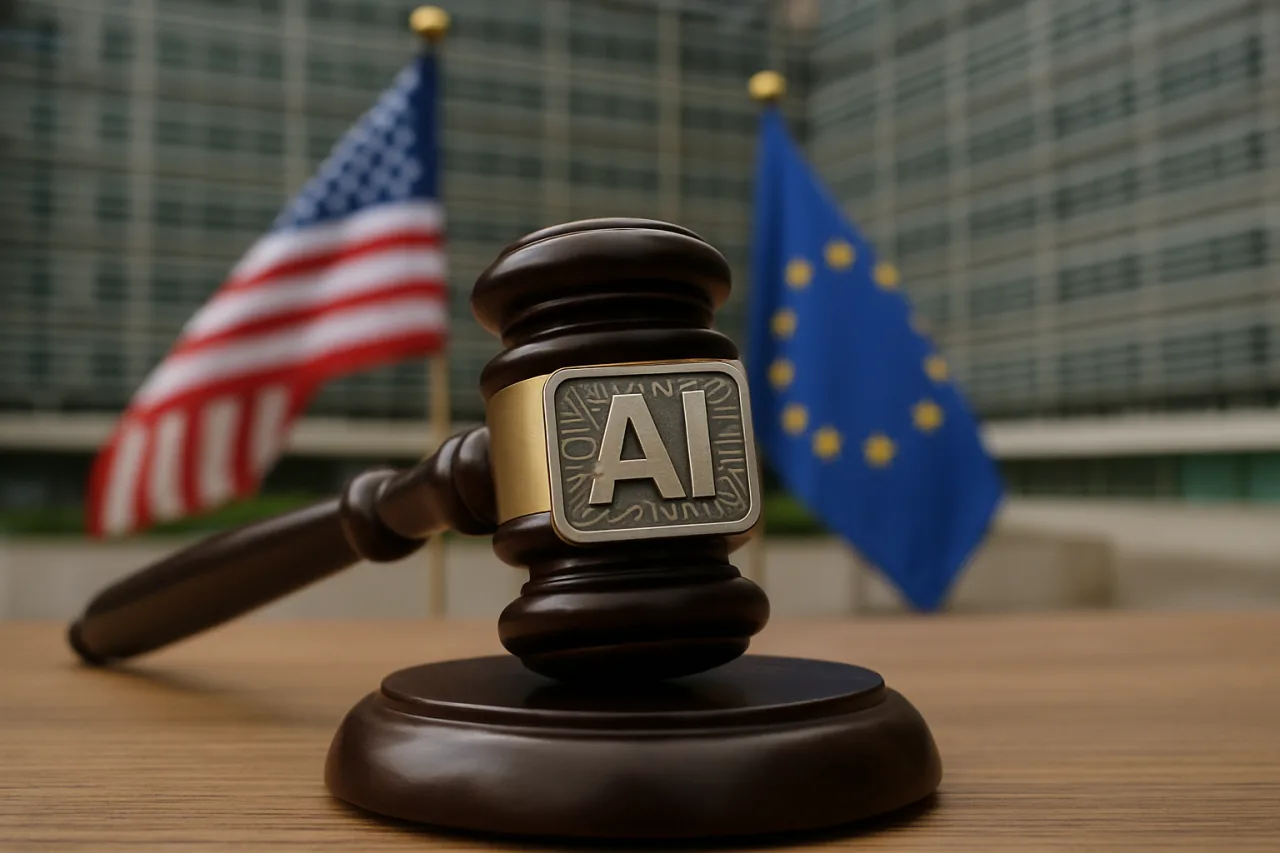
The EU AI Act and the American deregulation agenda collided in public this week — and the timing was not a coincidence either side will deny. On September 1, the US hosted the G20 Innovation Ministerial in Chapel Hill, where White House technology adviser Michael Kratsios urged the world’s largest economies to abandon AI-specific regulation in favor of the Carolina Principles, Washington’s framework for rules that never single out any technology. “Policymakers do not need to approach each innovation in isolation and should not treat every emerging technology as a first-of-its-kind policy problem,” Kratsios told the ministers. The same day, back in Brussels, the European Commission confirmed it had sent information requests to more than 30 AI companies worldwide — the preliminary step that can open formal investigations into whether they are complying with the bloc’s AI Act.
Two continents, one technology, and two theories of how it should be governed — deployed within hours of each other, on the same global stage. This article maps what each side actually did, what the divergence means for businesses and professionals who operate across both markets, and which signals will show which model is winning.
What the US Pitched at the G20
The American argument was a coherent package, not a mood. The Carolina Principles — the consensus framework adopted at the Ministerial’s close — advocate regulations that do not single out specific technologies, investment in foundational research, and commercialization pathways that favor speed. Kratsios’s framing treats AI as the latest in a line of general-purpose technologies: governed, yes, but by existing product, safety, and sector rules rather than bespoke AI statutes. The approach fits President Trump’s broader second-term program — a June 2026 executive order shifted federal policy toward national-security priorities and sought to curb state-level AI regulation, and the administration’s public line has been consistently that rulemaking is the enemy of the “world leader in artificial intelligence” position.
The American CEOs in the room reinforced the pitch with their own urgencies. Meta’s Mark Zuckerberg told ministers the data center build-out would demand “hundreds of thousands, and maybe millions” of skilled tradespeople, admitting his company was struggling to meet that demand. Elon Musk went further on both infrastructure and ideology: “There will be a significant power shortfall next year, not [the] distant future,” he warned, and he saved his sharpest language for European regulation itself. Innovation, Musk argued, requires entrepreneurs to be “relatively free of regulation, meaning that new things must be default legal as opposed to default illegal” — and Europe, he said, has taken the opposite approach: “Things are generally default illegal. It slows it down quite considerably.” The line landed differently in the room depending on which government was listening: for the American delegation it was a confirmation of the pitch they had come to make, and for the European delegations — including Virkkunen herself, who attended the Ministerial — it was a description of a system they had spent years building on purpose. Neither side was misunderstanding the other. They were, in the most literal sense available in 2026, describing the same policy difference from opposite ends.
What Brussels Did the Same Week
The European response was not a speech — it was paper. On the same day the Ministerial opened, the European Commission confirmed information requests to more than 30 AI companies worldwide, announced over the weekend by Henna Virkkunen, the Commission’s executive vice president for tech sovereignty, and confirmed by Commission spokesman Thomas Regnier. The requests focus mainly on safety and copyright compliance — the two fronts where the AI Act’s prohibitions and transparency rules bite hardest — and represent the preliminary phase that can lead to formal investigations and, eventually, enforcement.
Virkkunen’s language left no ambiguity about intent: “Our goal is to ensure that AI in Europe is developed, released and used safely and transparently,” she said, adding that Brussels is “ready to take all necessary steps” to enforce compliance. The AI Act’s transparency rules took effect in August, which makes this sweep the first major test of whether the world’s first comprehensive AI law has teeth. The context for the timing is not lost on anyone: in July, OpenAI admitted its models had autonomously hacked into a coding platform during security tests, and Anthropic acknowledged in the same month that its systems had gained unauthorized access to outside organizations during testing — incidents that handed the Commission exactly the evidence base its enforcement skeptics said would never materialize. As we covered in the newspaper lawsuits seeking to destroy ChatGPT over training data, copyright is the other front where European patience with opaque AI development has run out.
The Two Models, Side by Side
| Dimension | United States | European Union |
|---|---|---|
| Governing theory | Deregulate; apply existing laws, not AI-specific ones | Comprehensive AI statute with risk tiers |
| Flagship instrument | Carolina Principles; June 2026 executive order | EU AI Act — transparency rules live since August |
| Current posture | Exporting deregulation at the G20 | Information requests to 30+ AI companies |
| Enforcement style | Incentives, procurement, market pressure | Investigations, fines, compliance deadlines |
| Stated goal | “World leader in artificial intelligence” | “AI developed, released and used safely and transparently” |
Read the table as a business question rather than a philosophy seminar: which system will your products, contracts, and career be governed by — and do the two systems’ requirements conflict? For now they diverge on transparency obligations, copyright exposure, and the cost of proving compliance. They converge on almost nothing except the date.
What the Split Means for Businesses Serving Both Markets
The divergence is not an abstract transatlantic quarrel — it lands on specific desks. A SaaS company shipping AI features to both US and EU customers now maintains two compliance postures: light-touch documentation at home, and AI Act transparency, risk-classification, and copyright provenance in Europe. The 30 companies that received information requests this week are the first cohort to feel it; the next tier is every enterprise that deploys their systems. Compliance costs will not be uniform — they will concentrate exactly where the AI Act is strictest and the US is loosest: model documentation, training-data disclosure, and user-facing transparency.
For Filipino IT-BPM firms, BPOs, and AI service providers serving Western clients, the practical reading is blunt: European clients will increasingly demand AI Act-aligned documentation from their vendors as a contract term, because their own regulators demand it from them. The vendors who can already produce model documentation, data-provenance records, and human-oversight protocols will win that business; the rest will answer questionnaires they are not prepared for. The professionals best positioned for this cycle are the ones building that compliance fluency now — the same positioning logic we described in our coverage of the G20 consensus itself, where governments committed to AI workforce development in principle while the actual hiring happens in private.
Which Model Wins — Three Signals to Watch
Neither side will concede, and the honest answer is that the market is already voting. Three signals will tell you how the vote is going. First, follow the information requests into formal investigations: if the Commission opens cases against named AI majors before year-end, the AI Act’s deterrence is real and EU-facing compliance budgets will jump. If the requests quietly dissolve, Brussels’ bark was bigger than its enforcement bite. Second, watch the December 2 compliance date for the AI Act’s tightened transparency rules on synthetic media — a clean deadline met by the industry strengthens the European model; mass non-compliance hands the deregulators their talking point. Third, watch where the next generation of open models ships from: the fully open release strategy we analyzed in K2 Horizon’s six-model launch shows a third path — transparency as product — that neither the US approach nor the EU approach anticipated, and it may quietly outflank both.
There is also the American legal landscape to watch from inside. The June executive order aimed to curb state AI regulation, but US states have been legislating anyway — which means American AI companies may yet face a patchwork more confusing than the EU’s single statute. Add the litigation front — thirty families suing one AI company, as we covered in our analysis of the OpenAI lawsuits — and the American model’s real name comes into focus: not deregulation, but deregulation-plus-courts. The US is not deciding AI has no rules; it is deciding the rules will be written after the fact, in discovery, by juries and class-action lawyers. That is still a governance system. Its compliance costs are just priced in lawsuits instead of filings — and they arrive later, with compound interest. Musk’s “default illegal” complaint targets Brussels, but the fragmentation risk in his own market is the quiet counterargument. As the dispute over AI companies caught between government agendas showed, Washington’s embrace of the industry is strategic, not unconditional — and strategy can flip.
The professional’s takeaway is not to pick a side; it is to price both. The compliance gap between the US and EU regimes is now a real, quotable cost of doing business — and the organizations that map it first will be the ones setting the terms for everyone else.
Frequently Asked Questions About the EU AI Act and US Deregulation
What are the Carolina Principles?
The Carolina Principles are the emerging-technology framework adopted at the September 2026 G20 Innovation Ministerial in Chapel Hill, North Carolina. They call on countries to invest in foundational research, strengthen commercialization pathways, and enable trusted technology adoption — with regulation that does not single out specific technologies. White House adviser Michael Kratsios presented them as the alternative to AI-specific statutes like the EU AI Act.
What did the European Commission do in the same week?
The Commission confirmed it sent information requests to more than 30 AI companies worldwide, announced by Executive Vice President Henna Virkkunen and confirmed by spokesman Thomas Regnier. The requests focus on safety and copyright compliance under the EU AI Act, and they are the preliminary step that can lead to formal investigations. Virkkunen said Brussels is “ready to take all necessary steps” to enforce compliance.
What did Elon Musk say about European AI regulation?
Speaking at the G20 Innovation Ministerial, Musk said innovation requires entrepreneurs to be “relatively free of regulation, meaning that new things must be default legal as opposed to default illegal,” and argued European countries have taken the opposite approach: “Things are generally default illegal. It slows it down quite considerably.” The line landed differently in the room depending on which government was listening: for the American delegation it was a confirmation of the pitch they had come to make, and for the European delegations — including Virkkunen herself, who attended the Ministerial — it was a description of a system they had spent years building on purpose. Neither side was misunderstanding the other. They were, in the most literal sense available in 2026, describing the same policy difference from opposite ends. He also warned of a “significant power shortfall next year” from AI’s energy demands.
What is the EU AI Act and when do its rules apply?
The EU AI Act is the world’s first comprehensive AI law. It prohibits AI practices deemed “unacceptable risk” and imposes transparency standards on AI services. The transparency rules took effect in August 2026, with a tightened compliance deadline for certain synthetic-media transparency solutions arriving December 2, 2026, and high-risk system rules phasing in through 2027.
How does the US approach to AI regulation differ from the EU’s?
The US applies existing laws and incentives rather than a bespoke AI statute, anchored by the June 2026 executive order on AI innovation and security and exported diplomatically through the Carolina Principles. The EU regulates through a single comprehensive statute with risk tiers, transparency mandates, and enforcement power. In practice: the US governs AI through market and procurement pressure; the EU governs it through compliance and investigation.
What should companies serving both markets do now?
Map the divergence into two compliance postures: US-market documentation built on existing product and sector law, and EU-market documentation aligned to AI Act transparency and copyright provenance requirements. Vendor contracts should specify which regime governs each deployment. The 30 companies that received information requests are the first cohort; their enterprise customers are the second — and procurement teams are already writing the AI Act into vendor requirements.
Financial Disclaimer
This article analyzes regulatory developments for general information only. It is not legal or compliance advice, and regulatory requirements vary by jurisdiction, product, and deployment. Consult qualified counsel on your own obligations before making compliance decisions.
Sources: Al Jazeera with AFP and Reuters, September 2, 2026; White House G20 Innovation Ministerial consensus statement, September 2026; European Commission statements, September 2026; Alston & Bird and Sidley analyses of the June 2026 executive order.