Table of Contents
Key Takeaway
- Bank of China Macau pushed mBridge beyond trade payments: multiple interbank lending, FX swap and bond transactions worth about ¥200 million were settled on the platform — the first time the digital yuan bridge has cleared wholesale financial-market deals.
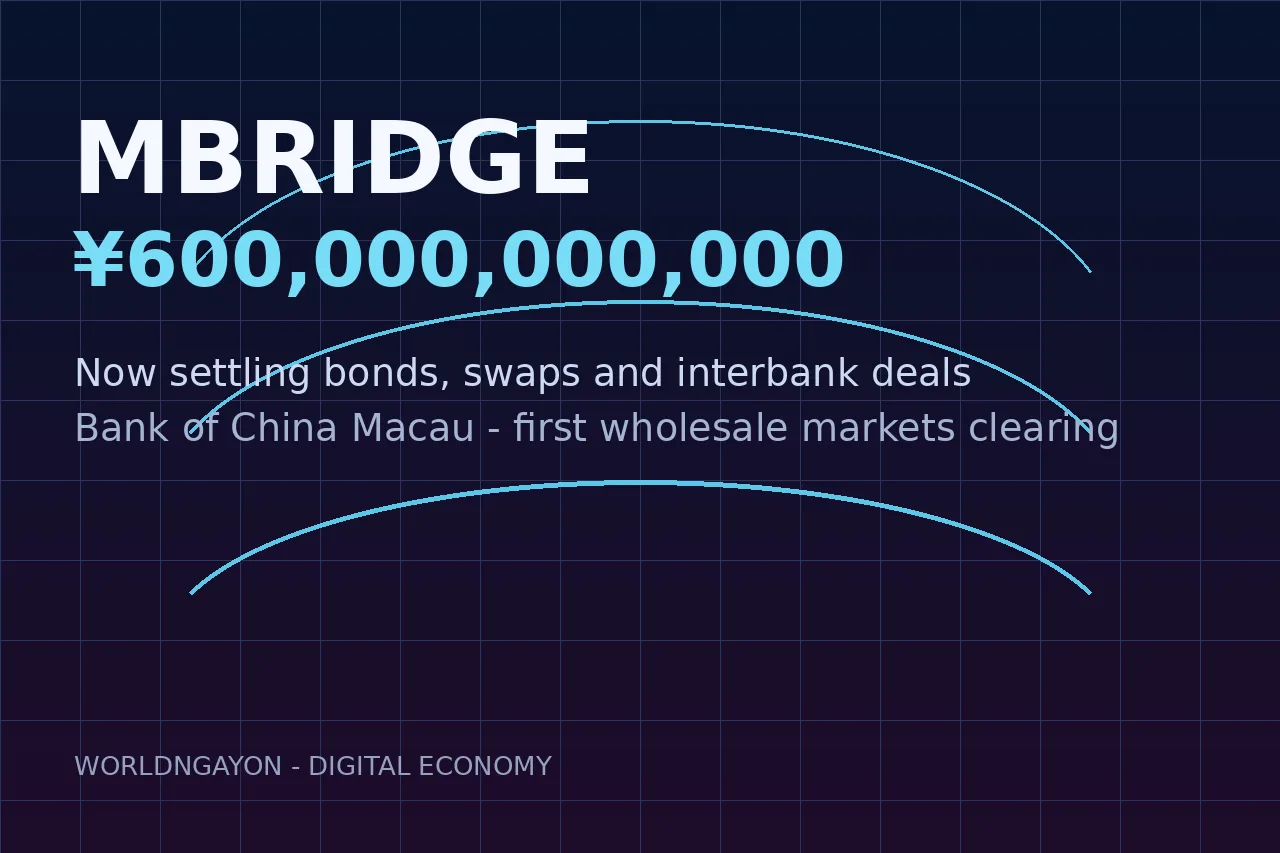
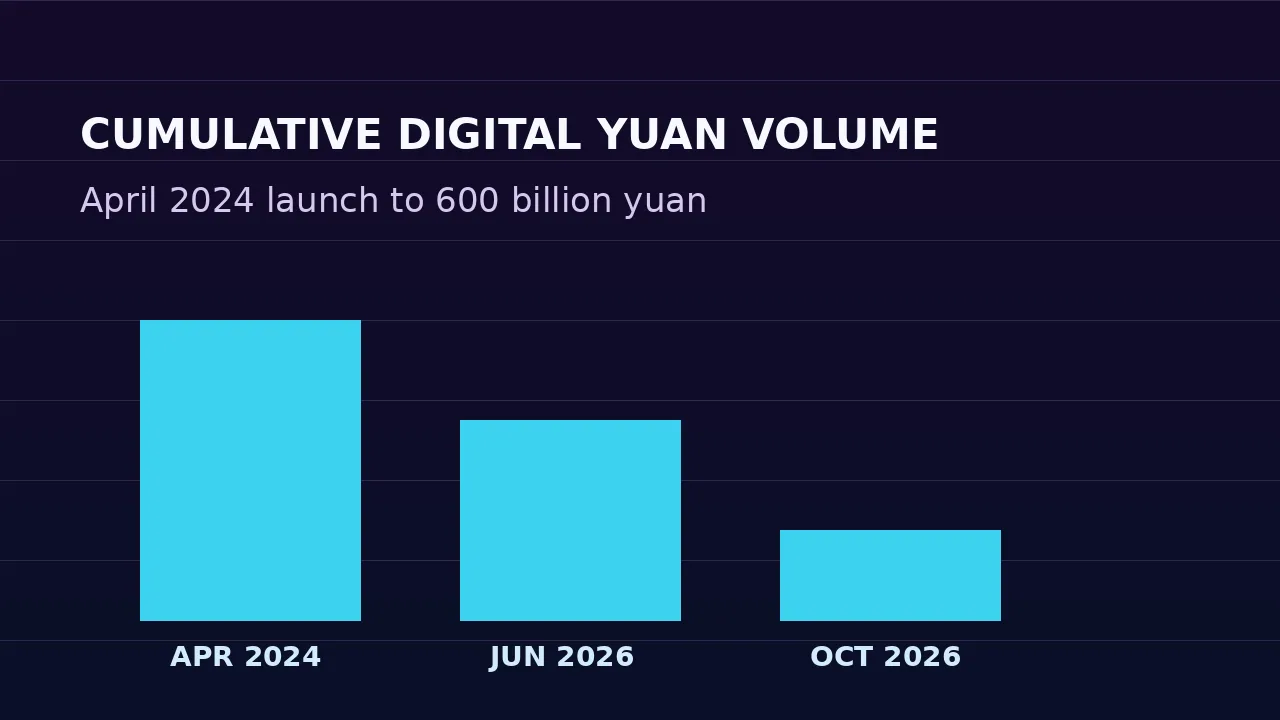
- BOC’s mBridge ledger has now crossed ¥600 billion (≈ $85 billion) in cumulative transactions since April 2024, with several ¥10-billion-class deals landing this year alone.
- China Construction Bank’s Shanghai branch is past ¥20 billion on the same rails, and a China–Laos QR-payment interconnection went live on October 10.
- Cross-border settlement is converging on seconds, not days — the infrastructure that will eventually touch every corridor economy, including remittances.
The Digital Yuan’s Institutional Turn
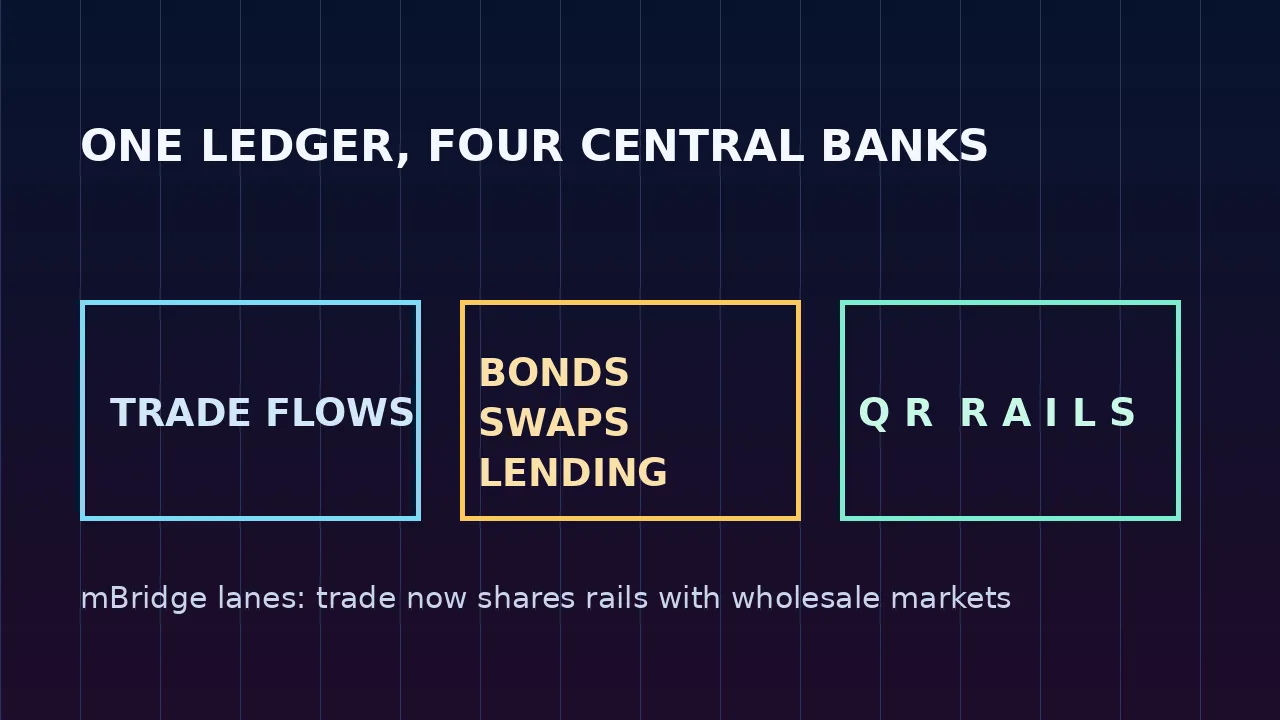
For two years, China’s digital yuan bridge was a trade-settlement machine: corporate invoices, supplier payments, remittances between group companies. On October 10, state media confirmed the wall came down. Bank of China’s Macau branch executed multiple mBridge deals — the moment mBridge graduated from payments to markets that belong to a different world — interbank lending, foreign-exchange swaps and bond purchases, roughly ¥200 million in total, all cleared directly on the platform between the mainland, Hong Kong and Macau with second-level arrival.
That is not a payment story. It is a markets story. Wholesale desks do not care about wallet apps; they care about whether collateral can move between entities in time zones faster than risk can move against them. A central-bank bridge that settles an FX swap in seconds while recording every step on-chain is answering that question — and Beijing’s answer is now live.
Who Built the Bridge
mBridge was jointly initiated by the People’s Bank of China, the Hong Kong Monetary Authority that licenses the territory’s stablecoin issuers, the central banks of Thailand and the UAE — blockchain-based cross-border financial infrastructure with each participant issuing its own central-bank digital currency onto shared rails. The Bank for International Settlements stepped back from the project in late 2024, leaving the member central banks to carry it forward. They have: BOC’s cumulative mBridge volume broke ¥600 billion by the end of June, and the bank describes multi-currency, full-scenario, integrated service as the operating model.
The Parallel Lanes Are Multiplying
Macau is one node. China Construction Bank’s Shanghai branch passed ¥20 billion in cumulative mBridge transactions by end-August, first among its Shanghai peers — including a UAE-direction bridge, a Macau-pataca bridge and a real-time corporate funds-pool structure. Hengqin and Macau logged 15 cooperative transactions above ¥60 million since Macau joined in June. And on October 10, China and Laos switched on QR-code interconnection between the digital yuan’s CBETS platform and Laos’s LAPNet network — the first working output of a June bilateral MOU, and explicitly framed by Beijing as a template for other countries.
The ¥600 Billion Ledger, Line by Line
The headline number deserves its footnote. Bank of China’s ¥600 billion mBridge cumulative figure, reported this week covering activity through end-June, is not one big pipeline — it is many lanes at once. Since April 2024, the bank says it has landed multiple ¥10-billion-class transactions this year alone, in a multi-currency, full-scenario, integrated operating model. Under the umbrella: corporate trade settlement, enterprise cross-border remittances, and now financial-market collateral moves.
The component numbers tell the build-out story. China Construction Bank’s Shanghai branch crossed ¥20 billion by end-August, first among Shanghai peers, stacking firsts along the way — a UAE-direction mBridge corridor, a Macau-pataca bridge, a real-time funds-pool structure for corporate clients, and an “FT account plus bridge” model that has moved over ¥10 billion in cross-border settlement on its own. Hengqin and Macau logged 15 cooperative transactions above ¥60 million since Macau joined in June, starting with a government service-fee payment from a Hengqin cooperative-zone agency to a Macau service provider. None of these is glamorous. All of them are proof-of-rails.
That is how state infrastructure actually scales: not with a launch keynote, but with a list of unremarkable firsts — first government payment, first pataca leg, first funds pool — accumulating into a system that treasury desks treat as boring plumbing. Boring is the milestone.
How the Seconds Standard Spreads
Two mechanisms push mBridge settlement speed outward. The first is competitive: once one corridor in a region runs state-grade second-level clearing, the incumbent correspondent pricing next door looks like a tax. The second is institutional: the June China-Laos MOU template — bilateral agreement, platform connection, phased merchant opening — is deliberately packaged for replication. Beijing’s own trade press markets the pairing as a reference model, and the economies that fit the profile read the same regional press treasury desks do.
For corridor families, the timeline matters more than the technology. Remittance pricing does not fall the day new rails open; it falls when corridor operators conclude that losing volume to the cheap rail hurts more than cutting fees. The digital yuan build-out is assembling exactly that negotiation position, corridor by corridor.
What the Macau Node Signals for Hengqin’s Next Move
Macau’s promotion from trade-settlement node to financial-markets participant is the structural event inside this week’s numbers. A currency board economy with a pataca peg, real-estate-heavy balance sheets and a government-run payment base just demonstrated that its banks can hold their own in interbank lending and FX operations on shared central-bank-currency rails. The mBridge platform recorded every leg on-chain while clearing digital yuan collateral in seconds — and Macau’s regulator let it happen without a sandbox extension.
Hengqin’s cooperative zone is the logical next step: a mainland enclave with Macau-facing policy built precisely to test cross-border financial arrangements before they scale. Fifteen transactions and ¥60 million since June is a pilot trajectory; the markets-debut template Macau just wrote is the upgrade path. Watch for Hengqin’s first funds-pool structures to mirror CCB Shanghai’s “FT account plus bridge” model — that combination is what treasury operations actually adopt.
The Number to Watch Next Quarter
Cumulative volume is the vanity metric. The honest one is composition: what share of mBridge flows are now financial-market transactions — swaps, bonds, interbank borrowings — rather than trade invoices. Macau’s ¥200 million markets debut is a rounding error against ¥600 billion in volume. But composition shifts precede price shifts. When collateral moves on central-bank rails as routinely as invoices do, the pricing negotiations change, and corridor fees follow with a lag measured in quarters, not years.
Why Two of the Bridge Founders Matter to OFW Households
Read the founder list again with corridor eyes. The Hong Kong Monetary Authority operates the clearing hub through which most offshore RMB moves, and Hong Kong remains a top processing point for Asian remittance flows. The UAE central bank anchors the Gulf employment corridor that sends more Filipino wages home than any other region. A mBridge built by this quartet is, whether designed that way or not, infrastructure sitting directly on the routes OFW money travels.
None of this means Filipino wages clear over digital yuan rails tomorrow — corridor selection runs through licensing, bilateral arrangements and remittance-company economics that take years to shift. But pricing benchmarks ignore borders. When Gulf-to-Asia corporate settlement compresses to seconds at near-zero marginal cost, the corridor banks and MoneyGram-class operators competing for worker remittances inherit a customer who now knows what near-free clearing looks like. That knowledge travels faster than infrastructure does — and once a corridor’s fee committees have seen near-free clearing, every incumbent’s renewal conversation gets harder.
What Corridor Economies Should Read From This
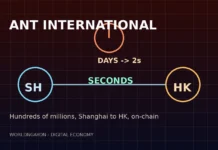
The Philippines sits in the middle of this shift whether or not it participates. When the region’s largest economy moves corporate treasury at second-level speed through state rails, corridor pricing follows the cheapest clearing path. The same architecture that compresses a Shanghai treasury sweep eventually compresses a Manila remittance — Ant International’s Shanghai-Hong Kong seconds deal is the consumer-grade preview. Our earlier coverage of China’s reopening thesis and the Philippines’ majority-digital payments base set the stage; the missing piece was wholesale proof. This is the proof.
Inside the ¥200 Million Markets Debut
Interbank lending is the most conservative instrument in finance: a bank lends another bank money overnight against balance-sheet trust. If mBridge can settle that — plus FX swaps and bond purchases, roughly ¥200 million across multiple deals — then the argument that blockchain rails are too fragile for wholesale finance is over in the jurisdictions that matter. The digital yuan collateral movements behind these trades cleared mainland-to-Hong Kong-to-Macau direct, arrival measured in seconds, every leg on-chain auditable.
Consider what that replaces. A cross-border swap typically moves through correspondent banking chains, with cut-off times, reconciliation batches and settlement risk windows that treasurers price into hedging costs. The digital yuan on mBridge deletes the middle of that chain. When the collateral leg settles in seconds, the hedge costs less to run — and in wholesale markets, cheaper settlement is not a feature, it is an arms race.
The BIS Walked Away; the Rails Did Not
Desks that clear faster quote tighter prices; desks that quote tighter prices win the flow; flow won on settlement speed compounds into reserve management and clearing mandates. The digital yuan bridges give Chinese institutions that loop, and the ¥200 million of markets deals this week — small in absolute terms — are the first turns of it.
The Bank for International Settlements’ exit from mBridge in late 2024 was treated in Western commentary as the project losing credibility. Member central banks read it differently: fewer cooks. Since then the digital yuan bridge has absorbed Macau as a participant, pushed Hengqin cooperative-zone government payments through the platform, broken ¥600 billion in cumulative volume, and now cleared its first financial-market transactions. Progress accelerated after the exit, not before it.
The Laos Lane: Where the Template Goes Public
The founder list still matters for corridor watchers: the People’s Bank of China, the Hong Kong Monetary Authority, the Bank of Thailand and the UAE central bank. Two of those members anchor the two economies where OFW money lives — Hong Kong as the offshore RMB clearing hub, the UAE as the largest Gulf employment base for Filipino workers. Infrastructure built by this quartet does not stay confined to central-bank laboratories.
The China-Laos interconnection is smaller but strategically louder. The digital yuan’s CBETS platform connected with Laos’s LAPNet network for QR-code interoperability — a Chinese resident’s e-CNY wallet paying a Lao merchant’s QR as if it were domestic. Two economies with minimal financial-market sophistication built working cross-border central-bank-currency retail rails and switched them on October 10. Beijing’s trade press calls it a reference template for other countries, and the mechanics — bilateral MOU, system connection, phased merchant onboarding — are deliberately copyable.
The CounterArgument Worth Stating
ASEAN is full of economies that fit the Laos mold: heavy remittance inflows, growing QR-payment bases, governments allergic to dollar dependence. Each one that adopts the template adds another corridor where the digital yuan clears at near-zero marginal cost.
mBridge skeptics still hold real cards. Capital controls on the mainland mean the digital yuan crossing these rails is managed mobility, not free convertibility. Western correspondent banks — the incumbent pricing power — are not queuing to join a system designed partly to route around them. And ¥600 billion cumulative on mBridge is a few hours of correspondent-bank volume globally. The bear case survives on scale.
Watch the Number, Not the Narrative
But the bear case is losing its time argument. Four central banks keep building. Financial-market transactions, the most conservative instrument class, just settled. And every corridor that adopts the Laos template extends the network one economy further from the SWIFT pricing cartel — which is, in the end, the point.