Table of Contents
Key Takeaway
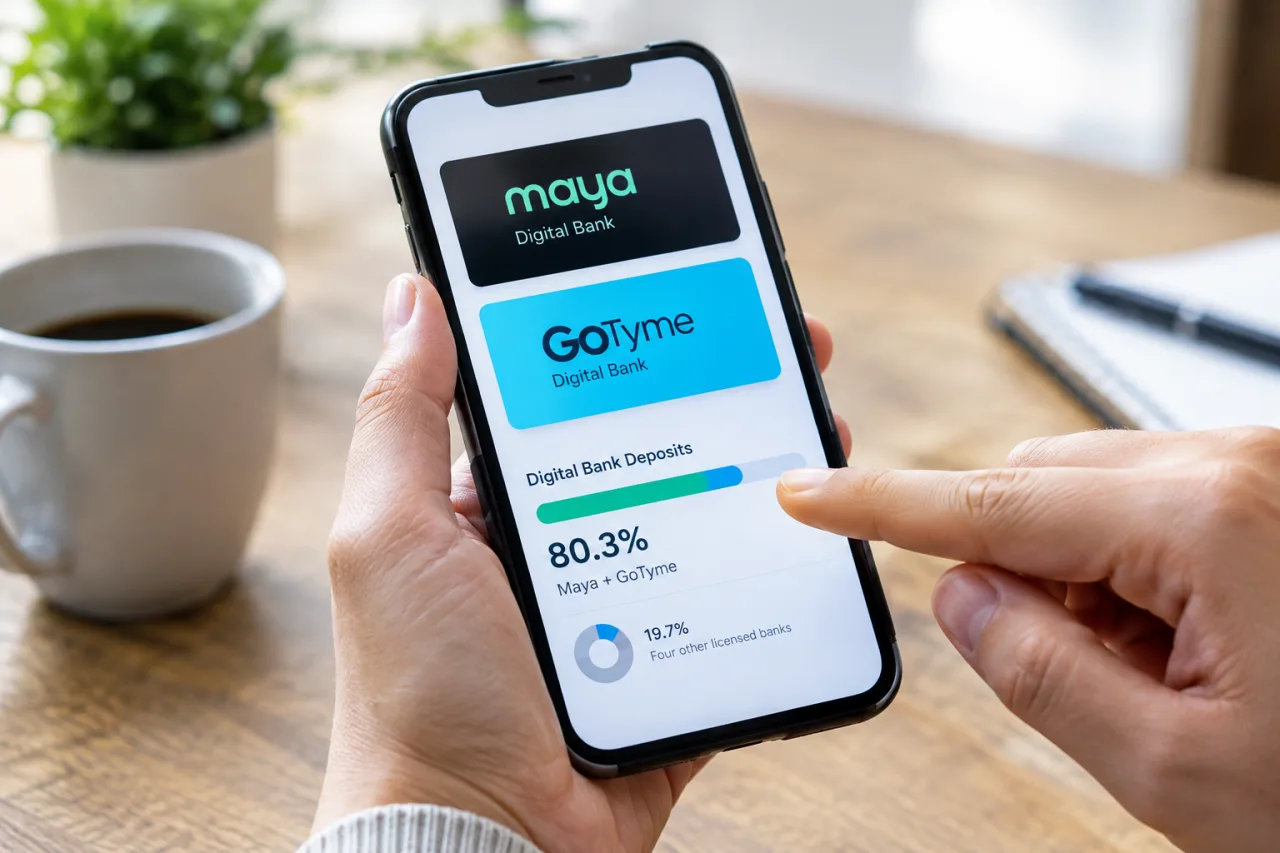
- 🏆 The concentration number: Maya and GoTyme together hold 80.3% of digital bank deposits in the Philippines as of December 2025 — Maya ₱67.7 billion (48.9%) and GoTyme ₱43.5 billion (31.4%) — while four licensed banks split the remaining fifth.
- 📈 The growth number: BSP data shows digital bank deposits hit ₱153 billion by March 2026, up about 50% in a year across roughly 38 million accounts — faster growth than the whole Philippine banking system.
- ✅ The profitability map: Maya Bank is profitable, UNO Digital reached operating breakeven in February 2026, Tonik reported IFRS profitability in May 2026, and OFBank is profitable — while UnionDigital is being absorbed into UnionBank.
- 🛡️ The saver move: Every BSP-licensed digital bank carries PDIC deposit insurance up to ₱1 million per depositor per bank — so the practical rule is split large balances across banks and watch the new entrants arriving through 2027.
Four of every five pesos parked in the Philippines’ digital banks sit in just two accounts: Maya and GoTyme. Officially, digital bank deposits in the country total about ₱139 billion as of December 2025 — and the 2026 Philippines Fintech Report credits Maya Bank with ₱67.7 billion (48.9% of the total) and GoTyme Bank with ₱43.5 billion (31.4%). The other four banks that have held their licenses since 2021 share what remains. For savers, that split is the single most useful picture of the market: it shows who won distribution, who is still standing, and where the next round of rate competition will come from.
Data note: the December 2025 ladder below comes from the 2026 Philippines Fintech Report published by Fintech Alliance.Ph with Fintech News Philippines, and the March 2026 growth figures come from Bangko Sentral ng Pilipinas data reported in May. Figures are the latest disclosed at the time of writing.
The Full Digital Bank Deposits Ladder, Bank by Bank
The six digital banks that opened the industry under the original six-license cap reported the following deposit totals as of December 2025:
| Bank | Deposits (Dec 2025) | Share | 2026 status |
|---|---|---|---|
| Maya Bank | ₱67.7 billion | 48.9% | Profitable; planning a 2027 IPO listing |
| GoTyme Bank | ₱43.5 billion | 31.4% | About 9 million customers by March 2026 |
| UNO Digital Bank | ₱8.8 billion | 6.4% | Operating breakeven reached February 2026 |
| UnionDigital Bank | ₱8.06 billion | 5.8% | Job cuts; being absorbed into UnionBank |
| Tonik Digital Bank | ₱6.6 billion | 4.8% | First standalone bank profitable under IFRS (May 2026) |
| Overseas Filipino Bank | ₱3.76 billion | 2.7% | Profitable on its OFW and government niche |
The arithmetic behind the headline is easy to verify: Maya and GoTyme together hold ₱111.2 billion of the roughly ₱138.4 billion reported across the six banks, which is 80.3%. Maya’s share alone is bigger than UNO, UnionDigital, Tonik and OFBank combined. And the ladder is about to gain steps: MariBank, Sea Limited’s Philippine bank, became the seventh licensed and operating digital bank in July 2026, and the BSP has raised the industry cap from six to ten, with applications already filed for the remaining slots.
How Two Banks Pulled Ahead of Four
Concentration this heavy does not come from rates alone — every digital bank in the country advertises savings yields far above the sub-1% traditional banks pay — a gap Nikkei Asia documents across the sector. It comes from distribution, and the two leaders built it in opposite ways.
Maya inherited its customer base: the wallet’s payment, merchant and crypto ecosystem funnels users into savings products inside the same app, so the bank never had to win a saver from scratch. Its promotional structure — headline rates that run far above the 3% base through spending missions — is documented in our breakdown of how Maya savings interest really works, including the gap between the banner number and what most statements show.
GoTyme built its channel in the physical world. The Gokongwei-Tyme venture kept kiosks at Robinsons retail locations where customers can open an account and get a debit card in minutes, then backed it with a flat, no-condition 3% rate on GoalSave balances. It pushed its customer count to roughly 9 million by March 2026, and our independent GoTyme review covers what that no-frills model includes and omits.
The pattern the deposit report underlines is blunt: distribution counts for a great deal in digital bank deposits. Banks with a ready audience — or a place to be found in a mall — did not need to outbid anyone. The four trailing banks, none of which hold more than 7% of the market, are now competing on partnerships, niches and product features instead of raw rates.
What the Four Challengers Are Doing About It
The trailing four are not standing still — every one of them is attacking the same problem from a different direction, and each direction is a different bet on what earns digital bank deposits next.
UNO Digital Bank is betting on partnerships. It teamed with Pascal Resources Energy to bring business banking to the underbanked micro-business segment and with Sun Life Grepa to bundle insurance with its accounts. UnionDigital is betting on lending: it runs an SSS microloan program through its app for small businesses, adds complimentary Chubb Philippines insurance on its digital loans, and was already the infrastructure behind instant SSS loans — the program our LoanLite walkthrough covers from the borrower’s side. Tonik is betting on capital and automation, taking fresh pre-Series C funding from K2 Investments and running much of its customer service through AI voice agents. OFBank, the state-run Landbank subsidiary, bets on its monopoly position in government disbursements and the OFW niche.
What that list shows is that the challengers’ strategies are smart and none of them has yet moved the deposit ladder — as of December 2025, no challenger bank had shifted its share of digital bank deposits by more than rounding-error amounts. Lending, partnerships and automation earn revenue; only distribution earns the deposit base, and so far only two banks found it.
The Bigger Number: ₱153 Billion and 50% Growth in One Year
Concentration is only half the story; the market is also exploding. BSP data shows digital bank deposits reached ₱153 billion at the end of March 2026, up about 50% from a year earlier, spread across nearly 38 million accounts — an account count that grew 58% year on year. The entire Philippine banking system, by comparison, grew deposits about 10% to ₱22 trillion in the same window.
Two readings follow from those numbers. First, the digital banks are still tiny — ₱153 billion is well under 1% of the ₱22-trillion system — so the growth runway is long. Second, the growth rate is exceptional: Filipinos are moving deposits into digital banks faster than into any other category, which is exactly why the concentration battle in digital bank deposits matters before the next four licenses turn on.
Who Is Actually Making Money
Deposits are the scoreboard, but profitability is the business model, and the 2026 picture is more varied than the July one — when our review of the Philippine digital bank landscape found only two of the six operating profitably and BSP itself calling profitability “a challenge” across the sector.
The updated map: Maya Bank reached profitability on the strength of its ecosystem. Overseas Filipino Bank, despite holding the smallest deposit base, runs profitably on its narrow OFW and government-disbursement niche. UNO Digital Bank announced operating breakeven in February 2026, and Tonik reported in May 2026 that it had become the first standalone digital bank profitable under IFRS accounting. UnionDigital, by contrast, has been targeting breakeven rather than reporting it — and its parent has decided a harder pivot than patience.
For savers, the profitability map is a proxy for staying power. A bank that makes money can afford to keep paying 3% on balances without a price war; a bank still burning capital to chase deposits has to choose between growth and survival when rates move.
The UnionDigital Signal: Consolidation Has Started
The clearest evidence that the deposit race settled early came from UnionBank in late October 2026. The Aboitiz-led bank announced it would fold UnionDigital and its fintech arm UBX into its main operations, subject to BSP approval, and began cutting jobs across the two subsidiaries shortly after. The bank stressed that UnionDigital customers keep using their accounts and apps without interruption, and that the cuts are confined to the subsidiaries.
Read the consolidation alongside UnionBank’s own numbers — the bank doubled its profit while the index bled, and justified the cost of its digital rebuild — and the strategy is visible: rather than run a money-losing standalone deposit business alongside a profitable parent, the parent absorbs the digital operation and keeps the technology. Four of the original six digital banks remain standalone; the race for digital bank deposits is no longer six banks versus each other, it is two winners versus an industry reshaping itself around them.
Where You Should Keep Your Savings — the Saver’s Playbook
None of this market structure changes what a saver needs to protect, but it should change where savers look. The playbook in a two-bank-led market:
1. Treat ₱1 million as the split line. Every BSP-licensed digital bank is covered by PDIC deposit insurance up to ₱1 million per depositor per bank. Balances above that line should be spread across more than one bank — insurance is per bank, not per person, so splitting is the only way a large balance stays fully covered.
2. Match the rate structure to your behavior. The high headline rates in this market come with conditions: Maya’s top tiers run through spending missions, GoTyme’s flat 3% applies to GoalSave accounts rather than the everyday number. Our monthly-updated digital bank rates comparison walks the fine print for every bank, so the comparison point is the net yield you actually earn, not the banner.
3. Watch the new entrants before committing long. MariBank now operates as the seventh digital bank with Sea Limited behind it, and the BSP cap of ten leaves three licenses in play. New entrants almost always enter by paying for deposits — which historically means promotional rates for early accounts. The current duopoly earns its concentration; it does not get to charge for it.
4. Re-check your bank’s structural news quarterly. The UnionDigital absorption is the first structural event of the consolidating phase. Customers’ accounts continue under the parent, but products, app experience and loan channels evolve. Saver-side changes are announced, not silent — but only if you check.
Frequently Asked Questions
Q: How much money is actually in digital bank deposits in the Philippines?
A: About ₱139 billion across the six original digital banks as of December 2025, growing to ₱153 billion by the end of March 2026 according to BSP data — around 38 million accounts growing 58% a year.
Q: Why do Maya and GoTyme hold 80% of digital bank deposits?
A: Distribution. Maya funnels users from its existing payments ecosystem into savings, and GoTyme combines retail kiosks with a flat no-condition 3% GoalSave rate. Both started with audiences the other four banks had to build from zero, and the 2026 Philippines Fintech Report credits that distribution with the win.
Q: Which digital banks are profitable in 2026?
A: Maya is profitable; OFBank runs profitably on its niche; UNO Digital Bank reached operating breakeven in February 2026; and Tonik became the first standalone digital bank profitable under IFRS accounting in May 2026. UnionDigital has been aiming for breakeven and is being absorbed into UnionBank instead.
Q: Is UnionDigital closing or unsafe?
A: Neither. UnionBank is integrating UnionDigital and UBX into its core operations pending BSP approval. Customer accounts and apps continue without interruption, and deposits remain PDIC-insured. The change is organizational, not an exit.
Q: Are digital bank deposits insured?
A: Yes — up to ₱1 million per depositor per bank through PDIC, the same coverage a traditional bank account carries. Balances above ₱1 million at any single bank should be split across banks to remain fully covered.
Q: Will rates stay this high once two banks dominate?
A: The concentration makes high base rates less certain over time, but three forces keep short-term pressure upward: the remaining banks competing for the other fifth of the market, MariBank’s entry with Sea Limited’s capital, and up to three more licenses the BSP has capped the industry to accept. Watch the promos, not the banners.
The Bottom Line
Digital bank deposits in the Philippines tell a clean two-part story: a market that grows 50% a year, led by two banks that won distribution rather than a rate war. The next phase belongs to lending and profitability — the battleground that decides whether the four challengers close the gap or the industry consolidates further around Maya and GoTyme. Savers do not need to take a side: PDIC coverage keeps any balance under ₱1 million whole wherever it sits, new entrants keep promo pressure alive, and the saver’s edge in this market has always been the same — split, compare net yields, and revisit the standings quarterly.
Sources: 2026 Philippines Fintech Report (Fintech Alliance.Ph / Fintech News Philippines), February-May 2026 digital banking coverage; BusinessWorld and Philippine Daily Inquirer reporting on BSP digital bank deposit data; UnionBank statements on the UnionDigital integration reported by Fintech News Philippines and InsiderPH; Banko Sentral ng Pilipinas industry statements on the digital bank license cap.
Disclaimer: This article is for general information only and is not financial or investment advice. Rates, promotions and bank structures change; verify current terms with each bank and PDIC before making deposit decisions.
- fintechnews.ph/73245/digital-banking-news-philippines/digital-bank-de… — the 2026 Philippines Fintech Report
- asia.nikkei.com/spotlight/asean-money/philippine-digital-banks-strugg… — Nikkei Asia documents
- business.inquirer.net/592487/digital-bank-deposits-top-p150b
- fintechnews.ph/74185/digital-banking-news-philippines/uniondigital-ba… — cutting jobs across the two subsidiaries
External sources linked in this article, in order of first mention. Spotted an error or a broken link? Tell us.
Cite this pagePublished Nov 11, 2026
Agron, E. (2026, November 11). Maya and GoTyme Hold 80% of All Digital Bank Deposits. WorldNgayon. https://worldngayon.com/digital-bank-deposits/
Agron, Edmon. “Maya and GoTyme Hold 80% of All Digital Bank Deposits.” WorldNgayon, 11 Nov. 2026, worldngayon.com/digital-bank-deposits/.
Agron, Edmon. “Maya and GoTyme Hold 80% of All Digital Bank Deposits.” WorldNgayon, November 11, 2026. https://worldngayon.com/digital-bank-deposits/.
Agron, E. (2026) ‘Maya and GoTyme Hold 80% of All Digital Bank Deposits’, WorldNgayon, 11 November. Available at: https://worldngayon.com/digital-bank-deposits/.
E. Agron, “Maya and GoTyme Hold 80% of All Digital Bank Deposits,” WorldNgayon, Nov. 11, 2026. [Online]. Available: https://worldngayon.com/digital-bank-deposits/
@online{agron2026digitalbank,
  author       = {Agron, Edmon},
  title        = {{Maya and GoTyme Hold 80\% of All Digital Bank Deposits}},
  year         = {2026},
  date         = {2026-11-11},
  organization = {WorldNgayon},
  url          = {https://worldngayon.com/digital-bank-deposits/},
  urldate      = {}
}TY - ELEC AU - Agron, Edmon TI - Maya and GoTyme Hold 80% of All Digital Bank Deposits T2 - WorldNgayon PY - 2026 DA - 2026/11/11/ UR - https://worldngayon.com/digital-bank-deposits/ Y2 - ER -
Cite the version you read; the page may be updated. Zotero and Mendeley can also import this page directly.