Key Takeaway
- 🔗 The definition, split correctly: a cross connect is the physical point-to-point cable of data center interconnection linking two endpoints inside one data-center facility; data center interconnection is the broader practice — connecting companies, networks and facilities (in-building cross connects, campus links across ~10 km, metro circuits, and cloud on-ramps) into one addressable ecosystem.
- 🧵 The physical truth: the base unit is a fiber cable — single-mode fiber is now the standard medium (Equinix went SMF-only across its global sites in 2024) — terminating in meet-me rooms and carrier-neutral exchange points; SLAs run 99.99%+ availability on the commercial product.
- 🏢 Why the colo matters: the reason a network exists to connect into is the carrier-neutral data center — dozens of networks, clouds and enterprises under one roof, where a $300/month cross connect replaces months of trenching; the ecosystem density, not the cable spec, is what buyers actually purchase.
- 🤖 The AI rewrite: AI campuses re-scale the layer — racks at 100+ kW with GPU clustering that demands east-west throughput inside buildings (the two-plane network designs of the neocloud class) and multi-GW campuses that need interconnection planning as early as power planning; the delays ring in search demand reflects a real procurement constraint.
- 💼 The career lane: the interconnection function (provisioning, agreements, delay management) is staffed jobs-with-titles now — the search ring literally contains “data center interconnection jobs” — one of the infrastructure-specialist lanes this site tracks for the OFW-side buildout.
Table of Contents
Data center interconnection is the invisible layer under every enterprise cloud you have ever used — the physical cabling practice that lets two companies’ networks exchange traffic across the same lobby of a building, and the commercial machinery (agreements, provisioning queues, meet-me rooms) that makes those meters of fiber worth millions. It is also one of the least-explained products in IT infrastructure: the term collides with the grid-interconnection language (power queues), and the AI buildout is actively rewriting what the layer has to do. This piece sorts the terminology, walks the cable-to-campus product ladder, explains why ecosystem density is a better buy than cable bandwidth, and maps how AI campuses re-scale the whole function — with the jobs and delays reality readers search for.
What data center interconnection means: the terms, sorted
The definitions, correctly nested: cross connect — a point-to-point connection between two endpoints in a single data center (two devices, two networks, two tenants’ cages), built as a physical cable run. interconnection — the broader practice of linking systems and networks: in-facility cross connects, campus connections between nearby buildings, metro circuits across a city, and direct connections into cloud regions. carrier-neutral colocation — the business model that makes both useful: a data-center operator that does not compete with the networks inside it, and instead sells space, power and the ability to interconnect freely.
Why the nesting matters for buyers: the confusion between the terms maps onto confusion between products: “we need a cross connect” is an IT-provisioning request; “we need an interconnection strategy” is a business-decision about where your company’s network lives. The same building can serve both: a cross connect is a piece of the interconnection layer the way a brick is part of a wall — and the strategy decision (which facility, which ecosystem) prices the brick before the request ever goes in. The GPU-rental economics pieces apply the same nesting to compute: the unit (the cable, the GPU-hour) markets well, but the facility choice dominates the outcome.
The cable layer: types, media and the SMF shift
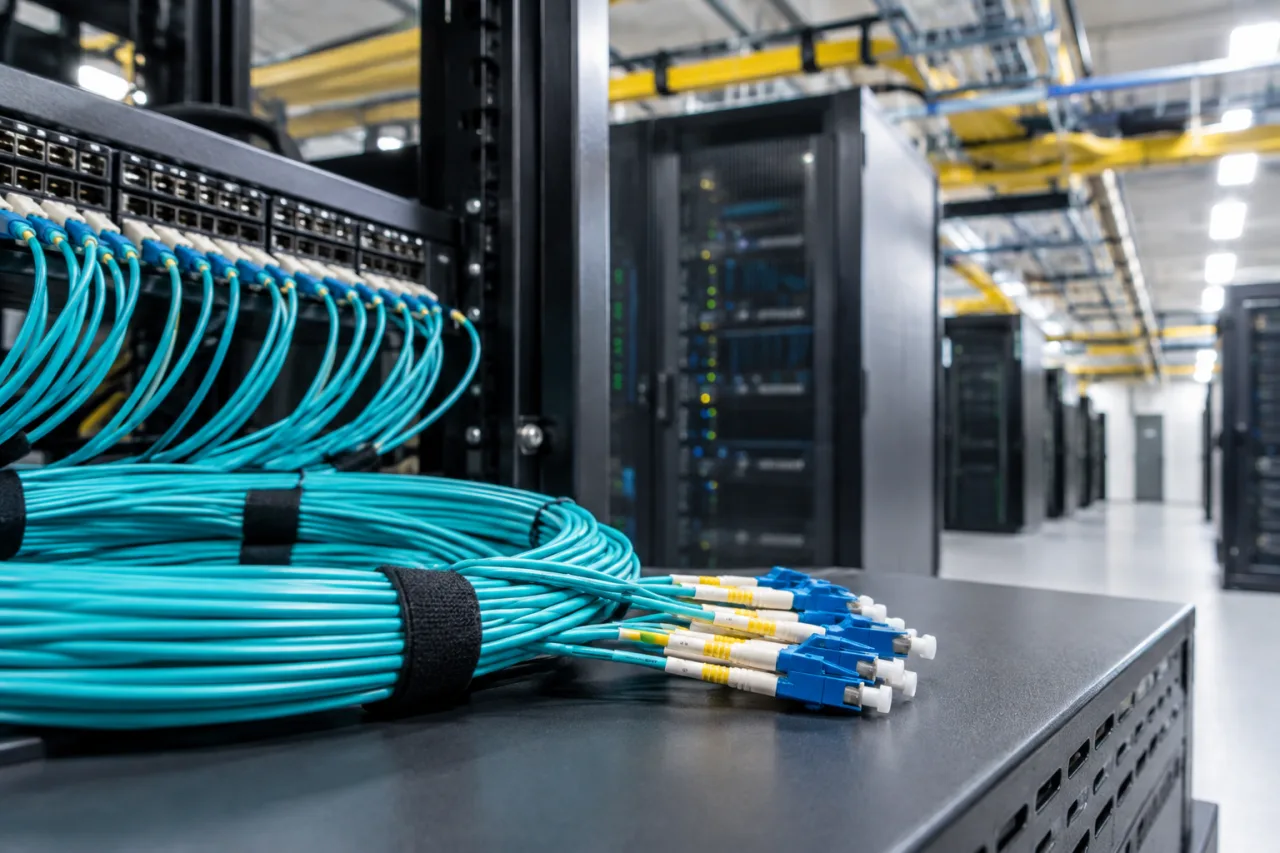
The media, by reach and bandwidth: fiber-optic cross connects (single-mode — laser over one path, for distance and bandwidth; multimode — cheaper, for short in-building runs), copper (cost-effective for legacy low-bandwidth links), and Ethernet-class structured cabling (CAT5/CAT6) in-office standard practice. The industry has settled: as of March 31, 2024, Equinix — the largest global interconnection platform — supports only single-mode fiber for new cross-connect orders across its global footprint; the long-distance, high-bandwidth medium won the standard’s future. Commercial cross-connect products run under 99.99%-availability SLAs — five-nines reliability on a physical cable is the layer’s standard promise (the physical run plus the termination hardware and monitoring behind it).
The physical anatomy, walked: each tenant’s cage terminates in the facility’s meet-me room — the shared exchange hall where carriers’ and tenants’ cables converge; the cross connect is the cable path between your cage and the counterpart’s port or the meet-me frame. Inside a carrier-neutral facility, that physical simplicity is the product: order a cross connect, the provisioning team runs it, and latency drops to the length-of-cable class — the entire point of keeping partners inside the same building.
The product ladder: cross connect to campus to cloud
The ladder, bottom to top: 1 — the standard cross connect: in-building, point-to-point, days to provision, the workhorse of every colo tenant relationship (private peering to a carrier, service delivery between companies sharing a facility, direct WAN termination). 2 — metro/campus products: pre-run fiber connecting separate facilities in the same market — Equinix’s campus cross connects join buildings within ~10 km via pre-run SMF conduits, with diverse-campus cross connects adding a physically separated redundant path (route diversity is the availability backstop — two cables that cannot share a trench). 3 — cloud on-ramps: the direct-connect products that terminate a tenant’s private network inside a cloud provider’s edge in the same facility — the physical layer of every direct-connect product the hyperscalers sell. 4 — interconnect fabrics/virtual connections: the software layer above the physical products — portal-defined virtual circuits across an ecosystem, provisioned in hours instead of cabled in days.
Which data center interconnection rung you buy, decided structurally: in-building relationships (your vendor is your colo neighbor) buy rung 1; multi-site regional footprints buy rung 2; anything cloud-adjacent buys rung 3-4. Every rung solves the same economic problem — dedicated private capacity without building your own network — at increasing reach, and the AI buildout is currently stretching every rung at once (the campus layer below).
Why ecosystem density is the real product
The paradox that prices the product: a cross connect itself is cheap (a meter-scale fiber run with terminations, billed monthly at a few hundred dollars). What buyers really select is the ecosystem: how many carriers, clouds, CDNs, financial networks, content platforms and enterprise peers already live behind the same walls. In a dense ecosystem, a single cross connect reaches a marketplace of counterparties instantly; in an empty facility, the same cable reaches nobody. That is why interconnection campuses concentrate: the network-effects pricing of physical geography — each additional participant raises the value of every existing cross connect.
The density ledger, for enterprise buyers: performance (direct paths cut transit hops — latency and jitter wins where milliseconds price: finance, media, real-time apps); security posture (private peering avoids public-internet exposure for critical flows); resilience (redundant paths within and across campuses — the diverse-path products exist for exactly this); and cloud-strategy optionality (direct paths to multiple clouds from one cabinet — the multi-cloud architecture’s physical foundation). The AI era adds the fourth reason: GPU-class workloads and data-heavy training runs make data-transfer costs and speeds a first-order line item — interconnection moved from “the plumbing budget” to “the architecture budget” in this cycle.
Interconnection for AI campuses: the density rewrite
Inside the AI building: the AI rack (100+ kW, GPU-dense) forced a network redesign before it forced anything else: east-west traffic between thousands of GPUs inside a single cluster — the two-plane network architecture this site documented across the neocloud class (compute-plane fabric sized for GPU-to-GPU bursts, separate storage/service planes for data movement) — is interconnection INSIDE the building, re-engineered at hardware-switch scale. The engineering logic carries up the ladder: what a cross connect does between two tenants’ cages, the cluster fabric does between two GPU nodes — private, provisioned, low-lag.
Between AI campuses: the gigawatt-class AI buildout stretches the campus layer: training runs replicate state across regional clusters (data-center-to-data-center circuits at Tb/s-class), inference traffic fans out to edge sites, and the power-constrained siting pushes campuses into lower-cost power markets — which makes the links BETWEEN the compute sites strategically priced infrastructure. The multi-GW campuses (the class the power-pipeline analysis tracks) interconnect as a first-order requirement — a campus without interconnection plans cannot participate in the distributed training and serving topologies AI economics increasingly assumes. The AI-capex analyses this site runs carry the spending side; the interconnection layer is where that spending becomes function.
The delays, the agreements, the jobs
The delays, honest: the search demand for “data center interconnection delays” resolves to a real constraint stack: circuit provisioning queues (carrier capacity in popular buildings), construction windows (route builds for new paths), and the AI-era amplifier — every new hyperscale campus orders dozens of high-count fiber circuits into the same metro duct infrastructure that already congested. The practice-side answer is ordering early and diversely: the diverse-path products, pre-run conduits and fabric-layer virtual circuits exist precisely because physical provisioning waits are the binding constraint. The same discipline applies to the agreements: interconnection contracts (master service agreements, cross-connect orders, carrier relationships) are negotiated with lead times and route-diversity clauses — the “interconnection agreement” ring is a procurement topic, not a software one.
The jobs, honestly: “data center interconnection jobs” is a real hiring lane — network provisioning engineers, interconnection program managers (the hyperscalers and colos both list them), carrier-relations and capacity-planning roles. The role’s shape: part network engineer, part procurement, part logistics — the trade that turns orders into lit fiber. For the global workforces entering AI infrastructure (of which OFW-adjacent talent is a named part — the infrastructure-jobs analysis), the interconnection lane is one where certifications (networking fundamentals) convert quickly into contract work: the demand is facility-by-facility and worldwide.
Not the same word: interconnection vs grid interconnection
The collision, sorted for readers arriving from power-grid searches: grid interconnection is the process of connecting a power plant or a large load to the electricity network — the queue process (studies, upgrades, timelines — years!) documented in this site’s data-center power-pipeline analysis and the energy-buildout pieces. Data center interconnection is the fiber-and-ecosystem layer in this piece — cabling and commercial relationships between networks. They share the word and nothing else: one prices electrons, one prices bandwidth. The two rungs share one management discipline — both are long-lead infrastructure that must be ordered before the building is ready — which is why the same program-manager role class (provisioning, vendor management, schedule tracking) covers both, and why misreading which interconnection a contract refers to wastes weeks of a project’s critical path.
What this means for work, money and the Philippines
Budgets: the interconnection line is a real budget row for enterprises operating in multi-cloud and AI-adjacent arrangements — evaluating it once (ecosystem density per facility, SLA tiers, route diversity) beats discovering it in an outage post-mortem. Careers: the lane hires across skill levels — provisioning analysts, network engineers, interconnection PMs — and the regional data-center boom (Malaysia’s 42% trajectory, Singapore’s constrained market, the Philippine edge builds the SEA analysis tracks) staffs it region by region. For Filipino professionals and OFWs: the skills transfer cleanly — the same meet-me-room discipline the global colos run is what the region’s new campuses will hire for; certifications in networking convert into this lane faster than most AI-infrastructure roles. The buildings go up fast; the ecosystems take years — get in while the ducts are still being planned.
Verdict: the network is the building
Data center interconnection, settled: the practice of linking networks across the physical layer of colocated facilities — cross connects inside buildings, metro products across campuses, cloud on-ramps into the hyperscalers, fabrics above them all — with the ecosystem’s density, not the cable’s spec, as the thing being bought. AI re-scaled the layer (two-plane fabrics inside, Tb/s campus links between, delay queues outside) and the careers attached are hiring in every market the buildout reaches. The physical truth stands: the network is the building — and the buildings are multiplying.
Sources on the record: the Equinix cross-connect documentation · the Digital Realty cross-connect explainer.
Financial Disclaimer
This article is editorial analysis of publicly reported technical and market information, not investment or financial advice, and no outcome is promised. Product terms, SLAs and market forecasts change; verify with the named sources. Technology and infrastructure markets carry substantial risk.
- docs.equinix.com/cross-connect — the Equinix cross-connect documentation
- digitalrealty.com/resources/blog/what-is-a-cross-connect — the Digital Realty cross-connect explainer
External sources linked in this article, in order of first mention. Spotted an error or a broken link? Tell us.
Cite this pagePublished Oct 31, 2026
Agron, E. (2026, October 31). Inside Data Center Interconnection: How AI Campuses Get Connected. WorldNgayon. https://worldngayon.com/data-center-interconnection/
Agron, Edmon. “Inside Data Center Interconnection: How AI Campuses Get Connected.” WorldNgayon, 31 Oct. 2026, worldngayon.com/data-center-interconnection/.
Agron, Edmon. “Inside Data Center Interconnection: How AI Campuses Get Connected.” WorldNgayon, October 31, 2026. https://worldngayon.com/data-center-interconnection/.
Agron, E. (2026) ‘Inside Data Center Interconnection: How AI Campuses Get Connected’, WorldNgayon, 31 October. Available at: https://worldngayon.com/data-center-interconnection/.
E. Agron, “Inside Data Center Interconnection: How AI Campuses Get Connected,” WorldNgayon, Oct. 31, 2026. [Online]. Available: https://worldngayon.com/data-center-interconnection/
@online{agron2026datacenter,
  author       = {Agron, Edmon},
  title        = {{Inside Data Center Interconnection: How AI Campuses Get Connected}},
  year         = {2026},
  date         = {2026-10-31},
  organization = {WorldNgayon},
  url          = {https://worldngayon.com/data-center-interconnection/},
  urldate      = {}
}TY - ELEC AU - Agron, Edmon TI - Inside Data Center Interconnection: How AI Campuses Get Connected T2 - WorldNgayon PY - 2026 DA - 2026/10/31/ UR - https://worldngayon.com/data-center-interconnection/ Y2 - ER -
Cite the version you read; the page may be updated. Zotero and Mendeley can also import this page directly.