Key Takeaway
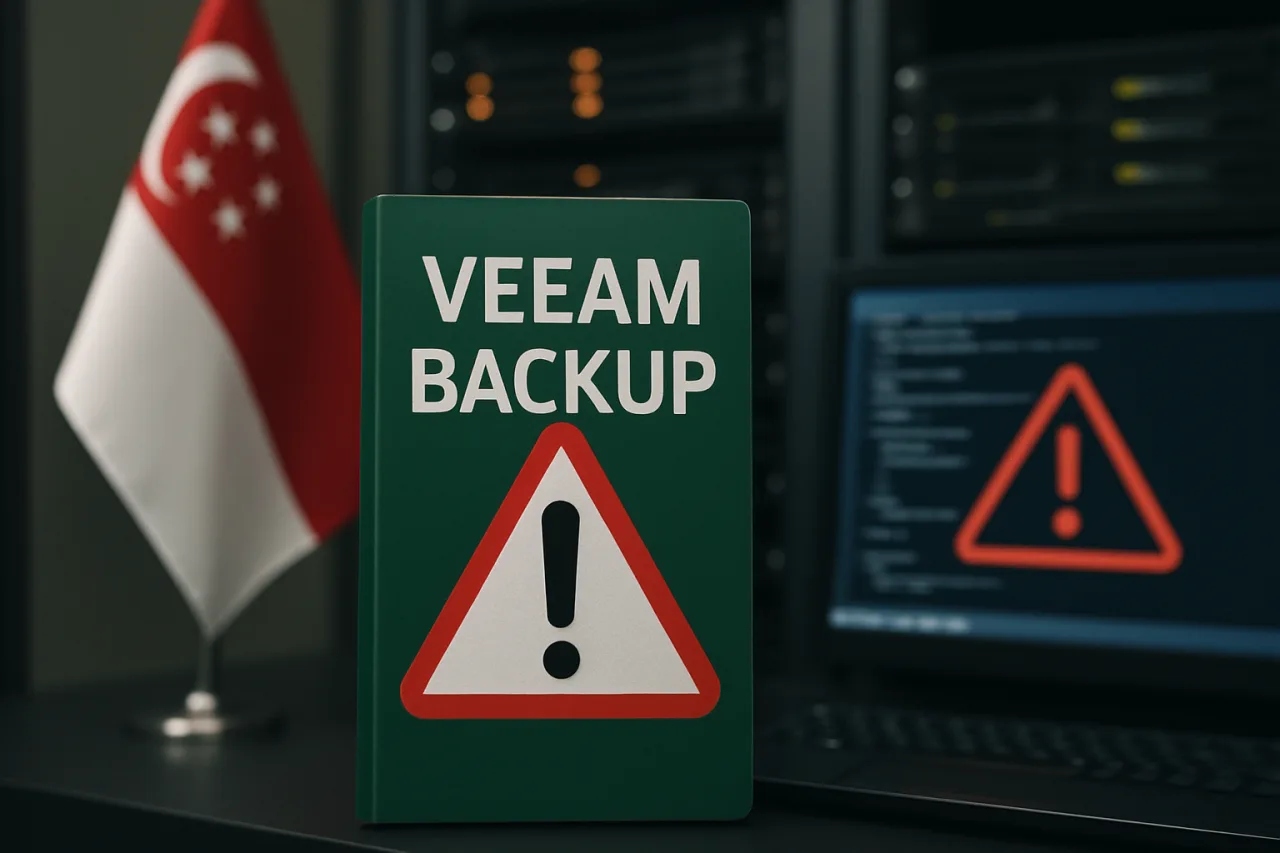
- The flaw: Singapore’s Cyber Security Agency (CSA) warned that a logged-in user with the low-privilege “Backup Viewer” role can push crafted data through the Mount Service and run code on the Veeam backup server with SYSTEM-level rights.
- The severity: The flaw is tracked as CVE-2025-64393 and scores 9.4 out of 10 on CVSS v4.0 — “critical” on any remediation scale.
- Who is exposed: every Veeam Backup & Replication version 12 build from 12.0 through 12.3.2.4854; version 13 is not affected.
- What to do: patch to 12.3.2 P4 (build 12.3.2.4934) immediately, audit who holds the Backup Viewer role, and confirm backup copies are still immutable.
- The honest limit: neither agency reports confirmed mass exploitation yet — the risk is that anyone can reverse-engineer the patch, so treat an unpatched Veeam backup server as an open incident.
Attackers rarely need to smash the front door when they can simply switch off your ability to recover. Singapore’s cyber security agency is warning teams about a flaw in Veeam Backup & Replication — the backup console that protects files, databases, and virtual machines for thousands of companies across Southeast Asia — because a person holding an ordinary-looking “viewer” account can turn it into SYSTEM-level control of the very server that manages every restore point. Patches have existed since 6 October 2026, and the vendor itself cautions that attackers will now test the flaw against systems that have not patched.
Scale note: that Veeam alert was one item in a 13-day run of product alerts CSA published across October — read the full wave as one event, not nine separate patch tasks.
Table of Contents
What CSA Confirmed: A Critical Veeam Backup Flaw
The Cyber Security Agency of Singapore published alert AL-2026-138 on 9 October 2026 with an unusually blunt instruction: patch immediately. The alert follows Veeam’s own security bulletin, KB4934, released on 6 October 2026, which describes three vulnerabilities fixed in one update — one critical, two medium. The critical case was reported to the vendor through the HackerOne bug-bounty program. The alert also lands in a Singapore year already crowded with security wake-up calls, from leaked firewall credentials to the record scam losses counted in the city-state’s 2026 Cyber Landscape report.
The numbers explain the alarm. The flaw sits in Veeam Backup & Replication and carries a Common Vulnerability Scoring System (CVSS v4.0) score of 9.4 out of 10. A score that high is not decoration: the attack requires no user interaction, no stolen administrator password, and no expensive tooling beyond network access and one low-privileged account.
The affected span is precise. Versions 12 through 12.3.2.4854 of Veeam Backup & Replication are vulnerable — in practical terms, every version 12 build, including 12.0, 12.1, 12.2, 12.3, 12.3.1, and 12.3.2 up to and including 12.3.2.4854. Version 13 is not affected. Organizations still running version 12 gain one more reason not to wait, because Veeam’s published support calendar ends for that product line on 28 February 2027.
CSA’s recommendation is one line long: users and administrators of affected products should update to the latest versions immediately. The same vendor update also closes CVE-2026-93026, a medium-rated flaw that lets a Backup Viewer account alter or delete the Enterprise Manager master key, and CVE-2025-64392, a reflected cross-site scripting bug in Enterprise Manager — two sides of the wider Veeam backup platform covered by the same bulletin. One patching session clears all three.
How the Flaw Works in Plain Language
Strip the jargon and the attack has three moving parts: a role, a service, and a data-handling mistake.
Start with the role. The Backup Viewer role exists so that help-desk staff and managers can watch backup jobs without being able to change them — a sensible least-privilege idea. In the affected versions of Veeam Backup & Replication, however, an account holding that “look, don’t touch” role could do far more than look.
Next, the service. The Mount Service is the component that lets an administrator browse inside a backup file, opening its contents as if they were files on a drive. It is a genuinely useful feature — and it became the attack path. The service accepted untrusted data from an authenticated viewer and converted that data into executable objects, a class of bug known as insecure deserialization. In plain terms, the server confused data with program code and obeyed the data.
The outcome is what makes this flaw critical. A successful attack delivers remote code execution as SYSTEM on the Veeam backup server — the Windows account that outranks every named administrator. From that position, an attacker can read or alter the backup database, tamper with jobs, reach whatever network the backup server can see, and, in the nightmare scenario incident responders fear most, quietly edit or erase the restore points a company would depend on during a real crisis.

Veeam’s bulletin adds a sober warning worth quoting directly: once a vulnerability and its patch are public, attackers will likely reverse-engineer the patch to find where the weakness lives, then hunt for unpatched deployments. The company’s own guidance is to install updates “without delay.”
Why Backups Are the Target
Ransomware groups inverted the asset years ago. The most valuable computer in a mid-size network is often no longer the domain controller — it is the backup server, because the machine that holds every recovery point also decides whether a victim can refuse a ransom demand. That is a documented target pattern in the ransomware era, not a claim about this specific CVE: extortion crews have repeatedly gone after backup infrastructure first, precisely so victims have nothing clean left to restore with.
Now look at the entry conditions for this flaw: network reachability plus one low-privileged account. No zero-day exploit kit, no privileged credentials. Weak portal passwords and reused credentials close that gap quickly — the FortiBleed disclosure, which dumped 73,000 Fortinet VPN credentials, showed how much raw material from old infrastructure leaks already sits in attacker bazaars waiting to be tried on the next portal.
Known-flaw longevity is the second lesson of the week. CISA confirmed in 2026 what every patch manager already suspected about the MikroTik SSH exploit chain: a flaw that is fully documented is not a flaw that is fully closed, because unpatched gear keeps the door open month after month. A Veeam backup console is exactly that kind of long-lived, quietly running system — the classic habitat for the pattern, which is why this alert exists at all.
The Veeam Backup Patch-and-Verify Playbook
Patching closes the flaw; verification closes the doubt. These five steps are ordered so that each one gates the next.
1. Inventory the exact build
Check the installed version in the console under Main Menu > Help > About, and record the build number for every site and every instance — including secondary or replica deployments that often get missed. Every Veeam Backup & Replication deployment from version 12 up to and including 12.3.2.4854 needs the update. The fix ships in version 12.3.2 P4, build 12.3.2.4934.
2. Apply the patch in the right order
Recent 12.3.2 builds (12.3.2.3617, .4165, .4465, and .4854) take the patch ISO or EXE, while earlier version 12 releases require the full upgrade ISO. Where Enterprise Manager is deployed, stage that component first. Book a maintenance window and allow for a reboot, because a half-applied patch on a production backup console is a new problem, not a fixed one.
3. Audit the Backup Viewer role
The attack needs that specific role as its ticket, so enumerate every account holding the Backup Viewer role in the Veeam backup console, remove the ones that no longer need it, and rotate credentials for the rest. Where the portal is exposed externally, review whether it needs internet-wide access at all — Veeam’s bulletin documents no workaround for these flaws, so privilege and exposure reduction is defense, not an excuse to defer patching.
4. Verify immutability
Confirm that at least one backup copy still lives on storage that cannot be altered or deleted through the console — object-lock storage, air-gapped media, or physically separated copies. Immutability is what keeps a compromised console from becoming a compromised history.
5. Test a restore
Run one real test restore after patching and record the result. The purpose of a backup server is a restore that works; the purpose of this exercise is proving yours still will.

What This Means for Filipino IT Teams and SMB Owners
The regional footprint is concrete: many business process outsourcing (BPO) and shared-services centers across the Philippines run Veeam Backup environments for their global clients, and Filipino IT administrators are among the engineers spending this week on exactly this patch. For those teams, the deliverable is simple and valuable — a written record of the build number before, the build number after, and the ticket that proves both.
Small business owners who outsource IT should ask their provider three questions before the week ends: what build number is running on the Veeam backup server today, when does the patch ticket close, and can they show a recent test restore. A provider who answers all three in writing has converted a scary headline into a routine maintenance item. One that answers vaguely has told you something too — about how the same provider will behave during your next real emergency.
For globally distributed Filipino teams and Filipino-owned businesses abroad, the calculus rarely changes: remote-work laptops seldom touch the backup console, but shared infrastructure rented from regional providers does. The same three questions apply, and the same written answer is the proof of care — for freelancers and remote contractors whose work rides on someone else’s server room, knowing that build number is part of doing business safely online.
Compliance and Trust: Patching Is a Regulatory Expectation
Data protection regulators increasingly read vendor-published critical flaws as the baseline for accountability. Singapore’s Personal Data Protection Commission demonstrated after the Simba Telecom breach that its post-incident probe reaches for exactly this standard — how fast, how thoroughly, and how verifiably an organization responded once risk was documented. Philippine companies face the same logic under the Data Privacy Act, where the defensible answer to “why did this flaw stay open” is a dated patch ticket, not an intention.
There is a commercial layer, too. Enterprise clients now ask service providers for evidence of patch discipline during audits and renewals. A documented critical-flaw response — build number, patch date, test restore — has become part of the sales conversation, which means the humble maintenance ticket is quietly earning trust revenue.
What to Watch
Three signals should change your clock, and each has a clear trigger:
- CISA KEV listing: if CVE-2025-64393 lands in CISA’s Known Exploited Vulnerabilities catalog, treat the patch deadline as days, not weeks — KEV listings are also the trigger for many regulated patch mandates.
- Exploitation evidence: any published proof-of-concept code or observed scanning against the Mount Service upgrades this from a patchable risk to an active hunt — at that point, restrict console access before you finish patching, not after.
- Vendor updates: Veeam’s security bulletins and CSA’s advisory page are the two feeds that matter; a follow-up bulletin adding more CVEs or new builds means re-running the inventory step.

FAQ
What is CVE-2025-64393 in plain language?
It is a critical flaw, scored 9.4 out of 10, in Veeam Backup & Replication. A low-privileged user holding the Backup Viewer role can run code on the Veeam backup server as SYSTEM by sending crafted data through the Mount Service.
Which Veeam Backup & Replication versions need the patch?
Every version 12 build up to and including 12.3.2.4854 is affected. The fix ships in version 12.3.2 P4, build 12.3.2.4934, and version 13 is not affected.
Has this flaw been exploited in the wild?
Neither CSA nor Veeam reports confirmed attacks as of mid-October 2026. The vendor warns that attackers will reverse-engineer the public patch, so the honest status is: risk is live, mass exploitation is not yet documented. Check CISA’s KEV catalog for changes.
What should a small business owner do first?
Ask your IT provider in writing for the exact build number on the Veeam backup server, a patch completion date, and a recent test-restore receipt. Those three answers separate a serious provider from a hopeful one.
About This Analysis
This analysis is based on the Cyber Security Agency of Singapore’s alert AL-2026-138, dated 9 October 2026, and Veeam’s vendor bulletin KB4934, dated 6 October 2026, with specialist context from heise online; facts were last verified on 18 October 2026, and the National Vulnerability Database entry for CVE-2025-64393 is linked for readers who want the formal scoring detail. WorldNgayon delivers Digital Intelligence for the AI-powered world — explaining the technologies that decide whether your data, work, and money stay recoverable, and what practical steps keep them that way.