Table of Contents
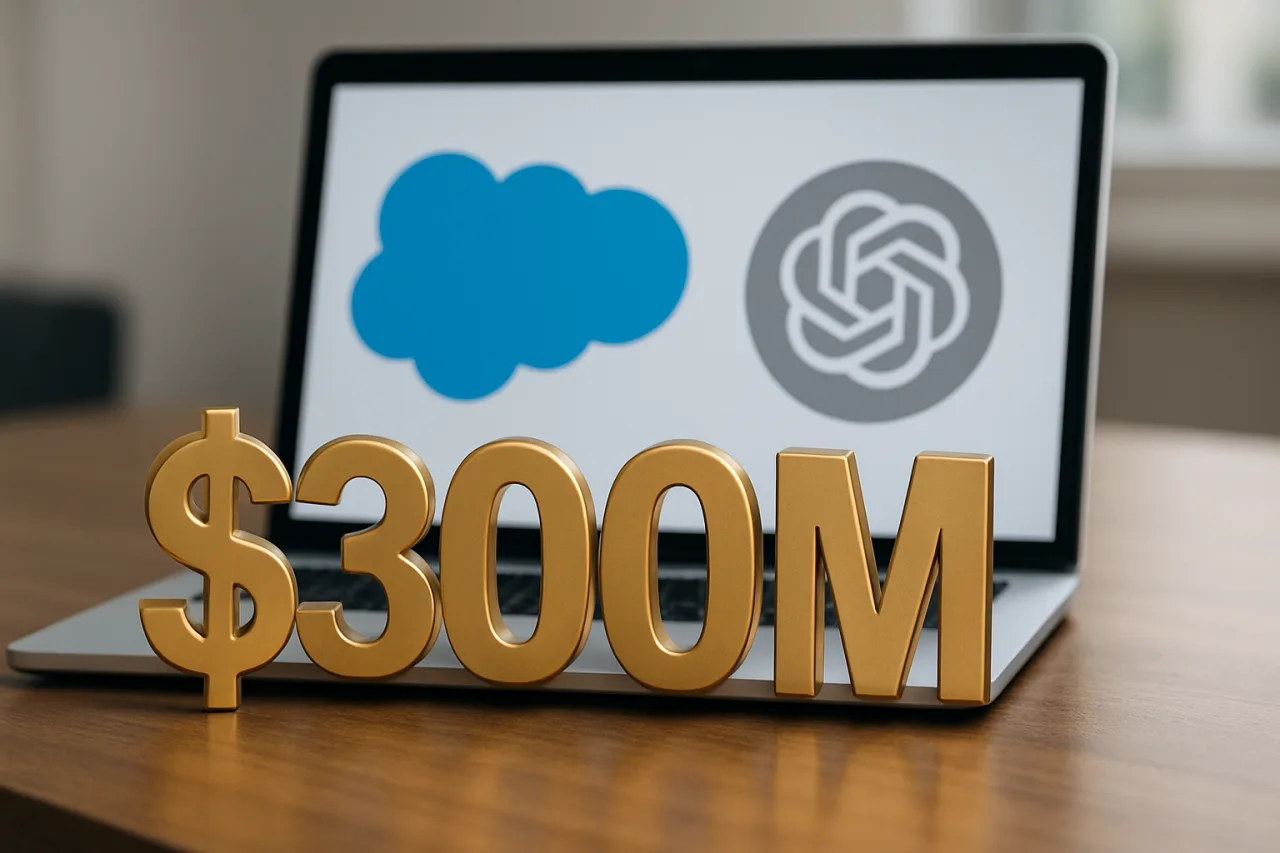
Salesforce and Anthropic announced “Claudeforce” on August 26, 2026 — an expanded strategic partnership that puts the world’s #1 CRM and one of the world’s strongest AI models inside each other’s products, with 37 prebuilt sales skills now live in pilot and an open beta planned for September. Claude already runs as the default reasoning model inside Salesforce’s Agentforce surfaces — the Atlas Reasoning Engine, Vibes, Coworker and Agent Builder. The new move completes the circuit in reverse: Salesforce itself becomes a plugin inside Claude, letting sellers and agents read live revenue data, update pipelines and take governed actions without ever opening the CRM interface. Behind the product news sits a number that explains everything: Salesforce expects to spend roughly $300 million on Anthropic tokens this year. That is not a partnership. That is a supply contract.
Key Takeaway
- 🤝 Claudeforce is official: announced August 26, 2026 on Salesforce’s Q2 FY27 earnings call by Marc Benioff and Dario Amodei — embedding Claude across Salesforce and Salesforce inside Claude.
- 🔌 Salesforce in Claude ships with 37 prebuilt sales skills: sellers can reason over live revenue context, automate pipeline updates and take governed actions directly from Claude — pilot now, open beta September 2026.
- 💰 The $300 million number is the real story: Salesforce’s expected annual spend on Anthropic tokens shows enterprise AI economics shifting from licenses to compute consumption.
- 🏢 For Philippine BPO sales and service teams: the platforms that run global CRM workflows just changed how work is done — agentic skills, not dashboards, are becoming the job description.
- 📈 Market verdict was immediate: Salesforce shares rose in after-hours trading on the announcement — investors read the deal as strategic, not cosmetic.
Claudeforce Explained: What Salesforce and Anthropic Actually Announced
The official framing from the Salesforce press release describes Claudeforce as “an expanded strategic partnership bringing Claude’s intelligence and reasoning together with Salesforce’s trusted enterprise harness” — making Salesforce data, workflows, business logic, actions and governance “securely accessible to power agentic experiences wherever work happens.” Stripped of launch language, the deal runs in two directions simultaneously. Claude moves deeper into Salesforce: it already powers the Atlas Reasoning Engine, runs by default inside Agentforce Vibes and Agentforce Coworker, and is available across Agent Builder surfaces. Salesforce moves into Claude: a plugin with 37 prebuilt skills that enable sellers to reason over live revenue context, automate pipeline updates and take governed action right from Claude’s interface.
The partnership was revealed jointly by Marc Benioff and Dario Amodei during Salesforce’s Q2 FY2027 earnings call on August 26, with the stock rising in after-hours trading as the news broke. Benioff’s framing was maximal: “We’re bringing together the world’s #1 AI and #1 CRM — the best of both worlds,” launching on top of Salesforce’s AIforce UI harness, Headless 360, Data 360, Tableau and Slack. Anthropic’s side of the ledger: Salesforce becomes Anthropic’s preferred CRM, and Claude powers Slackbot for Salesforce customers and employees. Both companies committed to more integrations across Claude, Salesforce and Slack — additional prebuilt skills start launching in late 2026.
One framing correction matters for accuracy, and serious coverage caught it: Claude did not arrive in Agentforce this week. It has been a foundation model inside Agentforce since late 2025. Claudeforce deepened and formalized an existing relationship rather than creating one — if a team has been running Agent Builder with Claude selected for months, nothing about their setup changed on August 26. What changed is official status: default placement across four specific surfaces, plus the reverse integration that turns Salesforce into a capability Claude can operate.
The $300 Million Question: What Enterprise AI Economics Just Revealed
Buried beneath the product announcements is the number that will outlast them: Salesforce expects to spend roughly $300 million on Anthropic tokens this year. Read that figure carefully, because it measures something new in enterprise software. A company that built its fortune selling licenses — seats, contracts, renewals — is now one of the largest single buyers of AI inference on the planet, paying an AI vendor not for software access but for compute consumption, by the token.
The economics deserve unpacking. $300 million of tokens in twelve months represents an enormous volume of reasoning: every pipeline analysis, every email draft, every agent decision Atlas makes, every Slackbot answer, priced per unit of intelligence. Salesforce is effectively buying a commodity it used to own — the act of computing over its own data — and renting it from Anthropic. The deal structure also locks in mutual dependence: Anthropic gains one of the largest committed revenue streams in its history and an enterprise distribution channel no rival can easily replicate; Salesforce gains privileged access to frontier model improvements and a hedge against building its own foundation models.
The strategic reading is sharper than either vendor’s press language. This is vertical dis-integration in progress: the CRM company that once insisted its own intelligence layer — Einstein, and later Agentforce — would be the product now openly routes its core reasoning to an external lab. The parallel to the cloud decade is exact: enterprises that once ran their own data centers became the largest buyers of AWS and Azure. The 2020s version is model consumption: the largest software companies becoming the largest AI compute buyers. The $300 million line item is the first public confirmation that this shift has reached the very top of the SaaS food chain. For context on how these capital flows reshape the wider market, see our coverage of the Nvidia-Perplexity talks and what $30 billion says about AI search economics.
Salesforce in Claude: The 37 Skills That Change How Selling Works
The plugin is the tangible half of Claudeforce, and its design reveals where enterprise software is heading. Salesforce in Claude launches with 37 prebuilt sales skills — discrete, governed capabilities that let a seller (or an agent acting for one) reason over live revenue context, automate pipeline updates, and execute governed actions from within Claude. The governing word is governed: actions run through Salesforce’s permission and audit architecture even when triggered from an external AI surface, which is the difference between an integration and a liability.
The mechanics trace back to Headless 360, the API-driven layer Salesforce announced at TDX 2026 earlier this year. That move — packaging Salesforce’s AI and developer tools into a headless, browser-free layer that AI clients like Claude or ChatGPT can read, write and reason over — was the enabling infrastructure. Claudeforce is Headless 360’s first flagship customer. The implication generalizes: any enterprise system that exposes a governed headless API becomes addressable by frontier AI assistants, and the UI that humans used to navigate becomes one interface among several rather than the product itself. Patrick Stokes, Salesforce’s President of Applications & Marketing, put the trajectory plainly in CIO.com’s analysis of the partnership: the goal is what happens “when people stop using Salesforce through the traditional human interface” — the interface becomes the agent.
For sales professionals, the skill list is the job description of the next era: pipeline hygiene automated, next-best-action reasoning over live deal data, governed updates executed conversationally. The sellers who thrive will not be those who resist the agent layer but those who manage it — supervising automations, validating reasoning, handling the exceptions agents escalate. The skill of supervising AI work is becoming the differentiator, a theme we developed in our practical guide to working with AI agents.
What Claudeforce Means for Philippine BPO and Sales Teams
The Philippines runs a meaningful share of the world’s outsourced sales, service and CRM operations — global brands trust Filipino teams with customer relationships at scale. Claudeforce therefore lands here as an operational event, not distant tech news: the platforms those teams use daily are being rebuilt around agents that reason over Salesforce data and act through Claude. The near-term change is workflow-shaped. Salesforce administration, pipeline management, lead qualification and customer-response drafting are all tasks where the 37 skills and Agentforce surfaces automate meaningful portions of current work.
The displacement-and-upgrade pattern follows the one this publication has tracked across the AI transition: routine execution compresses, supervision and judgment expand. A BPO seat that once meant navigating Salesforce screens increasingly means supervising an agent fleet that navigates them — reviewing AI-drafted responses, validating automated pipeline actions, and handling the escalation path when the agent is unsure. Teams that train early on Agentforce surfaces and Claude’s enterprise behaviors will hold the advantage when clients begin demanding them; the contract language of outsourcing renewals is already starting to reflect agentic capability requirements. Filipino team leads position best by treating the shift the way we framed it in our analysis of AI and leadership work: the tool does the task, the professional owns the outcome.
There is also a national-industry reading. The Philippines’ IT-BPM sector competes on cost, English fluency and service quality; the Claudeforce-era CRM changes which of those still matters. When frontier AI handles first-draft everything, the differentiators become process ownership, data governance and the judgment layer above automation — areas where experienced Filipino operations managers, not entry-level seats, hold value. The sector’s strategic response to the agentic era is a national competitive question, and Claudeforce is one of its clearest previews.
The Anthropic-Salesforce Alliance in the AI Wars
Zoom out, and Claudeforce is a move in the industry’s consolidation chess. Salesforce — the largest enterprise CRM — has now formally aligned its intelligence layer with Anthropic, the safety-focused frontier lab, while its rival Microsoft embeds OpenAI across Dynamics and Copilot. The enterprise AI market is sorting into camps, and the camps are being drawn by exactly these mega-partnerships: compute contracts, preferred-vendor designations, and token-spend commitments measured in hundreds of millions.
For Anthropic, the deal answers the distribution question that has trailed every frontier lab: who owns the customer relationship? Claude’s strength is model quality; Salesforce’s is that it sits inside the daily workflow of the world’s sales organizations. By wiring Claude into that workflow by default, Anthropic acquires what money alone buys slowly — habitual enterprise usage at massive scale. For Salesforce, the calculation is defensive as much as offensive: an AI-native CRM challenger is being built somewhere right now, and the fastest shield is to become the AI-native platform first, on the back of the strongest reasoning model willing to live inside its harness. Both companies, notably, describe this as the beginning — “more integrations across Claude, Salesforce, and Slack” is a roadmap line, not a completion statement.
The open question is pricing power. A $300 million annual token bill gives Anthropic leverage; a preferred-CRM designation gives Salesforce leverage. The next frontier of enterprise software negotiation is precisely this: compute-for-distribution swaps between the model layer and the workflow layer. Claudeforce is the first deal big enough to establish the template.
What Comes Next: The September Open Beta and the Agent Era’s Real Test
The calendar is short-term concrete. Salesforce in Claude moves from select pilot customers to open beta in September 2026; additional prebuilt skills begin launching in late 2026; deeper integrations across Claude, Slack and Salesforce follow. Each step widens the population of sales and service professionals whose daily work runs through the combined stack — and each is a data point on whether agentic enterprise software actually changes productivity, or merely relocates where the work happens.
The metric that matters is governed action volume: how many real, audited business actions — pipeline updates, approvals, customer responses — flow through agents rather than humans per week. If that number grows the way ChatGPT adoption grew, the “AI-first interface” Patrick Stokes described stops being a vision statement and becomes the default. If it stalls at novelty, Claudeforce becomes the era’s well-documented experiment. Either outcome teaches the market something it needs to learn; the difference is whether Salesforce’s $300 million buys the lesson or the transformation.
For Filipino professionals, the practical takeaway needs no hedging: the tools that will define the next phase of sales, service and operations work are arriving inside the platforms Philippine teams already use. The September beta is the moment to get hands-on — because in every previous platform shift, from cloud to mobile, the professionals who learned early set the terms for everyone who learned late.
Frequently Asked Questions About Claudeforce
What is Claudeforce?
Claudeforce is the expanded strategic partnership between Salesforce and Anthropic, announced August 26, 2026. It embeds Claude as the default reasoning model across Salesforce’s Agentforce surfaces (Atlas, Vibes, Coworker, Agent Builder) and embeds Salesforce inside Claude as a plugin with 37 prebuilt sales skills, so sellers can work with live CRM data and take governed actions directly from Claude.
When did Salesforce and Anthropic announce Claudeforce?
The announcement came August 26, 2026, made jointly by Marc Benioff and Dario Amodei during Salesforce’s Q2 FY2027 earnings call, with Salesforce shares rising in after-hours trading on the news. Salesforce in Claude is in pilot now, with open beta expected September 2026.
What is “Salesforce in Claude” and how does it work?
It is a plugin that makes Salesforce’s data, workflows and actions accessible inside Claude, launching with 37 prebuilt sales skills. Sellers can reason over live revenue context, automate pipeline updates and take governed actions — executed through Salesforce’s permission and audit controls — without switching to the CRM’s traditional interface. It runs on the Headless 360 API layer announced at TDX 2026.
How much does Salesforce spend on Anthropic?
Salesforce expects to spend roughly $300 million on Anthropic tokens this year, per reporting on the partnership — one of the largest known single-enterprise commitments to frontier-model compute, and a signal that enterprise AI economics have shifted from software licenses to usage-based consumption.
Does Claude already work inside Salesforce?
Yes — Claude has been a foundation model inside Agentforce since late 2025, powering the Atlas Reasoning Engine and running by default in Agentforce Vibes and Coworker. Claudeforce formalizes and deepens that placement across four surfaces and adds the reverse direction: Salesforce capabilities inside Claude.
What does Claudeforce mean for jobs in Philippine BPO and sales?
Routine execution — data entry, first-draft responses, pipeline updates — compresses under agentic automation, while supervision, judgment and exception-handling expand. Filipino sales and service professionals position best by learning Agentforce surfaces and Claude’s enterprise behaviors early, and by owning outcomes rather than tasks: the agent does the work, the professional accounts for it.