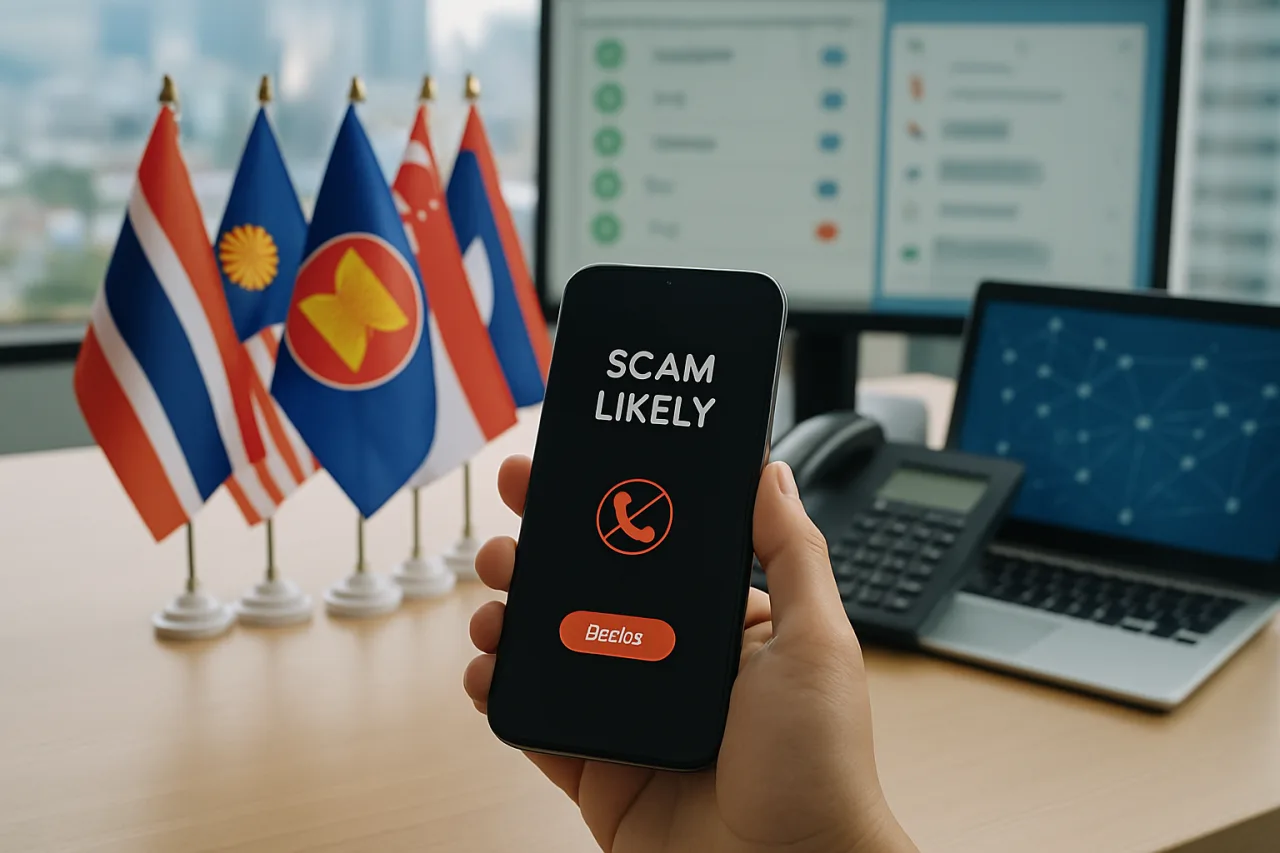
ASEAN anti-scam policy is moving beyond national warnings. The region now has a practical blueprint for controlling scam calls and SMS, sharing intelligence between regulators and telcos, and eventually tracing suspicious communications across borders. The important caveat is that this is a framework for implementation, not a single live ASEAN switch that can instantly stop every fraud campaign.
Key Takeaway
- 📞 The regional problem: Calls and SMS remain major scam entry points across Southeast Asia, with the ASEAN guide reporting that they account for up to 80% of reported scam cases in some member states.
- 🛰️ The proposed fix: ASEAN’s plan combines SIM and equipment controls, network-level detection, SMS firewalls, secure information sharing, and a cross-border traceback mechanism.
- ⚠️ The reality check: The ASEAN anti-scam guide is a policy blueprint. Member states still have to adapt, fund, and implement the measures through their own regulators and telcos.
- 🛡️ Your move: Businesses and individuals should strengthen identity checks, separate approval channels, MFA, payment controls, and evidence preservation before regional coordination is complete.
Why ASEAN Anti-Scam Coordination Matters
The central weakness in a cross-border scam is also the central weakness in the response: the victim, phone number, bank, messaging route, telecom operator, and criminal infrastructure may all sit in different places. A victim can receive an SMS on one national network, click a link hosted somewhere else, speak to a caller using spoofed identity, and send money through a third jurisdiction before a local investigator has enough information to act.
That is why the ASEAN Guide on Anti-Scam Policies and Best Practices frames scams as a regional digital-trust problem rather than only a consumer-awareness problem. The guide says calls and SMS account for up to 80% of reported scam cases in some ASEAN member states. It also cites a regional survey in which 63% of adults experienced a scam in the previous year, with scam calls affecting 62% of respondents and scam SMS affecting 56%.
The guide cites the Global Anti-Scam Alliance’s estimate of USD23.6 billion in scam losses across Southeast Asia in 2024. That figure includes multiple scam channels, not only calls and SMS, so it should not be read as a telecom-only loss total. Its significance is directional: the communications layer is where many scam campaigns establish trust and pressure before the financial transaction happens.
WorldNgayon already tracks the consumer and criminal sides of this problem. Our Singapore scam statistics report examines the scale of losses, while the AI Scam Economy analysis explains how criminal groups industrialize fraud. The ASEAN anti-scam framework adds the missing operating question: what can governments and telecom companies do before a victim is persuaded to pay?
What the ASEAN Anti-Scam Guide Proposes
The guide organizes its recommendations into two connected pillars. The first is stronger national anti-scam protection. The second is collaboration across ASEAN. The structure matters because a country can improve its own network and still leave a cross-border gap that criminals exploit.
| Protection layer | What it is designed to do | Examples in the ASEAN framework |
|---|---|---|
| Tier 1: Baseline protection | Reduce criminals’ access to telecom infrastructure and validate traffic | SIM registration, ownership limits, equipment controls, basic call and SMS checks |
| Tier 2: Enhanced protection | Detect suspicious patterns and stop more scam traffic | Pattern recognition, sender-ID controls, network analytics, SMS filtering |
| Tier 3: Advanced protection | Intervene dynamically as scam campaigns change | Real-time analytics, adaptive policies, deeper intelligence sharing and automated disruption |
The guide’s ten sub-recommendations cover SIM-card registration, SIM ownership limits, SIM-swap safeguards, equipment controls, call-spoofing detection, SMS firewalls, scam-pattern analytics, traceback protocols, secure data sharing, and regional capacity building.
This is more useful than a generic call for “better cybersecurity” because each control interrupts a different part of the scam lifecycle. Registration and ownership limits raise the cost of creating disposable identities. Equipment controls target SIM boxes and other tools used to send communications at scale. Call authentication and sender-ID registries make impersonation harder. SMS firewalls can identify malicious links and suspicious message patterns before delivery. Traceback and information-sharing mechanisms address what happens after a suspicious communication crosses a border.
The framework is deliberately tiered. ASEAN member states do not have identical telecom infrastructure, regulatory capacity, or enforcement resources. A tiered model lets a regulator establish baseline controls first, then move toward analytics and real-time intervention without pretending that every country can deploy the same system on the same day.
How Scam Call Traceback Could Work
A traceback mechanism is not a magic button that reveals a criminal’s identity from a phone number. It is a structured process for following the records and network path behind a call or SMS, then asking the relevant operators and regulators to preserve and share the information needed to identify the source.
In practice, the process could look like this:
- Detection: a telco, bank, regulator, platform, or victim-reporting channel identifies a suspicious call or message.
- Evidence preservation: the sender number or ID, timestamp, destination, message content, link, call-detail data, and related indicators are retained according to local law.
- Network inquiry: the receiving operator asks where the communication entered its network and which upstream provider handled it.
- Cross-border request: if the source is outside the receiving country, the appropriate regulator or operator sends a structured request to its ASEAN counterpart.
- Disruption: operators and authorities can block numbers, suspend abusive sender IDs, freeze associated infrastructure where legally permitted, and pass evidence to investigators or financial institutions.
The value is speed and consistency. Today, every cross-border request can become a bespoke process. A common traceback procedure would give regulators and telcos a shared language for what data to request, how to authenticate the request, and how to escalate when a scam campaign is moving faster than an ordinary investigation.
There is also a limit: traceback follows communications infrastructure. It does not automatically prove who controlled the criminal operation, recover money, or replace a criminal investigation. Attackers can use spoofing, compromised accounts, rented infrastructure, SIM farms, and layered money-movement networks. The ASEAN anti-scam framework therefore needs to work alongside bank controls, law enforcement, digital-evidence rules, and victim-support systems.
The Wider Southeast Asian Cybersecurity Shift
The anti-scam guide is part of a broader regional shift from isolated national cyber policy toward shared digital resilience. ASEAN’s Cybersecurity Cooperation Strategy 2026–2030 identifies cyber readiness, regional policy coordination, trust, capacity building, and wider cooperation as its five dimensions. It also gives the ASEAN Regional CERT a role in regional capacity building, information management, crisis communication, and CERT-to-CERT coordination.
The ASEAN Digital Outlook describes a projected 67% expansion in cybersecurity-related regulations, policies, and initiatives across the region. Its message is not that every country is equally prepared. Its message is that digital resilience is becoming a multi-layered governance issue involving physical infrastructure, networks, applications, data, and people.
Business evidence points in the same direction. The September 2026 World Economic Forum ASEAN Digital Economy Outlook found that ASEAN’s data-protection and cybersecurity score improved from 62.8 to 70.0 on its regional index, but remained 26.5 points below the selected comparator economies. Among MSMEs, 46.1% identified cybersecurity risk as a barrier to digital payments. For electronic signatures, 28.5% identified cross-jurisdiction compliance and interoperability as barriers.
That evidence changes the business question. Cybersecurity is not only about preventing a breach inside one office. A small company selling, paying, signing, or storing data across ASEAN also needs confidence that identity checks, records, data transfers, and incident responses will work across different legal and technical systems.
At the infrastructure level, Singapore’s Cyber Security Agency reported in February 2026 that all four major telecommunications operators had been targeted by UNC3886. The campaign used a zero-day exploit and rootkits to maintain access, but authorities said there was no evidence that customer records were accessed or that telecom services were disrupted. The eleven-month Operation CYBER GUARDIAN demonstrates why government agencies and critical-infrastructure operators need a shared response process before a regional crisis begins.
INTERPOL’s 2025/2026 Asia and South Pacific cyber-threat assessment adds the wider threat context: infostealers, ransomware-as-a-service, deepfake-enabled fraud, financial scams, and credential harvesting increasingly overlap. Its regional figures cover Asia and the South Pacific, not Southeast Asia alone, so they should not be treated as an ASEAN-only count. The operational lesson still applies: a stolen credential often becomes the opening move for fraud, espionage, or a more destructive attack.
What Businesses Should Do Now
Businesses should not wait for the ASEAN anti-scam mechanism to become fully operational. The regional framework is aimed at regulators and telcos, but companies can reduce the value of scam calls and SMS immediately.
- Create a separate verification channel. If a message requests payment, credentials, a change of bank account, or urgent access, verify it through a known phone number, official application, or previously established contact—not by replying to the message.
- Use two-person approval for money movement. One employee should prepare a payment and another should verify the recipient, purpose, and account details. A voice call from a senior executive is not sufficient approval.
- Protect privileged accounts. Require MFA for email, cloud administration, finance systems, social accounts, and remote access. Review old accounts and remove access when a worker or vendor leaves.
- Keep an evidence packet. Preserve the original message, sender ID, number, timestamp, link, headers where available, screenshots, transaction reference, and the names of people contacted. Evidence that is captured early is easier for a telco, bank, or investigator to use.
- Map your reporting path. Record the contact route for your bank, telco, national cyber agency, and privacy regulator before an incident. A crisis is the wrong time to search for the correct reporting form.
- Audit suppliers and payment instructions. A vendor mailbox or messaging account can be compromised even when your own systems are clean. Confirm changes to invoices or bank details independently.
- Test recovery. Maintain offline or separately protected backups for critical records and rehearse who can shut down a compromised account, isolate a device, notify customers, and contact law enforcement.
These steps address the part of the scam chain that regional telecom controls cannot fix: the human decision to trust an instruction and the business process that allows one message to move money.
What Individuals Should Do Now
For individuals, the most useful rule is simple: treat the message as untrusted until the identity and request are verified independently. Caller ID, a familiar profile photo, a correct name, and a convincing voice are clues—not proof.
- Do not disclose one-time passwords, recovery codes, or banking credentials during an unsolicited call.
- Do not click a payment or login link in an unexpected SMS. Open the official app or type the known website address yourself.
- Pause urgent requests involving family emergencies, account suspension, employment fees, investments, or government penalties.
- Call the person or institution using a number already saved in your contacts or published on its official website.
- Report the message to your telco, bank, platform, and the relevant national authority. Keep the original evidence instead of deleting it immediately.
- Tell family members and co-workers what happened. Reporting is not only recovery; it can help identify a campaign affecting other people.
The Scam Ready ASEAN programme reflects this broader approach by combining public awareness, digital confidence, critical thinking, and policy cooperation. Education is not a substitute for network controls, but network controls are not a substitute for a person who knows when to stop.
What This Means for Filipino Professionals and OFWs
The Philippines is part of the same cross-border communications and payment environment as the rest of ASEAN. A Filipino professional can work for a Singaporean client, receive a message from a Malaysian number, use a cloud service hosted elsewhere, and send money through a Philippine bank or wallet. An OFW family can receive a fake recruitment, remittance, delivery, or government message while the person abroad is still on a different telecom network.
That makes the ASEAN anti-scam framework relevant without turning the article into a Philippines-only story. The practical local layer is to keep bank and e-wallet hotlines in a trusted contact list, verify recruitment and government notices through official domains, and use a family rule that urgent money requests require a second conversation through a known channel. WorldNgayon’s Philippines cybersecurity guide covers the national layer; this article explains why the cross-border layer matters.
What the Framework Cannot Promise Yet
The ASEAN anti-scam guide is important, but it is not a guarantee that every scam call will be blocked or traced. It is a recommended framework that member states and industry participants must adapt to their own laws, infrastructure, and capabilities.
Three limitations deserve plain language:
- Implementation will be uneven. A regional guide can set direction, but regulators and operators still have to fund systems, train staff, establish legal processes, and connect reporting channels.
- Not every scam uses calls or SMS. The guide focuses on telecommunications channels. Social platforms, encrypted messaging, fake websites, investment apps, compromised email, and crypto rails require additional controls.
- Traceback is not recovery. Finding the originating network can support disruption and investigation, but it does not automatically identify the human operator or return money to a victim.
The right verdict is therefore neither “ASEAN has solved scams” nor “nothing is changing.” ASEAN has moved toward a common operating blueprint. The next test is whether the blueprint becomes a fast, authenticated, cross-border process that telcos, banks, regulators, and victims can actually use.
Frequently Asked Questions
What is the ASEAN anti-scam strategy?
It is a regional framework for reducing scam calls and SMS through SIM and equipment controls, network detection, SMS firewalls, information sharing, traceback procedures, and capacity building.
Does ASEAN already have a live scam-call traceback system?
ASEAN has proposed and documented a regional traceback mechanism, but the guide is a blueprint for implementation rather than proof that one fully integrated system is already live across every member state.
Why do scam calls cross borders in Southeast Asia?
Criminal groups can use spoofed caller IDs, SIM farms, compromised accounts, rented infrastructure, and telecom routes in different jurisdictions. The victim’s network may not be the same network where the communication originated.
What should a small business do about scam calls and SMS?
Use MFA, two-person payment approval, independent callback verification, supplier-change checks, protected backups, and an evidence-and-reporting procedure that preserves the original message and transaction details.
Does the ASEAN guide cover WhatsApp and other messaging apps?
The guide focuses mainly on calls and SMS. Social platforms and over-the-top messaging services require additional platform, account-security, and reporting controls.
Is the ASEAN anti-scam guide legally binding?
No. It is a regional best-practice framework. Each ASEAN member state must adapt and implement its measures through national laws, regulators, telecom operators, and enforcement systems.
Cybersecurity Disclaimer
This article provides general cybersecurity guidance and does not constitute professional security advice. Laws, reporting channels, telecom controls, and regulatory requirements differ across ASEAN member states and may change. Verify current instructions with the relevant regulator, bank, telco, or qualified cybersecurity professional. The author and publisher disclaim any liability for actions taken based on this information.