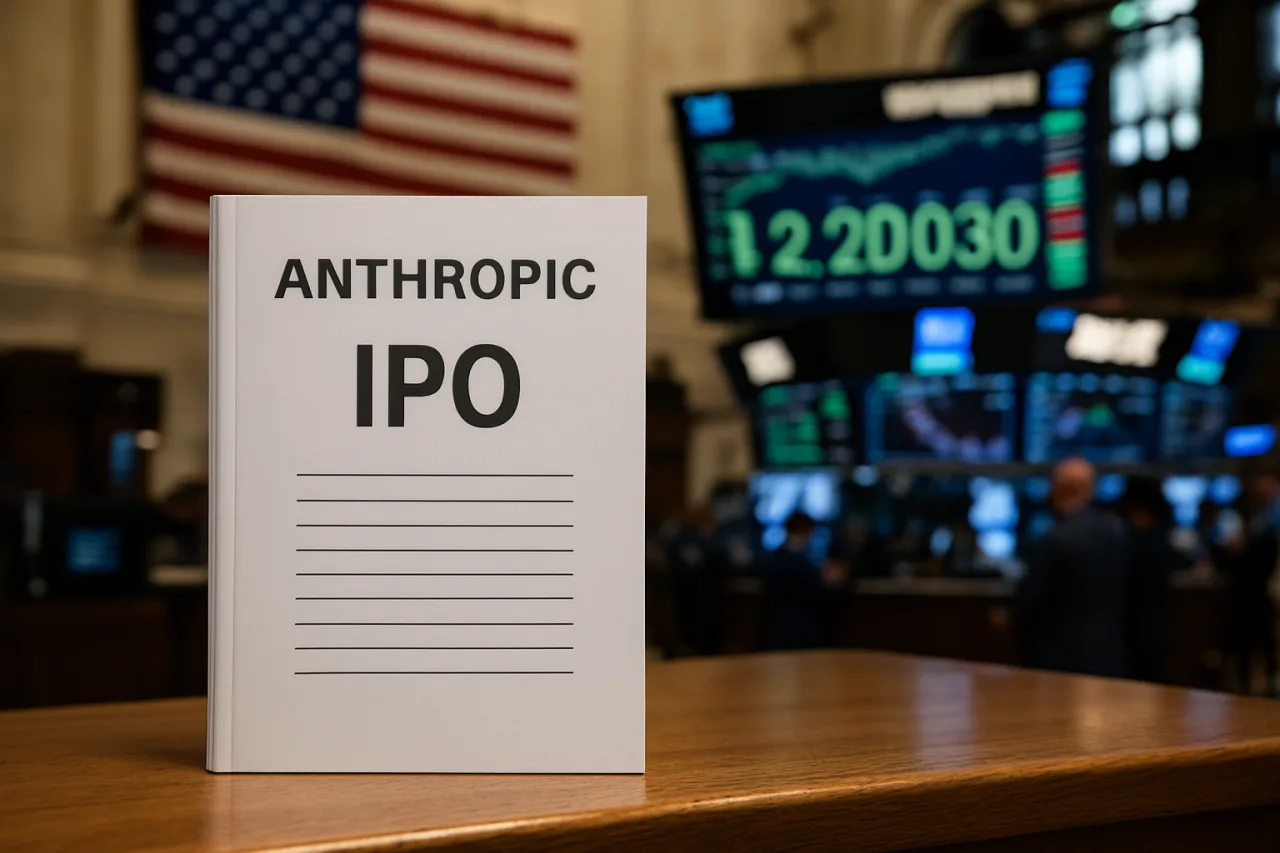
The Anthropic IPO could make its prospectus public as early as Friday — the largest AI listing ever attempted, targeted at a valuation above $2 trillion on a private-market last round of $965 billion, in the same week its closest rival’s valuation chatter hit $1.25 trillion and the AI trade itself is being repriced line by line. The filing — the moment the Antropic IPO story becomes an audited document — reported by Yahoo Finance on the word of three people familiar with the company’s plans, turns months of leaked-prospectus reading into a public document — and for the first time puts the Claude maker’s actual revenue, costs and risk factors where every investor can read them. This guide explains what the prospectus has already shown, what the public filing must answer, and what the market context of this exact week means for the biggest first-day print in history.
Key Takeaway
- The clock: Anthropic may publicly file its IPO prospectus as early as Friday per three sources speaking to Yahoo Finance — weeks after a prospectus summary already circulated showing a valuation target above $2 trillion.
- The valuation arc: from a $965 billion private-market round to a prospectus targeting $2 trillion-plus — which would make the Anthropic IPO the largest in stock-market history by almost any measure.
- What the leak showed: reported coverage of the prospectus describes sweeping AI ambitions beside surging costs — the gap between those two words is exactly what a public filing must reconcile.
- The price of conviction: a $2 trillion-plus mark on the leaked numbers drew immediate skepticism — the filing converts argument into audited numbers for the first time.
- The week it lands: the filing would arrive in the same market that just punished Tesla for trimming AI spending and rewarded Meta for raising it — the capex-verdict regime our AI-spending analysis mapped is the tide the Anthropic IPO floats on.
The filing versus the leak: what is already public
Two documents matter and they are different things. The first is the prospectus material that surfaced in late September (Reuters read the sweeping vision and the surging costs in one document): Reuters reported the document showed sweeping AI vision alongside surging costs, with an IPO valuation target above $2 trillion — a summary, not a public filing, and everyone quoting it has been careful to say the audited version arrives with the real thing. The second is the registration filing itself: per Yahoo Finance’s three sources, Anthropic planned to make the prospectus public as early as Friday, which initiates the roadshow-and-pricing sequence the largest IPO in history would follow. Until the filing posts, every number in circulation — including the $2.2 trillion figure some coverage questioned and the $4.6 billion-class revenue figure that drew the same — are leak-quality, not audited reality. The desk’s rule for reading weeks like this: score the filing, not the leak.
The difference is not pedantry. A leaked prospectus summary tells you the story a company wants investors to hear; a public filing puts the financial statements, the risk factors, the related-party structures and the auditor opinions into a document everyone reads from the same page. For a company whose entire valuation rests on compute economics few outsiders have been able to verify, the audit — more than the roadmap — is the product being sold this Friday.
The numbers that matter: $965 billion to $2 trillion
The arc of the valuation tells the market’s whole 2026. Anthropic’s last private round priced the company around $965 billion — already one of the largest private valuations ever — and the prospectus material targets more than $2 trillion, which would crown the Anthropic IPO the largest in stock-market history. The smart-money context: Axios has reported that the company’s Public Benefit Fund stake alone would be worth roughly $100 billion at the IPO price, and the running tracker guides keep the timeline honest until it prints at a $2 trillion mark — a governance-wrapped charity stake the size of a mega-cap company, attached to the governance structure the filing will have to explain in detail. The New York Times had framed the possibility in late August: an eventual IPO could value the company at $2 trillion, which would make it the largest IPO in history — and the reporting since has only widened the figure’s range upward.
Against those marks sits the cost side the Reuters read emphasized: surging costs — compute commitments, the inference bills our prompt-caching analysis tracks, the talent war, and the capex halo effect every AI giant now carries — the same line item that re-scored the trade this week. The investor’s question is not whether the revenue is real — reported coverage suggests a multi-billion annual run rate — but whether the growth rate outruns the cost curve after the IPO’s glare arrives. That tension is exactly what a prospectus is built to resolve in public.
What the prospectus must answer
Five disclosures will set the Anthropic IPO’s opening print. One: the revenue composition — how much of the book is API versus enterprise subscriptions versus consumer plans, and how concentrated it is among a handful of giant customers. Two: the compute commitments — the multi-year capacity reservations our infrastructure coverage maps, which arrive on the balance sheet as obligations regardless of demand. Three: the competitive calendar — a rival shipped three frontier-class releases inside one month, and the filing’s own competition section will have to price that churn honestly. Four: the structure — the Public Benefit Fund, the governance rights, and any dual-class arrangements, because valuation and control are priced together. Five: the risk factors’ honesty — every AI-era registration statement this cycle has had to concede something about concentration, circular financing or benchmark fragility, and the market has started charging for euphemisms.
The comparison set matters too. OpenAI’s private-market chatter this week put the ChatGPT maker near a $1.25 trillion valuation on a $30 billion raise with UAE investors and Coatue leading — reported, not filed — which means the two largest AI franchises are now being priced against each other on different information sets at the same moment. The filing that goes public first gets the market’s attention; the one that discloses more gets its margin.
The market context: a repricing week
The IPO lands into a market that spent this week learning a new rule: capital-expenditure guidance has become the verdict line for AI-era companies — Tesla was punished for trimming around $5 billion of planned buildout; Meta was rewarded for raising its range to $135-145 billion; the chip equipment layer slipped on supply-bottleneck warnings. Our capex-verdict analysis mapped the mechanics: the market now reads spending intentions as the truth-teller for AI demand, and a $2 trillion-plus IPO asks that same market to underwrite the most concentrated version of the bet. The week’s tape also carried the cautionary arcs our own coverage has tracked all cycle — the CoreWeave leverage test, the demand-surge-versus-stock-price paradox in our Anthropic-file piece — and the listing arrives as Asian markets took the same repricing lower. A good filing does not fix a bad tape; it just gets graded on a harder curve.
The bull counter is real as well: the IPO would put a directly-investable Anthropic into portfolios that can only touch public names, the index-fund flows that follow any listing that large are mechanical, and the market has repeatedly paid scarcity premiums for the only listed pure-play in a category. Scarcity, in a $2 trillion class of one, is the most credible bull argument in the document.
The timing question: why this week matters
Timing an IPO is a bet on the next month’s mood, and Anthropic’s window sits inside an unusually loud news cycle: safety disclosures at the rival lab, an agentic-attack report at scale, a price war in cached-token economics, and earnings that re-priced the AI trade on guidance alone. Filing the Anthropic IPO into that tape is either brave or priced-for-it — and the filing’s own risk factors will read like they were written this week, because they were. For readers tracking the money lane: the filing’s first public trading prints will set the reference for every AI-era valuation that follows, from the private rounds our coverage tracks to the infrastructure debt that floats beneath them. The desk’s assignment list for the weekend: read the risk factors first, the revenue composition second, and the愿景 last.
The mega-IPO scoreboard: where the Anthropic IPO would land
History gives the $2-trillion class one honest comparison frame: none – the Anthropic IPO would not merely top those marks on day one, it would leapfrog an order of magnitude while this market prices capex honesty in real time. The largest IPOs ever completed sit an order of magnitude below this line — Saudi Aramco’s 2019 listing raised about $29 billion at a $1.7 trillion valuation; Alibaba’s 2014 print priced near $168 billion; Facebook’s 2012 debut valued the company at $104 billion, and Meta’s market capitalization only crossed the $2 trillion line a decade later. The Anthropic IPO would not merely top those marks — it would leapfrog an entire order of magnitude on day one, listing at a valuation the largest oil company on earth took 90 years of operations to earn. That is either the market’s clearest statement that AI revenue compounds differently than any industry before it, or the most expensive sentence in financial history; the filing alone decides which. The scoreboard makes the burden of proof legible at a glance.
| Listing | Year | Valuation at debut |
| Anthropic (targeted) | 2026 | $2 trillion-plus |
| Saudi Aramco | 2019 | ~$1.7 trillion |
| Alibaba | 2014 | ~$168 billion |
| Meta (Facebook) | 2012 | ~$104 billion |
For the Philippine and OFW reader, the practical layer travels cleanly: none of this requires a US brokerage to matter. A listing this size re-rates every AI-adjacent asset the market prices — the semiconductor suppliers inside the PSE’s own tech-conglomerate webs, the fund products with US growth sleeves that OFW-held brokers sell, and the peso’s risk appetite itself, which leans on global equity flows. Our Global Filipino coverage keeps repeating one discipline for weeks like this: the biggest IPOs in history were followed, within months, by both heroic prints and brutal first-year drawdowns; Facebook’s debut taught the market that lesson and Meta’s history redeemed it a decade on. The filing is the beginning of that evidence, not the end of the argument — and the retail playbook is the same as always: read the risk factors before the roadshow highlights, size by what you can hold through the drawdown, and let the audited numbers, not the leak-era headlines, do the talking.
One more reading note before the filing posts: the Anthropic IPO prospectus will also price the company’s own restraint commitments – the compute obligations, the safety-governance structures and the customer-concentration disclosures all arrive in one document, and the market will grade the whole package against the leak-era expectations that have been compounding since September. The biggest first-day story in history deserves the dullest reading discipline: statements, notes, then roadmap. An Anthropic IPO filed into this tape still benefits from the same mechanics every mega-listing gets – index-driven demand, scarcity pricing and the largest single-day liquidity event the AI sector will have seen – but the audited risk factors are what survive contact with week two.
Financial Disclaimer
This article is for general information and analysis, not financial advice or a solicitation. IPO participation, allocation mechanics and post-listing volatility carry risks including the loss of principal; valuations, revenue figures and prospectus details described here reflect reporting believed reliable at publication and remain subject to the audited filing. Nothing here recommends buying, selling or holding any security. Consult a licensed financial adviser or SEC-registered broker – and for Philippine investors, PSE-accredited institutions – before acting. WorldNgayon holds no positions in any security discussed.
FAQ
When will Anthropic’s IPO prospectus become public?
As early as Friday, October 24, per Yahoo Finance reporting that cites three people familiar with the company’s plans. The filing initiates the roadshow-and-pricing sequence for what coverage expects to be the largest IPO in history.
What valuation is Anthropic targeting for its IPO?
Prospectus material that circulated in late September targeted a valuation above $2 trillion — some coverage cited a $2.2 trillion figure — against a last private-market round near $965 billion. The audited public filing is the first authoritative source for the range.
Would the Anthropic IPO be the largest in history?
At the $2 trillion-plus class, yes by essentially every measure — the New York Times framed the possibility in late August, and the prospectus material since has tracked to that class. The final size depends on shares offered and pricing within the range.
What did the leaked prospectus show?
Reuters reported the document showed sweeping AI vision alongside surging costs — the strategic ambition and the compute-bill reality in one document — with reported revenue figures in the billions and cost commitments that scale ahead of demand. Every figure remains leak-quality until the public filing.
How does OpenAI’s valuation compare?
OpenAI was reported this week to be closing a $30 billion round near a $1.25 trillion valuation, led by UAE investors and Coatue, with IPO plans reportedly delayed to 2027. Anthropic’s filing means the two largest AI franchises are being priced on different information sets in the same window — the filing makes one side’s numbers public first.
What should investors watch in the filing?
Five disclosures: revenue composition and customer concentration, multi-year compute commitments, the competition calendar priced honestly, governance structure including the Public Benefit Fund, and the risk factors’ candor. In this market, capex-guidance honesty is the metric AI-era filings are graded on first.