
Table of Contents
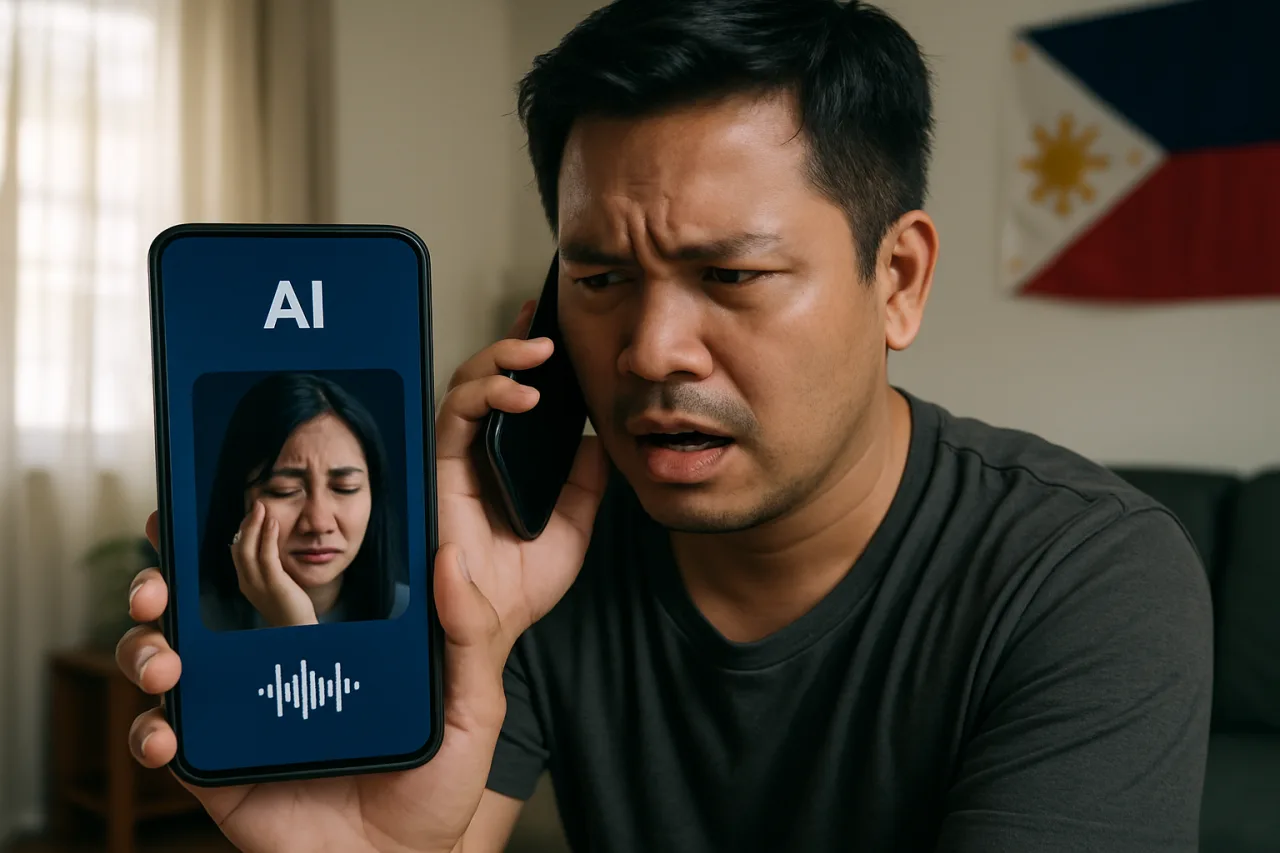
In January 2026, a Filipino OFW in Riyadh received a phone call from his wife’s number. The voice was hers — the accent, the cadence, the way she said his name. She was crying. She said she had been in an accident and needed ₱50,000 for emergency surgery. He sent the money. His wife was safe at home, sleeping. The voice was AI-generated, cloned from 30 seconds of a TikTok video she had posted the week before.
This is not a hypothetical scenario. AI voice cloning scams surged 1,210% in 2025, according to Vectra AI’s 2026 report, and the Philippines is among the most targeted countries in Southeast Asia. The technology to clone a voice from a short audio sample is now free, accessible, and requires no technical skill. ElevenLabs, Resemble AI, and open-source tools like Tortoise TTS can replicate a person’s voice with 95% accuracy from less than 60 seconds of audio. For Filipino families — who routinely share voice messages, video calls, and social media content across long-distance relationships — this threat is uniquely personal.
Key Takeaway
- 🎙️ The Threat: AI voice cloning tools can replicate anyone’s voice from 30-60 seconds of audio. The technology is free or low-cost, requires no technical skill, and produces voices indistinguishable from the real person.
- 📈 The Scale: AI-powered scams surged 1,210% in 2025. 90% of Filipinos cannot distinguish AI-generated voices from human voices, per the 2026 AI Transparency Report. The Philippines is among the top 5 targeted countries in Southeast Asia.
- 👨👩👧 The Pattern: Scammers target OFW families: the caller claims to be a family member in distress — an accident, an arrest, a medical emergency — and demands an urgent money transfer. The urgency prevents verification.
- 🛡️ The Defense: Create a family safe word, verify every distress call through a second channel, limit public voice content, and train elderly family members who are most vulnerable to voice impersonation.
- 🇵🇭 The Law: The Anti-Financial Account Scamming Act (AFASA) provides a recovery path for scam victims, but prevention is the only reliable defense. Report incidents to the PNP Anti-Cybercrime Group and the DICT Cybersecurity Bureau.
The question that matters is not whether AI voice cloning is possible — it is. The question is whether your family is prepared for the call that sounds exactly like someone you love, in a moment of fabricated crisis, demanding money before you have time to think.
How AI Voice Cloning Works — and Why It Is So Dangerous
Voice cloning uses machine learning models to analyze a person’s voice — its pitch, cadence, accent, emotional range, and vocal fingerprint — and generate new speech that sounds identical to the original speaker. The technology has existed in research labs for years, but three things changed in 2025-2026 that made it a mass-market threat.
First, the quality collapsed the gap between real and synthetic. ElevenLabs’ third-generation model, released in 2025, produces voices that pass blind listening tests with 95% accuracy. A study by the University of Maryland found that human listeners could distinguish AI voices from real ones only 47% of the time — barely better than a coin flip. As we documented in our AI transparency analysis, 90% of Filipinos cannot tell AI voice from human voice, and the technology is improving faster than human perception can adapt.
Second, the cost dropped to zero. ElevenLabs offers a free tier that generates up to 10,000 characters of speech per month. Open-source alternatives like Tortoise TTS and RVC (Retrieval-based Voice Conversion) run on a standard laptop with no subscription. A scammer can clone a voice for free in under 10 minutes.
Third, the source material is everywhere. Every TikTok video, every Facebook story, every voice message sent through WhatsApp or Viber, every Instagram reel, every YouTube comment — all of it is raw material for voice cloning. Filipino families share enormous amounts of voice and video content across long-distance relationships. OFWs post daily updates from Saudi Arabia, Dubai, Singapore, and Hong Kong. Families back home share graduation videos, birthday messages, and Sunday lunch clips. Each one is a voice sample that a scammer can harvest.
The OFW Family Target Pattern
The attack pattern is consistent across reported incidents in the Philippines. The scammer identifies a family with an OFW member through social media — Facebook is the primary reconnaissance tool. They download voice samples from public posts. They clone the OFW’s voice. Then they call the family in the Philippines, claiming to be the OFW in distress: a car accident, an arrest, a medical emergency, a workplace injury. The caller is frantic, emotional, and urgent. They demand a money transfer — through GCash, Palawan Express, or a bank wire — before the family has time to verify.
The reverse also happens. Scammers clone the voice of a family member in the Philippines and call the OFW abroad, claiming a parent is sick, a child was in an accident, or the house was damaged in a typhoon. The OFW, thousands of miles away and unable to verify immediately, sends money. In both directions, the attack exploits love and distance — the two conditions that define the OFW experience.
The Philippine National Police Anti-Cybercrime Group reported a significant increase in voice cloning complaints in 2025-2026, though exact figures are difficult to obtain because many victims do not report due to embarrassment. The Anti-Money Laundering Council (AMLC) flagged ₱1.2 billion in suspicious transactions linked to social engineering scams in 2025, a category that includes voice cloning. As we noted in our smishing scam protection guide, the shift from SMS-based scams to AI-powered voice attacks represents an evolution in sophistication that catches families off guard.
7 Steps to Protect Your Family From AI Voice Cloning Scams
Based on guidance from CISA, the FTC, the Philippine DICT, and cybersecurity practitioners, here are seven concrete steps every Filipino family can take — especially families with OFW members.
Step 1: Create a family safe word. Choose a word or phrase that only your family knows. It should be something random — not a pet’s name, not a birthday, not anything visible on social media. When anyone receives a distress call claiming to be a family member, the first question is: “What is the safe word?” If the caller cannot answer, hang up and call the person directly on a number you already have. This is the single most effective defense against voice cloning scams, and it takes 30 seconds to implement.
Step 2: Verify through a second channel before sending money. If you receive a distress call, do not send money from the same call. Hang up and call the person back on a number you already have saved. If you cannot reach them, call another family member who can verify. If the caller claims to be in a hospital, ask which hospital and call the hospital directly. Scammers rely on urgency — the moment you slow down, the scam falls apart.
Step 3: Limit public voice and video content. Every voice message, TikTok video, and Facebook story is a voice sample for a scammer. This does not mean stop posting — it means be aware. Set social media profiles to private. Avoid posting voice clips that include emotional speech (crying, laughing, shouting), as these provide the richest training data for voice cloning models. Consider that a 30-second TikTok of your child singing “Happy Birthday” is enough to clone their voice.
Step 4: Train elderly family members. Seniors are the most vulnerable to voice cloning scams because they are less familiar with AI technology and more likely to trust a voice they recognize. Sit down with parents and grandparents, explain that voices can now be faked, and teach them the safe word system. Practice the verification process: “If anyone calls asking for money, even if it sounds like me, ask for the safe word.” As we documented in our deepfake scam detection guide, awareness is the first and most effective layer of defense.
Step 5: Set up transaction alerts on banking and e-wallet apps. Enable real-time notifications for every transaction on GCash, Maya, BDO, BPI, and all other financial apps. If a scammer convinces a family member to send money, the account holder receives an immediate alert and can reverse the transaction or freeze the account. The BSP’s AFASA framework requires banks to provide a recovery mechanism for scam victims, but the recovery window narrows quickly — the faster you detect the fraudulent transfer, the higher the chance of recovery.
6. Report incidents immediately. If your family is targeted — even if no money was lost — report the incident to the PNP Anti-Cybercrime Group (through their hotline or at any PNP station) and the DICT Cybersecurity Bureau. File a report with the National Privacy Commission if personal data was involved. Every report strengthens the intelligence database that protects other Filipino families. As we noted in our email phishing protection guide, silence only benefits the attackers.
7. Use AI detection tools for high-value verification. Several tools can help detect AI-generated audio. Pindrop, AI Voice Detector, and Hive’s AI-Generated Audio Detection API analyze audio for synthetic patterns. For most families, these tools are overkill — the safe word and second-channel verification are simpler and more effective. But for businesses, government agencies, and high-net-worth families, AI detection adds a technical layer to the human defenses. See our deepfake detector tools guide for a comparison of available options.
Frequently Asked Questions About AI Voice Cloning Scams
What is an AI voice cloning scam?
An AI voice cloning scam is a fraud technique where scammers use artificial intelligence to replicate a person’s voice from audio samples harvested from social media, then use that cloned voice to impersonate the person in phone calls to their family or contacts. The caller typically claims to be in an emergency situation — an accident, arrest, or medical crisis — and demands an urgent money transfer. The technology can clone a voice from 30-60 seconds of audio with 95% accuracy.
How can I tell if a voice is AI-generated?
In 2026, it is extremely difficult to distinguish AI-generated voices from real ones — human listeners succeed only 47% of the time, barely better than a coin flip. Instead of trying to detect the fake voice, focus on verification: ask for a family safe word, call the person back on a known number, or verify through a second channel. Do not rely on your ability to hear the difference — the technology has surpassed human perception.
How common are AI voice cloning scams in the Philippines?
AI-powered scams surged 1,210% in 2025 globally, and the Philippines is among the top 5 targeted countries in Southeast Asia. The PNP Anti-Cybercrime Group reported a significant increase in voice cloning complaints in 2025-2026. The AMLC flagged ₱1.2 billion in suspicious transactions linked to social engineering scams in 2025. Many cases go unreported due to victim embarrassment, so the actual number is likely much higher.
How do I protect my family from AI voice cloning scams?
Create a family safe word — a random word that only your family knows. When anyone receives a distress call, ask for the safe word before taking any action. Verify every distress call through a second channel (call the person back on a known number). Limit public voice and video content on social media. Train elderly family members on the safe word system. Set up transaction alerts on banking apps. Report incidents to the PNP Anti-Cybercrime Group and DICT.
What should I do if I already sent money to an AI voice cloning scammer?
Act immediately. Contact your bank or e-wallet provider and request a transaction reversal or account freeze. File a report with the PNP Anti-Cybercrime Group and the DICT Cybersecurity Bureau. Under the BSP’s AFASA framework, victims of financial account scams may be eligible for reimbursement, but the recovery window narrows quickly — the faster you report, the higher the chance of recovery. Document all communication, transaction details, and the phone number used by the scammer.
Can scammers clone voices from TikTok or Facebook videos?
Yes. AI voice cloning tools can extract voice samples from any public video or audio post. A 30-second TikTok video, a Facebook story, a WhatsApp voice message, or a YouTube clip is sufficient to clone a voice with 95% accuracy. Filipino families who share voice and video content across long-distance relationships are particularly vulnerable because they have large volumes of public audio available for cloning. Set social media profiles to private and be aware that any public audio is potential cloning material.
Is there a way to detect AI voice cloning technology?
AI voice detection tools like Pindrop, AI Voice Detector, and Hive’s detection API can analyze audio for synthetic patterns, but these are primarily enterprise-grade solutions. For families, the most effective defense is not detection technology but verification protocols: the safe word system, second-channel verification, and family awareness training. Technology will always improve faster than detection tools — human verification habits are the durable defense.
This article is for informational and educational purposes only. It does not constitute professional cybersecurity advice. For incident reporting in the Philippines, contact the PNP Anti-Cybercrime Group or the DICT Cybersecurity Bureau. For financial scam recovery, consult the BSP’s AFASA framework.