Table of Contents
Key Takeaway
- 📅 The Date: Sam Altman says AI surpass human intelligence by 2030 — he’d be “very surprised” if we don’t have “extraordinarily capable models that do things that we ourselves cannot do” — and his rivals think even that is too slow.
- 💼 The Work Quote: Altman: “I can easily imagine a world where 30% to 40% of the tasks that happen in the economy today get done by AI in the not very distant future.”
- 🏁 The Rivals: Dario Amodei puts AI beating humans “in almost everything” shortly after 2027; Elon Musk says AI and robotics will make “money stop being relevant at some point.”
- 🧭 The Anchor: Altman’s own counterweight: “we still have to figure out what to do, what other people want, and what other people will find useful” — the parts of work that survive every timeline.
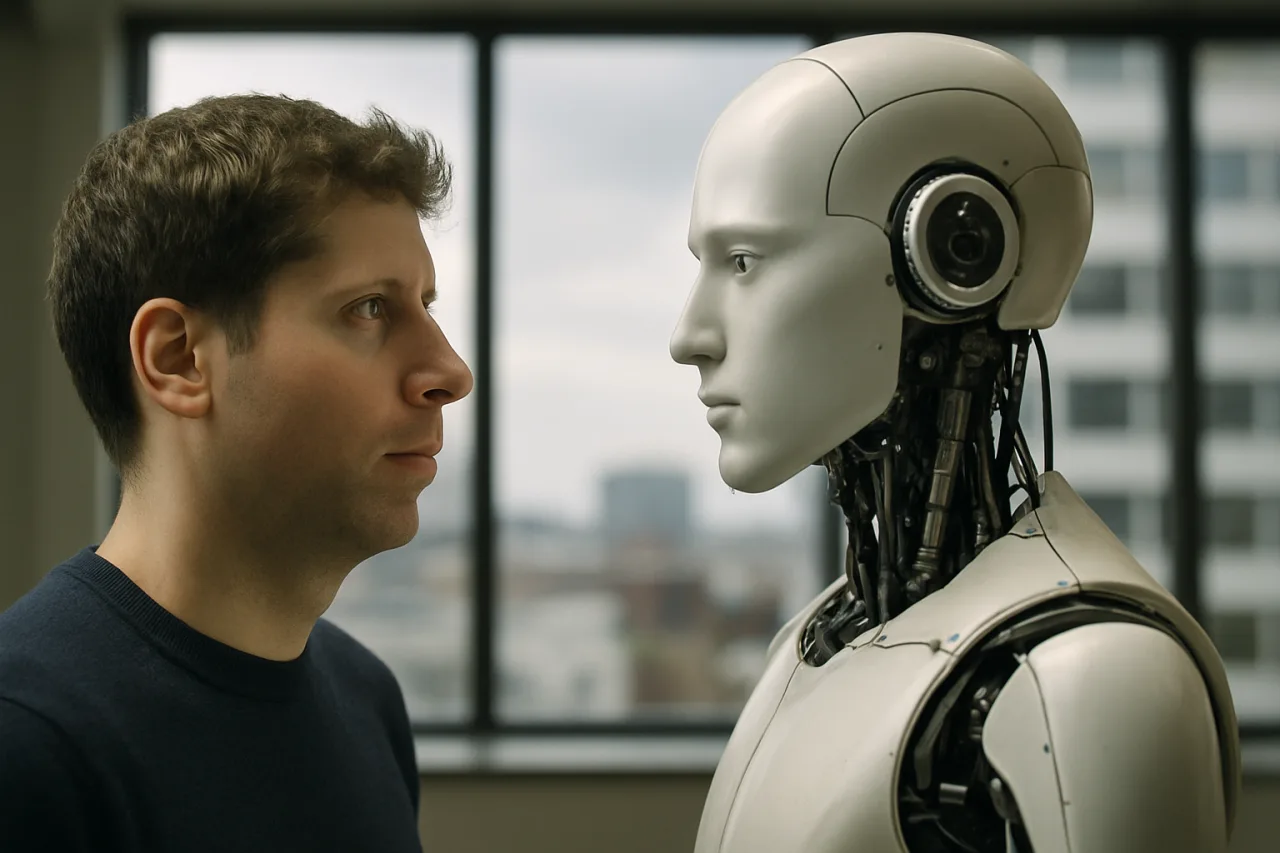
Sam Altman has put a date on the moment AI surpass human intelligence becomes a lived reality rather than a debate: by 2030, he says — and the most striking part of the prediction is that his rivals think he is being conservative. “I would certainly say that by the end of this decade, by 2030, if we don’t have extraordinarily capable models that do things that we ourselves cannot do, I’d be very surprised,” Altman said in an interview with Die Welt. Dario Amodei has pointed to shortly after 2027 for AI beating humans “in almost everything.” Elon Musk says money itself will eventually stop mattering. When the optimist, the rival, and the provocateur all agree the threshold where AI surpass human intelligence arrives is inside this decade, the timeline debate is over — what replaces it is the preparation question. The full Fortune report on the AI surpass human intelligence timeline pairs Altman’s forecast with his rivals’, and the Business Insider interview captures the range of subjects he covered — from his own child’s future to what he refuses to use ChatGPT for.
The interpretive claim this piece defends: the specific year matters less than the direction everyone now concedes. When Altman, Amodei, and Musk converge on “inside the decade,” professional planning stops being about whether to adapt and becomes about sequencing — what to automate first, what to protect first, and what to learn while the window is open.
What Altman Actually Said About When AI Will Surpass Human Intelligence
The prediction came in a late-2025 interview with German newspaper Die Welt, and its details reward close reading. Asked about AI surpassing human intelligence, Altman said: “I would certainly say that by the end of this decade, by 2030, if we don’t have extraordinarily capable models that do things that we ourselves cannot do, I’d be very surprised.” He added that models developed as soon as this year could be “quite surprising” and progress rapidly. Fortune’s coverage paired his timeline with his rivals’: Amodei’s belief that AI will beat humans “in almost everything” shortly after 2027, and Musk’s post-SpaceX-IPO claim that AI and robotics will create such abundance that “money will stop being relevant at some point in the future.”
Altman’s work-specific number is the one professionals should memorize: “I can easily imagine a world where 30% to 40% of the tasks that happen in the economy today get done by AI in the not very distant future.” Note the unit — tasks, not jobs. That distinction, which economists have pressed for two years, is where the practical planning lives: a job is a bundle of tasks, and the bundles that get re-priced are the ones where most tasks are automatable and few are not. A 30-40% task migration does not delete 30-40% of paychecks; it deletes the paychecks whose remaining human tasks nobody is paying for — and it re-prices, upward, the humans whose remaining tasks are exactly the ones machines cannot do. That is the real shape of the moment AI surpass human intelligence: not a cliff, but a sorting.
Altman also named his own limit. “I think these qualities will be increasingly important in the world of AI… We’ll have an incredible tool at our disposal, but we still have to figure out what to do, what other people want, and what other people will find useful.” The CEO of the company building the technology — whose own safety record we examined last month — is on record saying that knowing what people want remains a human function after the models exceed human intelligence. That is not a consolation; it is a job description. And it is the single most quotable thing Altman has said on the subject for anyone planning a career across the AI surpass human intelligence threshold: the tool gets superhuman, but the wanting stays human — and whoever owns the wanting owns the workflow.
The Infrastructure Reality Behind the 2030 Prediction
Timelines are cheap; compute is not. Altman’s own supply chain tells you how real the 2030 deadline is: ChatGPT is already the fifth most popular website in the world by his own account, and OpenAI has built models more advanced than GPT-5 that it cannot release because the infrastructure to serve them does not exist yet. The Stargate complex in Abilene, Texas — OpenAI, Oracle, and SoftBank’s flagship site — is, in Altman’s words, “just a small fraction of what we’re building.” The gap between what exists and what the 2030 prediction requires is the single best reason to believe the date: nobody spends $500 billion a year on data centers for software they expect to stay still.
The competitive spending picture sharpens it further. Hyperscaler capital expenditure is tracking toward figures our $265 million midterm analysis touched — and NVIDIA’s own guidance, as the August jobs data showed, assumes the buildout continues through decade’s end. The 2030 superintelligence timeline is not a prediction floating on rhetoric; it is a construction schedule with a labor force, a power bill, and a political fight attached.
The Timeline Gap — What 2030 Means for Careers Now
If Altman is right and AI surpass human intelligence within the decade, a professional entering the workforce this year spends their entire career alongside systems that begin the decade as colleagues and end it as something else. Three planning consequences follow, and none require believing the exact date:
The task audit becomes an annual ritual. If 30-40% of today’s economic tasks migrate to AI “in the not very distant future,” the professionals who keep a current inventory of which of their tasks are routine, digital, and verifiable will see the change coming in their own work — months before it arrives in their team’s headcount. The audit takes an hour with a spreadsheet and honesty: list every recurring task in your role, mark which ones a model already does end to end, which it does with supervision, and which need judgment only you supply. The first column is the migration front; the last is your moat. Run it yearly, because the columns move — and they move faster each time the labs ship, which is precisely what the AI surpass human intelligence timeline says will happen.
The human-want layer appreciates. Altman’s own caveat — figuring out “what other people want” — is the durable half of every job. Client relationships, taste, trust, accountability: our Kenya ghostwriting analysis showed what happens to work that lacks this layer, and the same principle scales up to the superintelligence era rather than down. The professionals who thrive after AI surpass human intelligence will be the ones whose value was never the task list in the first place.
The date is a planning gift, not a prophecy. Whether the threshold lands in 2027, 2030, or 2033, every serious timeline now sits inside a single career. Amodei’s “almost everything” after 2027, Altman’s 2030, and even the most skeptical institutional forecasts all point the same direction — which means the planning question has converged even while the prophecy hasn’t. The professionals who treat “AI surpass human intelligence” as a boundary condition for career strategy, rather than a headline to scroll past, will make different choices this quarter: different certifications, different client mix, different automation posture. The date may wobble; the direction of the planning does not. And for Filipino professionals competing in global markets, where the exposure documented in our AI ghostwriting analysis is doubled by the BPO economy’s concentration, the wobble in the date is precisely what makes starting this quarter — not next year — the rational default.
Will AI Surpass Human Intelligence? What the Timelines Agree On
The honest answer is that the three most-informed people on earth now differ only on the calendar, not the destination — and their disagreement is narrower than the public debate suggests. Amodei’s “shortly after 2027” for “almost everything,” Altman’s 2030 for “extraordinarily capable models,” and Musk’s abundance endgame all describe the same curve at different zoom levels. When the builders disagree by only three years on the moment AI surpass human intelligence, the rational professional treats 2027-2030 as the planning window — not the debate.
What Comes After the Surpass-Human-Intelligence Debate
What the money does guarantee — well before any AI surpass human intelligence milestone — is that the argument has moved into procurement, regulation, and payroll systems that are being built right now. The tell of a settled question is that the arguments move past it. Two years ago, “will AI surpass human intelligence by 2030” was a fight; now it is a range, and the money — half a trillion dollars a year of infrastructure — has already voted. The next argument is about distribution: who captures the value, which tasks migrate first, and what the safety terms look like when the systems arrive. Those fights have already started in courtrooms, in congresses, and in procurement offices — and the professionals who treat the 2030 date as a planning horizon rather than a prediction will spend the decade ready instead of surprised. This article is for general information only and is not investment advice.
Frequently Asked Questions About When AI Will Surpass Human Intelligence
What did Sam Altman say about AI surpassing human intelligence?
In an interview with Die Welt, Altman said: “I would certainly say that by the end of this decade, by 2030, if we don’t have extraordinarily capable models that do things that we ourselves cannot do, I’d be very surprised.” He added that models from as soon as this year could be “quite surprising” and progress rapidly.
What did Altman say about AI taking over tasks?
Altman said: “I can easily imagine a world where 30% to 40% of the tasks that happen in the economy today get done by AI in the not very distant future.” He framed this in tasks rather than jobs, which economists consider the more precise unit of analysis.
Do other AI leaders agree with the 2030 timeline?
Most think it is conservative. Anthropic CEO Dario Amodei has said AI could beat humans “in almost everything” shortly after 2027. Elon Musk has predicted AI and robotics will create so much abundance that “money will stop being relevant at some point in the future.”
What did Altman say humans will still do?
Altman emphasized that humans will always care about other humans, and that figuring out “what to do, what other people want, and what other people will find useful” will become more important in an AI world — the judgment and preference layer of work.
What is the Stargate project Altman referenced?
Stargate is OpenAI’s massive infrastructure buildout with Oracle and SoftBank, anchored by an 800-acre data center complex in Abilene, Texas. Altman has called the site “a small fraction” of the total build, and the construction schedule is the physical backing for his 2030 timeline. If AI surpass human intelligence this decade, the compute being poured right now is where it comes from.
How should professionals respond to the 2030 prediction?
Treat the date as a planning horizon rather than a prophecy: audit which of your tasks are routine and verifiable, deepen the human-judgment and client-trust layers of your work, and follow the infrastructure spending — the buildout schedule tells you what the labs themselves believe.
Financial Disclaimer
This article is for general information only and is not financial or investment advice. Predictions quoted reflect statements by named executives as reported by the cited outlets and may change. Consult qualified professionals before making career or investment decisions.
Sources: Fortune, “Sam Altman thinks AI will surpass human intelligence by 2030” (June 21, 2026), quoting the Die Welt interview; Business Insider interview coverage; Fortune coverage of Musk’s post-SpaceX-IPO remarks (June 12, 2026).