Table of Contents
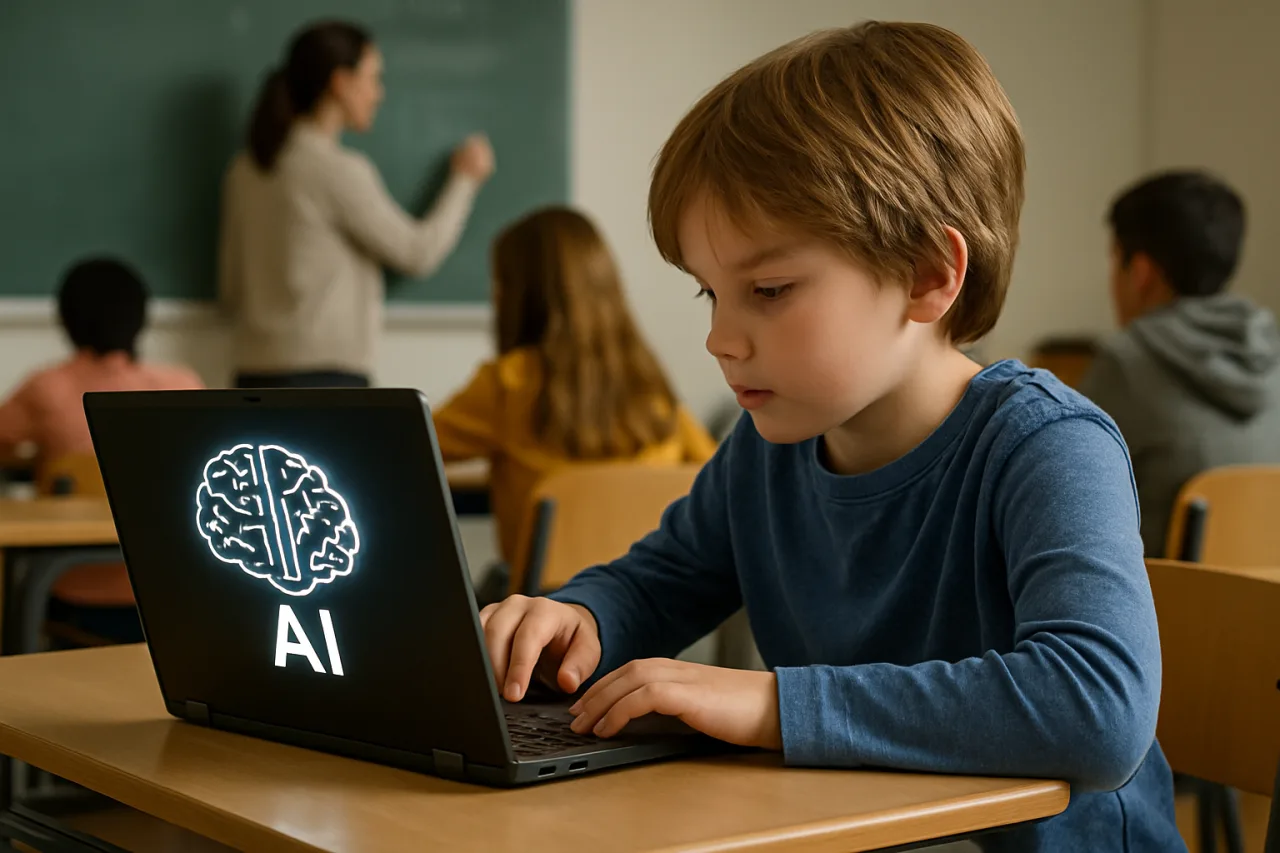
AI is a tool. That sentence sounds like a trite opening to the loudest education debate of 2026 — but sharpened honestly, it is still the most defensible ground in it. New York City has imposed a one-year moratorium on student-facing generative AI for students in 2-K through Grade 8 — nearly 600,000 children — because it fears what unsupervised use does to developing minds. China has made AI lessons compulsory for every child from age six, because it fears what falling behind costs a nation. Both governments are responding to the same technology with opposite policies, and both are making the same underlying mistake: treating the presence of AI as the decision, when the decision that matters is what AI does to the learner. AI is a tool, and a tool takes its character from its task — so AI does not determine its own educational purpose; its consequences depend on how the system is designed, deployed, and used, and that is where policy should aim. This is our position, and we will defend it against both camps.
Key Takeaway
- 🔭 Our position: AI should be governed according to what it does to the learner — not simply according to whether AI is present. The unit of policy is the task, not the technology, because AI is a tool whose effect depends entirely on the task it is given.
- ⚖️ What both camps get right — and miss: New York correctly protects developing minds and studies before permanent policy; China correctly treats AI literacy as economic necessity. But both regulate the presence of AI; the actual risk lives in the task — because AI is a tool that either supports or replaces the cognitive work the student is supposed to do.
- 🧒 The sequencing that matters: mastery first, fluency second. Children should build the judgment AI cannot replace before they are handed systems that can substitute for practicing it.
- 🇵🇭 For the Philippines: compared with jurisdictions already committed to broad mandates or moratoria, the country still has considerable policy room to design its own approach — and should build it on the UP College of Law’s documented evidence.
What New York Gets Right — and Where It May Go Too Far
Credit where the evidence supports it. The Mamdani administration’s moratorium is not a panic reaction: it covers only student-facing generative AI, from 2-K through Grade 8, for one year, explicitly to study the impacts before permanent policy. High-school students are treated as the developing adults they are — biannual AI-literacy instruction covering detection of AI content, career impacts, and algorithmic bias, plus supervised pilots in a few classes per school. Exemptions are deliberate: assistive tools for students with disabilities, multilingual learners, and computer-science career programs. Teachers keep their AI. Union concerns about software-level safeguards are fair. This is a serious, age-differentiated policy — and New York’s willingness to study before committing permanently is the most intellectually honest feature of the entire global debate.
Where we believe it may go too far: a blanket moratorium treats all tasks alike. It removes the ghostwriter risk and the tutor benefit together — and, for a year, it defers the AI-literacy question for the youngest students entirely. New York’s own design implicitly concedes our point: the age ladder, the purpose distinctions, the supervised pilots are all task-and-context decisions. The policy is less a ban on a technology than a bet that a year of evidence will teach the city what a task-based framework would have told it on day one — because AI is a tool that takes its character from the task, not from its mere presence.
What China Gets Right — and What Its Compression Risks
China’s case deserves equal seriousness. The Ministry of Education’s framework is progressive by age — lower-primary students encounter AI through experience and exploration while older students advance to machine learning concepts, applications, ethics, and safety — and the April 2026 national plan extends AI literacy through after-school programs and study tours. Beijing alone requires every primary and secondary school to deliver no fewer than eight class hours of AI instruction per academic year, roughly one lesson a month, guaranteed. The underlying judgment is sound: AI is a tool for national competitiveness, and fluency with it is becoming table stakes for economic participation — a generation that reaches adulthood unable to interrogate, verify, and deploy these systems will be structurally disadvantaged. China is right that AI illiteracy is also a danger.
Our concern is narrower and evidence-based. China risks compressing the mastery-first sequence by introducing AI literacy before policymakers have sufficient evidence about how sustained AI exposure affects foundational cognitive development. The grade ladder organizes AI content by age; it does not yet ensure that a child has demonstrated unaided competence in a skill before AI is allowed to touch that skill’s practice. That ordering — fluency before mastery — is precisely the pattern that produced the dependence documented at UP Law. The concern assumes AI is a tool whose effects depend on ordering, and that is exactly the assumption the evidence must now test. It is a risk to be studied and managed, not an accusation. But until the evidence exists, it is the correct one to name.
Why “AI Is a Tool” Is True — and Not Enough
The tool claim needs precision, because both camps implicitly deny it in opposite ways. New York’s moratorium treats AI’s presence itself as the hazard to young minds; China’s mandate treats it as inherently enriching. The defensible version sits between them — and it begins by asking what kind of tool AI actually is.
AI is a tool, but no AI system is context-free. Modern systems are shaped end to end by human decisions: training data and what it contains, model architecture, optimization objectives, system instructions, safety policies, and interface design. A companion chatbot built to keep a child talking at midnight is not the same artifact as a homework explainer built to ask guiding questions — even if both run on similar models. Traditional tools wait to be used. AI systems can converse, persuade, recommend, adapt, and — in some commercial deployments — optimize for continued engagement. That is why “AI is a tool” cannot mean “AI is neutral in all respects.” What it can mean, precisely, is this: AI does not determine its own educational purpose. Its consequences depend on how the system is designed, deployed, and used — and the deployment variable is where policy has purchase.
This is why the phrase is not a shrug. It tells you to stop asking “should AI be in classrooms?” and start asking “doing what, to which learner, under whose supervision?” The calculator analogy holds where it matters: ban the presence and you lose the tutor along with the ghostwriter; mandate the presence and you install both. Aim the policy at the task and the two separate cleanly.
Our Position: AI Is a Tool — Let It Support the Cognitive Work, Never Replace It
WorldNgayon’s editorial position comes down to five planks, built on one principle we would paint on the classroom wall:
Let AI support the cognitive work. Do not let it replace the cognitive work the student is supposed to develop.
The principle has teeth because it splits the practical cases cleanly. AI that explains, quizzes, critiques, and translates is a tutor — it supports the work. AI that produces the deliverable the child was supposed to produce is a ghostwriter — it replaces the work. The boundary needs one honest caveat, because even translation can assist learning in a language class or replace the skill being assessed in an exam. The task, the learner’s competence, and the assessment purpose decide; the function alone does not. AI may assist the learning process, but it should not substitute for the cognitive skill being assessed.
From that principle, five planks follow.
One. The task is the unit of policy, not the technology. Every serious policy we studied already distinguishes tasks implicitly — New York by age and purpose, UP Law by assignment type, China by grade band. Make it explicit: tutor-uses permitted and encouraged from early grades; ghostwriter-uses restricted until mastery of the underlying skill is demonstrated unaided.
Two. Mastery first, fluency second. The ladder runs: unaided competence, then tool-assisted practice, then tool-directed creativity. New York risks freezing the ladder for its youngest learners; China risks compressing it before the evidence exists. Both should aim at the same target sequence.
Three. Evidence before architecture — but time-boxed. We support New York’s study design and would import it to the Philippines — with a decision deadline. A study without a commitment point becomes an excuse. Commit in advance to the task-based framework regardless of outcome, because task-splitting is robust under every plausible result — the whole premise is that AI is a tool defined by deployment, so evidence about deployment, not presence, is what matters.
Four. Teachers are the deployment. The evidence increasingly suggests AI is most defensible educationally when it operates under trained teacher supervision rather than replacing the student’s own cognitive work. The strongest current data points support this: a World Bank randomized trial in Nigeria found six weeks of after-school, teacher-led AI tutoring produced learning gains equivalent to roughly two years of typical schooling, and a Harvard randomized controlled trial (Kestin et al., 2025, Scientific Reports) found students learned more in less time with a purpose-built AI tutor under instructor guidance than in an in-class active-learning format. Both were designed, supervised deployments — not unsupervised access. New York was wise to exempt teacher use; any Philippine policy should invest in teacher training before regulating students.
Five. Parents are the real regulators. Ministries move in years; childhood moves in months. Until national policy exists, the household is where the support-or-replace line gets drawn — which is why our parent playbook matters more than any bill now pending in the Senate.
The UP Law Warning — Scaled Honestly
The most instructive Philippine evidence comes from higher education, and it must be cited with its limits. On August 4, 2026, the regular faculty of the UP College of Law adopted a policy for first-year Juris Doctor core subjects after observing “a considerable decline in the quality of reasoning and argumentation coinciding with the regular use of AI by students for case briefing, answering simple queries during class, and research” — and employer feedback that graduates had become “not just AI-literate but AI-dependent.”
UP Law offers a warning from higher education that may be relevant to younger learners: when AI substitutes for foundational cognitive work, fluency can become dependence. Its evidence concerns law students and graduates, not elementary-school children — developing brains are a different matter, and the one-year New York study may tell us exactly that. We cite it as the strongest Philippine data point on the substitution pattern, not as proof about childhood. That is precisely why New York’s study year matters, and why the Philippines should run its own measured pilot rather than wait for foreign conclusions.
What This Means for the Philippines
Compared with jurisdictions already committed to broad student AI mandates or moratoria, the Philippines still has considerable policy room to design its approach — with existing foundations to build on, not a vacuum. National AI strategies and governance work already exist; DepEd is already trusting AI with school safety through Project LIGTAS; and the economic case is quantified: Access Partnership’s study for Google (May 2024) put the AI opportunity at ₱2.8 trillion (US$50.7 billion) in business benefits by 2030, contingent on adoption — a figure UNESCO’s AI readiness observatory and the regional readiness assessment we covered both cite, with the skills gap flagged as the binding constraint. The country does not need to choose between New York and China. It needs to be the first that regulates the task instead of the presence.
Our recommendation to DepEd is specific: adopt the task-based framework above, pilot it in the next school year in a measurable cohort, publish the results the way UP Law did — and resist both the Manhattan impulse and the Beijing one. Every month without a framework, classrooms improvise private policies with no adult coordination, producing exactly the uncontrolled variation that made the UP Law evidence necessary in the first place. The policy room is an advantage only if we use it — and the first country to govern AI in schools by what it does to the learner, rather than by whether AI is present, will have written the template everyone else studies.
What We Expect to Be Wrong About
A position worth holding must be falsifiable. Here are our explicit update triggers. If New York’s year of evidence shows measurable cognitive harm even under task-split, supervised use — we were too optimistic about the tutor, and presence-based restriction earns more credit than we give it. If China’s cohorts demonstrate compounding fluency dividends with no mastery deficit through late primary — we were too conservative about sequencing, and the mastery-first ladder should loosen. If UP Law’s unaided-trained graduates outperform AI-fluent peers in bar outcomes and employment — mastery-first wins outright, and the case for task-based frameworks strengthens beyond argument. If rigorous studies show unsupervised child AI use produces no worse outcomes than supervised use — the supervision principle itself needs revision. And if AI systems become sufficiently autonomous that they can plan, initiate, and execute consequential actions with minimal human direction, the simple “AI is a tool” framework may become inadequate — the question shifts from who wields it to what it wields, and this framework would need rewriting from the ground up. We are watching all five. That is what it means to hold a position rather than merely have one.
Frequently Asked Questions
Is AI really neutral?
No AI system is fully neutral — training data, optimization objectives, and interface choices all shape outcomes. But AI does not determine its own educational purpose: its consequences depend on how it is designed, deployed, and used. That is why our position regulates the task, not the presence of the technology.
Why may New York’s ban go too far?
Because a blanket year-long moratorium treats all tasks alike: it removes the ghostwriter risk and the tutor benefit together, and defers AI-literacy building for the youngest learners. New York’s age distinctions and supervised pilots are steps in the task-based direction — we support the study, question the breadth.
What is the risk in China’s approach?
China risks compressing the mastery-first sequence by introducing AI literacy before sufficient evidence exists on how sustained AI exposure affects foundational cognitive development. Its grade ladder is progressive by age, but it does not yet guarantee unaided competence before AI touches a skill.
What does “regulate the task, not the tool” mean for parents?
Draw the support-or-replace line at home: AI may explain, quiz, critique, and translate the learning process; it may not produce the homework itself until the underlying skill is demonstrated unaided. Even translation depends on context — assisting practice is different from replacing the skill being assessed.
What should the Philippines do about AI in schools?
Use its policy room deliberately: a task-based framework (support yes, replace no until mastery), teacher training first in the budget, a time-boxed measurable pilot, and published results — built on the UP College of Law’s documented evidence. Neither copy New York’s moratorium nor China’s mandate.
Could AI stop being a tool?
If AI systems become sufficiently autonomous that they can plan, initiate, and execute consequential actions with minimal human direction, the simple “AI is a tool” framework may become inadequate. Our position includes explicit update triggers; we will rewrite this analysis if that threshold is crossed.
Editorial Disclaimer
This article presents WorldNgayon’s analysis and editorial position on AI and education policy. It is intended for informational purposes and should not be interpreted as legal, educational, or public-policy advice.
Sources: NYC Mayor’s Office announcement (September 2, 2026); Reuters; Associated Press; UP College of Law policy, law.upd.edu.ph (August 4, 2026); Rappler; Georgetown CSET translation of the China MOE notice (July 2026); China State Council English portal (April 2026); NPR (January 27, 2026); Access Partnership economic impact study for Google (May 2024); World Bank randomized trial, Nigeria (2025); Kestin et al., Scientific Reports (2025); Global Times/BRTV (June 2025, Beijing eight-hour requirement).