Table of Contents
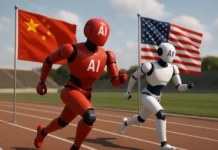
AI in schools just became the dividing line of global education policy — and in one extraordinary stretch of weeks, two global powers drew opposite conclusions — and a third quietly picked its own side. New York City, the largest school district in the United States, banned generative AI for roughly 600,000 elementary and middle school students. China, meanwhile, is doing the reverse: AI lessons are compulsory for children as young as six, in every grade, with a national plan to make the entire population AI-literate.
Two decisions, two philosophies — and later in this report, the Philippine evidence that may be the most instructive of all. One unresolved question that lands on the desk of every Filipino parent — including the millions raising children in Philippine schools from Riyadh, Dubai, Hong Kong, or Singapore: which system is actually preparing a child for the world of 2035? This is the full comparison, based on the primary policy documents, the research each side cites, and what it means for Philippine families.
Key Takeaway
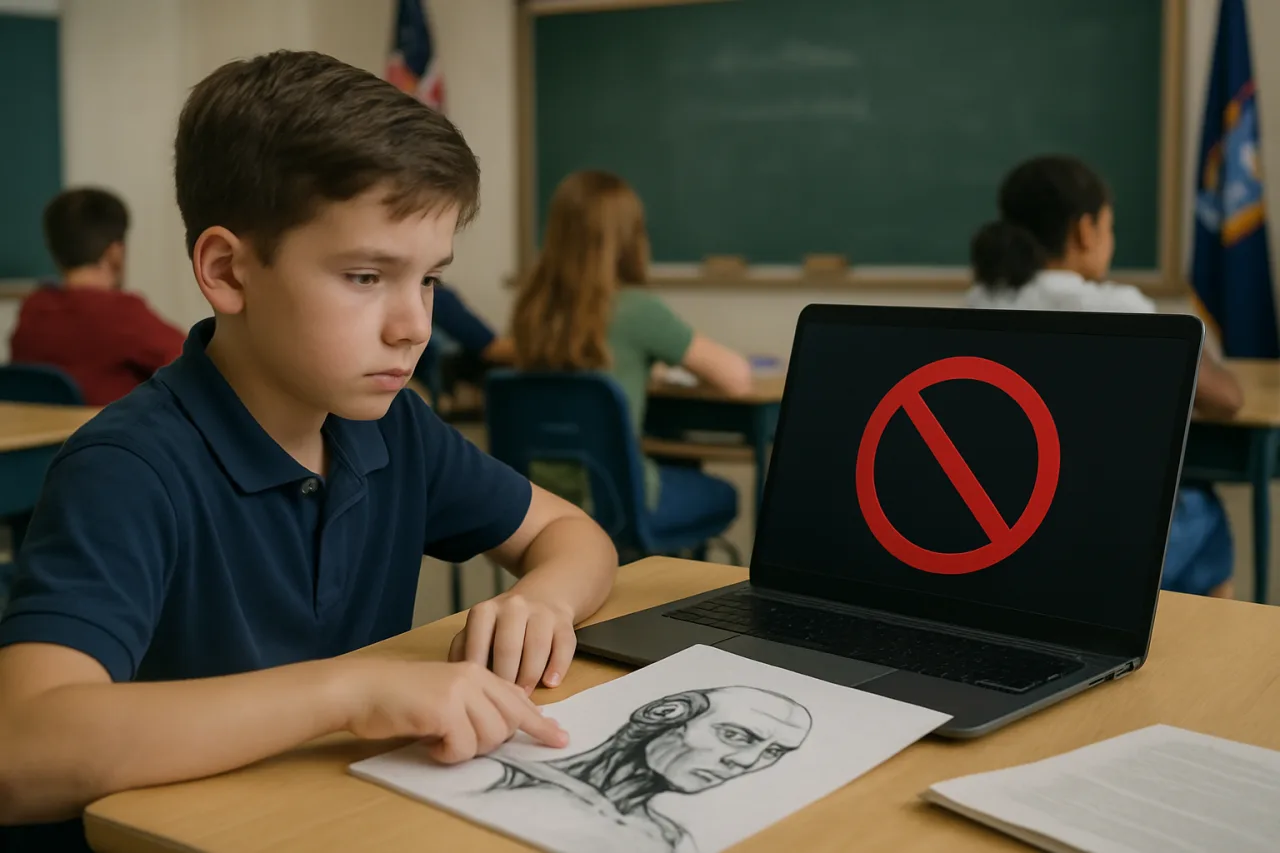
- 🗽 AI in schools is now a global fork: NYC imposed a one-year moratorium on generative AI for 2-K through 8th grade (~600,000 students) on September 2, 2026 — the most restrictive US policy to date.
- 🇨🇳 China mandated the opposite: AI education is compulsory from age 6 in every grade, with Beijing requiring at least eight class hours a year, expanded nationally in an April 2026 AI literacy plan.
- ⚖️ The UP College of Law joined the restrictors: its faculty adopted an offline, no-generative-AI policy for first-year core law subjects on August 4, 2026, citing “a considerable decline in the quality of reasoning” among students who use AI regularly.
- 👨👩👧 For Filipino families: the Philippines has no national AI curriculum mandate — parents are effectively choosing a side by school choice, household rules, and the questions they ask teachers.
What New York Decided: Protect First, Study, Then Decide
On September 2, 2026, one week before the school year began, Mayor Zohran Mamdani and Schools Chancellor Samuels announced a sweeping policy (official announcement) for the nation’s largest school district: a one-year moratorium on student-facing generative AI across all elementary and middle school grades, from 2-K through 8th grade. The ban covers “all software that uses student-facing generative AI,” and roughly 600,000 students fall under it. Companion chatbots — the always-available AI tutors that several edtech companies had been marketing to districts — are prohibited at every grade level, including high school.
The policy also imposes a screen-time ladder that loosens with age: younger students get zero to 45 minutes per day depending on grade. High school students are treated differently — they receive biannual AI critical thinking training covering how to detect AI-generated content, AI’s impact on careers, and algorithmic bias — and a limited number of supervised pilot classes may integrate AI tools under a trained educator’s direct oversight.
The exemptions are narrow and deliberate: assistive tools for students with disabilities, multilingual learners, and career-track computer science students remain permitted. Teachers, notably, are still free to use AI for lesson planning and operational tasks — the ban targets student cognitive development, not teacher productivity.
Mamdani’s framing at the press conference was blunt: “Children need their teachers and human connection in order to learn and in order to grow. And they need to develop skills alongside their peers, build relationships with their teachers, and wrestle with tough problems on their own.” Then the line that will be quoted in education policy debates for years: “The tech industry wants us to believe that AI in early education is not only inevitable, but that it is necessary. We do not see it that way.”
Reuters called it the most restrictive AI policy adopted by any major US district to date, and the sharpest reversal in the brief history of AI in schools. The United Federation of Teachers supported the screen-time limits but flagged unanswered questions about enforcement — union president Michael Mulgrew argued safeguards should be built into the software at the source rather than left to individual schools to figure out. Los Angeles, the second-largest district, is now reviewing its own AI policies.
What China Decided: AI Literacy Is National Strategy
While New York hit pause, China institutionalized. The Ministry of Education’s notice on strengthening AI education in primary and secondary schools — in effect since September 2025 — mandates structured AI instruction from age six, integrated into the information technology curriculum across every grade through senior high school. The concrete floor is set city by city: Beijing requires every primary and secondary school to deliver no fewer than eight class hours of AI instruction per academic year — roughly one lesson a month, guaranteed — with other major cities rolling out their own requirements.
The curriculum is a deliberate ladder: early grades learn the basics of how intelligent systems perceive the world; middle grades progress to machine learning concepts, hands-on projects, and the critical skill of detecting AI-generated misinformation; senior students tackle real applications. NPR’s classroom reporting from Beijing earlier this year captured what this looks like in practice: 11-year-olds programming small AI-driven robots, a fifth-grader explaining how AI autonomy could solve deep-space communication delays for Mars rovers, a classmate using an AI image generator to design competition posters.
And it keeps expanding. In April 2026, China’s national plan for building an AI literacy system called for integrating AI education into local curricula nationwide, interdisciplinary AI teaching, after-school AI programs, and AI-focused study tours. The framing is unmistakably strategic: state media and policy documents speak of building a pool of AI-savvy professionals to secure national competitiveness. Where the American debate centers on child development and cognitive risk, the Chinese framing is a race — and children are the pipeline.
The scale difference matters too. China’s mandate covers hundreds of millions of students. New York’s moratorium covers 600,000. One system is running the largest AI-education experiment in human history; the other just opted out of the experiment for its youngest learners for one year while it studies the evidence.
The Evidence War on AI in Schools: Cognitive Offloading vs. National Survival
Underneath the three decisions sit two competing bodies of evidence. The restrict-first camp points to a growing research literature on cognitive offloading: the concern that students who habitually delegate thinking to AI systems fail to develop the underlying skills — the way GPS navigation eroded spatial memory. A January 2026 NPR-cited report argued the risks of AI in schools outweigh the benefits. UP Law’s faculty observed the decline directly. New York is betting a school year on that evidence — and with 600,000 students now offline for AI, the district has become the largest natural experiment in reverting classroom AI use.
The mandate-first camp runs a different calculation. China’s position is that AI literacy is a survival skill for the coming economy, that the productivity gains compound over a lifetime, and that a generation trained to work with AI will out-compete a generation protected from it. Singapore has moved similarly with its AI-student initiatives, and several US states encourage AI literacy standards even as districts restrict classroom use. The disagreement is not about whether AI matters — it is about whether childhood is the right time to build that fluency, and who bears the risk of being wrong.
There is also an equity wrinkle on both sides. Bans tend to protect wealthy students least — families with tutors and home access continue building AI fluency while school-restricted students don’t, which can widen gaps. Mandates, meanwhile, risk nationalizing a curriculum around tools that change every six months. Neither system has solved this; they have simply chosen which risk to bear.
Where the Philippines Stands on AI in Schools: Undecided, in Both Directions
The Philippines is not watching this debate — it is living parts of it. DepEd has been deploying AI in administration and school safety: Project LIGTAS, launched in August 2026, uses AI and satellite data to protect schools from disasters and shows the government already trusts AI with school operations (what Project LIGTAS actually does). The UNESCO-UNESCAP regional assessment we covered recently flagged the country’s AI skills shortage as its single biggest adoption barrier, while sizing the AI opportunity at ₱2.8 trillion in GDP by 2030 — a readiness gap that starts in classrooms (the full AI readiness report). The Senate is still weighing the Artificial Intelligence Regulation Act (what SB 25 would do). But on the specific question roiling New York and Beijing — should children learn with AI, or from AI — there is no national curriculum mandate and no moratorium. Individual schools and teachers are improvising.
That vacuum makes the global fork over AI in schools more relevant to Filipino families, not less. OFW parents — who fund Philippine education disproportionately and often supplement schooling with their own devices and apps — are making these decisions daily with less guidance than either New York or Beijing provides. The question is no longer whether to form a position, but which position to form.
What Filipino Parents Can Do Right Now
Until Philippine policy arrives, the practical playbook on AI in schools borrows from all three systems. Ask your child’s school for its written AI policy — most have none, and the question itself starts the conversation. Separate the two uses that the policies above consistently distinguish: AI as a tutor that explains (lower risk, often transformative) versus AI as a ghostwriter that replaces the struggle where learning actually happens (the pattern UP Law moved to ban). Watch for the UP Law signal in reverse: if a student can no longer produce reasoning without the tool, dependence has already formed — the faculty’s employer-feedback observation is a warning every household can check for free. Favor tools and rules that keep the child doing the thinking: use AI to quiz, critique, and explain after the attempt, not before. And for older students, teach detection and skepticism explicitly — the skill every system now agrees on is not blind trust in AI output, whether the user is 8 or 28.
The deeper point for Filipino professionals watching this debate: whatever side wins, the differentiating skill is exactly what UP Law described — judgment, argumentation from context, comfort with uncertainty. Those skills have never been credentialed by any ministry. They are built the slow way, and every policy on three continents is, in its own way, an attempt to protect them.
What UP Law Saw: The Evidence From a Philippine Classroom
The third decision came from the Philippines, and it may be the most instructive of the three because it is grounded in firsthand observation rather than ideology. On August 4, 2026, the regular faculty of the UP College of Law adopted a policy titled “Philippine Legal Education in the Time of Artificial Intelligence I: Recommitting to the Fundamentals of Legal Analysis,” effective academic year 2026-2027.
The faculty’s reasoning deserves to be quoted, because it is the concrete classroom evidence that New York’s one-year study period will now try to gather at scale: the College “noted a considerable decline in the quality of reasoning and argumentation coinciding with the regular use of AI by students for case briefing, answering simple queries during class, and research.” Employer feedback on recent graduates confirmed the fear — that many students “have not just become AI-literate but AI-dependent.”
The policy for first-year Juris Doctor core subjects — the courses traditionally tested in the Philippine Bar Exam — is comprehensive: offline, onsite instruction; a prohibition on digital and electronic devices during class, including for note-taking; offline major assessments and final exams; and a ban on generative AI in research and writing assignments “from conceptualization to writing and finalization, including editing and grammar checks,” including AI-reliant research databases. Possessing devices during assessments can trigger formal disciplinary action.
But the UP policy is not a Luddite document. It explicitly rejects “complete isolation” and “complete acceptance” as equally unsatisfactory. The College acknowledges AI’s pervasiveness and its own responsibility to prepare students for its ethical use — some AI-based research tools remain available at faculty discretion, and the policy is deliberately titled Part I of an ongoing series. The philosophical core is the sentence every Filipino educator should read: the task is to “train students to master skills that the technology cannot replace: deriving legal arguments from language and social context, finding or creating law in or from its interstices, and transposing these to actual cases and situations in the persuasive, ethical, and humane manner that underlies the law’s legitimacy.”
UP Law is in distinguished company: the faculty cited policy developments at the University of Chicago and UC Berkeley, and Columbia Law School adopted its own default AI policy for 2026-27. Philippine legal education — often a follower in global academic trends — moved early and decisively here, and the UP College of Law’s documented observation of AI-dependence among students is precisely the kind of evidence the cognitive-offloading research predicts.
And then there is the Philippines — where the country’s premier law school became the third system to act on AI in schools, with the most instructive evidence of all.
Frequently Asked Questions About AI in Schools
Which country banned AI in schools for young students?
New York City did not ban AI nationwide, but as the largest US school district it imposed the strictest policy to date: a one-year moratorium on student-facing generative AI for elementary and middle school students (2-K through 8th grade, about 600,000 students), announced September 2, 2026 by Mayor Zohran Mamdani.
Is AI education mandatory in China?
Yes — the sharpest contrast to New York’s AI in schools moratorium. China’s Ministry of Education requires AI instruction in primary and secondary schools, effective since September 2025, the national framework builds a curriculum ladder from basics in early grades to machine learning and misinformation detection, and Beijing requires at least eight class hours of AI per academic year. An April 2026 national plan extends AI literacy through after-school programs and study tours.
Why did UP College of Law ban AI for freshmen?
The UP College of Law faculty adopted the policy on August 4, 2026 after observing “a considerable decline in the quality of reasoning and argumentation” among students regularly using AI for case briefing and research, and employer feedback that graduates had become “AI-dependent.” First-year core subjects are now taught offline, with devices and generative AI banned in class and in written assignments.
Does the NYC ban apply to teachers?
No. Teachers may still use AI for lesson planning and operational tasks. The moratorium targets student-facing generative AI tools, with narrow exemptions for assistive technology for students with disabilities, multilingual learners, and career-track computer science students.
What is the risk of banning AI in schools?
Critics of restrictions point to two risks: students may fall behind peers who build AI fluency early, and bans can widen inequality because well-resourced households continue AI exposure outside school. New York’s one-year design is an attempt to weigh those risks against evidence of cognitive harm before setting permanent policy.
What should Filipino parents do about AI in schools?
Practical steps: ask the school for its written AI policy (most have none yet); distinguish AI-as-tutor from AI-as-ghostwriter and allow the former; check for dependence — a child who cannot reason without the tool; and encourage AI use after the attempt, not before. Philippine national policy remains undecided, so household and school-level choices are doing the work.
Sources: NYC Mayor’s Office announcement (September 2, 2026); Reuters; Associated Press; UP College of Law policy page, law.upd.edu.ph (August 4, 2026); Rappler; Georgetown CSET translation of the China MOE notice; China State Council English portal (April 2026); NPR (January 27, 2026).
Financial Disclaimer
This article is for general information and education policy analysis only. It does not constitute financial, legal, or investment advice. Readers should consult qualified professionals before making decisions affecting their families or finances.