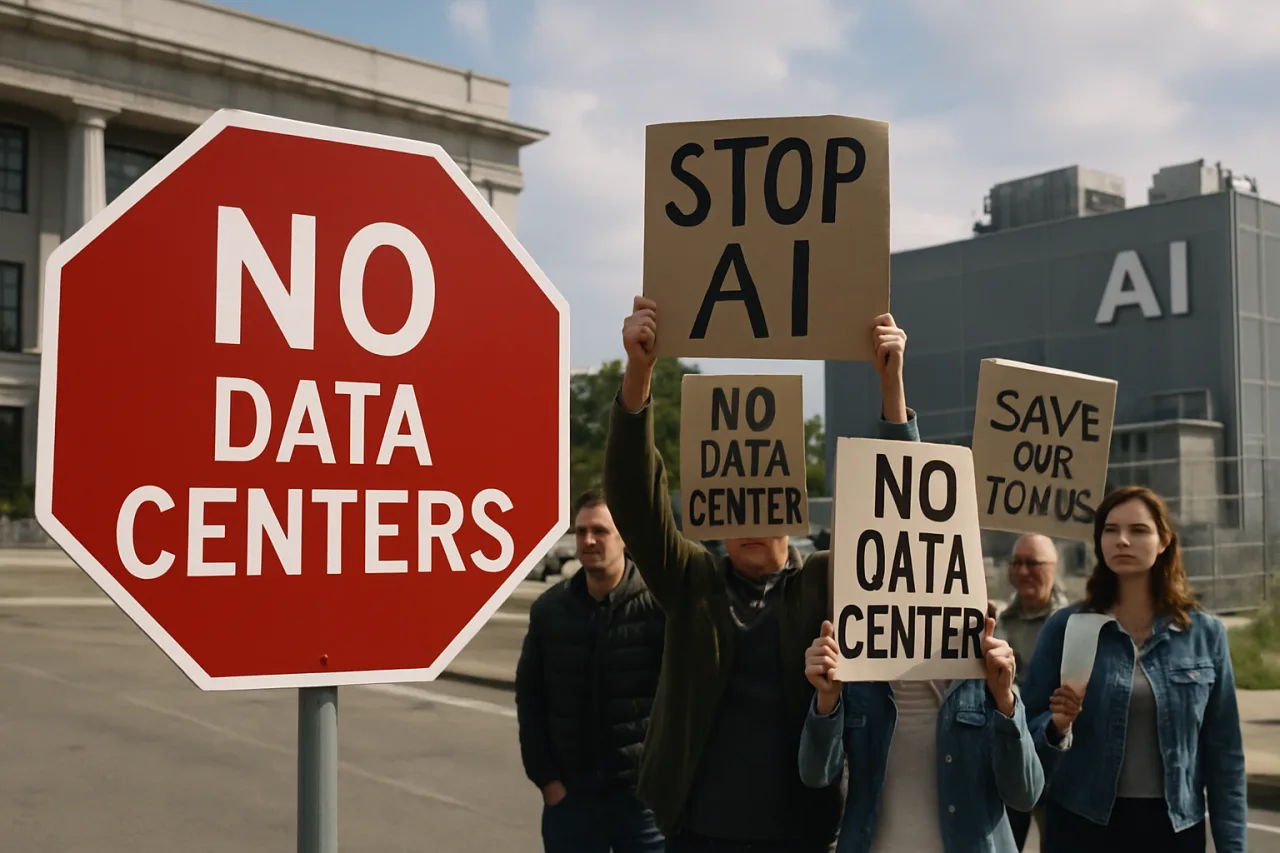
The AI data center backlash reached a milestone answer on Friday: San Francisco Mayor Daniel Lurie signed a citywide moratorium pausing data center development for 45 days while the Planning Department studies impacts and drafts controls — a unanimous Board of Supervisors vote behind it — while New Jersey’s new Rutgers-Eagleton Poll put the mood in numbers: 72% of adults oppose a data center in their own town, 62% oppose one anywhere in the state, and 55% say the costs outweigh the benefits. This year has turned the AI buildout’s physical footprint into a political file, and the ground is shifting under the most capital-intensive infrastructure project in modern history. This piece maps where the blocks are happening, why the backlash is rational, and what it changes for the AI economy.
Key Takeaway
- 🏗️ The signal event: San Francisco — the Bay Area’s own tech city — signed a 45-day citywide data center moratorium on October 16, tasking the Planning Department with studying impacts before any controls land.
- 🗳️ The numbers: New Jersey’s Rutgers-Eagleton Poll: 72% oppose a data center in their town, 64% in a neighboring county, 62% anywhere in the state — with costs judged to outweigh benefits 55%-11%.
- 🗺️ The spread: the AI data center backlash now runs nationwide with cancellations to match — Heatmap tracking put 2026’s data center cancellations above $260 billion, and cities from St. Louis to metro Oklahoma report the same neighbors-versus-gigawatts fight.
- ⚡ The reason it is rational: data centers consume gigawatts and millions of gallons of water while their tax deals are negotiated behind closed doors — the costs land locally and the profits land elsewhere.
- 🎯 What changes: slower siting, costlier power fights, and the migration of AI infrastructure to cooperative jurisdictions — the physical layer is now a political constraint on the AI boom.
The AI data center backlash map
Where the AI data center backlash is landing is easiest to answer with the places that started. San Francisco signed its 45-day moratorium on Friday — Mayor Daniel Lurie enacting Supervisor Shamann Walton’s measure after a unanimous Board of Supervisors approval fast-tracked by board President Rafael Mandelman. New Jersey’s Eagleton poll quantified a whole state’s mood of AI data center backlash the same week. St. Louis is fighting over a $3 billion tech hub whose data center anchor has split the city’s boosters from its neighborhoods — the same pattern metro Oklahoma, Columbus and New England communities have been living since spring. And the cancellations column is growing faster than the approvals column: Heatmap’s October count topped $260 billion in shelved or withdrawn data center projects for 2026 alone.
The AI data center backlash pattern in the map is unmistakable once seen: the blocks cluster where citizens can actually see the infrastructure — in existing urban cores and their suburbs, in water-stressed counties, and in states where utilities must justify new generation to regulators and ratepayers. Rural sites without organized opposition keep approving; visible urban-adjacent sites increasingly cannot. The AI economy is discovering that siting is not a technical decision — it is a democratic one.
San Francisco: the 45-day moratorium
San Francisco’s move carries the AI data center backlash’s symbolism beyond its size: the city that made its fortune on the cloud now pauses the concrete version of it. The moratorium Lurie signed pauses data center development citywide for 45 days while the Planning Department studies the impacts and develops controls; the Board’s unanimous vote — rare in a fractious chamber — and Mandelman’s praise (“Supervisor Walton has done us a service in forcing us to think about it”) show a local political consensus forming around the same realization national analysts reached this month: the bill for the AI buildout lands somewhere, and usually it lands on municipal power and water systems first. Expect the study to end in a set of controls — zoning limits, grid-connection conditions, water-use reporting — that other cities will copy, because the questions San Francisco is formalizing are the same ones every city council has been improvising since the gigawatt era began.
New Jersey: the poll that quantified the backlash
The Eagleton Center’s poll gives the mood its arithmetic: 72% of New Jersey adults oppose a data center in their town (54% strongly), 21% support; 64% oppose one in a neighboring county; 62% oppose one anywhere in the state. Asked to weigh jobs and tax revenue against electricity and water consumption and the risk of higher utility bills, New Jerseyans call the costs bigger by 55% to 11%. Eagleton’s director Ashley Koning read the result plainly — no group reaches majority support anywhere; the only softening appears when projects sit far away. The AI data center backlash’s political meaning is immediate: New Jersey voters also want a moratorium, and the state’s politicians now know where their electorate stands. The utility-cost fear is not hypothetical — data centers add gigawatt-scale demand to grids whose residential customers already pay the expansion’s costs, and the “growth in energy supply” that the state’s voters resist is growth priced onto their own bills.
The St. Louis case: a $3-billion hub meets neighbors
St. Louis is the textbook middle case: a city that wants the jobs, the investment and the identity of a tech hub — attached to a $3 billion project whose data center anchor draws the opposition. The real-estate press documented the split this week: boosters promise employment and tax base; neighbors promise a fight over power, noise, water and the terms of the incentives. The pattern generalizes because most US cities now sit somewhere on it: they want the AI economy’s jobs and are wary of its infrastructure — the buildout’s next decade depends on which of the two wins where. Cities that resolve the conflict with visible terms — community benefits, grid-impact caps, water disclosure — get the hub; cities that improvise get the moratorium.
Why the backlash is rational: power, water and bills
The opposition stops being mysterious when priced. A single hyperscale campus can draw hundreds of megawatts — the power demand of a small city — and the expansion of generation and transmission to serve it is paid for through the utility system whose residential rates are set by regulators. Water consumption at cooling scale runs to millions of gallons daily where drought is already a planning reality. Jobs are real but front-loaded — construction peaks, operations employ a fraction of the build crew — while power and water obligations run for the asset’s 20-year life. And the physical constraints have already produced the market’s own verdict: over $260 billion of projects canceled in 2026, Southeast Asia’s biggest AI campus halted over water, and the sector’s purest borrower repriced to distressed-adjacent yields. Communities read the same ledger as the bond market, and they are reaching the same conclusions in zoning language.
Southeast Asia’s version of the same fight — Indonesia’s halt of a 640-megawatt AI campus over water and approvals — is documented in our water wall feature; our power-proven analysis covers the grid mechanics. The global picture is one system: AI’s growth now runs through physical and political infrastructure that does not scale on a venture timeline.
The backlash map’s next moves to watch on the ground
Three watch items keep the AI data center backlash map honest in the next quarter. First, San Francisco’s Planning Department study — its 45-day clock ends in early December, and whatever controls emerge (zoning, grid conditions, water disclosure, community-benefit terms) becomes the copybook other cities reach for. Second, New Jersey’s legislative session: the poll’s 62% statewide opposition plus a fresh governor’s race makes a moratorium bill or disclosure law the most-followed test of whether backlash converts into binding code. Third, the cancellation ledger itself: Heatmap’s running count, now past $260 billion, turns each new halt into a data point the bond market reads as refining risk — siting politics and credit pricing now move in the same column.
What the blocks mean for the AI economy
First-order effects of why US cities are blocking AI data centers are pricing effects: cooperative jurisdictions gain leverage — cheaper land and faster approvals in exchange for the terms communities demand; contested jurisdictions risk the same rate-of-return math that has already repriced the sector’s debt. Second-order effects are structural: the industry migrates toward cheap, available power and organized approvals — which is why the buildout’s map is consolidating around utility corridors with headroom rather than coastal demand centers. Third-order effects are fiscal: cities writing data center codes now are deciding twenty-year revenue shares, and the San Francisco study plus New Jersey’s polls suggest the codes will be stricter and more transparent than the incentive-heavy deals of the boom’s first wave.
The deep reading of the AI data center backlash for investors and workers alike: siting friction is now part of the AI trade’s cost of capital. Gartner’s gap math, the bond repricing, and the moratorium wave are three expressions of one repricing — the buildout’s next trillion dollars will be harder to site, more expensive to finance, and more conditional on community terms than the last one. The demand is real. The permission is the constraint. The map above is where that constraint lives.
The investor and worker translation
The AI data center backlash is not an argument against AI — it is a repricing of where and how the buildout can happen, and both workers and investors should carry the translation. For investors, siting friction enters the model as a cost line: projects in cooperative jurisdictions finish and lease; projects in contested jurisdictions carry approval risk that the bond market now prices alongside credit risk. The read-through for AI-heavy portfolios follows: favor operators with permitted, utility-partnered capacity; treat new construction commitments in backlash-posture metros as conditional plays with entry points that reward patience. For workers, the constraint is a hiring map: facilities that clear zoning arrive with operations roles — electricians, facilities technicians, security engineering, cooling specialists — and the local economies that negotiate the cleanest terms are the ones that keep those roles after the construction peak fades.
The AI data center backlash also has a civic dimension worth understanding rather than dismissing: the review San Francisco started is the first systematic attempt by a major US city to write data center rules in public — zoning limits, grid-connection conditions, water-use reporting, and benefit terms all on the table at once, with a unanimous council behind it. Cities that follow will copy the parts they need and skip the rest, and the national conversation moves from ‘should we host AI infrastructure’ to ‘on what terms.’ That shift — from if to how — is the backlash’s most durable product, and it is the frame that makes this year’s moratorium wave legible as governance catching up to a technology cycle rather than politics fighting one.
FAQ
What is driving the AI data center backlash in US cities?
Cities are pausing or blocking data center development over power and water consumption, utility-bill pass-throughs, and incentive deals negotiated with little community input. San Francisco’s 45-day citywide moratorium and New Jersey’s 72%-opposition poll are the week’s clearest markers of a 2026 groundswell that has already canceled more than $260 billion of projects nationally.
What did San Francisco’s data center moratorium do?
Mayor Daniel Lurie signed a unanimous Board-approved moratorium on October 16 pausing citywide data center development for 45 days while the Planning Department studies impacts and develops controls — a template other cities are watching for zoning, grid-connection and water-use conditions.
What did the New Jersey data center poll find?
The Rutgers-Eagleton Poll found 72% of New Jersey adults oppose a data center in their town (54% strongly), 64% oppose one in a neighboring county, and 62% oppose one anywhere in the state; 55% say data centers’ costs outweigh their benefits versus 11% who see mostly benefits.
Does the AI data center backlash stop AI growth?
It redistributes and reprices it. Demand is real — record chip quarters and enormous contracted backlogs — but the physical buildout migrates toward cooperative jurisdictions with cheap power and organized approvals, and financing costs rise with siting risk: the sector’s purest borrower now yields 15.78% on its 2031 bonds. Growth continues under harder terms.
How much did the AI data center backlash cancel in 2026?
Heatmap’s tracking put data center cancellations above $260 billion in 2026 — before the October selloff — alongside halts driven by power, water and approval failures from Southeast Asia to US metros. The cancellations are the market’s accounting for the same risks communities are voting on.
What should small businesses and workers watch?
Where the buildout lands next: utility-corridor states with modern approval processes, community-benefit terms attached to local incentives, and the power-price trajectory regulators set — because data center siting decisions become electricity prices, jobs, and the local terms of the AI economy within a single budget cycle.
Financial Disclaimer
This article is for informational purposes only and does not constitute financial, investment, or real-estate advice. Siting decisions, policy developments, and market figures reflect public reporting as of publication date and may change. Consult licensed professionals before acting on anything affecting your investments or business. WorldNgayon publishes infrastructure and market intelligence, not personalized recommendations.