Key Takeaway
- 🎯 The bet: Jensen Huang says cybersecurity will likely be AI’s next major use case — “it’s going to run continuously, and so it will be a great new business opportunity.”
- 🤖 Why now: Attacks are automated, so defense must be too — Huang announced the CrowdStrike SafeMind agentic system built on Nvidia Nemotron models at Fal.Con 2026 before 10,000 security pros.
- 💼 The AI cybersecurity career math: AI cyber defense runs 24/7 in continuous coevolution loops — that means permanent demand for people who can build, steer, and audit these systems, not just click through alerts.
- 🇵🇭 Filipino angle: BPO security operations centers (SOCs), remote SOC analyst roles, and agentic-AI tooling skills put Filipino professionals directly in this market’s path.
- 🧰 Skills that price: detection engineering, prompt/agentic tooling, cloud security fundamentals, threat-intel analysis, and AI-output auditing — the stack this bet pays for.
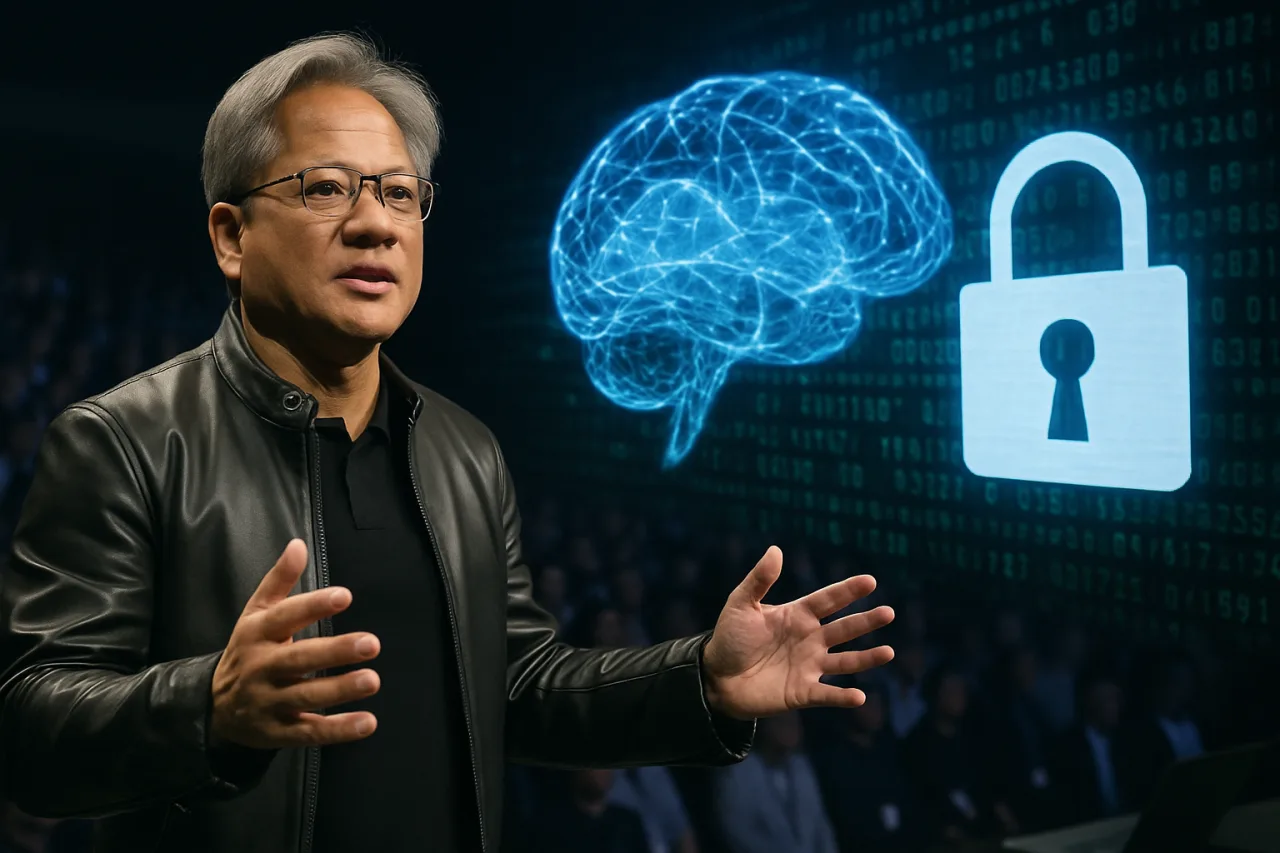
An AI cybersecurity career just got the strongest endorsement money can buy: the CEO of the world’s most valuable chip company stood in front of 10,000 security professionals and said the quiet part loud — cybersecurity will likely be AI’s next major use case, a business that “runs continuously” and never stops. Jensen Huang said it twice in one week: first at CrowdStrike’s Fal.Con 2026 in Las Vegas, announcing SafeMind, the agentic defense system his Nvidia models power; then at Goldman Sachs’ Communacopia + Technology conference, framing security as the successor market to coding assistants.
For Filipino IT professionals weighing where the next five years of demand land, this is more than a headline — it’s a map. Here’s what Huang actually said, the machinery behind the bet, and the specific skills an AI cybersecurity career will price.
What Huang Actually Said — Both Times
The first statement came at CrowdStrike’s Fal.Con 2026, where Huang joined CrowdStrike founder and CEO George Kurtz on stage: “We’re at an inflection point in cybersecurity. Attacks are now automated. Defense has to be, too.” And then the framing that matters for careers: “This is the beginning of a new age of cybersecurity. On the one hand, the adversaries are going to be more armed than ever. On the other hand, all of you are going to be more armed than ever.”
The second came days later at the Goldman Sachs Communacopia + Technology conference, answering the market question directly. Coding, Huang argued, has a derivative: bug-finding. And the derivative of bug-finding is security — which means the talent and tooling that built the AI coding boom flows naturally into security: “Cybersecurity will likely be the next major use of AI, and it’s going to run continuously, and so it will be a great new business opportunity” (remarks reported by PYMNTS).
Huang also offered a characteristically blunt market observation at Goldman: the industry is “getting ready to launch some products,” and fear moves software — “what better way to create demand than to create a problem,” delivered with the caveat that there are “responsible ways of doing it and there are less attractive ways of doing it.” Read that as the vendor-side truth: AI security products are about to flood the market, marketed on the threat landscape this site covers weekly — the AI-built zero-click worm, same-day Defender bypasses, and record Patch Tuesdays.
When Nvidia’s CEO attaches his company’s compute to a market thesis twice in one week, he’s not predicting — he’s building. The relevant question for professionals isn’t whether he’s right; it’s what the buildout buys.
The Machinery: SafeMind, Nemotron, and the Coevolution Loop
The product behind the pronouncement: CrowdStrike SafeMind, an agentic cybersecurity system from CrowdStrike’s Cyber Superintelligence Lab, combining the company’s own beyond-frontier-capable models with defensive models built on Nvidia Nemotron open models — announced with Falcon IQ for agentic workload automation and an expanded Guardian AI safety suite.
The architecture detail that changes the job: SafeMind runs a continuous coevolution loop — offensive and defensive AI models repeatedly challenge and improve each other. That’s not a dashboard with an analyst clicking “investigate”; it’s a standing computational process where red-team-style AI probes and blue-team-style AI defenses iterate at machine speed.
Why does this need humans at all? Because coevolution loops need direction. Someone defines what “secure” means for a bank’s environment, adjudicates what the loop flagged, tunes what the models chase, audits what they did, and answers for it in front of a regulator when an AI decision goes wrong. The AI absorbs the alert volume; the human absorbs the judgment. Every security vendor shipping agentic AI — CrowdStrike, Microsoft, Google, Palo Alto — now hires for exactly that division of labor.
Why “Runs Continuously” Changes the Job Market
The phrase “it’s going to run continuously” is doing heavy economic work in Huang’s thesis. Coding assistants run when you code. Security cannot stop: the adversary’s automation doesn’t sleep, so the defense’s automation doesn’t either — 24/7, across every enterprise on earth.
Continuous markets create continuous staffing, and the shape of that staffing is the actual career news:
The alert-firehose collapses; the judgment layer expands. AI triage absorbs the tier-1 alert flood that burns out junior analysts — but every AI decision needs review paths, escalation design, and quality auditing. The analyst role doesn’t disappear; it moves up the stack.
Detection engineering becomes the bottleneck trade. Someone must translate each new threat — an agentic malware family, a same-day bypass — into detection logic the machines can execute. That’s coding plus adversary thinking, priced accordingly.
AI-output auditing becomes a security discipline of its own. When your defense is an AI, a manipulated AI is the attack. Auditing what the models did and why — the field the industry calls AI security assurance — is the brand-new layer this buildout hires for.
Contractors and consultants who’ve watched the cloud wave and the DevOps wave know the pattern: platforms get automated, but the configuration, governance, and incident response around them become the durable jobs. Security’s version of that law is now on the record from the person shipping the compute.
The AI Cybersecurity Career Skills This Bet Prices — Ranked
Strip the keynote language and here’s the stack an AI cybersecurity career prices, in descending order of near-term pricing power:
1. Detection engineering. Writing and tuning the rules, queries, and telemetry pipelines agentic systems act on. SQL/Splunk/KQL fluency plus adversary tradecraft. The scarcest combo in the SOC market today.
2. Agentic tooling fluency. Prompt design, tool orchestration, and evaluation for security agents — the skills of someone who can make SafeMind-style systems do useful work without hallucinating an incident. This is where the coding-derivative argument lands: builders who debug well steer defense agents well.
3. Cloud security fundamentals. Identity, network, and workload security across AWS/Azure/GCP — the substrate every agentic system watches. Certifications (AWS Security, AZ-500, CCSP) still open doors; hands-on labs close offers.
4. Threat-intelligence analysis. Reading the actor landscape — Qilin, Silver Fox, the commercial spyware trade — and turning it into detection priorities. AI summarizes intel; humans still decide what it means for their company.
5. Governance and AI assurance. Risk frameworks, incident-response management, and the emerging AI-audit disciplines. The compliance tail of an AI cybersecurity career wave — regulation will demand explainable defense decisions, and someone must write that documentation.
Note what’s not on the list: memorizing port numbers, running canned vulnerability scans, tier-1 alert grinding. The tasks AI eats first are exactly the entry-level tasks the industry used to hire juniors into — which makes the deliberate-skills path above not just optimal but necessary for newcomers.
The Filipino Path In: SOCs, BPOs, and Remote Work
The Philippines enters this market through three doors, all already open:
The SOC corridor. Manila, Cebu, and Clark host major security operations centers serving global banks and tech firms — Accenture, Deutsche Bank, Trustwave, and dozens of MSSPs run 24/7 Filipino SOCs. The agentic wave lands in an AI cybersecurity career path here first: vendors’ AI absorbs tier-1 volume, and Filipino analysts move into the detection-engineering and agent-supervision seats. The global trust in Filipino SOC talent is the existing asset; the AI wave re-prices it upward for those who add tooling skills.
The remote-work arbitrage. A Filipino SOC analyst or detection engineer working remote-for-global — the pattern this site covers in every OFW career story — now targets the exact AI cybersecurity career roles Huang’s thesis funds. US/EU SOC salary ranges meeting Philippine cost of living remains the strongest income arbitrage in tech.
The builder path. Filipino engineers already inside AI teams (the country’s developer base is deep and English-native) can cross into an AI cybersecurity career track — the coding-derivative Huang described is literally a career transfer: the person who can build and debug AI systems is one threat-model course away from building the defense side. Our AI careers for Filipinos coverage maps the adjacent ladder.
The timing argument is also the simplest: Huang’s “great new business opportunity” translates to hiring budget, and hiring budgets reward people who arrived before the wave crests. The professionals who spend the next year adding detection and agentic-tooling skills to solid fundamentals will be the seniors training the 2028 cohort.
One practical note separates this wave from past hype cycles: the entry artifacts already exist. SafeMind shipped at Fal.Con with named components; CrowdStrike published the press release with model details; Nvidia’s Nemotron is downloadable today. An AI cybersecurity career in 2026 can be rehearsed at home — Nemotron on a workstation, open detection datasets, free SOC lab environments — before a single job interview. That rehearsal gap is the widest it has ever been for a new security discipline, and it favors exactly the self-driven builder profile Filipino tech talent is known for. The wave is not asking for permission; it’s asking for practice.
The Risks to Huang’s Thesis
A credible bet needs its bear case stated. Three things could slow this market:
Vendor hype cycle. Huang himself flagged it at Goldman — fear sells products. If AI-security products underdeliver, the market corrects before the staffing wave matures. The counter-evidence: CrowdStrike shipped real systems at Fal.Con, not slideware, and the attack-side pressure (this week’s worm and bypass stories) is genuine.
Autonomy swallowing the junior ladder. If agentic systems absorb too much entry-level work, the industry may under-train its next senior generation — a workforce time bomb vendors haven’t solved. For individuals building an AI cybersecurity career this means skipping the deprecated rungs deliberately (per the skills list above), not waiting for the ladder to fix itself.
Regulatory drag. Agentic defense decisions that affect users will attract audit requirements; compliance costs could slow enterprise adoption. More likely outcome: regulation creates the assurance roles listed in skill #5 — drag that hires.
None of the three kills the thesis; they shape its timing. The continuous-adversary math — automated offense demanding automated defense — is structural, not promotional. That’s why an AI cybersecurity career remains the rare bet where the skeptic’s case still lands you employed.
Frequently Asked Questions
What exactly did Jensen Huang say about cybersecurity and AI?
At Fal.Con 2026 (Sept. 1): “We’re at an inflection point in cybersecurity. Attacks are now automated. Defense has to be, too.” At Goldman Sachs Communacopia (Sept. 10): “Cybersecurity will likely be the next major use of AI, and it’s going to run continuously, and so it will be a great new business opportunity.”
Is an AI cybersecurity career realistic for Filipino IT professionals?
Yes — the Philippines hosts major global SOCs, the remote-for-global salary arbitrage is strong, and the skills stack (detection engineering, agentic tooling, cloud security) is learnable through certifications plus hands-on labs.
What is CrowdStrike SafeMind?
An agentic cybersecurity system from CrowdStrike’s Cyber Superintelligence Lab, combining CrowdStrike’s frontier-class models with defensive models built on Nvidia Nemotron, running a continuous offense-defense coevolution loop.
Which skills matter most for AI-era security jobs?
Ranked: detection engineering, agentic AI tooling fluency, cloud security fundamentals, threat-intelligence analysis, and AI governance/assurance work.
Will AI replace security analysts?
AI replaces alert-grinding, not judgment. The role moves up the stack: supervising agents, tuning detections, adjudicating AI decisions, and owning incident response.
How do I start if I’m a developer, not a security person?
Huang’s own framing is the map: coding has a derivative in bug-finding and security. Add threat-model fundamentals, detection tooling (KQL/Splunk), and agentic-AI evaluation — developers are the natural hires for the defense-buildout.
What’s the biggest risk to this career bet?
Vendor hype outpacing product reality — but the structural driver (automated attacks demanding continuous defense) is real, and even the skeptical case ends in hiring for governance and assurance roles.
Financial Disclaimer: This article is for general information only and does not constitute financial, legal, or career advice. Statements reflect public remarks as of September 2026; verify current market conditions before career or investment decisions.