Key Takeaway
- 📜 The bill: Senate Bill 25, the Artificial Intelligence Regulation Act (AIRA), filed July 2, 2025, would regulate all AI developers and deployers in the Philippines — explicitly covering AGI, superintelligence, and foundation models.
- 🏢 The machinery: mandatory system registration with data-source disclosure, high-risk tiers triggering privacy reviews and algorithmic impact assessments, and audits for bias, security, and privacy.
- ⚖️ The teeth: Section 20 makes AI-content disclaimers a legal duty in political, medical, educational, and legal contexts — and holds platforms liable for missing compliance protocols.
- ⏳ The status: the AI bill Philippines has awaited remains stuck in Senate committee as of July 2026, fourteen months after filing — while regulators improvise under 2012-era laws.
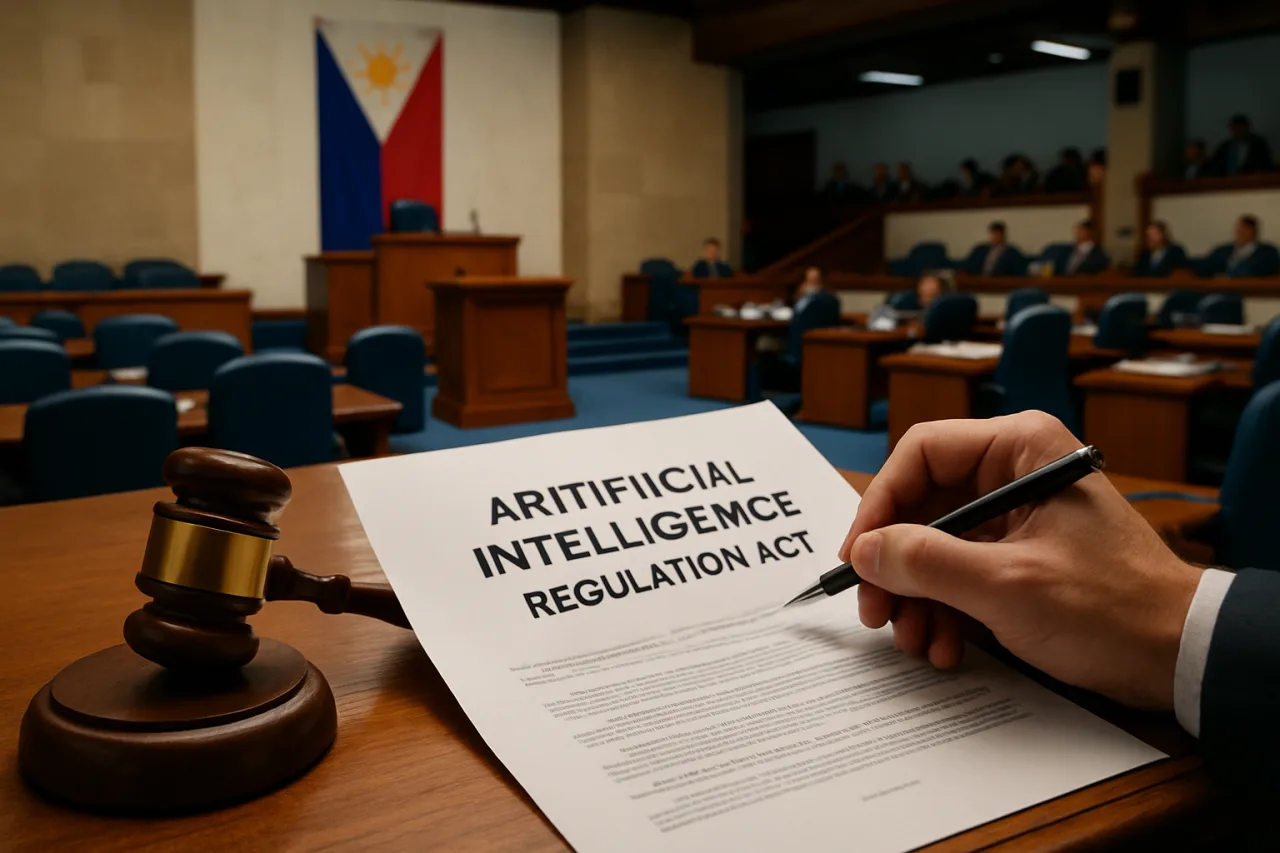
The AI bill Philippines has waited for since chatbots entered daily life is finally on the table — written, filed, and stuck. Senate Bill No. 25, the Artificial Intelligence Regulation Act (AIRA), filed July 2, 2025 in the 20th Congress, is the most comprehensive attempt yet to govern how AI is built, sold, and used in the country: it would regulate everything from ordinary chatbots to artificial general intelligence, force developers and deployers to register their systems with the government, mandate algorithmic audits for bias and security, and require clear disclosure whenever a Filipino is talking to a machine instead of a person. It would also create a National AI Commission — a new regulator with a mandate spanning the entire technology stack. Fourteen months after filing, the bill sits pending in committee, a fact confirmed on the Senate’s own legislation page as of late July 2026. This is the analysis of what SB 25 actually says, who it would touch, why it has not moved, and what its trajectory tells every Filipino professional about the rules that will govern the technology now reshaping their work.
What the AI Bill Philippines Actually Proposes: The Seven Pillars of SB 25
Reading AIRA’s architecture through the legislative summaries and the bill text filed with the Senate Secretariat, seven load-bearing elements emerge — and each one lands on a different shoulder of the local tech economy.
First, scope without escape hatches. The bill applies to all AI developers and deployers operating in the Philippines, and it reaches beyond today’s tools to explicitly cover artificial general intelligence, artificial superintelligence, and AI foundation models. That breadth is deliberate: the drafters want a framework that survives the next model generation, not one obsoleted by it. Second, mandatory registration. Section 12 conditions registration on disclosure of data sources, intended data use, safeguards used in training, and the status and dates of data collection — in effect, a census of every significant AI system in the country, with paperwork that traces each model back to its training corpus.
Third, high-risk classification. Section 16 empowers regulators to sort AI systems into risk tiers, with the high-risk tier triggering data privacy reviews before certification and mandatory algorithmic impact assessments. Fourth, algorithmic audits. Section 17 requires developers and deployers to test systems for bias, security, and privacy — the three failure modes that have defined AI’s public controversies worldwide. Fifth, disclosure duties. The same section requires clear notice when users are interacting with AI systems, and the enforcement provisions in Section 20 treat missing AI-content disclaimers as especially serious in sensitive contexts: political, medical, educational, and legal. Platforms and publishers that fail to implement monitoring or compliance protocols would share liability.
Sixth, prohibited conduct. The bill would outlaw using AI to manipulate public opinion — language aimed directly at the disinformation economy that has battered Philippine elections — alongside other abuse categories the drafters enumerate. Seventh, a National AI Commission. SB 25 consolidates oversight in a new body with the power to certify, audit, and enforce, a structure that answers the institutional fragmentation UN assessments keep flagging as one of the country’s worst AI-readiness barriers. The Senate’s own bill page confirms the long title’s ambition: regulating AI systems while promoting ethical and responsible development — the classic double mandate of every AI law being drafted worldwide.
Who Would Feel the AI Bill Philippines Law First — and How Hard
Regulatory breadth is abstract until it is priced. Under SB 25, the first Filipinos to feel the law would be the companies already selling AI: the local BPO and IT enterprises deploying AI agents into client workflows, the startups fine-tuning models on Filipino data, the platforms serving AI-generated content to millions of users. Registration, audits, and impact assessments are compliance line items — real money for small firms, rounding errors for telco-scale players. The AI bill Philippines registration triggers, requiring information about data sources and safeguards, would land hardest on companies that scraped Filipino data without documentation, a category that includes more local AI products than anyone in the industry says out loud.
The second ring of impact is institutional. Hospitals using AI triage, schools adopting AI tutors — the very deployments the Department of Education is pioneering with platforms like Project LIGTAS — would operate under disclosure and audit duties that raise the cost of adoption while lowering the risk of harm. Banks and fintechs, already the most regulated AI users through BSP circulars and NPC privacy rulings, would face a second compliance stack; the question every compliance officer is already asking is whether the two regimes can be reconciled or will simply double the paperwork.
The third ring is the public — and here the bill’s design choices get genuinely interesting for professionals watching the global AI-governance debate. Section 20’s escalation of penalties for undisclosed AI content in political contexts is aimed at the deepfake and astroturfing problem that has already reached Philippine Senate hearings, with celebrities testifying about non-consensual explicit AI imagery. The FMA’s analysis of the 20th Congress documents how technology-facilitated gender-based violence drove much of the legislative energy — SB 25 is the comprehensive bill in a field that also includes deepfake-specific measures, and its drafters chose to fold those harms into general AI regulation rather than wait for a patchwork. For Filipino professionals in media, healthcare, education, and law, the practical read is this: if you publish or deploy AI-generated content in any of those four sensitive contexts, the AI bill Philippines as drafted makes your disclaimer a legal obligation, not an etiquette choice.
Why the Bill Is Stuck — and Whether That Matters
The honest answer to “why hasn’t SB 25 moved” is that AI regulation has no natural Philippine constituency with legislative leverage. Consumer groups lack the organized lobbying muscle of the business chambers that historically move tech-adjacent legislation; the agencies that would administer the regime — an NPC already stretched, a DICT still building capacity — cannot lobby for jurisdiction without admitting current gaps; and the private sector is split, with larger incumbents quietly welcoming rules that raise rivals’ compliance costs and smaller developers openly fearing the compliance bill. Add the arithmetic of the 20th Congress’s calendar — priority measures, budget season, and the 2027 midterm horizon — and fourteen months of committee inactivity stops being mysterious.
Whether the delay matters depends on which risk you weigh more. The cost of waiting is visible in the enforcement gap: while Congress deliberates, the NPC has been improvising AI-adjacent oversight through the Data Privacy Act — its 2025 cease-and-desist order against the iris-scanning World App showed regulators reaching for old tools to police new technology, and winning, but on privacy grounds rather than AI-specific ones. Every month without an AI statute is a month of precedent accumulating under laws drafted in 2012. The cost of rushing is equally real: a premature registration regime could freeze the startup sector the national AI strategy is supposed to grow, or push AI deployment into regulatory arbitrage through Singapore. The honest answer is that both risks are real, and the quality of the eventual law — not its speed — is what determines which dominates.
There is also the design critique that policy specialists keep raising: SB 25’s National AI Commission concentrates enormous discretion in one new body, and the bill’s obligation architecture — developers and deployers alike — blurs the liability line between those who build models and those who merely use them. Comparative jurisdictions are converging on differentiated duties for model developers versus deployers; an AI bill Philippines law that treats a startup fine-tuning an open model identically to the model’s original creator risks either chilling local adoption or being quietly ignored. These are amendable flaws — which is why the committee stage, where the bill currently sleeps, is precisely where the next twelve months of Philippine AI policy will actually be decided.
The Regional Stakes: What the Philippines Regulates While Others Wait
The regional context sharpens the stakes. ASEAN has moved first on high-level principles and is now operationalizing them — the Philippines’ chairmanship year put AI on the summit agenda, and the country hosted the ASEAN AI Summit for MSMEs in September 2026, a deliberate signal that adoption, not just regulation, is the regional priority. Indonesia, Vietnam, and Thailand are each moving at their own pace; Singapore’s model AI governance framework remains the reference text for Southeast Asian policymakers. The Philippines’ choice is therefore not whether to regulate but how to regulate without losing the adoption race its own strategies promise — and the window in which an AI bill Philippines law could be framed as enabling rather than restrictive is the same window the Senate is currently spending on other priorities. Regional trackers, from the Digital Policy Alert to ASEAN secretariat papers, log every step.
For Filipino professionals, the pragmatic response to SB 25’s limbo is preparation that pays off under any outcome. Compliance-adjacent skills — privacy impact assessment, algorithmic audit literacy, AI vendor due diligence — appreciate whether or not the bill passes, because sectoral regulators and the NPC are already moving. Businesses deploying AI should inventory their systems now: which tools touch personal data, which produce content in the sensitive contexts SB 25 flags, which decisions are materially automated. That inventory is the first homework assignment of an AI bill Philippines law that has not been passed yet — and the asset that makes adoption trivial rather than traumatic when it is. Our coverage of the country’s AI readiness gaps and our analysis of the decisions no AI agent should make alone frame the same conclusion from different directions: governance, like capability, rewards the prepared.
The honest bottom line: the AI bill Philippines needs is written, filed, and waiting — and the wait is itself a policy choice with costs compounding quietly. SB 25’s seven pillars map the future rules of Philippine AI with unusual clarity: registration, risk classification, audits, disclosure, a commission, enforcement, and a scope that already anticipates superintelligence. What remains is the part of lawmaking no draft controls — the politics of deciding whose AI future gets protected first. When the Senate’s committee calendar finally reaches it, the professionals who read the bill now will be the ones shaping how it lands.
Frequently Asked Questions
What is Senate Bill 25, the AI Regulation Act?
SB 25 is the Artificial Intelligence Regulation Act (AIRA), filed July 2, 2025 in the Philippines’ 20th Congress. It proposes a comprehensive regulatory regime for AI development and use — covering AGI, superintelligence, and foundation models — with mandatory registration, high-risk classifications, algorithmic audits, disclosure duties, and a new National AI Commission as regulator.
What is the current status of the AI bill Philippines Congress is considering?
The AI bill Philippines has awaited remains pending in Senate committee. As of the Senate’s own July 2026 status listing, AIRA has not advanced to plenary debate, more than a year after filing. No companion framework has been enacted into law.
Who would be covered under the AI bill Philippines filed as SB 25?
All AI developers and deployers operating in the Philippines. Duties scale with risk: registration requires disclosure of data sources and safeguards; systems classified as high-risk face privacy reviews and algorithmic impact assessments before certification; all deployers must disclose when users are interacting with AI.
What are the penalties under the proposed AI law?
Section 20 sets out the enforcement regime, with missing AI-content disclaimers treated as especially serious in political, medical, educational, and legal contexts. Platforms and publishers would face liability for failing to implement monitoring and compliance protocols, and using AI to manipulate public opinion would be a prohibited act.
How would SB 25 affect ordinary Filipino workers and businesses?
Businesses deploying AI would face registration, audit, and disclosure duties; consumers would gain the right to know when they are dealing with AI systems and stronger remedies against harms like malicious deepfakes. Compliance costs would fall hardest on small AI startups, while enterprises already under privacy regulation would add an AI-specific layer.
Is the Philippines the only Southeast Asian country regulating AI?
No. The region is moving at different speeds — Singapore leads with its model governance framework, while Indonesia, Vietnam, and Thailand are advancing their own approaches. The Philippines’ SB 25 would be among the region’s most comprehensive if passed, which is why its progress is watched regionally.
Financial Disclaimer
This article is provided for general information and educational purposes only. It does not constitute legal, financial, or investment advice, and the status and contents of pending legislation may change without notice. For authoritative information on the bill, consult the Senate of the Philippines’ official legislative documents, and seek advice from a qualified professional before making compliance or investment decisions.