Table of Contents
Reading Time: 8 minutes
₿ THE CRYPTO BOARD — Monday, September 28, 2026: BTC ~$84,241 (−0.06% 24h) · US spot BTC ETFs: $2.39B net inflows last week (largest of 2026) cooling to $134.47M Friday — seventh straight positive day · ETH ETFs 7-day net +$740.57M · SOL ETFs 12 straight weeks of inflows · $82,000 = the standing OFW tranche trigger.
Key Takeaway
- 📊 Bitcoin ETF inflows set the 2026 record at $2.39B last week — then cooled 87% by Friday ($134.47M, the seventh straight positive day). Deceleration after a record is pattern, not panic: the same week held seven green days.
- 🏦 River’s supply-side counter-read complicates the narrative: ETFs bought only ~18,000 BTC in September — the rally toward $84,000 was carried more by shrinking available supply than by ETF demand alone. Both facts can be true at once.
- 💰 The practical read for the ₱82,000 tranche plan: the standing OFW trigger sits $2,200 under Monday’s price — cool-down weeks are for writing rules, not for chasing green candles.
- 📉 Ethereum is quietly out-inflowing Bitcoin on the weekly frame (+$740.57M over 7 days per the flow trackers) — the rotation story inside the cooling story.
- 📋 You can finish this piece with three written triggers — what confirms the cool-down, what reverses it, and what the $82,000 rule says to do in each case.
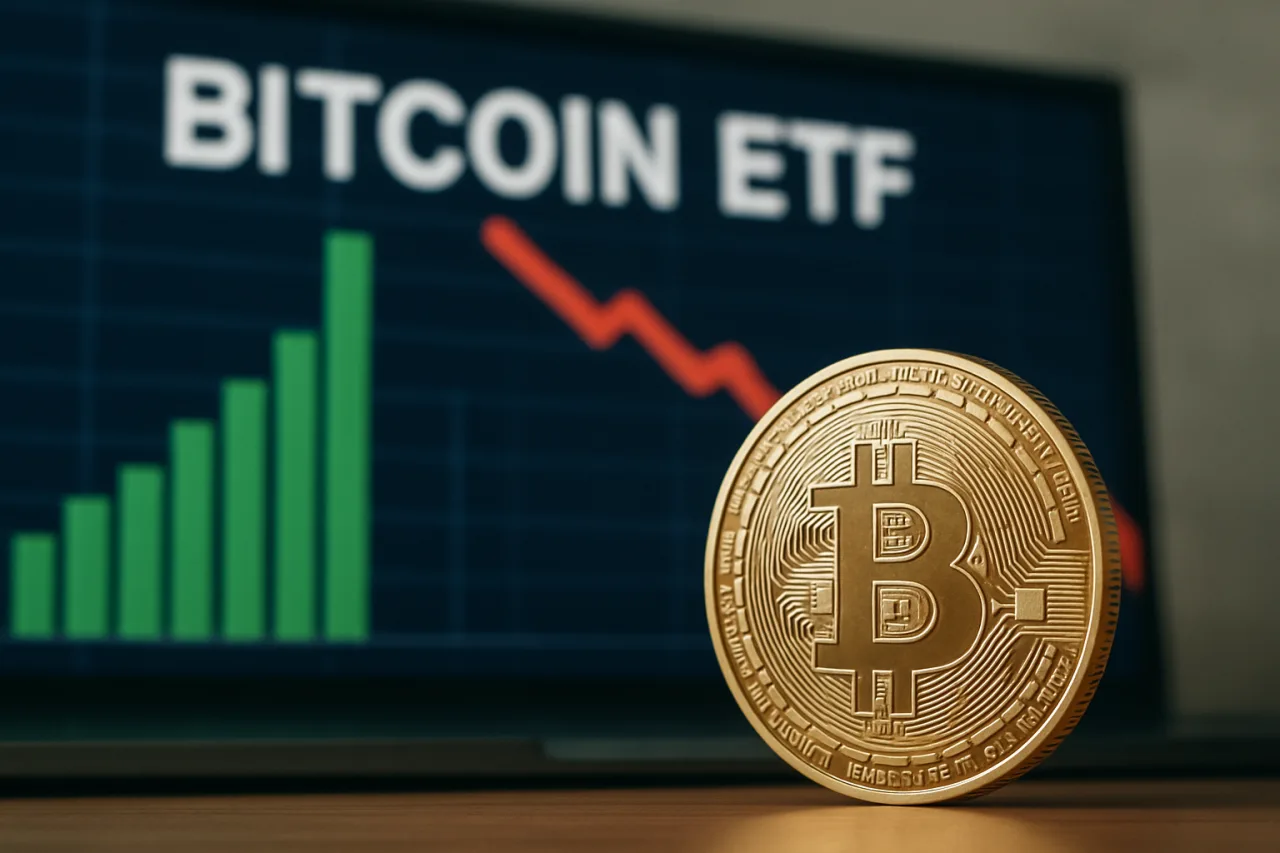
The week that just ended was, by the flow numbers, the strongest Bitcoin ETF inflow week of Bitcoin’s 2026 — and by Friday it was also the clearest lesson in how institutional momentum actually breathes. US spot Bitcoin ETF inflows hit $2.39 billion for the week, the largest weekly total of the year, with a multi-day streak that carried the price toward $84,000. Then the daily prints began shrinking: each session smaller than the last, down to $134.47 million on Friday — about 87% below Monday’s pace, though still positive, still buying, the seventh consecutive day without an outflow. Bitcoin sits at roughly $84,241, essentially flat on the day. Meanwhile the counter-narrative arrived from River’s September 23 report: ETFs had bought only about 18,000 BTC for the whole month — the rally’s fuel was as much shrinking sell-side supply as returning demand. Both readings matter for the OFW investor running the ₱82,000 tranche plan from Crypto Watch #002: decelerating inflows are a reason to check the rules, not to abandon them — and the three triggers below are those rules, written out before the next green candle tempts anyone into improvisation.

The Week in Bitcoin ETF Inflows — the Full Shape, Not Just the Peak
Reading Bitcoin ETF inflows as one number misses the shape, and the shape is the information. Monday’s pace carried the week’s total; each subsequent session printed smaller; Friday’s $134.47 million was the smallest positive day of the streak but the seventh straight day the ETFs were net buyers. The Yahoo Finance/BeInCrypto tape flagged the pattern — “ETF buying had shrunk three sessions running” — while the price held the $84,000 area, down 0.06% in 24 hours at Monday’s print. The shape tells you three things: institutional Bitcoin ETF inflows are real but pace-dependent (they breathe); the seven-day streak shows no reversal, only deceleration; and the distinction matters enormously for how the ₱82,000 rule executes. The 2026 context for Bitcoin ETF inflows sharpens the read: the year’s previous record week came in the same early-September window, August delivered roughly $3 billion of inflows before one $200M outflow session, and the SoSoValue flow trackers now count $2.97 billion over the trailing seven trading days. A market that set its annual Bitcoin ETF inflows record two weeks ago and cooled 87% by Friday is not a market in retreat — it is a market that absorbed its own good news and is waiting for the next confirmed input. The next confirmed inputs are dated: the Fed’s October odds (66%), Wednesday’s US inflation print, Friday’s payrolls — the same macro calendar steering the peso and gold this week.
WorldNgayon Analysis: Flow data is the institutional footprint, not the institutional mind — deceleration after a record is breathing; the reversal signal would be red days stacked against the week’s macro prints, and that is what the triggers below watch for.
Bottom Line: $2.39B in, seven green days, an 87% daily deceleration — the week’s shape says pause, not pivot.
Bitcoin ETF Inflows Meet the Supply Read — Why 18,000 BTC Changes the Demand Story
The most useful counterweight to the inflow narrative arrived September 23 from River: as of that report, ETFs had bought only about 18,000 BTC in September — a modest institutional footprint against Bitcoin’s daily issuance and the market’s actual turnover. The implication cuts both ways, and the discipline is to hold both: if ETF demand was modest and the price still rallied toward $84,000, then supply-side forces — long-term holders not selling, issuance halving effects, coins leaving exchanges — did more work than the flow headlines credit. That matters for the cool-down week precisely because flow-chasing narratives dominate the retail feed: a trader reading only the ETF tape would have bought the $2.39B headline at the top of the momentum and faced Friday’s 87% deceleration without context. The supply-side frame converts the Bitcoin ETF inflows cool-down from scary to structural: demand was never the sole engine, so a decelerating demand number is not a verdict on the rally. The practical translation for the tranche plan is a confirmation hierarchy — Bitcoin ETF inflows confirm, price levels trigger, macro prints decide — and the three rules below write that hierarchy down in execution order.
Bottom Line: When demand cools but supply holds, price does not follow flows down — the 18,000-BTC fact is why the cool-down reads as consolidation, not exodus.
Ethereum’s Quiet Rotation — the Second Story Inside the Numbers
While Bitcoin ETF inflows decelerated, Ethereum’s did the opposite: the 7-day net flow shows roughly +$740.57 million into ETH products against Bitcoin’s cooling pace, with the trackers logging +31,399 ETH ($76.99M) on a single day and the multi-week streak intact. The rotation thesis from Crypto Watch #002 strengthens: the 2026 institutional book is not a Bitcoin trade with altcoin crumbs — it is a barbell, with Bitcoin as the macro asset (Fed odds, dollar strength, digital gold framing) and Ethereum as the productivity asset (staking yield, stablecoin settlement, the rails institutional products actually run on). The OFW-relevant consequence is allocation shape, not timing: a ₱82,000 tranche plan that ignores ETH entirely is making an unpriced bet on the Bitcoin narrative — the Maya dual-listing analysis shows where PH fintech exposure lives — and the flow data says the institutions are not making that bet. The practical implementation stays boring by design — broad vehicles, documented sources, no leverage — because the rotation thesis does not need leverage to compound; it needs patience and the same written-trigger discipline the Bitcoin side runs.
Bottom Line: The barbell is the institutions’ shape — the tranche plan that mirrors it inherits their diversification without their research budget.
The ₱82,000 Tranche Rules — Three Triggers, Written Before the Tape Moves
The rules for the week, in execution order: Trigger one — the confirmation line ($82,000): the standing OFW tranche trigger from #002 stays — a confirmed daily close below $82,000 with negative ETF flows in the same window is the cool-down becoming a correction; that combination is the buy-the-tranche signal, not the panic one, because the plan was built to buy weakness on schedule. Trigger two — the reversal print (daily inflows back above $500M): a single session at that scale after a deceleration week has historically marked momentum resumption; the rule says let the first $500M+ day complete, then evaluate the ADD tranche against the ₱82,000 floor — never pre-position before the print. Trigger three — the macro veto (Friday payrolls): a hot US jobs print that pushes Fed October odds toward 70% compresses all risk assets including Bitcoin; the rule says the tranche scheduled for that week simply waits for the following week’s first green flow day — the veto is calendar-based, not price-based, and it keeps the plan from buying into a macro air pocket. Three rules, all written before Wednesday’s print, all executable from the GStocks and GCrypto rails without any midnight chart-watching. The BSP’s licensed-VASP framework remains the only lane this series recommends for Philippine conversions — Coins.ph, PDAX, GCrypto — because the tranche plan’s integrity depends on the rails being boring.
Bottom Line: Write the three triggers now — $82,000 confirmation, $500M reversal print, Friday’s macro veto — and the coolest week of the year becomes the most useful one.
What Would Change This Reading — the Two Watch Conditions
Condition one — a red-streak print: two consecutive outflow days above $200M each (the August pattern’s worst session was one at $200M+) inside the same week as a hot payrolls number would flip the reading from deceleration to distribution; the tranche rule answers it mechanically — the $82,000 close-plus-red-flows combination is the ADD signal, scaled to the plan, not the exit signal, because the series’ whole architecture buys confirmed weakness on schedule. Condition two — an acceleration print: a $700M+ day (the scale of the early-September record days) before Friday would confirm the cool-down was digestion; the plan’s response is patience, not FOMO — the ADD tranche still waits for the ₱82,000 zone or the written level, because the series does not chase institutional momentum with retail timing. Both conditions are already priced into the rules; that is the difference between a plan and a prediction. The flow trackers update daily; the Wednesday PCE print and Friday payrolls are the dated events; and the discipline — reading the shape, not the headline — carries the OFW wallet through any of them.
WorldNgayon Analysis: The most expensive mistake in a cooling tape is narrative whiplash — bullish on the record week, bearish on the Friday print. The triggers exist so the narrative noise never reaches the execution layer.
Bottom Line: The plan already contains both futures — red streak and acceleration print — which is why the cool-down costs the disciplined reader nothing but attention.
Frequently Asked Questions
Why did Bitcoin ETF inflows slow down last week?
After the year’s record $2.39B weekly total, daily prints shrank each session to $134.47M by Friday — an 87% deceleration from Monday’s pace, though all seven days stayed net-positive. The pattern reads as momentum absorption after a record week; River’s data adds that ETFs bought only ~18,000 BTC in September, meaning supply dynamics did much of the price work — so the cool-down is demand breathing, not demand leaving. The shape also matters for execution timing: the streak means no session forced a reprice, and the deceleration happened into a standing price — the institutions digested the record rather than reversing it, which is historically the pattern that precedes either consolidation weeks or a fresh acceleration leg once the next macro input confirms direction.
Is $84,000 still a good Bitcoin entry level for OFW investors?
The tranche framework treats zones, not moments: $82,000 remains the standing trigger for confirmed-weakness ADD tranches, while the current $84,200 area is a hold-and-rule zone — the three triggers ($82K confirmation, $500M reversal print, Friday macro veto) decide execution, and no single day’s print overrides them.
What is River’s supply argument about Bitcoin?
River’s September 23 report noted ETFs purchased only ~18,000 BTC in September while the price rallied toward $84,000 — implying supply-side forces (holders not selling, coins moving off exchanges, issuance pressure) did more work than ETF demand alone. The reading matters because it reframes decelerating inflows as less predictive of price than the headlines imply.
Should OFW investors buy Ethereum ETFs instead?
The flow data shows Ethereum’s 7-day net inflows (+$740.57M) outpacing Bitcoin’s cooled pace — the institutional barbell thesis. The practical answer is allocation shape, not a swap: a tranche plan split across both broad vehicles mirrors what the institutions are actually doing, sized to money whose loss would not change the family’s month.
What macro events move Bitcoin this week?
The same calendar steering the peso: the Reserve Bank of Australia’s rate decision Tuesday, the US PCE inflation print Wednesday, and US nonfarm payrolls Friday. A hot payrolls print pushing Fed October hike odds toward 70% pressures all risk assets including Bitcoin; a cool PCE would ease it — the tranche rules key to these dates, not to daily candles.
Financial Disclaimer: This article is for general information and education, not personalized investment advice. Crypto assets are volatile and may lose value; flow data reflect third-party tracker estimates as of September 28, 2026. WorldNgayon.com is not an investment adviser; verify figures with licensed channels (BSP-registered VASPs for Philippine conversions) before acting.