Table of Contents
Key Takeaway
- 🏦 What happened: the Western Union JuanPay partnership, announced September 2, 2026, puts international money transfer services into more than 1,400 JuanPay stores across the country.
- 📍 What it means for families: cash pickup of remittances from abroad moves closer to home — senders can also pay via Western Union’s app or web, receivers claim funds at a JuanPay counter with a reference number and valid ID.
- 💰 Why the timing matters: the peso just hit a record-low ₱62.565 per dollar, and the first half of 2026 saw $17.15 billion in cash remittances — up only 2.4 percent, the slowest growth in years. Every channel fight is now also a price fight.
- ⚔️ The bigger story: the world’s oldest remittance brand is doubling down on physical cash networks at the exact moment digital wallets are winning the volume war — a signal that the last mile of Filipino money is still cash.
- ✅ What to do: check whether your beneficiary’s town has a JuanPay store, compare fees against your current channel, and verify any remittance agent’s authorization before transacting.
Western Union JuanPay partnership news landed quietly on September 2, between a Fed scare and a peso record — but for millions of Filipino families, it may matter more than either. The American money-transfer giant and the homegrown fintech announced that international remittances can now flow through more than 1,400 JuanPay stores nationwide, putting a global payout network inside neighborhood shops that already handle bills payment and e-loading. For the OFW mother in Dubai, nothing changes about how she sends; for the grandfather in the barangay who walks to claim her padala, everything changes about how close he walks.
Western Union JuanPay: What the Partnership Actually Covers
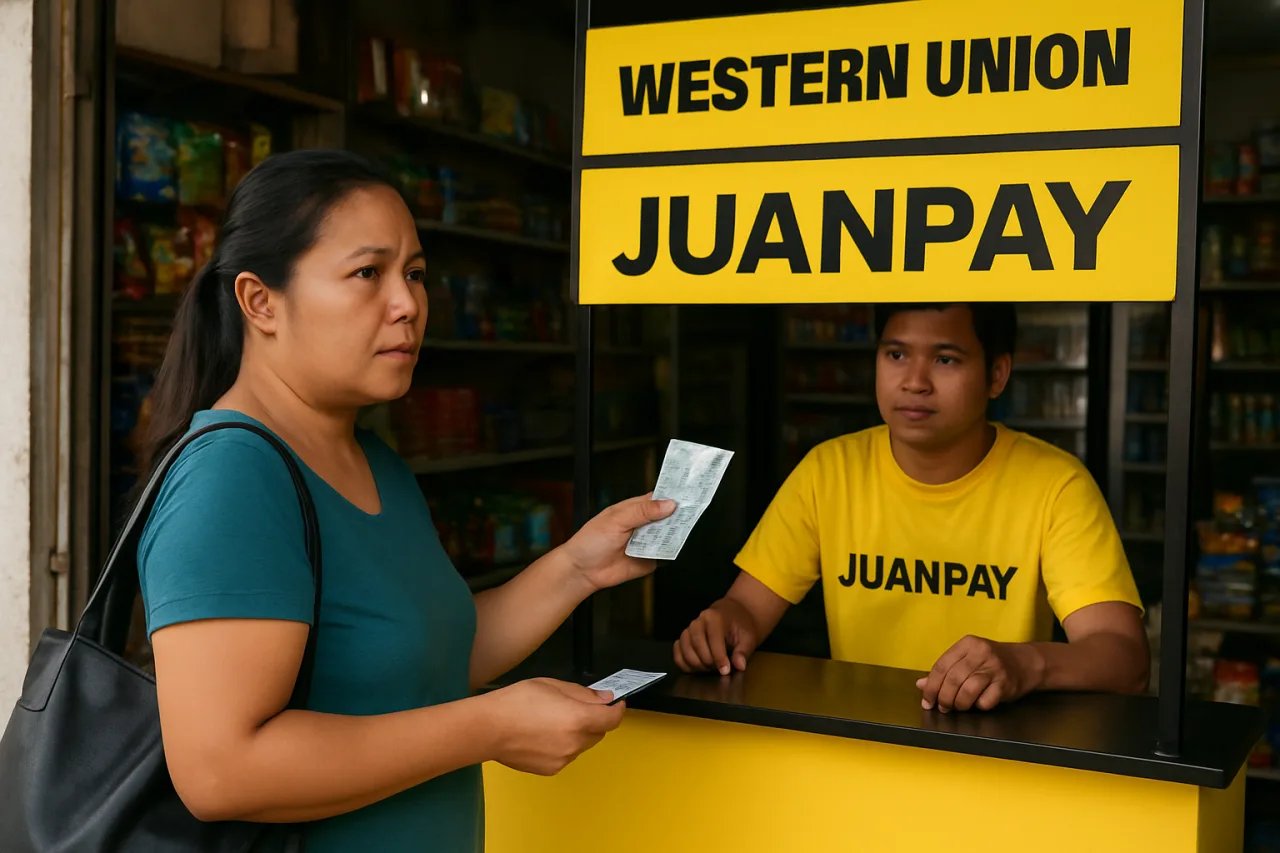
The deal itself is straightforward. The Western Union JuanPay arrangement makes JuanPay’s store network part of Western Union’s payout infrastructure: money sent from abroad through Western Union’s app, website, or agent network can be collected in cash at participating JuanPay locations. The rollout starts with more than 1,400 stores, and both companies describe it as the beginning of a wider expansion. Senders keep the familiar Western Union flow — including the money-transfer control number that receivers present, along with a government-issued ID, to claim funds. Receivers gain a new set of counters where that transaction can happen.
The executive lineup at the signing told the story of two companies that need each other. Western Union sent Don Alair, its country director for the Philippines; Gregory Laurent, regional vice president for Japan, the Philippines, Australia, New Zealand and the Pacific Islands; and Vince Tallent, senior vice president for APAC. JuanPay answered with chairman Rico Fernando Chico, president Atty. Rafael Padilla, and director Arlene Chico. That is not a ceremonial roster — it is a country director, a regional vice president, and an APAC senior vice president flying in to stand beside a Philippine fintech’s founding family, which tells you how much strategic weight Western Union is putting on this archipelago.
What makes the deal notable is what Western Union said alongside it: its Philippine business is growing faster than the broader remittance market. In a year when overall flows are flattening — the Bangko Sentral ng Pilipinas reported first-half cash remittances of $17.15 billion, up just 2.4 percent from a year earlier — the company is not riding a wave. It is fighting for share, and it chose to fight with store count.
Why the World’s Oldest Money Mover Is Betting on Barangay Counters
Western Union has been moving money since 1851 — it predates the telephone, the automobile, and the Philippine republic. That longevity comes from a habit few fintechs have matched: following the customer’s actual behavior rather than the industry’s predictions about it. The prediction for the last decade has been that digital wallets would make cash pickup obsolete. The reality in the Philippines is more stubborn. Bills still need paying in cash at rural banks and village stores; grandparents still prefer a counter, a receipt, and a human being over an app notification; and according to the companies themselves, communities with strong OFW ties wanted more places to receive money without traveling to a city mall. The Western Union JuanPay pairing works precisely because each side supplies what the other cannot build alone — global rails on one side, neighborhood trust on the other.
JuanPay’s network solves Western Union’s last-mile problem the way pawnshops did a generation ago. The neighborhood store is already trusted, already staffed, already equipped with the compliance paperwork that money services businesses require, and already visited weekly for e-loading and bills payment. Bolting remittance payout onto that existing trust is cheaper than building it — for Western Union, which gains reach without capital expenditure, and for JuanPay, which gains foot traffic and a brand partnership no local marketing budget could buy. The consumer barely notices the machinery; they notice that Tita’s padala can now be claimed two streets away instead of two jeepney rides away.
There is also a defensive logic. Digital-first players — GCash, Maya, and a dozen remittance apps — have been compressing fees and delivery times for years, and bank-to-bank transfers via InstaPay have made account crediting nearly instant. If the future were purely digital, Western Union’s counter network would be a museum. But the BSP’s own financial-inclusion surveys keep finding the same thing: a large share of Filipino adults remain unbanked or underbanked, and cash-in-hand remains the format families actually spend. The Western Union JuanPay bet, stated plainly, is that the last mile of Filipino money stays physical for at least another decade — and that whoever owns the counters owns the customer relationship that apps cannot dislodge.
The Timing: A Record-Low Peso Meets a Flattening Remittance Market
The partnership lands at a genuinely strange moment in the remittance economy. The peso closed at a record ₱62.565 per dollar on September 2, which means every dollar earned abroad converts into more pesos than at any point in Philippine history — we broke down the arithmetic in our report on the record peso and what a $500 remittance now buys. Yet the volume data is the softest in years: 2.4 percent first-half growth, well below the historical norm, with an expert quoted by BusinessMirror in August suggesting money sent home may be plateauing. Fewer dollars are not the problem — each dollar is worth more — but slower flow growth changes how aggressively every remittance company must compete for each transaction.
Competition, in turn, is shifting from speed to price and reach. When the market grew seven percent a year, every player could grow without fighting. At two percent, growth is taken, not given — and the weapons become payout coverage, fee transparency, and exchange-rate margins. That is the real meaning of 1,400 new counters: the Western Union JuanPay alliance is arming itself for a share war at the exact moment the pie stops growing. The Federal Reserve’s September 15-16 decision, with a hike priced at roughly 70 percent odds, adds another layer — we mapped the transmission to Filipino wallets in our analysis of the 70 percent September rate-hike odds. Whatever the Fed does, the dollar-peso rate that determines what a padala is worth will stay volatile, and families who can claim money closer to home will also be able to time conversions better — claiming when the rate favors them rather than when the queue at the mall finally lets them.
How to Actually Use It: A Practical Guide for Families
For senders, the process starts the same way it always has with Western Union: send from the app, the website, or any Western Union agent location abroad, entering the beneficiary’s details as usual. The change is on the receiving side — when choosing a payout method, the sender can now direct the transfer for cash pickup at a JuanPay store. The beneficiary claims the money by presenting the transfer reference number and a valid government-issued ID at the counter, exactly as the cash-pickup process works at any Western Union location. No JuanPay account is required to receive; no new app needs to be installed; the transaction runs on Western Union’s compliance and settlement rails.
For families deciding whether to switch channels, three checks are worth ten minutes. First, coverage: confirm that a JuanPay store near the beneficiary actually participates — partnership announcements often roll out in waves, and the first 1,400 stores will not cover every barangay on day one. Second, cost: compare the total cost of the transfer — fee plus exchange-rate margin — against the current channel, because headline fees can hide wider spreads. Third, legitimacy: verify that any money services counter is registered with the Bangko Sentral, whose supervisory framework for remittance agents exists precisely so that families can check who is authorized to hold their money. The BSP maintains registration records for remittance and transfer companies, and five minutes on its website beats any flyer. Beneficiaries abroad who want an extra layer of assurance can also check deployment and agency statuses through the Department of Migrant Workers before routing money through new intermediaries.
One habit deserves special mention in this season of record rates: claim promptly and convert deliberately. Cash sitting unclaimed in the remittance system earns nothing, and rates this volatile make “I’ll pick it up next week” an accidental currency bet. With the Western Union JuanPay network putting counters closer to home, the excuse for delay shrinks — and so does the temptation to accept whatever rate the moment offers. The families who treat each remittance as a scheduled decision, not a scramble, capture the arithmetic instead of suffering it.
What This Means for the Remittance Giants’ War
Zoom out, and the Western Union JuanPay partnership is one battle in a larger war for the ₱2-trillion-plus that flows into the Philippine economy through formal and informal channels each year. Western Union brings the global network, the compliance stack, and 175 years of brand recognition that older beneficiaries trust without a second thought. JuanPay brings modern store economics and local ownership. Together they are targeting the segment digital wallets still struggle with: cash-preferred receivers outside metro centers. Meanwhile, digital players target the segment that never visits a counter at all. Both strategies can win simultaneously, because the Philippine market is not one audience — it is a metro professional paying tuition through an app and a farm town lolo waiting for a text message, and the two live in different financial centuries.
The competitive pressure will eventually show up where families can feel it: payout locations multiply, fee promotions sharpen, and the exchange-rate margins quietly tighten as each player tries to be the channel of choice. None of the providers will advertise their margin, which is why the discipline of comparing total cost per transfer — not just the headline fee — remains the most profitable habit a remittance family can build. Our guide to new OFW protections and what they cover complements this picture on the labor side; the money side rewards the same vigilance.
The Western Union JuanPay partnership is, in the end, a bet that proximity is the feature no app can delete. September 2’s announcement put 1,400 counters into that bet. If the early reads are right that Western Union is outgrowing the market, expect the number to grow — and expect every rival to answer with locations of their own. The winners of this war will be the families who understand that in remittances, convenience is currency too.
Frequently Asked Questions
What is the Western Union JuanPay partnership?
Announced on September 2, 2026, it makes international money transfer services available through more than 1,400 JuanPay stores across the Philippines. Money sent abroad via Western Union can be collected in cash at participating JuanPay counters, expanding payout access beyond traditional agent locations like banks and pawnshops.
How do I claim a Western Union remittance at a JuanPay store?
The receiver presents the money-transfer control number from the sender, along with a valid government-issued ID, at a participating JuanPay store counter and collects the funds in cash. No JuanPay account or app is required to receive money; the transfer itself runs on Western Union’s system.
How many JuanPay locations are included in the Western Union JuanPay rollout?
The partnership launches with more than 1,400 JuanPay stores nationwide, and both companies describe it as the start of a broader expansion. Coverage will vary by area at first, so families should confirm participation at their nearest store before relying on it.
Does the Western Union JuanPay partnership change fees?
The companies have not announced specific fee changes with the rollout. Remember that the total cost of any remittance includes the transfer fee and the exchange-rate margin, so families should compare the full cost against their current channel rather than assuming new locations mean lower prices.
Why is Western Union expanding physical locations when everything is going digital?
Because Filipino receivers still prefer cash in hand, and a large share of the population remains unbanked or underbanked. Western Union also reported that its Philippine business is growing faster than the broader remittance market — evidence that counter-based cash pickup remains a competitive advantage, not a legacy burden.
How can I verify a remittance operator is legitimate?
Check the Bangko Sentral ng Pilipinas registration records for money service businesses before transacting, and confirm agents through official provider websites. Legitimate operators will always issue official receipts, require valid identification for pickup, and never ask for fees to “release” a remittance — requests like that are a classic scam pattern.
Financial Disclaimer
This article is provided for general information and educational purposes only. It does not constitute financial advice, and fees, coverage, and service terms for remittance providers change frequently. Always verify current rates, charges, and store participation directly with the providers, and consult the Bangko Sentral ng Pilipinas registry to confirm that any money service business you use is duly registered before sending or receiving money.