Table of Contents
📱 THE BOARD — Thursday, October 1, 2026 → Events Intelligence: Singapore FinTech Festival 2026 (Nov 18-20): the world’s largest fintech gathering — MAS + GFTN + ABS, five forces rewiring finance, Bret Taylor on stage · the artifact: the remote-watch dossier — what Filipino fintech professionals extract from Singapore week without a ticket, the five forces mapped to Philippine rails, and the media-accreditation path · kw: Singapore FinTech Festival
Key Takeaway
- 🌍 The scale and the stage: the Singapore FinTech Festival 2026 runs November 18-20 at Singapore EXPO — organized by the Monetary Authority of Singapore, the Global Finance & Technology Network, and the Association of Banks in Singapore — with confirmed changemakers including Bret Taylor (CEO of Sierra, OpenAI board chair), Ravi Menon, and Bundesbank President Joachim Nagel; the invite-only Insights2040 meeting precedes it (Nov 16-17).
- 🧭 The five forces are this site’s beats: technology (AI in finance vs. AI-enabled scams and quantum risk), geoeconomics (fragmenting financial networks), capital (sustaining the AI investment boom — AI-connected firms near 40% of S&P 500 cap), talent (AI-rewired skills), and policy (governance keeping pace) — each maps below to a Philippine rail.
- 🇵🇭 The Philippine stakes are direct: remittance rails, BSP-licensed VASPs, digital-bank rules, and the PH ASEAN-chairmanship fintech agenda all respond to what MAS-class events standardize — SFF week is when the region’s next regulatory and infrastructure defaults get previewed.
- 🆓 The remote-watch dossier is the artifact: the festival publishes sessions, partner announcements, and media coverage through its media hub — this piece builds the watch list (five signals, three daily extraction drills) for the Filipinos following from home.
- 📰 The accreditation path exists: media passes are formally available (registration portal, media category) — the practical door for a digital-intelligence outlet to cover SFF credibly; application runs after approval (external-send rule).
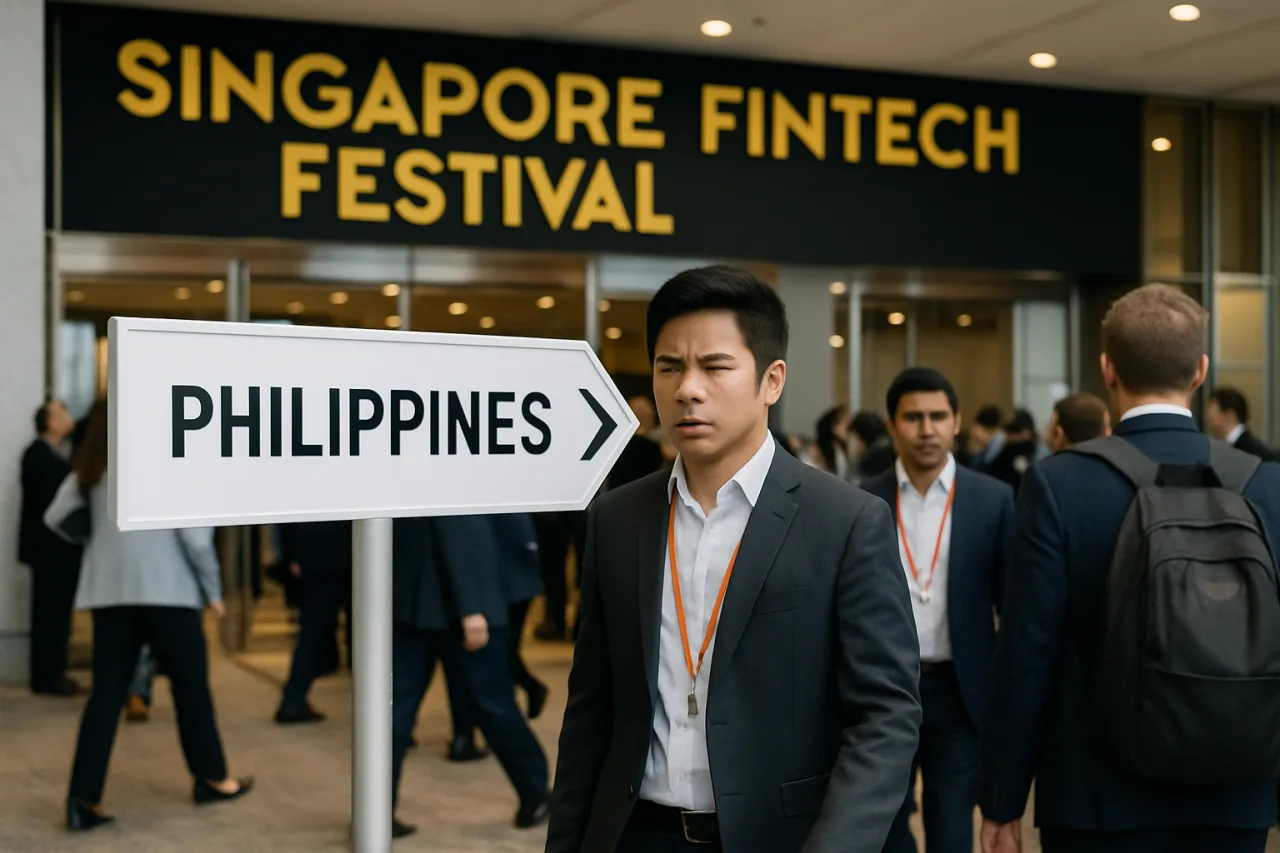
The Singapore FinTech Festival convenes November 18-20 at Singapore EXPO as the largest fintech gathering on earth — and for the Filipino professionals this site serves (fintech operators, digital-bank staff, crypto-asset readers, remittance-economy observers), it is the calendar’s single most consequential event for Philippine fintech watchers: the floor where the Singapore FinTech Festival host-agency MAS sets its agenda, global technology standards, and ASEAN’s capital flows intersect. The 2026 edition organizes around five forces rewiring finance — technology, geoeconomics, capital, talent, and policy — and the speaker slate confirms the altitude: Bret Taylor (Sierra CEO and OpenAI board chair), Ravi Menon (GFTN chair and Singapore’s former central-bank chief), Bundesbank President Joachim Nagel, ECB Executive Board member Piero Cipollone, and BNY’s chief product officer among the confirmed. This register’s final episode (#009 in the Oct-Dec tech events board) is built for the honest majority reading from Manila or Riyadh: a remote-watch dossier that turns three Singapore days into Philippine decisions — what to follow, what each five-force theme means for the rails Filipino money rides, and how a credible digital-intelligence outlet (this one) applies for the media accreditation the festival formally offers. The companion reading on the site stays live: the Singapore fintech funding analysis (87% of ASEAN’s capital) holds the money baseline this event moves.
The Singapore FinTech Festival’s Five Forces Mapped to Philippine Rails
Force 1 — technology (AI in finance vs. AI-enabled scams and quantum): the festival’s core tech programming centers on intelligent financial systems and agentic finance — while confronting the same AI-scam wave this site’s Cyber Watch tracks against Filipino victims (the 596-complaint OFW baseline, the BER-season scam economy); the Philippine extraction: whichever scam-defense standards SFF normalizes (shared fraud-intelligence, AI-driven transaction monitoring) preview what BSP and the banks’ compliance floors will require next — the OFW-protection layer of this watch. Force 2 — geoeconomics (fragmenting networks): session themes examine how financial networks adapt as trade and capital flows re-route — read against the Luzon Economic Corridor’s US-Japan industrial financing and the peso’s 2026 stress (the World Investment Watch’s macro lane), this is the force that prices WHERE Philippine funding and settlement connections run in 2027. Force 3 — capital (the AI investment boom): the headline question — can productivity gains sustain AI-connected firms at ~40% of S&P 500 capitalization — is the same valuation-debate our crypto and AI Watch pricing handles weekly; the fintech-side takeaway is the funding flow: Singapore’s capital stack (the 87% analysis) determines which ASEAN fintechs scale — and whether Philippine players raise from Singapore or get bought by it. Force 4 — talent (AI-rewired skills): the sessions on workforce transformation map directly to the Filipino fintech and BPO professional’s 2027 skill pricing — the same five-bets logic our AI Revolution Summit episode ran, exported to the finance layer: risk-and-compliance AI skills price highest in this force’s framework. Force 5 — policy (governance and resilience): MAS-class frameworks (AI risk governance, quantum-readiness timelines, stablecoin and settlement rules) become the templates ASEAN regulators borrow — with the Philippines holding the ASEAN chair this year, SFF week’s policy signal transmits into DEFA-era regional rules the DEFA analysis already tracks; the policy force is the one Filipino fintech professionals should follow minute-by-minute.
Bottom Line: Scam-defense standards, corridor financing, capital flows, skill pricing, governance templates — the five forces each land on a named Philippine rail.
The Singapore FinTech Festival Remote-Watch Dossier — Signals and Drills
Signal 1 — MAS’s own sessions: the regulator keynotes and policy panels publish quickly through the media hub; the extraction rule: one paragraph per announcement answering “does this change a Philippine rule or rail within 12 months?” Signal 2 — thecross-border payments announcements: the Festival’s settlement-layer themes (stablecoins, new rails, cross-border corridors) are where remittance economics quietly re-price — every corridor or settlement announcement gets mapped against the OFW-remit routes this site prices (the US-SG-ME inflow lanes), because infrastructure announcements made in Singapore reach Philippine remittance pricing within quarters. Signal 3 — the Philippine pavilion signals: the Philippine Embassy has tracked the festival’s PH pavilion tradition (past editions carried a BSP-orbiting delegation and fintech exhibitors) — the 2026 pavilion’s participants list (published through GFTN channels) is the country’s fintech export roster and the fastest read on which local players are raising, expanding, or selling. Signal 4 — the hackathon and Catalyst Stage: the Convergence@SFF hackathon’s winning builds (agentic payments, AI-fraud tools) preview the tool categories banks will buy in 2027 — for the BPO-and-fintech professional, this is next year’s skills-shortlist printed early. Signal 5 — the media-circle coverage: the festival’s own broadcast partners and the global fintech press run summaries within hours — the watcher’s daily drill: morning-in-Singapore scan (10 minutes), one-sentence ledger per relevant session, and a same-day Philippine-impact note; three days, one dossier, zero ticket. The Bottom Line drill belongs to this register’s readers: the decision product is not “what happened at SFF” but “which of the five forces moved MY rail this week” — and the answer builds the watch-piece we run the following week for the money lane.
The Accreditation Path — How a Digital-Intelligence Outlet Applies
The festival maintains a formal media-pass category through its registration portal (the media accreditation track) — the practical, legitimate path for coverage that goes beyond session-streaming: floor-level interviews, pavilion access, and the press-facing briefings. The application’s substance decides approval: a publishing outlet with a technology-and-finance coverage record, an audience footprint, and editorial independence — the exact profile this site carries, which is why the ECOMEX-class organizer relationships began the same way (a published preview the organizer found credible). The sequence this register recommends: (1) the outlet applies through the media registration with the standard credentials package; (2) coverage commitments follow the festival’s media rules (embargoed announcements respected, published summaries linked); (3) the resulting dossier becomes next week’s intelligence features — the Singapore-week coverage plan the register’s readers receive as the event-intelligence layer of the money lane. The external-send discipline this site operates under stays explicit: application materials get drafted and staged, but any outbound submission runs only at the publisher’s own approval — the standing comms rule — making the accreditation a decision Mon’s side approves rather than an autonomous action. For the majority reader: the media hub’s public side (announcements, session summaries, partner news) carries enough signal for the remote-watch dossier — accreditation multiplies the extraction; it does not gate it.
Bottom Line: Media accreditation is formal and available; the draft-stage-approve sequence protects the comms rule — and the public media hub alone carries the remote dossier’s core.
The OFW Money Read — What Singapore Week Changes for the Remittance Desk
The five forces compress to one question at the OFW household’s desk: does any of this change what a remittance costs, how fast it lands, or how safely it arrives? Three concrete watchlines connect Singapore FinTech Festival outputs to the family wire. Watchline 1 — the settlement-layer announcements: SFF’s cross-border and new-settlement themes regularly surface corridor-level infrastructure news (bank-network integrations, e-wallet interoperability, stablecoin settlement pilots with named partners); map any named Southeast Asia corridor against the remittance routes this site prices — when Singapore-side rails integrate Philippine receivers (the GCash/Maya/bank receiver matrix), fee-and-latency improvements follow within quarters, and the family’s transfer schedule should re-price accordingly (the remittance-comparison drill, rerun that month). Watchline 2 — the scam-defense standardization: the AI-enabled-fraud sessions (the same threat economy the Cyber Watch prices at ₱280B-class nationally) often preview shared-intelligence mechanics and bank-grade detection norms; the household action: when Philippine banks announce matching capabilities (real-time fraud flags, mule-account sweeps), the wire protocols this site teaches — beneficiary verification, phased first-transfers, in-app confirmations — get EASIER to run, and the ofw family briefing should update within the week. Watchline 3 — the capital-map read: which ASEAN fintechs raise or partner during festival week (the announcements pace doubles) forecasts which wallet-and-banking features reach Philippine consumers first; the practical translation: the remittance app the family already uses may announce exactly the feature mix (multi-currency holds, invest-in-remit, instant-peso lock rates) the SFF floor funded — the feature-adoption note lands in our GCash-and-wallets coverage the following week. The discipline that protects the household from hype: Singapore announcements become family-relevant ONLY when they reach a Philippine-licensed counterparty (BSP-supervised entity, PH-incorporated bank) — until then they are watch-list entries, not wire changes; that gate is the difference between fintech enthusiasm and household money discipline, and it is the standard the dossier’s watchlines run all three days.
Bottom Line: Three watchlines — settlement corridors, scam-defense adoption, funded features — each crosses to the household desk only when a Philippine-licensed counterparty confirms; watch the gate, not the stage.
One last dossier layer completes the preparation: the side-event calendar. SFF week’s real deal-flow runs in the satellite circuits — the founder brunches, the investor-hours spinoffs, the pavilion receptions — and for the Filipino founders and operators who DO travel (Riyadh’s fintech diaspora includes them), the side-event registrations open in sequence through October and November on the festival’s community boards; two satellite entries beat main-stage badges for pipeline building, the same two-meetings-beat-twenty-chats rule our SOFTCON episode ran. Everyone else: lock the media-hub bookmark, set the three-day phone window (Manila evenings catch Singapore’s afternoons), and let the dossier’s five signals do the traveling.
Frequently Asked Questions
When and where is the Singapore FinTech Festival 2026?
November 18-20, 2026, at Singapore EXPO (1 Expo Drive, Singapore) — organized by the Monetary Authority of Singapore, the Global Finance & Technology Network (GFTN), and the Association of Banks in Singapore; the invite-only Insights2040 meeting precedes it on November 16-17 at Sands Expo.
Can Filipinos follow the Singapore FinTech Festival without attending?
Yes — the festival’s media hub publishes announcements, session summaries, and partner news through the three days; this register’s remote-watch dossier (five signals, three daily drills) converts that public feed into the Philippine-rail decisions, and the site’s follow-up features distill the five forces the week after.
What are the five forces at SFF 2026?
Technology (AI in finance, AI-enabled scams, quantum risk), geoeconomics (fragmenting financial networks and new corridors), capital (the sustainability of the AI investment boom), talent (AI-rewired workforce skills), and policy (governance and risk frameworks) — the organizing frame MAS and GFTN set for the 2026 edition.
Who are the confirmed speakers?
The confirmed changemakers include Bret Taylor (CEO of Sierra and chair of the OpenAI board), Ravi Menon (GFTN chairman), Bundesbank President Joachim Nagel, ECB’s Piero Cipollone, Spain’s José Luis Escrivá, and BNY’s Carolyn Weinberg — the global-policy-to-product spectrum fintech’s top table draws.
How does WorldNgayon apply for media accreditation?
Through the festival’s registration portal media-pass category with the outlet’s credentials package — drafted and staged by this side, submitted only at the publisher’s go (the site’s external-communications rule); the public media hub carries the core session material regardless, which the remote-watch dossier runs on either way.
Financial Disclaimer: This article is for general information and education, not investment or financial advice. Event details, accreditation rules, and policy announcements change; verify with official sources before acting. WorldNgayon.com is not a financial adviser and may hold affiliate relationships with tools or services mentioned.