Table of Contents
Key Takeaway
- 📅 The odds arc: September rate hike odds swung from 50% (July 29) to 29% (August 18) to roughly 70% (September 2) after Chair Kevin Warsh’s hawkish Jackson Hole turn — with the FOMC decision landing September 15-16.
- 💵 Where rates stand: the Fed has held 3.50-3.75% for five consecutive meetings; a 25-basis-point September rate hike would be the first of this cycle, and some banks now project three.
- 🇵🇭 The Philippine exposure: the peso sits at a record ₱62.565 per dollar, the BSP’s next meeting is October 22 — a five-week gap that widens the dollar-peso differential if Washington moves first.
- ✅ The playbook: split remittance transfers around the decision, lock what loan rates are lockable, and size portfolios to survive both outcomes.
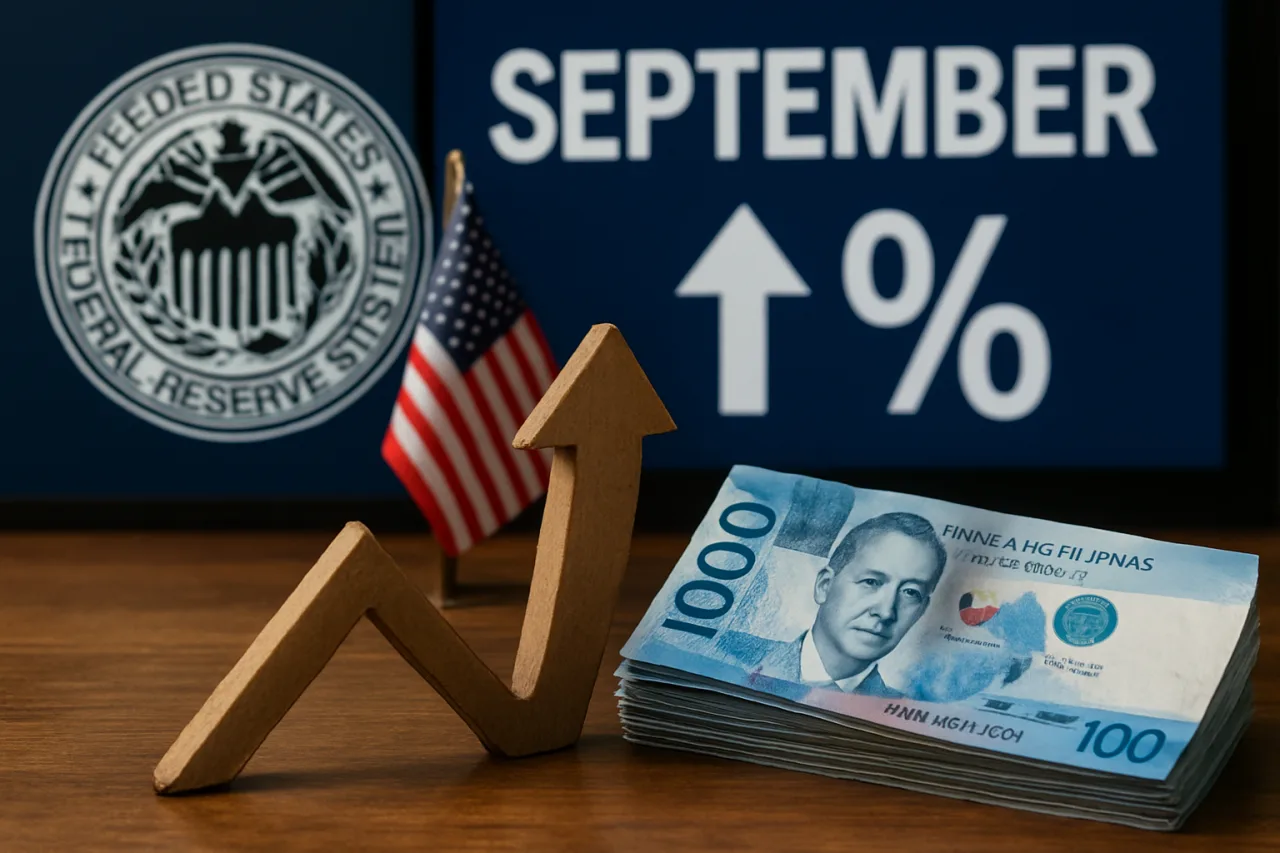
September rate hike odds hit 70 percent on September 2 — a number that would have sounded absurd three months ago, when the same traders priced cuts, not hikes. Wall Street has flipped its entire view of the Federal Reserve’s next move in a single quarter, and the decision lands September 15-16. For Filipino professionals, this is not distant American news: the peso just sank to a record ₱62.565 per dollar, the BSP is already defending the currency with its own hikes, and the gap between what the Fed does next and what your bank charges you is closing fast. This is the analysis of how a coin flip became a near-consensus bet, and what two weeks of preparation can do for your money before the gavel falls.
September Rate Hike Odds: From Coin Flip to Consensus
The fastest way to understand this story is to watch one number move. On July 29, odds of a 25-basis-point hike at the September meeting crossed 50 percent on the Kalshi prediction market, a shock at the time because the Fed had just held rates steady for a fifth consecutive meeting. By August 18, traders had retreated — Kalshi showed only a 29 percent chance of a hike, and the hold camp looked dominant again. Then came August 28, when Fed Chair Kevin Warsh used his Jackson Hole keynote to commit publicly to price stability, warning that inflation remained too high. CNBC called the September decision a coin flip that evening. By September 2, the coin had landed: investors saw roughly a 70 percent chance of a hike, some banks began forecasting three consecutive increases, and the 10-year Treasury yield reached its highest level since November 2023.
That arc — 50, then 29, then 70 — tells you something important about how markets actually think. The consensus is not a straight line; it is a tug-of-war between cooling inflation data and a chairman who keeps saying he is not finished. Warsh’s speech did not present new data. It repositioned the Fed’s reaction function: after years of assuming the central bank would rescue growth with cuts, traders now price a chair willing to inflict pain on markets to finish the inflation job. Prediction markets, which were invented for exactly this kind of ambiguity, still split 71-29 as of this week. A 70 percent probability is not certainty — it is a strong lean with real downside both ways.
Why the Fed Turned Hawkish — and What It Signals
The mechanical story is inflation. The Fed has held its federal funds rate at 3.50 to 3.75 percent since late 2025, and the June dot plot already revealed a hiking bias among FOMC members — a signal most investors dismissed at the time. What changed by late August was the market’s belief that the inflation fight had drifted from the 2 percent target for too long. Warsh’s speech made that explicit: the message, parsed by every trading desk from New York to Makati, was that the Fed would rather be blamed for slowing the economy than for tolerating rising prices. A September rate hike, in that framing, is not a policy accident — it is the announced destination of a chairman who told the market exactly what he intended and dared it to disbelieve him.
The deeper signal matters more for anyone planning beyond September. Goldman Sachs researchers do not expect cuts until 2027, and at least one major bank now projects three hikes in this cycle. If that view holds, the September meeting is not an isolated event — it is the first step of a tightening cycle that would keep dollar rates elevated through 2027. For global capital, higher American yields change everything: money flows toward dollar assets, emerging-market currencies bleed, and every peso-earning household importing dollars — or receiving them — feels the shift. The Fed’s decision ripples into Philippine interest rates whether the BSP follows or not, because bond investors price the differential.
The Peso, the BSP, and the Narrowing Gap
Here is where the story becomes personal for Filipinos. The peso closed at a record-low ₱62.565 per dollar on September 2, the second record break in a week — we tracked the full remittance math of that slide in our report on the record peso and what your $500 is now worth — and the pressure is not a mystery: the Fed’s higher-for-longer stance makes dollar assets more attractive, while the BSP has been cutting or holding to protect growth. The Bangko Sentral ng Pilipinas raised its benchmark by 25 basis points to 4.75 percent in June — its second consecutive hike — and held again at the August 27 meeting. Its next scheduled policy meeting is October 22, five weeks after the Fed’s decision. That timing gap is the risk window: if the Fed hikes on September 16 and the BSP waits until October 22, the interest-rate differential between dollar and peso assets widens for five full weeks, and the peso pays the price in the currency market.
The arithmetic for remittances cuts both ways. A weaker peso means every $500 sent home converts to more pesos — at ₱62.565 versus the ₱58 levels of early 2026, that is roughly ₱2,280 more per $500. For OFW families receiving money, the record-low peso is a windfall that no government program could match, which is why remittance-driven households have quietly cheered the currency slide even as economists warn about imported inflation. But the same slide raises the peso cost of imported fuel, food, and debt service, and the January-to-June remittance data — $17.15 billion, up just 2.4 percent year-on-year — suggests flows are flattening even as their purchasing power swings. Money sent home may be plateauing; its value no longer is. Every September rate hike scenario that traders price this month lands hardest exactly here: on families whose income is dollar-denominated and whose groceries, tuition, and electric bills are not. That asymmetry is why the smartest remittance plans we have seen this year treat the exchange rate not as a lottery ticket but as a schedule — fixed percentages, fixed dates, adjusted only when the fundamentals genuinely move.
What a September Rate Hike Means for Peso Loans
For borrowers, the transmission is slower but real. Philippine banks price loans off the BSP’s policy rate and their own funding costs, and the BSP’s recent hikes have already pushed lending rates higher across mortgages, auto loans, and credit cards. A Fed hike squeezes the system twice: it pressures the peso, which pushes the BSP toward defensive tightening, and it raises the cost of dollar funding for Philippine banks and corporations. None of this means your loan rate jumps on September 17 — but it means the direction of travel for borrowing costs points up, not down, through the BSP’s October meeting and likely beyond. A September rate hike in Washington does not need permission from Manila to raise the cost of money in Manila; it only needs the currency market to do the arithmetic.
There is also the market channel. The PSEi has whipsawed for two weeks on exactly this uncertainty — falling through late August, snapping a four-day losing streak on September 2 as we covered in our PSEi rebound report, then wobbling again — and foreign portfolio investors have pulled $3.94 billion from Philippine equities this year. A Fed hike would extend that pressure: higher dollar yields make emerging-market equities look riskier by comparison, and rate-sensitive sectors like property, banks, and holding firms take the first hit. Filipino investors who assumed the rate-cut era meant cheap money for years are now repricing that assumption in real time.
The Two-Week Playbook Before September 16
You cannot control the FOMC, but twelve days is enough time to position. For OFW families and remittance senders, the strongest argument favors splitting transfers: rather than converting a month’s salary at one rate, send half now and half after the Fed decision, capturing the current record-low peso while keeping powder dry if a hike sends the dollar even higher. Remittance timing has always been a small edge; at record levels, it is a measurable one. Consider the actual numbers: if the dollar climbs another two percent after a September rate hike — roughly what the last Fed-tightening phase did to the peso — a $1,000 monthly transfer gains an additional ₱1,250 per month by waiting on half. If instead the Fed shocks markets by holding and the peso rebounds, the half you already converted protected you from giving that back. The split is not a prediction; it is insurance paid in opportunity cost, and at these exchange-rate levels the premium is cheap.
For borrowers, the playbook is defensive. If you are pricing a mortgage or auto loan right now, assume the teaser rate you are quoted this month will not be available in November, and ask lenders to lock what is lockable. If you carry floating-rate debt, run the math on what two additional BSP hikes would do to your monthly payment — the discipline of knowing that number before October 22 is worth more than any forecast. For investors, the honest move is position sizing, not prediction: a 70 percent probability is not a sure thing, the 29 percent hold scenario produced a relief rally as recently as mid-August, and portfolios built to survive both outcomes beat portfolios built on either bet. And if the Fed holds after all, resist the urge to declare the inflation war won — the same Warsh who turned markets hawkish in one speech can hold them cautious with the next, and a September rate hike that fails to arrive in September usually arrives in October or December with the same consequences. The professionals who navigate this window best will be the ones who treat September 16 as a checkpoint, not a finish line — because whatever the Fed does, the BSP’s October 22 decision and the peso’s path through it will shape Filipino finances well into 2027.
The deeper lesson of the 70 percent moment is about humility with forecasts. Three months ago the consensus saw cuts; now it sees hikes; in either direction it was confident. The lesson for every Filipino professional with a loan, a remittance schedule, or a portfolio is not to guess the Fed — it is to build finances that do not require the guess to be right. The September rate hike may or may not arrive on September 16. The pressure behind it is already here.
Frequently Asked Questions
When exactly is the Fed’s September 2026 decision?
The Federal Open Market Committee meets September 15-16, 2026, with the rate decision and Chair Warsh’s press conference on the afternoon of September 16, Manila time. It is the Fed’s eighth and final scheduled policy meeting before October’s, and among the most consequential of the year given current pricing.
What is the chance of a September rate hike?
As of September 2, market pricing put the odds of a 25-basis-point hike at roughly 70 percent, up from a coin flip after Chair Kevin Warsh’s hawkish Jackson Hole speech on August 28. Prediction markets such as Kalshi still assign about a 29 percent chance to the hold scenario, so a hike is likely but not certain.
What is the current Fed interest rate?
The federal funds rate has sat at 3.50 to 3.75 percent since the Fed’s fifth consecutive hold in July 2026. A September hike of 25 basis points would lift the range to 3.75 to 4.00 percent, the first increase of this cycle.
How does a Fed rate hike affect the Philippine peso?
Higher US rates make dollar assets more attractive, pulling capital out of emerging markets like the Philippines and widening the gap between dollar and peso yields. That pressure weakens the peso — which just hit a record ₱62.565 per dollar — and increases the likelihood that the BSP responds with its own tightening at the October 22 meeting. Traders treat a September rate hike as the event most likely to test that transmission in real time.
Should OFWs send money home before or after the Fed decision?
No one can time currency markets reliably. A practical compromise: split transfers around the September 15-16 meeting. The peso is already at record lows, so converting some funds now locks in favorable rates, while holding back part of the transfer preserves upside if a Fed hike pushes the dollar higher still.
What happens to remittances if the Fed hikes?
In the short term, a stronger dollar typically means each remittance converts into more pesos — good news for receiving families. The offset arrives later: import costs, inflation, and possible BSP tightening can erode that gain. That is why a September rate hike is best treated as a reason to split transfers around the decision rather than to move everything at once.
Will the BSP raise rates after the Fed?
The BSP’s next scheduled meeting is October 22, five weeks after the Fed decision. The Bangko Sentral has already raised its policy rate to 4.75 percent across two consecutive hikes to defend the peso, and a Fed hike would widen the differential pressure — making a further BSP move more likely, though the decision depends on inflation and growth data between now and then.
Financial Disclaimer
This article is provided for general information and educational purposes only and does not constitute financial, investment, or tax advice. Interest rate outlooks, currency movements, and market odds change rapidly and may differ materially from what is described here at the time of reading. Always verify current rates with official sources such as the Bangko Sentral ng Pilipinas and consult a qualified financial advisor before making borrowing, remittance, or investment decisions.