Table of Contents
Key Takeaway
- 🔄 The Shift: Baidu CEO Robin Li declared at Create 2026 that the AI industry is moving from model competition to AI agents competition — “What users are willing to pay for is no longer whether AI can think, but whether it can get things done”
- 👤 Super Individuals: Li foresees the rise of “super individuals” — one person plus a fleet of intelligent agents replacing what used to require entire teams. The smallest productive unit in companies shifts from teams to individuals
- 🏢 Flattened Organizations: AI will reshape corporate management — organizations become flatter, managers oversee more people, and management shifts from supervision to goal alignment
- 📊 New Metric: Li introduced “Daily Active Agents” (DAA) as the new metric replacing DAU — predicting global DAA could exceed 10 billion. Platform success judged by tasks completed, not time spent
- ⚡ Global Implication: China’s largest AI company is betting on agents, not models. This means the next wave of workforce disruption comes not from smarter chatbots but from autonomous systems that execute entire workflows
Baidu CEO Robin Li has declared that the AI industry is entering a new phase — one where the competitive frontier is no longer which company has the smartest model but which company builds the most capable AI agents. Speaking at the Create 2026 Baidu AI Developer Conference in Beijing, themed “Agents at Scale,” Li outlined a vision where AI evolves from chatbots into digital workers that execute tasks autonomously, reshape organizational structures, and create a new category of professional: the “super individual.”
“For the first time, what really made AI go viral was not the model, but the application,” Li said. The AI products gaining attention in 2026 are not dependent on a single model but are built as agent systems that stay online continuously and carry out tasks over time. This signals a fundamental shift: from competing on model scale to competing on task execution. The question for users is no longer “can AI think?” but “can it get things done?”
From Models to AI Agents
Li’s core thesis is that the AI industry has passed through the model competition phase. Over the past few years, breakthroughs came from improvements in foundation model capabilities. But the logic behind breakout AI products has shifted. AI agents — systems that can call tools, break down tasks, and execute workflows autonomously — are now the central focus of the next phase.
“AI is evolving from chatbots into digital workers, task agents, and autonomous collaborative systems,” Li said. This is not a theoretical prediction. Baidu unveiled DuMate, a general-purpose AI agent that handles customer service resolution, data analysis, and poster generation. The Miaoda app, a code-generation agent, reportedly generates around 90% of its own code. Baidu YiJing is a multi-agent digital human platform for livestreaming and video generation. These are products shipping today, not concepts on a roadmap.
The Rise of the Super Individual
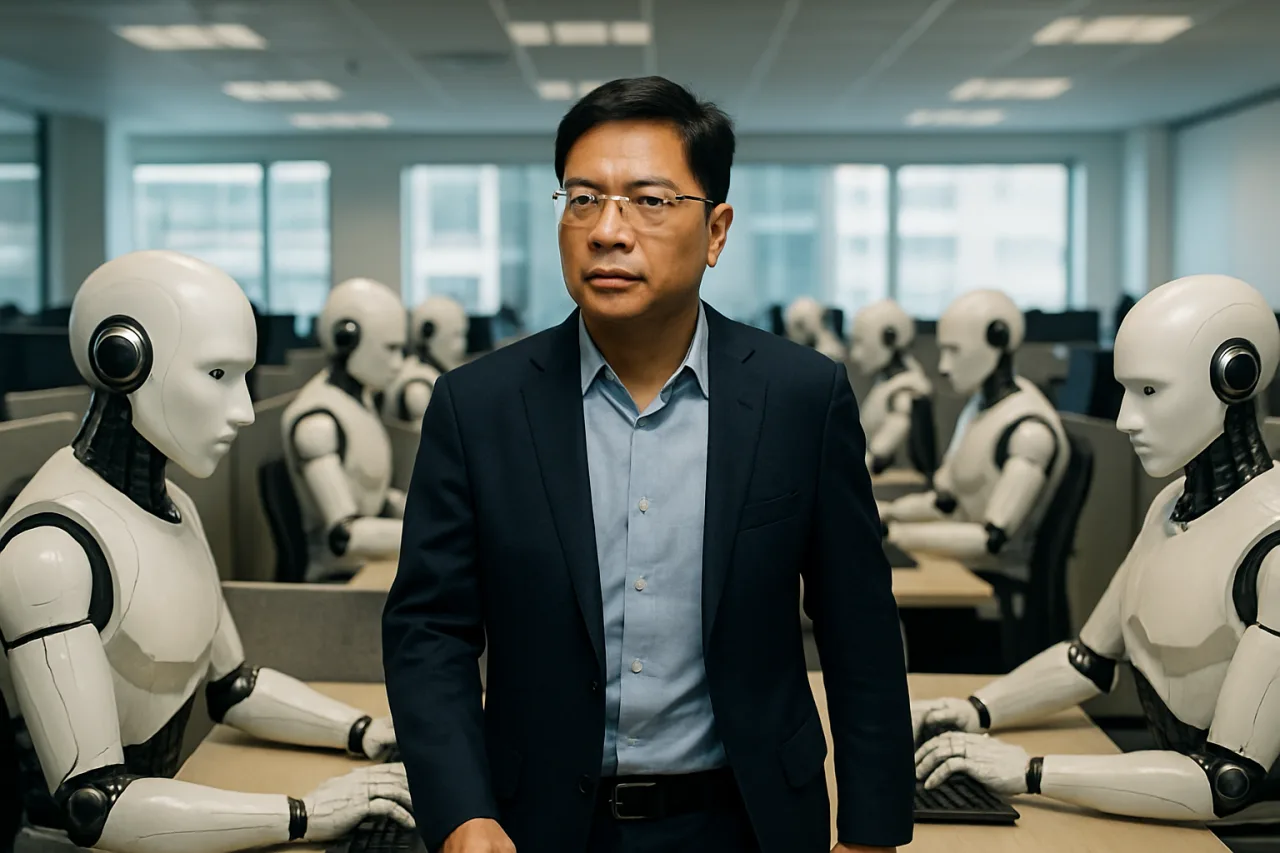
Li’s most provocative concept is the “super individual.” He argued that AI is driving a shift in the smallest productive unit within companies. Previously, the smallest unit was a team. In the future, it could be one person plus a fleet of intelligent agents. “As capabilities in code generation, content creation, and task execution continue to improve, the productivity boundaries of ordinary developers and creators will be greatly expanded,” Li said.
This is the Chinese AI industry’s version of the team compression that Andrew Ng described from the US perspective — but Li frames it as empowerment rather than displacement. Where Ng observed that “a project that used to need 8 engineers and 1 PM might now need 2 engineers and 1 PM,” Li envisions one person with agent systems doing the work of a full team. The framing differs; the outcome is the same: fewer people, more output.
For professionals worldwide, the “super individual” concept is both a promise and a threat. It promises that a single professional with the right agent fleet can build a company, serve clients, and produce at a scale previously requiring a team. It threatens that the employer who previously needed ten people may now need one — and if you’re not that one, you’re out. The skills gap data confirms this trajectory: 88% of organizations say AI skill shortages directly impact their ability to meet business objectives.
Self-Evolution and the Flattened Organization
Li introduced the concept of self-evolution as the defining theme of the AI era, operating across three levels: agents, individuals, and organizations. At the agent level, AI will no longer passively respond to instructions but will continuously learn from its environment, independently verify outcomes, and iteratively optimize its execution. “Once AI develops a closed-loop capability of verification-error correction-optimization, its reliance on human intervention will be significantly reduced,” Li said. This self-evolution capability is what separates agents from chatbots: a chatbot answers your question, but an agent learns from the outcome and improves its next execution without being told. For organizations deploying these systems, the compounding effect of self-improving agents means that the productivity gap between early adopters and late adopters widens exponentially over time.
At the organizational level, Li predicted that AI agents will reshape corporate management. “Organizations are expected to become more flattened, with managers able to directly oversee more people. Management itself will shift from supervision and control toward goal alignment and authorization-based collaboration.” This is a structural prediction: middle management layers shrink as agents handle coordination, reporting, and monitoring that previously required human supervisors.
Daily Active Agents: The New Metric
Li introduced a new metric: Daily Active Agents (DAA), drawing a parallel with Daily Active Users (DAU) in the mobile internet era. He argued that tokens — the current measure of AI usage — only reflect cost, not value, because they measure input rather than output. He predicted that global daily active AI agents could exceed 10 billion in the future.
“Platform success will no longer be judged by user time spent, but by how many agents are actively completing tasks and delivering outcomes for users,” Li said. This metric shift is significant. It means the AI industry is moving from measuring engagement (how long you talk to a chatbot) to measuring productivity (how many tasks an agent completes). For businesses, this means the ROI of AI investments will be judged by output, not usage.
The Global Race: China’s Agent Bet
Li’s speech at Create 2026 is not just a Baidu product launch. It is a signal of where China’s AI industry is heading. While US companies like OpenAI and Anthropic compete on model capability — GPT vs. Claude vs. Gemini — Baidu is betting that the next competitive frontier is AI agents that execute real work. This aligns with the broader Chinese AI strategy of deploying AI in real-world applications faster than Western competitors, even if the underlying models are less powerful.
The global implication is significant. If the agent era arrives as Li predicts, the workforce disruption described by Gates, Huang, Ng, Suleyman, and Amodei accelerates. Agents don’t just assist with tasks — they execute entire workflows. A customer service agent that resolves tickets end-to-end doesn’t help a human worker do the job faster. It does the job. The distinction between “AI as a tool” and “AI as a worker” dissolves — and with it, the distinction between task automation and job elimination that Suleyman tried to maintain. This connects directly to the white collar automation debate: if agents execute workflows, the “tasks not jobs” defense collapses entirely.
What This Means for Professionals Worldwide
Li’s vision, while delivered at a Chinese developer conference, has global implications. The shift from models to AI agents means that the competitive advantage in the next phase of the AI era is not who has the biggest model but who deploys agents most effectively. This has three immediate consequences for professionals in every market.
First, the skills that matter change. Model era skills — prompt engineering, model selection, API integration — give way to agent era skills: workflow design, task decomposition, agent orchestration, and outcome verification. The professional who can configure a fleet of agents to execute a business process end-to-end is worth more than one who can write good prompts.
Second, the unit of work changes. As Li described, the smallest productive unit shifts from team to individual-plus-agents. This means solo professionals — freelancers, consultants, independent developers — gain the most leverage. A solo marketing consultant with content generation agents, analytics agents, and customer outreach agents can serve clients at a volume previously requiring an agency. The BPO industry faces the most direct threat: if one person with agents can do what a 20-person call center does, the economics of offshore labor change fundamentally.
Third, the management layer compresses. Li’s prediction of flattened organizations means middle managers — whose primary function is coordination, monitoring, and reporting — are directly in the automation path. AI agents that can track progress, verify outcomes, and generate reports do exactly what middle managers do, faster and cheaper. The Huang-Ng warning applies here with extra force: the manager who learns to deploy agents will replace the manager who doesn’t.
Frequently Asked Questions About AI Agents
What did Robin Li say about AI agents at Baidu Create 2026?
Baidu CEO Robin Li declared that the AI industry is shifting from model competition to AI agents competition. He said “what users are willing to pay for is no longer whether AI can think, but whether it can get things done.” He introduced the concept of “Daily Active Agents” and predicted global DAA could exceed 10 billion.
What is a super individual in Robin Li’s vision?
Li foresees the rise of “super individuals” — one person plus a fleet of intelligent AI agents replacing what used to require entire teams. The smallest productive unit in companies shifts from teams to individuals augmented by agents that handle code generation, content creation, and task execution.
How will AI agents change corporate organizations?
Li predicted organizations will become flatter as AI agents handle coordination and monitoring. Managers will oversee more people. Management will shift from supervision and control to goal alignment and authorization-based collaboration. Middle management layers are expected to shrink.
What is Daily Active Agents (DAA)?
Robin Li introduced DAA as a new metric replacing Daily Active Users (DAU). DAA measures how many AI agents are actively completing tasks, not how much time users spend talking to AI. Li predicted global DAA could exceed 10 billion, signaling that platform success will be judged by task completion, not engagement.
What AI agent products did Baidu announce?
Baidu unveiled DuMate (general-purpose agent for customer service, data analysis, poster generation), Miaoda (code-generation agent that writes ~90% of its own code), and Baidu YiJing (multi-agent digital human platform for livestreaming and video generation).
How does Robin Li’s vision compare to US AI leaders?
While US companies like OpenAI and Anthropic compete on model capability, Baidu is betting on AI agents that execute real work. Li’s “super individual” concept mirrors Andrew Ng’s team compression observation — fewer people, more output. But Li frames it as empowerment while the data suggests displacement. Both US and Chinese AI leaders agree on the direction: the future of work is fewer people doing more with AI. They disagree on whether to call that empowerment or automation. For the professional on the receiving end, the label doesn’t matter — the outcome is the same.
Will the agent era affect developing economies differently?
Yes. Developing economies that rely on offshore labor — particularly the BPO sector in the Philippines and India — face a structural threat from AI agents that can execute customer service, data entry, and back-office tasks end-to-end. Li’s vision of “one person plus a fleet of agents” means the cost advantage of offshore labor narrows when a single professional with agents can match the output of a 20-person offshore team. The adaptation window is now.
This article is for informational purposes only and does not constitute professional career or technology advice.