Table of Contents
Key Takeaway
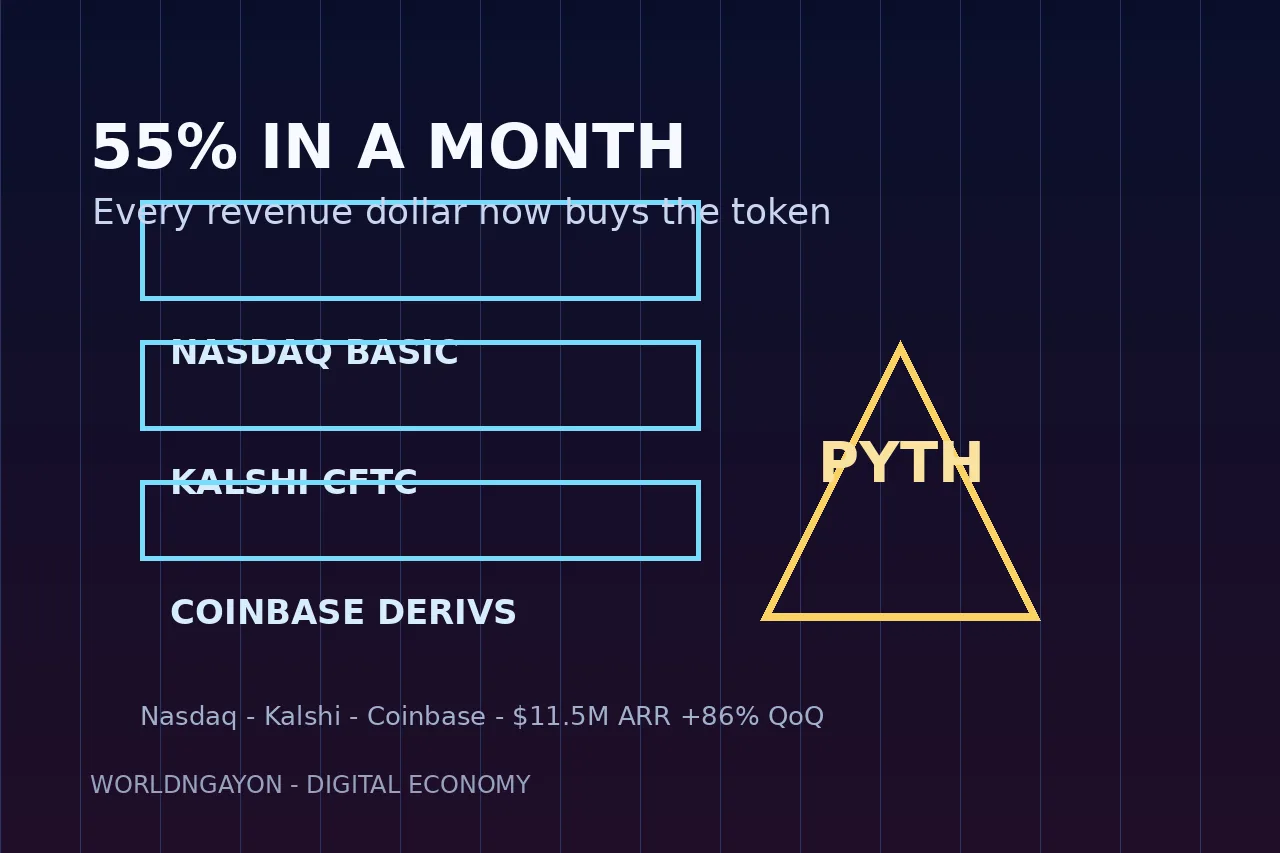
- Pyth Network is the best-performing fundamentally-backed crypto of the week — +16.8% over 7 days and +55% over 30 days — on a tape where everything else sank.
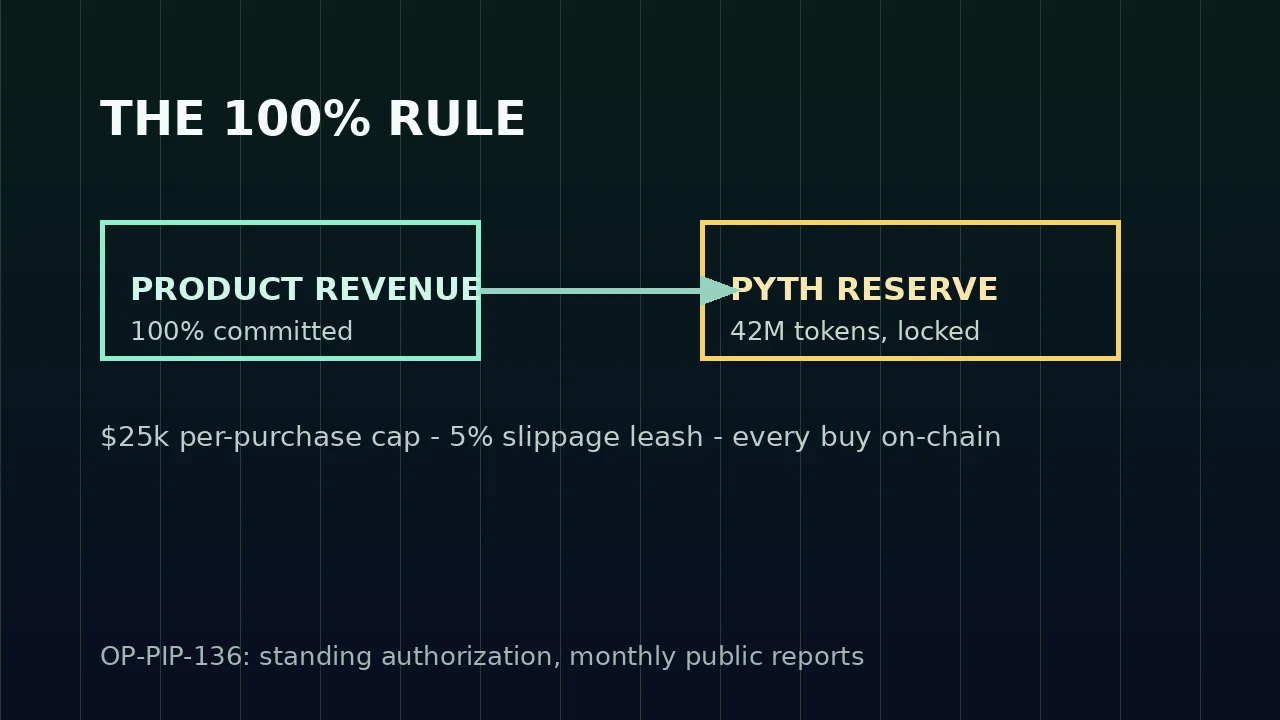
- The Oct 8 catalyst is self-funding: a new DAO rule commits 100% of Pyth’s product revenue to buying PYTH on the open market — no more monthly votes, no more one-third trims.
- The revenue engine behind it: $11.5M annual recurring revenue, up 86% in a quarter, 276 paying institutional accounts, with Pyth Pro subscriptions carrying $9.68M of the total.
- The distribution stack is the real story: Nasdaq Basic now flows through Pyth’s marketplace, Kalshi named Pyth its sole source agency on CFTC-registered gold and silver perpetuals, and Coinbase runs derivatives pricing on Pyth data.
The Tape Says Something Unusual
Zoom out to the week’s board and the anomaly is visible before any fundamentals. The total crypto market sits near $2.7 trillion, down more than 6% in 24 hours — one of those days where every screen is red and the commentary writes itself about deleveraging. Pyth Network’s PYTH token did the opposite: +16.8% on the week, +55% over the month, with turnover running near 15% of its market cap — real interest, not a thin illiquid squeeze. A token outperforming that hard into a market-wide washout usually has a driver with paperwork behind it. This one does.
The 100% Rule: a Buyback Written Like Infrastructure
On October 8, the Pyth DAO approved OP-PIP-136 — the proposal traders immediately nicknamed the 100% Rule. Every dollar the DAO receives from Pyth products now goes into the PYTH Reserve, which accumulates the token through open-market purchases. The structure replaced an older regime that moved one-third of the treasury’s non-PYTH balance each month and required a fresh governance vote per transfer. One standing authorization now does the whole job: stablecoin receipts route to a pre-authorized council that exchanges them for PYTH under defined execution instructions, and PYTH receipts flow straight into the reserve.
The guardrails matter as much as the commitment. Each acquisition transaction is capped at $25,000 with a 5% slippage limit, every purchase is published on-chain, and the reserve — 42 million PYTH and climbing — cannot be sold, borrowed against or distributed without a separate governance proposal.
This is not a burn; it is a treasury that only ever grows the locked float — the same Q3 recap that documents the revenue curve. The first purchases under the new authorization executed September 30, before the public announcement — the market spent the last week catching up to machinery already running. The DAO’s revenue share is the funding line: roughly 60% of Pyth Pro receipts and about 90% of Listing-as-a-Service revenue per project reporting, with 100% of whatever arrives now pointed at accumulation. Mike Cahill, Douro Labs’ CEO and a core contributor, framed the alignment bluntly: the people using Pyth, building it and governing it are “now all pulling on the same rope.”
Nasdaq, Kalshi, Coinbase: the Deal Flow Behind the Move
Pyth Network‘s distribution stack is what separates this rally from the week’s momentum trades. Start with the biggest name: Pyth is now an approved external distributor of Nasdaq Basic — Nasdaq’s proprietary real-time US-equity quote and trade feed — through the Pyth Data Marketplace, with clients licensing direct from Nasdaq and consuming through Pyth’s rails. That is a regulated-market data product from 1938-era Wall Street flowing through a crypto-native pipe.
The prediction-market lane is sharper still. Pyth Network‘s deepest seal may be Kalshi, the CFTC-registered exchange whose contracts made headlines all year, uses Pyth prices across its stock and commodity markets — and in September named Pyth the sole Source Agency in filings for gold and silver perpetuals. In regulated-derivatives language, sole source means Kalshi’s settlement quality now leans on Pyth’s feeds by name. Pyth Network completes it with Coinbase: the exchange uses Pyth data to support continuously priced thematic markets, and MarketVector indexes calculated with Pyth data underlie the equity index futures listed by Coinbase Derivatives.
The numbers underneath the logos: real-world-asset perpetual markets generated $2.09 trillion in volume in Q3, and Pyth-powered venues accounted for 94.1% of that activity. Coverage logged the reaction: PYTH jumped 14.2% on the announcement, with 24-hour volume up 287%. Revenue arrived in the same direction — active ARR hit $11.49 million at end-September, up 86.5% quarter over quarter after adding $5.33 million of net new ARR; Pyth Pro alone carries $9.68 million, Pyth Indices $1.81 million across 16 live clients, and the self-serve terminal passed 129,000 monthly active users. 276 paying accounts — institutions, not airdrop farmers.
Why Deal Flow Beats Hype Cycles for Pricing Data
Pyth Network sells something every serious financial system needs: the current price. Exchanges need it for new market types. Prediction markets need it to settle contracts without disputes. AI agents need it as ground truth wherever a model touches money. The AI-agents lane is already live in development — Pyth and search company Exa are testing a market-data layer where an agent researches a company or event and pulls structured prices and candlesticks through the same interface. Nasdaq’s distribution stamp, Kalshi’s sole-source filings and Coinbase’s derivative markets are the institutional versions of the same sentence: this is the feed money trusts — a framing market recaps picked up within a day.
That is also why the token design change matters more than it would on a project without revenue. A 100% revenue-accumulation rule at $11.5M ARR is a rounding error; the same rule at a $100M Pyth Network ARR — the trajectory the growth curve sketched this quarter — is a persistent bid the market can size. Buyback narratives fail when there is no cash flow behind them. This one has the cash flow, and the governance guardrails are written on-chain.
The Rails It Rides Are the Rails We Already Cover
There is a pattern connecting this month’s three strongest stories. Solana’s Alpenglow upgrade compresses consensus to 150 milliseconds; China’s mBridge pushes wholesale settlement to seconds; and Pyth Network distributes the price feeds the whole stack trades on, with sub-second confidence intervals on every number. Institutional finance is not adopting crypto — it is adopting speed, and speed has a supply chain. Pyth sits in the supply chain. Data distribution is the quietest layer of the new market structure, and the one with the clearest recurring revenue.
Inside the Q3 Numbers: What $11.5 Million Buys a Token
Pyth Network‘s revenue decomposition is the unfashionable reason this rally has legs. Pyth Pro — the professional-grade subscription carrying $9.68 million of the $11.49 million ARR — sold across 276 paying accounts, and Q3 added $5.33 million in net new ARR in a single quarter. September alone moved the monthly figure from $10.4 million to $11.5 million. Pyth Indices contributes $1.81 million across 16 live clients, and the self-serve terminal — 129,000 monthly active users — chipped in $500,000 of fresh September ARR on its own. These are small numbers by Wall Street standards and enormous ones by crypto-standards, because they are recurring, contract-based and growing 86% quarter over quarter.
Now run the 100% Rule arithmetic. At September’s run rate, the DAO’s product-revenue share flowing into purchases is measured in hundreds of thousands of dollars monthly — capped at $25,000 per transaction to avoid moving its own market, with a 5% slippage leash.
At $0.085 per token, a $1 million month buys roughly 11.7 million PYTH; the reserve already holds 42 million. Scaling matters more than today’s size: if ARR follows the Q3 trajectory another two quarters, the standing authorization converts a ~$50 million annualized revenue base at full maturity into a bid the market cannot ignore — all of it published on-chain, purchase by purchase, where anyone can audit whether the promise is executing. Buybacks written as promises are marketing. Buybacks published as transactions are a mechanism.
The Oracle Wars: Why First-Party Data Wins the Institutional Lane
The competitive context makes the Nasdaq and Kalshi seals more valuable. Oracles are the plumbing layer every lending market, perp exchange and settlement system leans on; the incumbent model aggregates third-party feeds and reports a composite. Pyth Network runs the opposite design — first-party data — where exchanges, market makers and trading firms publish their own prices directly, with confidence intervals attached and updates every 400 milliseconds. When a CFTC-registered exchange names a first-party oracle as sole source on metals perpetuals, the filing is an implicit quality ranking: settle against the feed the professionals themselves quote.
The agentic-finance extension is the forward lane. Pyth and AI-search company Exa are already testing a combined interface where research and market data arrive in one call — an agent investigating a company pulls filings and context from Exa while structured prices, historical observations and candlesticks come from Pyth, all through standard MCP tooling. Q4’s stated roadmap — converting trials to production, launching more indices, growing marketplace supply and deepening exchange integrations — reads like a mid-stage infrastructure company’s plan, not a token project’s. The Pyth Network pitch to institutions never required them to believe in crypto; it requires them to believe the feed is better. This quarter’s paperwork suggests they do.
Reading the Reserve: the On-Chain Fact-Check
The 100% Rule’s most underappreciated feature is that it is auditable by anyone, monthly. Pyth Network publishes each reserve acquisition on-chain with its transaction links on a single tracking page — amount purchased, execution, cumulative holding. A skeptical holder does not need a dashboard vendor or an investor call; they need one browser tab. When the next monthly report lands, the market gets a raw answer to the only question a buyback ever poses: did the bid actually show up? Mechanisms beats promises, and Pyth Network chose a mechanism.
The guardrail arithmetic also caps the downside of the design. The $25,000-per-transaction ceiling and 5% slippage leash mean the reserve cannot blast through thin order books and spike its own price — the failure mode that made older buyback schemes look self-dealing. Purchases grind at retail-scale lots, which is exactly what a supply-absorption program should do: accumulate quietly against a float that only locks harder with every acquisition.
The Month Ahead: Dates That Move PYTH
Three calendar items price the next leg. First, the reserve’s next monthly acquisition report — the first fully under the standing authorization, and the proof-of-velocity datapoint for the 100% Rule. Second, Q4’s stated conversions: Pyth Pro trials flipping to production contracts and new index launches, each one adding recurring revenue to the denominator the market now watches. Third, the unlock schedule — the standing overhang every high-FDV token carries; dilution timing can overwhelm weekly flows, and no 100% Rule outpaces a large cliff. Momentum carried Pyth Network into October’s tape; those three dates decide whether it rides out of it.
What Would Break the Thesis
Honesty first: +55% in a month has already paid the October optimists, and a −6% market day can reprice momentum quickly. The 100% Rule commits revenue, not a fixed amount — a bad quarter slows the reserve’s accumulation, and the DAO’s share is a slice of product revenue, not the whole top line.
Token unlocks remain the standing overhang for high-FDV assets. And sole-source status cuts both ways: if Kalshi’s regulators or Nasdaq’s licensing ever question vendor concentration, Pyth’s highest-visibility contracts sit exactly where the scrutiny lands. The tell to watch is the reserve’s monthly purchase reports — they are published on-chain, which means the market can fact-check the buyback intensity against the ARR curve every month, no analyst note required.
The Corridor Take
Same close as this week’s Metrobank flow piece, same discipline: institutions voted this week, and the tape recorded it. In Manila, the vote was foreign pesos buying an 8.2%-yield bank on a red index day. In crypto, it was Nasdaq’s stamp, a CFTC-registered exchange filing Pyth as its single source of truth, and a DAO converting every revenue dollar into a standing bid. Price follows paperwork — Pyth Network wrote the month’s best. This month, the paperwork is unusually good.
Market data: CoinGecko (Oct 15, 2026) and project disclosures; revenue figures from Pyth Network’s published Q3 recap. This is market analysis, not investment advice.