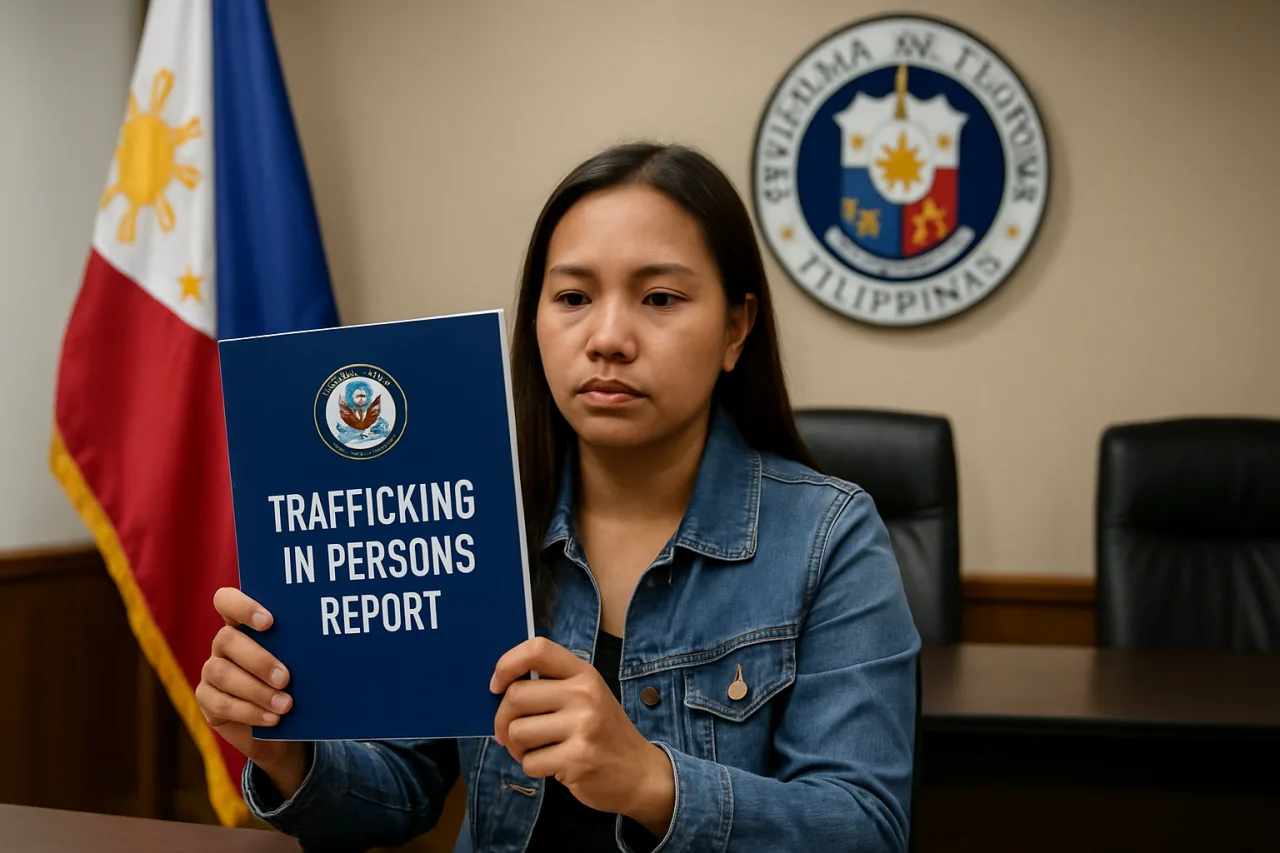
Philippines Tier 1 news arrived from Washington this week: the US State Department’s 2026 Trafficking in Persons Report kept the Philippines in the top tier for the 11th consecutive year — the fourth under President Ferdinand Marcos Jr. — confirming that the government “fully meets the minimum standards for eliminating human trafficking.” The Department of Migrant Workers welcomed the rating with receipts this year’s report itself documents: 1,546 trafficking victims assisted in 2025, up from 816 the year before; 447 trafficking and online child exploitation cases investigated; 366 alleged traffickers prosecuted; 103 convictions secured; and at least 1,606 victims of illegal recruitment and trafficking repatriated, many rescued from forced labor in scam compounds in Myanmar, Cambodia and Laos. This article explains what Tier 1 actually certifies, what it changes for OFWs and their families, and the four gaps the US report itself says remain open.
Key Takeaway
- 🏆 The rating: the Philippines stays Tier 1 in the 2026 Trafficking in Persons Report — 11 straight years — ranking it among governments fully meeting the minimum standards against human trafficking.
- 📈 The receipts: 1,546 victims assisted in 2025 (from 816 in 2024), 447 cases investigated, 366 prosecuted, 103 convicted, and 1,606 victims of illegal recruitment and trafficking brought home.
- 🏗️ The systems: a nationwide mandatory victim-identification system, an upgraded National Referral Mechanism, a centralized interagency database, and the October 2025 nationwide offshore-gaming ban targeting scam-hub trafficking.
- 🚨 The report’s own criticism: convictions are declining overall, online syndicates outpace digital forensics, foreign victims in scam compounds need screening, and seafarers remain vulnerable.
- 🎯 What it changes for OFWs: a certified protection architecture — verified agencies, victim assistance through the AKSYON Fund, and inter-agency enforcement — plus the standing obligation to use the verification ladder before every deployment.
Philippines Tier 1: what the ranking actually certifies
Philippines Tier 1 status is the top of the US State Department’s three-level scale — earned, in the report’s own words, by governments that fully meet the minimum standards for eliminating severe forms of trafficking. The Philippines Tier 1 scale matters because the alternative tiers carry consequences: Tier 2 and Tier 2 Watchlist governments face scrutiny and potential aid restrictions; Tier 3 governments face statutory sanctions on assistance and international financing. Tier 1 is not a certificate of perfection — the report attaches required actions to every country it rates — but it is the certification that the state’s own anti-trafficking machinery meets the standard, and in Southeast Asia it separates Manila from the ranks where scam-compound economies thrive. The Philippines Tier 1 streak — eleven consecutive years through four administrations — reflects a policy architecture that survived multiple governments precisely because it was institutional, not personal: raids and convictions change with headlines; a victim-identification system and a referral mechanism do not.
The numbers behind the 11-year streak
The 2026 report’s Philippine data read as a doubling of the protection machine’s throughput. Victim assistance rose from 816 in 2024 to 1,546 in 2025 — nearly doubled. Law enforcement investigated 447 trafficking and online child sexual exploitation cases, prosecuted 366 alleged traffickers, and secured 103 convictions. The structural upgrades cited include a nationwide mandatory victim-identification system, an enhanced National Referral Mechanism — the formal pipeline from rescue to shelter, case management and legal aid — and a centralized interagency trafficking database. The boldest cited milestone is regulatory: the nationwide ban on offshore gaming operations implemented in October 2025, the industry whose compounds became the anchor employers of trafficking economies in the region, alongside the scam-compound war next door whose victims the Philippines has been bringing home all year.
Migrant Workers Secretary Hans Leo J. Cacdac welcomed the rating as an IACAT member and framed it as a challenge: to intensify efforts against illegal recruiters and traffickers who exploit Filipino vulnerabilities, with strengthened protection for migrant workers and their families. The statement’s honesty clause — Tier 1 standing reflects collective resolve but does not signal that the work is complete — is also the report’s own headline judgment, and the next section is where it points.
The scam-compound war: the repatriation machine
The 1,606 repatriations are the human half of the Philippines Tier 1 record — and the most under-reported. These are Filipinos rescued from forced labor in scam compounds in Myanmar, Cambodia and Laos — the industrial-scale fraud parks where workers trafficked under fake job offers run romance-scam centers and crypto fraud operations under confiscation of documents and threat economies. Working alongside the Department of Foreign Affairs, the DMW brought them home and put them into a comprehensive assistance package under the AKSYON Fund: medical care, psychosocial support, legal aid, financial assistance and emergency shelter. The rescue-and-return pipeline is the direct descendant of the systems this report certifies — victim identification, referral, protection — executed across international borders at scale.
For families, the pipeline’s existence is the practical meaning of the rating. A missing worker in the scam-compound economy is a rescue case with a named process — hotlines, embassy coordination, repatriation, assistance — instead of a private nightmare. And the enforcement numbers behind the rating — the investigations, prosecutions, convictions — are what keep the pipeline fed with cases that end traffickers’ operations rather than just relocating victims. Our feature on the 250,000-post recruitment-scam takedown covers the front end of the same fight: stopping the fake job offers that feed these compounds in the first place.
What the 2026 report says is still wrong
The DMW’s own summary of the report’s critical findings reads as a homework list, and it should be read as one. First: reversing the decline in trafficking convictions — the conviction count remains the weakest metric behind the Philippines Tier 1 record, and cases that end in dismissal erode the deterrence the statute’s heavy penalties promise. Second: building digital-forensics capacity — online syndicates now operate on encrypted platforms and crypto rails faster than evidence-gathering scales up. Third: screening foreign victims found inside Philippine-linked operations — the report flags the gap between rescuing Filipino workers abroad and identifying trafficking victims of other nationalities caught in the same machinery. Fourth: bolstering protections for Filipino seafarers and commercial fishers — the maritime workforce whose isolation and flag-state complexity leaves it among the most exposed to labor trafficking.
The seafarers layer deserves its own paragraph because it is where the state’s newest protections meet the industry’s oldest blind spot. Filipino seafarers and commercial fishers serve on vessels where the working environment is international by definition — mixed crews, foreign flag states, manning agencies, and months at sea between ports. Labor trafficking in that world does not look like a locked compound; it looks like abandoned wages, replaced contracts, document confiscation, and isolation — patterns the TIP report’s authors have flagged with growing urgency. The Philippines Tier 1 machinery reaches these workers through pre-departure certification and agency accountability, and the report’s push is to extend the same victim-identification and referral infrastructure to ports and flag-state coordination, so the offshore worker’s rescue does not depend on reaching Manila first.
None of these criticisms changes the rating; all of them define the next year’s test of it. A Tier 1 grade with open actions is how the TIP report is designed to work — and the DMW’s stated program maps directly onto the list: intensified monitoring of deceptive online recruitment, strengthened evidence-gathering for prosecution, and strict adherence to the non-punishment principle — the rule that victims should not be prosecuted for crimes their trafficking forced them to commit. Keep the report’s list where the announcements go: the rating’s durability is measured in exactly these columns.
The 2026 economy of scam compounds: why the rating had to be earned again
The Philippines Tier 1 streak survived its hardest year yet for a structural reason: the scam-compound economy across Myanmar, Cambodia and Laos industrialized faster in 2026 than any anti-trafficking apparatus has ever adapted. Fraud parks that began as gambling dens now run diversified fraud portfolios — romance-scam centers, crypto-investment fraud, and the online recruitment scams whose fake job offers were documented at 250,000 takedowns this month alone. The compounds source their labor through two pipelines at once: trafficked foreign workers lured by real-looking job ads — including Filipinos promised legitimate work in third countries — and desperate local workers kept under threat economies. Every layer of the 2026 rating was tested against that machine: the victim-identification system had to function at airport counters, the referral mechanism had to coordinate across three foreign jurisdictions, and the inter-agency database had to move evidence faster than the syndicates moved victims.
The numbers show the machine held: 1,606 Filipinos repatriated from illegal recruitment and trafficking operations, with the AKSYON assistance package absorbing the intake. But the report’s criticism of digital forensics is exactly calibrated to this adversary — the scam compounds run on encrypted messaging, laundered crypto and rapid infrastructure rotation, and a conviction architecture built for physical raids needs a digital-evidence capacity that scales with the fraud’s industrial turnover. That is why the Philippine Tier 1 rating this year is best read as a checkpoint in a live war rather than a certificate of victory: the machinery worked through 2025’s pressure, and the report’s homework list is precisely the expansion plan the next year’s pressure will require.
For OFW families, the war’s practical geography is simple. The compounds recruit where information is thinnest: workers promised jobs in countries they cannot research casually, brokers whose channels are chat apps, and offers whose salary floors were never checked against official figures. The takedown programs, the verified-agency lists, the enforceable salary floors, and the AKSYON safety net together form the family-side defense — and each layer is a published, checkable instrument. The rating certifies that the state-side machinery held; the family-side ladder is still the one step that must be walked before every deployment.
What the rating means for OFWs in practice
Strip the diplomacy and the practical meaning for families planning an overseas job is three-layered. Layer one: the protection architecture is real and reachable — verified licenses, rescue hotlines, the AKSYON assistance package, and a repatriation pipeline with a track record, which is why the verification ladder before any job offer remains the single highest-value step a family takes. Layer two: the Philippines Tier 1 rating keeps the doors open — hiring countries and partner agencies weigh trafficking performance when building labor pipelines, and the Tier 1 certification is why Philippine workers stay trusted in formal corridors that exclude others. Layer three: the open items — conviction decline, seafarer protections — are the exact areas where worker vigilance still carries the load, especially offshore, where isolation makes reporting hard and the state’s newest protections have not yet reached.
Eleven consecutive years is a Philippines Tier 1 streak built on systems, and the systems’ value shows most in the years the pressure rises: this was a year the scam-compound economy reached its industrial peak — and the Philippines Tier 1 rating was kept not by rhetoric but by doubled victim assistance, over a thousand repatriations, and the largest platform-partnership takedown program in the region. The rating says the machinery works; the report’s own homework list says build it faster.
FAQ
What does Philippines Tier 1 mean in the US Trafficking in Persons Report?
Tier 1 is the top rating, given to governments that fully meet the minimum standards for eliminating human trafficking under US law’s framework. The 2026 report keeps the Philippines at Tier 1 for the 11th consecutive year. Lower tiers face increasing scrutiny and, at Tier 3, statutory sanctions on assistance.
How many years has the Philippines Tier 1 ranking been held?
The Philippines Tier 1 run spans eleven consecutive years through the 2026 report, and the fourth consecutive under the current administration. The streak reflects institutional systems — victim identification, referral mechanisms, prosecution capacity — that persisted across four national administrations.
What anti-trafficking results did the Philippines post in 2025?
The government assisted 1,546 trafficking victims (up from 816 in 2024), investigated 447 trafficking and online child exploitation cases, prosecuted 366 alleged traffickers, secured 103 convictions, and repatriated at least 1,606 victims of illegal recruitment and trafficking, many from forced labor in Southeast Asian scam compounds.
What did the 2026 TIP Report criticize the Philippines for?
The report identified areas needing stronger action: reversing a decline in trafficking convictions, building digital-forensics capacity against online syndicates, screening foreign victims found in scam-compound operations, and strengthening protections for seafarers and commercial fishers vulnerable to labor trafficking.
What help exists for Filipinos trafficked into overseas scam compounds?
The DMW runs a rescue-and-return pipeline with the Department of Foreign Affairs: repatriation followed by AKSYON Fund assistance covering medical care, psychosocial support, legal aid, financial assistance and emergency shelter. Families should report missing workers through DMW hotlines and keep every record of the recruitment that got the worker abroad.
Does the Tier 1 rating affect OFW job opportunities?
Indirectly and materially: Tier 1 certification keeps the Philippine labor pipeline trusted in formal hiring corridors and under bilateral labor agreements — countries that fail anti-trafficking standards face restrictions and partner-country scrutiny. The rating also anchors the protection infrastructure families rely on once the job begins.
Financial Disclaimer
This article is for informational purposes only and does not constitute legal or travel advice. Ratings, case counts, and program details reflect public reporting as of publication date and may change. Consult official government channels for time-sensitive assistance. WorldNgayon publishes policy intelligence, not personalized recommendations.