Table of Contents
Key Takeaway: Philippine Solar Surge 2026
- 💸 Cost reality: A typical Philippine household solar system costs $3,000–$5,000 (₱184,000–₱306,000), above the average annual household income of ₱353,200 — but payback periods have shrunk to 3.1 years from 4 years as electricity prices surge.
- 🌍 Global #1: The Philippines became the world’s biggest spender on solar panels since the Iran war began in February 2026, with $407 million in panel imports in three months — a 145% increase year-over-year.
- ⚡ Price pressure: Meralco raised electricity prices 10% since the Middle East conflict, and the median Filipino household now spends 12% of monthly income on power — the highest rate in Southeast Asia.
- 🏗️ Scale gap: Only 0.5% of the country’s available rooftop space is equipped for solar, but distributed solar capacity could nearly triple to 3,500 MW within two years, matching the entire utility-scale solar fleet.
- 📋 Policy bottleneck: Grid connection approvals that should take 10 days can stretch to 8 months, and government solar loans exclude private-sector workers — red tape, not demand, is the binding constraint on the Philippine solar surge.
The Philippine solar surge is no longer an environmental story. It is a financial survival story — and the Philippine solar surge is happening faster than anyone predicted.
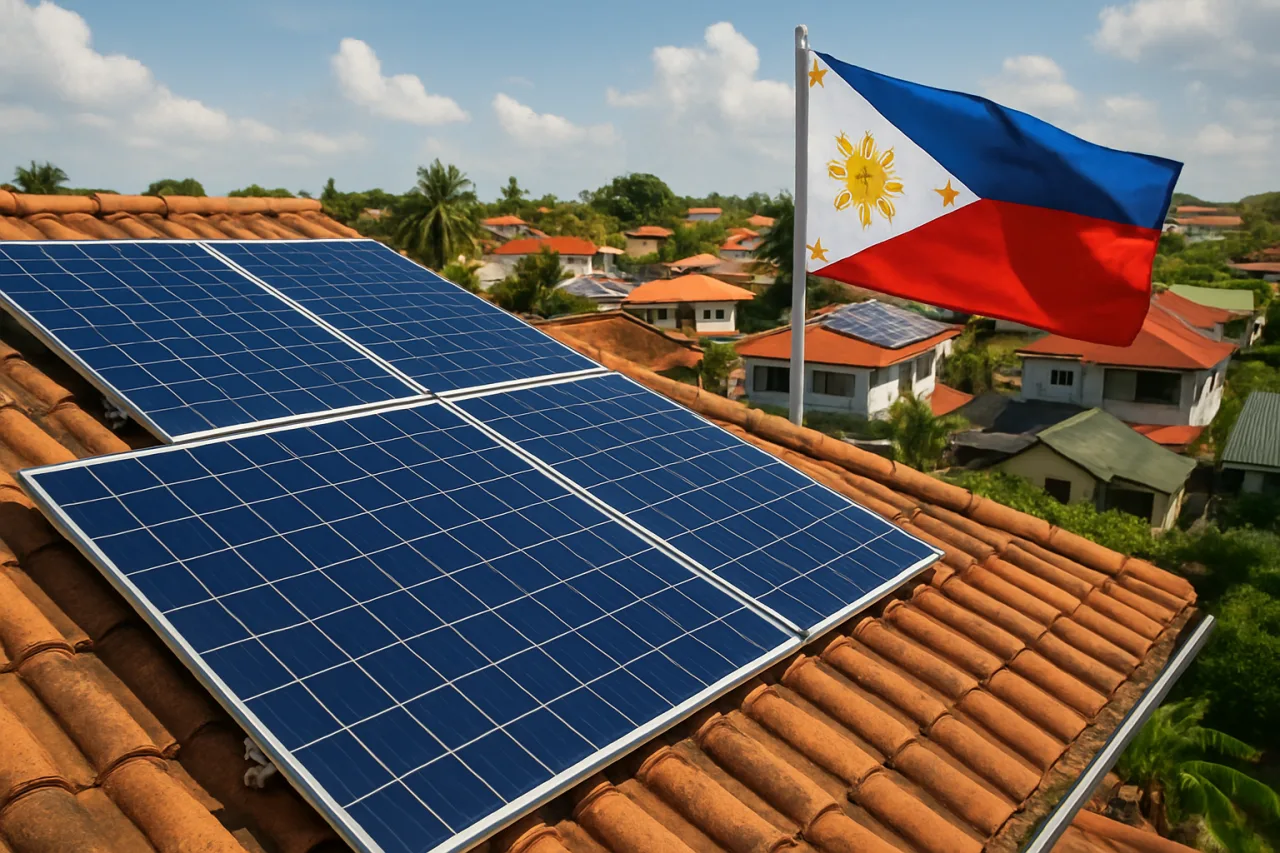
When Edwin Salas, a 46-year-old shuttle bus driver from two hours south of Manila, watched the first of 20 solar panels go up on his roof, he was not thinking about carbon emissions. He was thinking about the electric bill that had been climbing every month since the Middle East conflict sent oil prices through the roof in February 2026. “Even if we don’t achieve a zero bill, we’ll be able to save a lot and have power even during outages,” he told Agence France-Presse. His reasoning is echoed in thousands of households across the archipelago, and it has turned the Philippines into the unexpected center of a global rooftop solar boom.
According to Reuters, the Philippines became the world’s biggest spender on solar panels in the months following the outbreak of the Iran war. Chinese trade data shows $407 million in panel imports in the three months through May 2026 — a 145% increase from the same period a year earlier. Even when Chinese panel shipments globally fell 13% in May after a tax rebate removal, exports to the Philippines rose by nearly a third. The country is now China’s number two buyer of solar panels, according to a report from global energy think tank Ember, trailing only the Netherlands — and that comparison is misleading, because the Netherlands is primarily a transshipment hub for European redistribution.
Why the Philippine Solar Surge Is Happening Now
The drivers are painfully specific. Meralco, the country’s largest power distributor, raised prices by 10% since the Middle East conflict began in late February 2026. The Philippines has barely any power subsidies, and its residential electricity rates are the highest in Southeast Asia. Only Singapore comes close, but Singaporean purchasing power is nearly 13 times higher. The result: a median Filipino household spends roughly 12% of monthly income on electricity, assuming consumption of 200 kilowatt-hours per month — the average for a three-person household.
Brenda Valerio, country director for the non-profit New Energy Nexus, framed the shift in plain terms: “For years, rooftop solar was often framed as an environmental choice… today, it’s a practical response to financial pressure.” The Philippine solar surge, in other words, is being pulled by household budgets, not pushed by climate policy — even though the government has set a target of 35% renewable energy in the power mix by 2030.
That target remains distant. Solar accounts for under 4% of national power consumption, according to government data. Coal still dominates, accounting for nearly 60% of power generation. The country’s electricity prices — already the highest in the region — have been further squeezed by the same forces driving Philippine inflation to 6.4%, and consumers are feeling the squeeze in every billing cycle. But the trajectory is changing fast. The Department of Energy activated 250 megawatts of solar capacity and 450 megawatt-hours of battery storage on March 30, 2026, and announced it would fast-track 22 power projects to bring an additional 1,471 megawatts of renewable energy and storage online by the end of April. The Terra Solar Park in Central Luzon — billed as the world’s largest solar project — is scheduled for completion in 2026, according to the International Monetary Fund.
The Numbers Behind the Rooftop Revolution
The Philippine solar surge is visible in the data from every angle. Ember estimates that rooftop installations nearly doubled in the archipelago since early 2025. The Institute for Climate and Sustainable Cities, a Manila-based organization that tracks adoption by analyzing satellite imagery of rooftops, found that only 0.5% of the country’s available roof space is currently equipped for solar — which means the boom has barely begun. Alnie Demoral, an analyst at Ember, projects that distributed solar capacity could nearly triple to 3,500 megawatts within two years, matching the current size of the Philippines’ utility-scale solar fleet. Loan payback times, she noted, have already shrunk to 3.1 years from 4 years.
Installers are seeing the demand firsthand. Mike de Guzman, CEO of Manila-based Solaric, told AFP that five months of inventory were “wiped out” within weeks of the Middle East conflict’s outbreak. “It’s like a war happened and we were a bullet factory,” the 49-year-old said. Months later, his firm was still receiving 60 calls a day. Philergy German Solar, another Manila-based installer, received more than two-and-a-half times the number of customer enquiries in the first five months of 2026 compared to the same period last year. At one point, it fielded 3,000 inquiries in a single day, according to managing partner Jochen Staudter. “Customers are deciding to buy much faster than before,” Staudter said. “Demand will continue to be driven by high electricity prices.”
The on-grid solar panel market in the Philippines is projected to grow at a compound annual growth rate of 17.9% from 2025 to 2034, according to industry data, while the residential sector is expected to grow even faster at 19.8% annually. China’s total solar exports reached $13.96 billion in the first five months of 2026, up 26% from $11.07 billion during the same period last year, with Southeast Asian countries — particularly the Philippines, Malaysia, Thailand, and Cambodia — accounting for much of that growth.
What It Costs — and Who Can Afford It
The economics of the Philippine solar surge are a paradox. On one hand, plummeting panel prices and surging electricity rates mean systems pay for themselves faster than ever. On the other, the upfront cost remains out of reach for most Filipino families.
A typical household system costs between $3,000 and $5,000, according to Valerio — a range she called “too much” for a middle-class family without financing. The figure looms large against the average annual household income of ₱353,200 (approximately $5,760 at the exchange rate of ₱61.29 per dollar). Adrian Sabatera, a 39-year-old software engineer in Manila, spent ₱570,000 ($9,300) on his installation. He had thought about going solar for years but found it too costly until panel prices dropped. “I wouldn’t be shocked if a third of the middle-class population eventually finds their way to this setup,” he told Reuters.
Jason Porciuncula, a Manila entrepreneur, installed a 12-kilowatt system with battery storage in January 2026. As electricity prices hit record highs in May, his monthly bill dropped to a fifth of the previous summer’s ₱21,000. His experience illustrates the core appeal: the Philippine solar surge is not about going green — it is about keeping money in your pocket.
The government offers loans of up to ₱500,000 at 5% interest, below market rates, but the program excludes private-sector workers. A Department of Energy spokeswoman noted the government offers a financing program for civil servants, but fewer options exist for average Filipinos. Jose Rafael Mendoza, president of the Philippine Solar and Storage Energy Alliance, told AFP that his wish list includes an end to value-added taxes that are inflating costs. “We have so much pent-up demand in the Philippines,” he said. Australia, where one in three homes now has rooftop panels, offered a clear blueprint, he added: “We believe there’s going to be a similar trajectory.”
Big Business Is Already Moving
While households grapple with upfront costs, the Philippines’ largest conglomerates are installing at scale. SM Group has deployed more than 200,000 solar panels across its shopping centers, providing approximately 50% of the energy mix at its malls, including the sprawling Mall of Asia in Pasay — where customers are shaded from the Manila sun under a pergola built from solar panels. “We’ve been putting solar panels on our malls just to save on energy,” Frederic DyBuncio, president and CEO of SM Investments Corp, told AFP. “Most of them are looking at rooftop solar because that’s the easiest to do.” Competitor Robinsons now operates 28 solar-powered malls, while Ayala has arrays atop 13 properties.
“Solar panels continue to go down in price,” DyBuncio added, something he expected the Philippines “to take advantage of.” The corporate adoption wave matters beyond balance sheets — it normalizes solar for consumers who visit these malls daily and see the technology working overhead.
The Bottleneck: Red Tape, Not Demand
If demand is not the problem in the Philippine solar surge, what is? The answer, according to installers, policymakers, and advocates, is bureaucracy. Approvals for the required net metering and grid connection — theoretically a 10-day process — can take as long as eight months in some areas, according to Valerio. Senate President Sherwin Gatchalian said in June 2026: “The problem with solar rooftops is red tape,” calling for a faster, simpler permitting process. Mendoza, representing the industry alliance, echoed the call: the public no longer needs convincing, but the regulatory system has not caught up with the market.
The weakening peso has compounded the problem because the Philippines relies on imported coal and gas for power generation — the same currency pressure that has pushed economic growth forecasts down to 3.7% and inflation to multi-year highs. Each of these frictions individually would be manageable; collectively, they throttle a market that is otherwise primed for explosive growth. The EPIRA amendment debate over scrapping system loss charges is one example of how electricity market reform directly intersects with the solar adoption question.
What the Philippine Solar Surge Means for You
For Filipino professionals — whether working in Metro Manila, deployed overseas, or running a business — the Philippine solar surge creates both opportunities and obligations. If you own a home or business with roof space, the math increasingly favors solar: payback periods under 3.5 years, electricity bills cut by 80% or more, and protection against brownouts that have plagued the grid. The barriers are financing and permitting, not technology or supply.
For investors, the solar value chain offers exposure to a market growing at 18-20% annually — from panel importers and installers to energy storage providers and grid infrastructure companies. ACEN Corporation, the renewable energy arm of the Ayala Group, and SM Investments are already deploying capital at scale. The PSEi market outlook reflects growing investor interest in renewable energy and infrastructure. The question is whether smaller players and households can access the same economics.
For overseas Filipino workers sending money home, the solar surge offers a practical use for remittances: a one-time investment in rooftop solar can reduce a family’s monthly electricity burden for 25 years. At current electricity rates, a ₱300,000 system that saves ₱5,000 per month pays for itself in five years — and continues saving long after.
For policymakers, the Philippine solar surge is a test case for whether the country can remove friction faster than demand accumulates. The 35% renewable energy target by 2030 is achievable — the potential is 1,200 gigawatts across solar, wind, and hydro, according to Climate Analytics — but only if permitting timelines collapse from months to days, financing reaches private-sector workers, and VAT distortions are addressed. The market has spoken. The question is whether the government will listen.
Frequently Asked Questions
What is driving the Philippine solar surge in 2026?
The Philippine solar surge is driven primarily by soaring electricity prices — the highest in Southeast Asia — compounded by the Middle East conflict that began in February 2026. Meralco raised prices 10%, and the median household now spends 12% of monthly income on power. Plunging solar panel prices and shorter payback periods (3.1 years) have made rooftop solar a financial necessity, not just an environmental choice.
How much does a solar system cost in the Philippines?
A typical household solar system in the Philippines costs between $3,000 and $5,000 (₱184,000–₱306,000), according to Brenda Valerio of New Energy Nexus. This is above the average annual household income of ₱353,200. The government offers loans up to ₱500,000 at 5% interest, but the program excludes private-sector workers.
Is the Philippines a leader in solar energy adoption?
Yes. The Philippines became the world’s biggest spender on solar panels since the Iran war began, importing $407 million in panels in three months — a 145% increase year-over-year. It is China’s number two buyer of solar panels, according to Ember. However, solar still accounts for under 4% of national power consumption, and only 0.5% of available rooftop space is equipped.
How long does it take for solar panels to pay for themselves in the Philippines?
Loan payback times for rooftop solar in the Philippines have shrunk to 3.1 years, down from 4 years, according to Ember analyst Alnie Demoral. One Manila entrepreneur reported his monthly electricity bill dropped from ₱21,000 to roughly ₱4,200 after installing a 12-kilowatt system with battery storage.
What are the main barriers to the Philippine solar surge?
The primary barriers are bureaucratic: grid connection approvals that should take 10 days can stretch to 8 months. Other obstacles include high upfront costs, limited financing for private-sector workers, VAT taxes on solar equipment, component hoarding, and inadequate quality controls. Senate President Sherwin Gatchalian has called for faster, simpler permitting.
What is the Philippine government’s renewable energy target?
The Philippines aims for 35% renewable energy in the power generation mix by 2030, 50% by 2040, and over 50% by 2050. The Department of Energy is fast-tracking 22 power projects to add 1,471 megawatts of renewable energy and storage. The Terra Solar Park in Central Luzon, billed as the world’s largest solar project, is scheduled for completion in 2026.
Can OFWs invest in solar for their families in the Philippines?
Yes. A one-time investment of ₱300,000 in rooftop solar can reduce a family’s monthly electricity bill by up to 80% for 25 years. At current rates, the system pays for itself in approximately five years through savings alone. OFWs can research certified installers through the Department of Energy and the Philippine Solar and Storage Energy Alliance.
Disclaimer: This article is for informational purposes only and does not constitute financial or investment advice. Solar system costs, savings, and payback periods vary based on location, system size, energy consumption, and market conditions. Consult with a certified solar installer and your utility provider before making purchasing decisions.