Table of Contents
Key Takeaway
- Scam Alert: The Philippines’ parcel delivery boom has become fertile ground for digital fraud, with scammers impersonating J&T Express, LBC, and Flash Express through fake delivery SMS notifications. This parcel delivery scam is spreading rapidly across the OFW community.
- 74% Targeted: According to TransUnion Philippines, 74% of Filipinos have been targeted by fraud through text messages, phone calls, emails, or online platforms — significantly higher than the global average.
- 13.4% Fraud Rate: The Philippines logged a 13.4% suspected digital fraud rate in 2025, well above the global average, with logistics ranking among the highest-risk sectors.
- OFW Vulnerable: Overseas Filipino workers are prime targets for parcel scams because they regularly send packages home to family, making fake delivery notifications highly convincing.
- Protect Yourself: Never click links in unsolicited delivery texts. Verify directly through the courier’s official app or website. Legitimate companies never ask for payment via text message links.
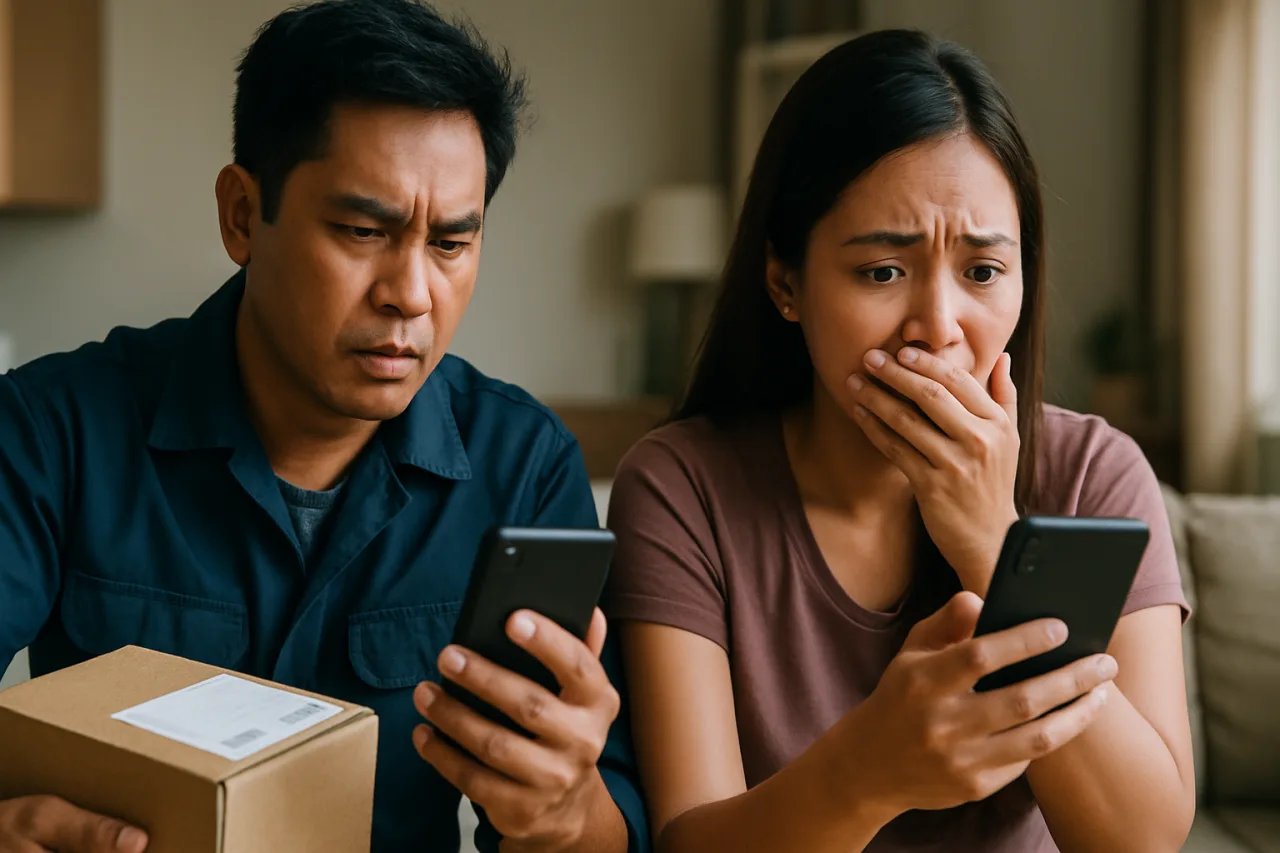
The Philippines is experiencing a surge in parcel delivery scam attacks as the country’s logistics boom creates new opportunities for cybercriminals. With millions of overseas Filipino workers (OFWs) regularly sending packages home to family, fake delivery notifications have become one of the most effective social engineering tools in the scammer’s arsenal. A June 25, 2026 ABS-CBN investigation found that every delivery notification now becomes a potential phishing vector, and every missed delivery becomes a social engineering opportunity. This crisis affects not just digital transactions but the fundamental trust that holds OFW families together across oceans.
How the Parcel Delivery Scam Works
The mechanics of a parcel delivery scam are deceptively simple but highly effective. Scammers send SMS text messages impersonating legitimate courier companies — primarily J&T Express, LBC, and Flash Express, the most popular delivery services for OFW senders. The messages typically claim:
- Your package cannot be delivered — click here to reschedule
- Your parcel is held at customs — pay the fee now
- Delivery failed — confirm your address to retry
- Your package is ready for pickup — pay the handling fee
These messages include phishing links that lead to fake websites designed to steal personal information, credit card details, or install malware on the victim’s phone. According to Lock.pub’s analysis of Philippine courier phishing, scammers have seized on the reality that Filipinos are already expecting package messages, making the fake notifications highly convincing.
The danger is amplified because SMS bypasses the email security stack entirely. People trust their phones more than their laptops, and text messages feel more personal and urgent. A 2026 smishing analysis by HackersHub Awareness Library identified package-delivery scams as one of the four dominant pretexts for SMS phishing globally, alongside bank-fraud alerts, tax-refund notices, and corporate IT-helpdesk lures.
The Scale: Philippines Digital Fraud by the Numbers
The parcel delivery scam is part of a broader digital fraud crisis in the Philippines. According to TransUnion Philippines’ H1 2025 fraud report:
- 13.4% — Suspected digital fraud rate in Philippine transactions (well above global average)
- 74% — Filipinos who reported being targeted by fraud through text, phone, email, or online
- Logistics sector — Ranks among the highest-risk sectors for suspected digital fraud
- ₱150,000 — Average loss per fraudulent transaction in the Philippines
TransUnion Philippines noted that the country’s digital fraud rate stands at a much higher level than the global average, driven by the explosive growth of digital payments (GCash, Maya, GrabPay) and e-commerce logistics. The Philippines processed over ₱5 trillion in digital payments in 2025, creating a massive attack surface for fraudsters.
The Department of Migrant Workers (DMW) and Global Anti-Scam Alliance (GASA) have partnered with Globe Telecom to equip OFWs with tools to spot warning signs and verify suspicious messages. This partnership recognizes that overseas workers are disproportionately targeted by scammers who exploit the emotional connection between OFWs and their families back home.
Why OFWs Are Prime Targets
Overseas Filipino workers are uniquely vulnerable to parcel delivery scam attacks for several reasons:
- Regular package sending: OFWs send balikbayan boxes, gifts, and packages home regularly — often monthly. This creates a constant expectation of delivery notifications, making fake messages highly believable.
- Emotional vulnerability: Scammers exploit the emotional bond between OFWs and their families. A message saying “your package is held” triggers urgency and anxiety, leading to impulsive clicks.
- Multiple courier use: OFWs use various couriers (J&T, LBC, Flash Express, DHL, FedEx) depending on the shipment. Victims cannot easily distinguish which messages are legitimate.
- Time zone confusion: OFWs working in different time zones (Middle East, Asia, Europe) may not be able to immediately verify delivery status with the courier’s hotline.
- Family members at home: Sometimes the scam targets the OFW’s family members (elderly parents, children) who receive the packages and may be less tech-savvy.
The Bangko Sentral ng Pilipinas has noted that remittance-related fraud has increased in parallel with the growth of digital channels. In 2025, overseas Filipino cash remittances hit $35.63 billion, and scammers have become increasingly sophisticated in intercepting these financial flows through social engineering.
Common Parcel Scam Text Messages in the Philippines
Here are the most frequently reported parcel delivery scam message formats circulating in the Philippines as of June 2026:
- J&T Express: “Hi [Name], your J&T package cannot be delivered. Please confirm your address: [malicious link]”
- LBC: “LBC: Your parcel is held at our facility due to incomplete address. Update here: [malicious link]”
- Flash Express: “FLASH: Your shipment is pending. Pay handling fee to proceed: [malicious link]”
- Customs (fake): “BOC: Your balikbayan box is held at customs. Pay ₱2,500 release fee: [malicious link]”
- Reward scam: “Congratulations! You won a free delivery voucher. Claim now: [malicious link]”
Red flags to watch for: (1) Messages from unknown numbers with +63 prefix variations, (2) Urgent language demanding immediate action, (3) Shortened or suspicious URLs (bit.ly, tinyurl, or misspelled domain names), (4) Requests for payment or personal information via text link, (5) Messages arriving when you are NOT expecting any delivery.
How to Protect Yourself and Your Family
Protecting yourself from a parcel delivery scam requires a combination of vigilance, verification, and education:
- Never click links in delivery SMS: Legitimate courier companies in the Philippines do not send clickable links for address confirmation or payment. Always go directly to the official app or website.
- Verify through official channels: Open the J&T Express, LBC, or Flash Express app directly (not through the text link) and check your tracking number. Call the official hotline if unsure.
- Check the sender number: Legitimate couriers use dedicated short codes or company names, not random mobile numbers. Save your courier’s official number in your phone.
- Never pay via text link: Legitimate delivery fees are paid at the pickup location or through the official app/website, never through SMS links.
- Educate your family: Tell your family members (especially elderly parents) about these scams. Many victims are family members who receive packages on behalf of OFWs.
- Use two-factor authentication: Enable 2FA on your GCash, Maya, and banking apps. Even if scammers get your password, they cannot access your funds without the second factor.
- Report suspicious messages: Forward scam SMS to 2020 (Globe) or report to the Philippine National Police Anti-Cybercrime Group.
What to Do If You’ve Been Scammed
If you or a family member has fallen victim to a parcel delivery scam, take these immediate steps:
- Do not enter any more information: If you clicked a link but did not enter payment details, close the page immediately and clear your browser cache.
- Change your passwords: If you entered login credentials, change your password immediately on the real app/website and enable 2FA.
- Contact your bank: If you entered credit card or banking details, call your bank immediately to block the card and dispute any unauthorized transactions.
- Report to authorities: File a report with the PNP Anti-Cybercrime Group (ACG) through their website or hotline. Also report to the Department of Trade and Industry (DTI) for consumer protection.
- Warn your family: If scammers have your family’s contact information, alert them immediately to prevent further targeting.
The Bigger Picture: Philippines Cybersecurity in 2026
The parcel delivery scam is just one facet of the Philippines’ broader cybersecurity challenges. According to the Philippine Star (June 9, 2026), new scam attempts affect Filipinos nearly every 2 days. The Global Anti-Scam Alliance (GASA) has noted that the scale of the problem has become a consumer rights crisis.
The Philippine government has responded with several initiatives: the DMW-GASA-Globe anti-scam partnership, the DICT’s cybersecurity awareness campaigns, and the BSP’s digital payment security guidelines. However, enforcement remains challenging because many scammers operate from overseas locations, making prosecution difficult. Learn more about the broader threat landscape in our complete Philippine cybersecurity guide and our article on AI-powered cyber attacks targeting Filipino workers.
For the OFW community, cybersecurity is not just about protecting money — it is about protecting the emotional bonds that make the overseas work meaningful. A successful scam does not just steal pesos; it erodes trust in the systems that connect OFWs to their families. Read our guide to smishing text scams for additional protection strategies.
Frequently Asked Questions (FAQ)
Q: How can I tell if a delivery text is real or a parcel delivery scam?
A: Legitimate courier texts in the Philippines come from dedicated short codes (not random mobile numbers), never include clickable links for payment or address confirmation, and reference specific tracking numbers you can verify in the official app. When in doubt, ignore the text and open the courier’s official app directly to check your shipment status.
Q: I clicked a link in a fake delivery text but did not enter any information. Am I safe?
A: If you did not enter any personal information or download anything, the risk is low. However, some malicious links can install tracking cookies or malware through drive-by downloads. Clear your browser cache, run a security scan on your phone, and monitor your accounts for unusual activity for the next few days.
Q: My family in the Philippines received a scam delivery text. What should they do?
A: Tell them to: (1) Not click any links, (2) Not reply to the message, (3) Delete the message immediately, (4) If they are expecting a package, check the status through the official courier app or by calling the courier’s hotline directly. If they already entered payment information, they should contact their bank immediately.
Q: Are J&T Express, LBC, and Flash Express aware of these scams?
A: Yes. All three companies have published advisories warning customers about fake SMS notifications. J&T Express Philippines regularly posts scam warnings on their official social media accounts. LBC and Flash Express similarly advise customers to only verify deliveries through their official apps and websites. None of these companies will ever ask for payment through SMS links.
Q: Why are OFWs specifically targeted by parcel scammers?
A: OFWs send packages home regularly (balikbayan boxes, gifts, electronics), creating a constant expectation of delivery notifications. Scammers exploit this by sending fake messages that blend in with legitimate ones. Additionally, OFWs often have higher disposable income, making them attractive targets for financial fraud.
Q: Can I get my money back if I paid a scammer through a fake delivery link?
A: It depends on how you paid. If you used a credit card, call your bank immediately to dispute the charge. If you used GCash or Maya, contact their support teams to report the fraudulent transaction — they may be able to reverse the payment if reported quickly. If you sent money through a remittance center, recovery is more difficult. Time is critical — report within 24 hours for the best chance of recovery.
Q: How do I report a parcel delivery scam in the Philippines?
A: Report to: (1) PNP Anti-Cybercrime Group: visit pnp.gov.ph or call their hotline, (2) DTI for consumer protection: 1-DTI (1-384), (3) NTC for SMS complaints: 1-321, (4) Your mobile network provider (Globe: 2020, Smart: 8888) to block the scam number. Also report to the courier company being impersonated so they can issue public warnings.
Disclaimer: This article is for informational and educational purposes only and does not constitute legal or cybersecurity advice. If you believe you have been a victim of fraud, contact the Philippine National Police Anti-Cybercrime Group or your local authorities immediately. Always verify delivery notifications through official courier apps and websites.