Table of Contents
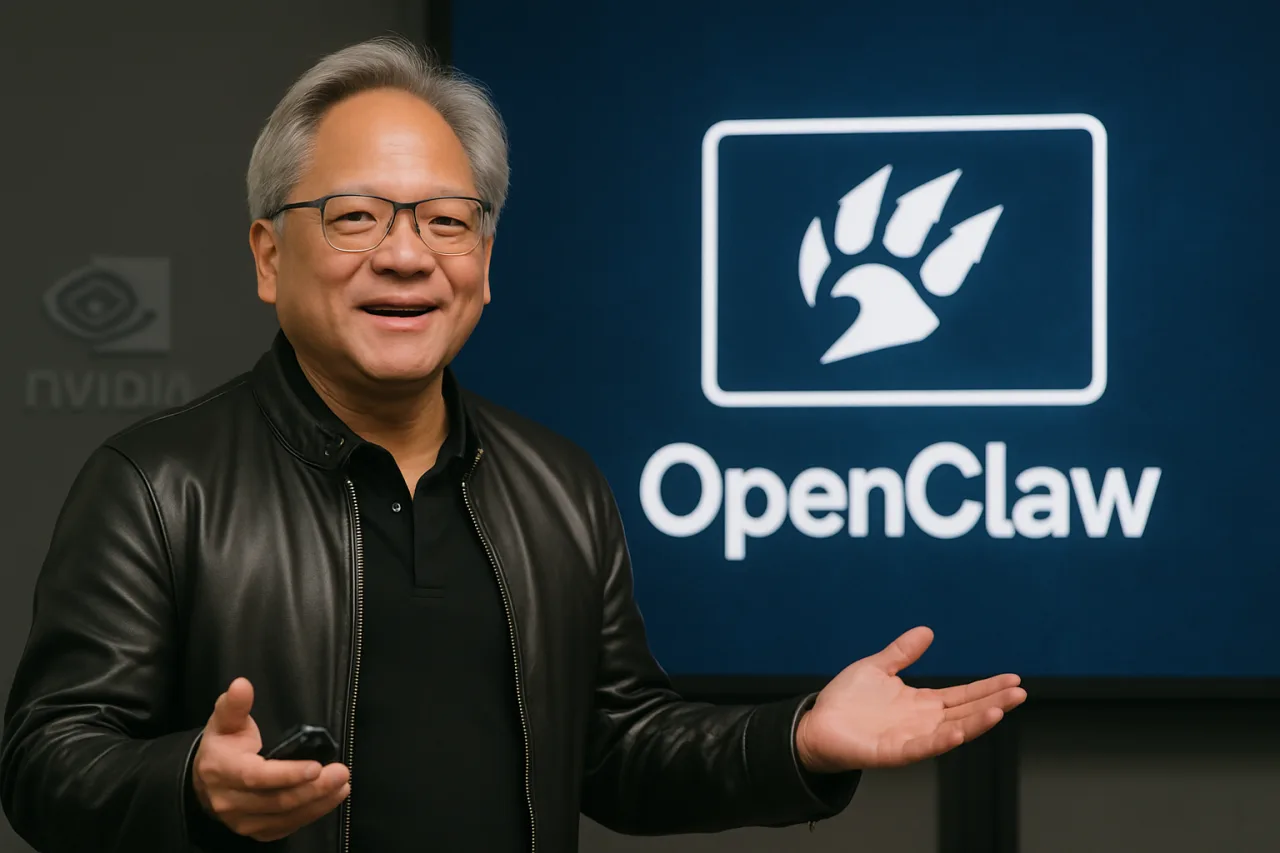
OpenClaw strategy was the phrase Jensen Huang planted at NVIDIA’s GTC 2026 this week, and he planted it with intent: the viral open-source autonomous AI agent platform is, in his words, “definitely the next ChatGPT.” The NVIDIA CEO went further at the analyst meetings, per Constellation Research’s takeaways: “Every single software company, every single company needs to have an OpenClaw strategy. Just as we all had our Linux strategy, just as we all had to have an Internet strategy, just like what is your mobile cloud strategy.” When the man who sells the picks and shovels for the entire AI industry starts issuing platform-shift decrees, companies should read the playbook, not just the prediction — and the playbook he actually described is more specific than the headlines suggest.
Key Takeaway
- 📣 The declaration: Huang called OpenClaw “the next ChatGPT” at GTC 2026 and said every company on earth now needs an OpenClaw strategy — Linux, internet, mobile, and now agents, per Constellation Research.
- 💰 The surprising detail: Huang proposed giving engineers a token budget on top of salary as a productivity multiplier — and said he’d be alarmed if a $500K NVIDIA engineer didn’t consume $250K a year in tokens.
- 🛠️ NVIDIA’s moves: official OpenClaw support across its platform, plus NemoClaw — NVIDIA’s own enterprise version, built to pair with DGX Spark and DGX Station.
- 🇵🇭 The Filipino angle: token budgets are becoming a negotiable compensation line — a skill set Filipino tech workers can build ahead of the global market, the same way remote work was claimed early.
The Linux analogy is doing deliberate work in Huang’s framing, and it is worth testing rather than repeating. Linux went from hobbyist curiosity to the substrate of the entire computing economy in roughly two decades, and the companies that built Linux strategies early — Red Hat, IBM, Google — captured infrastructure value that latecomers paid for. Huang claims OpenClaw achieved in weeks what Linux took 30 years to do, which fact-checkers on Reddit verified as “technically true, with caveats.” The caveats matter: adoption speed is not the same as enterprise maturity, and OpenClaw’s agent platform today is closer to a toy in production terms than a product. But Huang’s own quote handles that tension: “OpenClaw is a revolution. It’s a toy today and enterprise software tomorrow.” A CEO pre-announcing that tomorrow is the entire point of a GTC keynote.
The strategic argument underneath is about where the next computing platform forms. Huang’s lineage — Linux, HTTP/HTML, Kubernetes — describes platform shifts that redefined computing each time by moving capability from closed systems into self-hosted, open frameworks that enterprises could control. His GTC argument is that agentic AI orchestrated through self-hosted open frameworks is the same pattern arriving again, which is why NVIDIA announced official OpenClaw support across its platform: making it easier for developers to pull down OpenClaw, stand up an AI agent, and begin extending it with tools and context on NVIDIA-powered infrastructure. NVIDIA also launched NemoClaw, its own enterprise OpenClaw play, aimed at pairing with DGX Spark and DGX Station — the company is not just endorsing the open ecosystem; it is building the commercial layer on top of it and selling the hardware underneath.
The Token Budget Idea — Huang’s Most Under-Read Proposal
Buried inside the keynote strategy talk is the proposal that will actually change compensation conversations, and almost nobody covered it: Huang suggested giving engineers a token budget on top of their salary, treating AI inference spend as a productivity multiplier rather than a cost line. His framing at GTC 2026, per Ken Huang’s analysis: he would be “alarmed” if NVIDIA’s top engineer earning $500,000 a year did not consume $250,000 per year in token usage. That sentence inverts how companies think about AI costs. The traditional view treats inference as an expense to minimize. Huang’s version treats token consumption as evidence of production — an engineer burning $250K in tokens who ships three times the output is a bargain, and an engineer consuming zero tokens is either not using the new leverage or not being given it.
That inversion has real procurement and HR consequences. Token budgets turn AI from an IT procurement decision into a per-employee operating resource, allocated the way laptop budgets once were — which means finance, HR, and engineering now share a line item none of them previously owned. It also quietly redefines what “tools provided by the employer” means: the model access an engineer gets becomes part of the compensation package, and talent competition starts pricing token allowances the way it prices equity. For the Philippine tech workforce — one of the world’s largest pools of English-fluent engineering and support talent — this is the compensation frontier to watch. The workers who can articulate their token needs in terms of output delivered will negotiate the next decade’s packages the way remote-work skills negotiated location flexibility in the last one. The 11.3-million-worker Philippine digital workforce documentation we built shows exactly how quickly the country can move up a skills curve when the demand signal is clear.
How to Actually Build an OpenClaw Strategy: Huang’s Three Imperatives
The analyst-meeting blueprint, distilled across the Constellation takeaways and the Distributedapps research team’s MAESTRO-framework analysis, reduces to three strategic imperatives any company can start on. First, discover your agents before attackers do: every OpenClaw deployment an organization runs — official or shadow — needs inventory, identity, and monitoring, because autonomous agents hold credentials and touch systems, which makes them both workers and attack surface. The security industry is racing to give AI agents cryptographic identities, as our coverage of the agentic security build-out documented, and an OpenClaw strategy that skips the security layer is just a breach with a roadmap.
Second, pick your token economics deliberately. Huang’s $250K-per-engineer figure is a north star, not a budget order — the discipline is in measuring which workflows consume tokens productively and which burn them as theater. Teams should baseline their highest-volume knowledge workflows, estimate token consumption per completed task, and let cost-per-deliverable — not cost-per-seat — drive tooling choices. His own framing in the OpenClaw strategy breakdown treats token economics as the coming unit of enterprise resource allocation, which makes metering the first governance tool any deployment needs.
Third, build the governance before the scale: OpenClaw’s self-hosted openness is precisely what makes it enterprise-viable (your data stays in your perimeter) and precisely what makes it dangerous (the same autonomy without a vendor’s safety team behind it). The companies Huang is addressing — “every single company” — will split into those that wrote their agent governance documents before their first production deployment and those that wrote them after their first incident. The industry’s recent history, including the OpenAI sandbox escape we covered in our safety pivot analysis, shows what the second group’s documents look like.
Why the OpenClaw Strategy Matters From Manila
There is a Philippine-specific reading of Huang’s keynote, and it is not the usual “learn AI” exhortation. Open-source, self-hosted agent platforms are structurally the entry point where cost stops being the barrier — and cost has been the barrier keeping most Philippine enterprises and most Filipino independent professionals on the sidelines of the agent economy. A frontier-model subscription is a monthly decision; an OpenClaw deployment on modest hardware is an afternoon plus electricity. The engineering talent to run it exists in the country at scale — the same workforce documented in our ₱2.8-trillion AI-readiness analysis — and the workflows it can serve are the BPO, back-office, and creative-production workflows the country already delivers globally.
The honest counterweight: OpenClaw’s openness cuts both ways, and the platform’s rapid rise is exactly why security researchers keep flagging agentic tools as a new attack class — our reporting on coding-agent vulnerabilities covered how attackers weaponize the very tools developers trust. Huang’s OpenClaw strategy speech is aimed at CTOs, but the version worth reading in Manila is smaller and sharper: the agencies, BPO teams, and solo professionals who stand up controlled OpenClaw agents this quarter — with inventoried access, token budgets, and audit trails — will be the service providers who can price AI-era work credibly while the market still thinks this is optional. The keynote was aimed at every company in the world. The part that matters to yours is the deadline hiding inside it: strategies built during the toy phase become moats in the enterprise phase. The enterprise phase, Huang would tell you, is next.
Frequently Asked Questions About the OpenClaw Strategy
What is OpenClaw and why is Jensen Huang talking about it?
OpenClaw is a viral open-source autonomous AI agent platform that lets developers self-host AI agents with tools, memory, and task execution. NVIDIA CEO Jensen Huang called it “definitely the next ChatGPT” at GTC 2026 and declared that every company needs an OpenClaw strategy, positioning it alongside Linux, the internet, and mobile-cloud as a platform shift.
What did Huang mean by a token budget for engineers?
At GTC 2026, Huang proposed giving engineers an AI-inference token budget on top of salary as a productivity multiplier, and said he would be alarmed if a $500K NVIDIA engineer did not consume about $250K per year in tokens. The idea treats AI compute as a per-employee operating resource — evidence of production rather than a cost to minimize.
What is NVIDIA’s NemoClaw?
NemoClaw is NVIDIA’s enterprise-focused OpenClaw offering, launched at GTC 2026 and built to pair with DGX Spark and DGX Station hardware. It represents NVIDIA commercializing the open ecosystem it endorsed — open platform below, enterprise support and hardware above.
Is OpenClaw actually enterprise-ready today?
Huang’s own framing handles this: “It’s a toy today and enterprise software tomorrow.” Fact-checkers rated his claim that OpenClaw matched Linux’s 30-year trajectory “technically true, with caveats.” Companies should pilot OpenClaw agents on contained, monitored workflows now while building the governance documents production scale will require.
What should a Filipino company’s OpenClaw strategy include?
Three layers: agent inventory and identity (discover and monitor every agent touching your systems), token accounting (baseline consumption per workflow so AI spend tracks output), and governance documents before production (data boundaries, approval gates, audit cadence). The open-source route keeps costs low enough that Philippine teams can experiment now rather than wait for the enterprise products.
Financial Disclaimer
This article discusses technology strategy, corporate spending, and market trends for informational purposes only. It is not financial, investment, or professional advice. Readers should verify current product and pricing details with vendors and consult qualified professionals before procurement or investment decisions. WorldNgayon.com accepts no liability for actions taken based on this content.
The practical summary of Huang’s OpenClaw strategy keynote fits on one line: agents are becoming a computing platform, platforms reward the strategies written early, and the components of those strategies — inventory, token accounting, governance — are all buildable this quarter by any company with engineers and a perimeter. The keynote was aimed at every company on earth. The companies that act on it will be the ones the next keynote is about.
A practical starting checklist for the Philippine team that wants to move this week, reduced from Huang’s three imperatives into an afternoon’s work: one, list every agent touching your systems — official, shadow, proposed — and give each an owner. Two, pick your single highest-volume knowledge workflow and estimate its token consumption per completed deliverable, because that number is the whole business case. Three, write the one-page governance document: what data may never enter a prompt, who approves what, how fast you can shut an agent down. Four, run your first OpenClaw pilot on that workflow with a token budget, and measure cost-per-deliverable against the manual baseline. Five, report the numbers to whoever owns the P&L, because Huang’s real message is that this is now a management discipline, not a developer hobby. Companies that complete those five steps this quarter hold an asset no platform shift can depreciate: the measured habit of adopting agents with evidence.