Table of Contents
Key Takeaway
- 🤖 NVIDIA opened its first Singapore research hub on May 20, 2026 at ATxSummit — only its second in Asia-Pacific, signaling deep commitment to Southeast Asia’s AI infrastructure market.
- 🔬 Two research focus areas: Embodied AI (robots that perceive and act) and AI infrastructure efficiency (making data centers cheaper and faster to run).
- 🚀 The Vera Rubin platform delivers 10x lower cost per token than the previous Blackwell generation, with systems available via AWS, Microsoft, and Google in the second half of 2026.
- 🏙️ Singapore is launching a real-world robot testbed in Punggol Digital District with DHL, Grab, Certis, and QuikBot — creating immediate demand for robotics and AI systems engineers.
- 🇵🇭 Filipino professionals are positioned to benefit from the wave of AI infrastructure, robotics, and cloud engineering roles this hub will generate across Southeast Asia.
Why NVIDIA’s Singapore Move is a Defining Moment for Southeast Asian AI
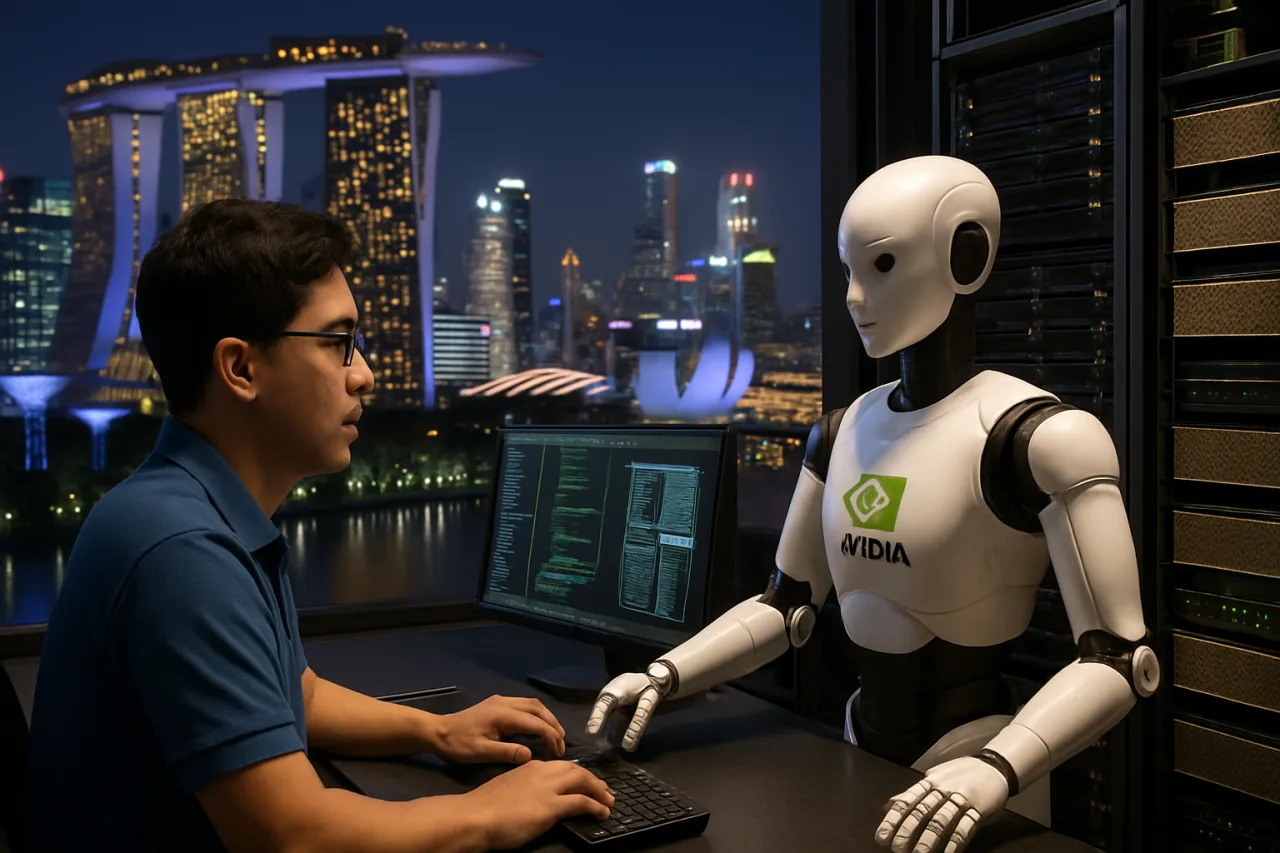
On May 20, 2026, at Singapore’s ATxSummit, NVIDIA did not just announce a product launch or a partnership. It announced something far more consequential for Southeast Asia’s technology sector: its first research hub in Singapore — and only its second research presence in the entire Asia-Pacific region. The opening of the NVIDIA Singapore research hub signals deep commitment to the region’s AI infrastructure market.
The announcement came alongside parallel moves from OpenAI, which unveiled its Singapore Applied AI Lab, and Google DeepMind, which confirmed expanded operations in the city-state. Together, these three announcements represent the most concentrated AI research investment in Southeast Asian history.
NVIDIA Singapore for Filipino professionals — software engineers, robotics specialists, cloud architects, and AI researchers — this is not Silicon Valley news happening far away. This is a regional signal that Southeast Asia is becoming a primary destination for frontier AI research and deployment, not merely a market for finished products developed elsewhere.
What NVIDIA’s Singapore Hub Will Actually Do
NVIDIA’s Singapore research lab will concentrate on two specific areas:
1. Advancing Embodied AI
NVIDIA Singapore embodied AI is the field of artificial intelligence that deals with systems that perceive, understand, and physically interact with the real world. Unlike large language models that process text in data centers, embodied AI powers robots, autonomous vehicles, drones, and industrial automation systems.
NVIDIA’s research in Singapore will focus on:
- Physical AI systems that can navigate real-world environments, not just simulated ones
- Sensor fusion — combining camera, lidar, radar, and tactile inputs for robot perception
- Real-time decision making under uncertainty, critical for delivery robots and factory automation
- Simulation-to-reality transfer — training robots in virtual environments and deploying them in physical ones
NVIDIA Singapore research hub is not theoretical research. Singapore is simultaneously launching a multi-operator robot testbed in Punggol Digital District, where robots from multiple companies will operate in a mixed-use public environment for deliveries, cleaning, and security patrols. NVIDIA’s research will feed directly into this deployment pipeline.
2. Improving AI Infrastructure Efficiency
The second focus area is equally critical: making AI computing infrastructure cheaper, faster, and more energy-efficient. As AI data centers consume an ever-growing share of global electricity — projected to rival the power consumption of major industrialized nations by 2030 — efficiency improvements translate directly into cost reductions and competitive advantage.
NVIDIA’s Singapore lab will work on:
- GPU utilization optimization for inference-heavy workloads
- Memory bandwidth improvements to reduce data movement bottlenecks
- Thermal design innovations for tropical data center environments
- Software-hardware co-design to squeeze more performance per watt
The Vera Rubin Platform: What Powers the Research
NVIDIA’s Singapore hub will not work with yesterday’s hardware. It will deploy and refine the Vera Rubin platform — NVIDIA’s next-generation AI infrastructure architecture announced at CES 2026 and showcased at GTC 2026.
The numbers are striking:
- 10x lower cost per token when inferencing mixture-of-experts (MoE) models compared to the Blackwell platform
- Vera Rubin NVL72 rack systems — the first to offer NVIDIA Confidential Computing at rack scale, keeping data secure across CPU, GPU, and NVLink domains
- AI factory model — industrializing the production of AI inference tokens at planetary scale
- Availability: Second half of 2026 via AWS, Microsoft, and Google Cloud
For enterprise IT leaders and cloud engineers, Vera Rubin represents a shift in assumption. The previous generation was training-centric — optimized for building models. Vera Rubin is inference-centric — optimized for running models at scale, which is where the majority of AI computing demand is moving.
This matters for Southeast Asia because the region’s data center boom — particularly in Malaysia, Indonesia, and the Philippines — is building infrastructure that will run AI services, not just train them. Vera Rubin is the platform that will power those services.
Singapore’s Robot Testbed: Real-World Deployment
NVIDIA’s research hub is not operating in isolation. It is embedded in a broader Singaporean strategy to become what the Economic Strategic Review committee calls a “trusted hub” for developing, testing, and deploying AI solutions at scale.
The centerpiece of this strategy is the Punggol Digital District (PDD) robot testbed — Singapore’s first large-scale public robotics deployment zone where multiple companies can trial embodied AI in a real urban environment.
Companies participating in the testbed include:
- DHL — logistics and delivery robotics
- Grab — autonomous delivery and mobility services
- Certis — security and patrol robots
- QuikBot — last-mile delivery automation
- Slamtec — autonomous navigation technology
- Unitree — quadruped and humanoid robots
The testbed is facilitated through a precinct-level exemption under Singapore’s Active Mobility Act, allowing robots to operate in public spaces under controlled conditions. The Singapore Institute of Technology (SIT) and the Infocomm Media Development Authority (IMDA) are coordinating the research, with NVIDIA’s lab providing the underlying GPU infrastructure and AI models.
NVIDIA Singapore research hub offers Filipino professionals, this means real, immediate job opportunities in robotics engineering, sensor integration, AI model deployment, and systems testing — roles that did not exist in Southeast Asia at this scale even two years ago.
Why Singapore — And Why Now?
Singapore is not the only country in Southeast Asia building AI infrastructure. Malaysia is constructing hundreds of data centers. Indonesia has over 2,000 operational facilities. Vietnam is investing in semiconductor testing. So why did NVIDIA, OpenAI, and Google DeepMind all choose Singapore for their regional research headquarters?
1. Regulatory Trust
Singapore’s National AI Strategy 2.0 (NAIS 2.0), launched in 2023, provides a clear framework for AI development, governance, and deployment. The city-state has built a reputation as a place where technology companies can experiment within defined boundaries — not the Wild West, but not bureaucratic paralysis either.
2. Talent Density
Singapore’s universities — National University of Singapore (NUS) and Nanyang Technological University (NTU) — produce some of the highest-quality AI research in Asia. NVIDIA’s lab will work directly with university researchers, creating a pipeline of talent and ideas.
3. Gateway Geography
Singapore is within 4 hours of every major Southeast Asian market. For NVIDIA, this means the research developed in Singapore can be deployed across Malaysia, Indonesia, Thailand, Vietnam, and the Philippines with minimal friction.
4. Capital Access
Singapore attracted US$8.4 billion in AI venture capital — 75% of all AI VC in Southeast Asia. Research hubs located near capital flows can more easily spin off startups, attract partnerships, and justify continued investment.
5. Real-World Testing Environment
The Punggol Digital District provides something few other locations can offer: a government-backed, liability-managed environment for testing robots in public spaces. This accelerates the timeline from research prototype to commercial product.
The Competitive Landscape: Who Else Is Building What
NVIDIA Singapore did not emerge in a vacuum. It is part of a broader pattern of AI infrastructure investment across Southeast Asia that Filipino professionals should understand:
| Company | Singapore Presence | Focus Area | Filipino Pro Relevance |
|---|---|---|---|
| NVIDIA | Research hub (May 2026) | Embodied AI + Infrastructure efficiency | GPU architecture, robotics, cloud engineering |
| OpenAI | Applied AI Lab (May 2026) | Enterprise AI deployment | AI integration, API development, product management |
| Google DeepMind | Expanded presence (2026) | AI research + cloud services | ML engineering, research, cloud architecture |
| Microsoft | US$5.5B investment (early 2026) | Azure AI + Copilot | Cloud engineering, enterprise AI, DevOps |
| Amazon/AWS | Cloud region expansion | Trainium/Inferentia chips, AI services | Solutions architecture, SRE, infrastructure |
What Embodied AI Actually Means for Your Career
For most Filipino professionals, “embodied AI” is a buzzword, not a job description. Here is what it translates to in practice:
Robotics Software Engineer
These engineers write the code that controls robot movement, perception, and decision-making. They work with ROS (Robot Operating System), sensor drivers, and real-time control systems. In Singapore’s testbed, they would program delivery robots to navigate sidewalks, avoid pedestrians, and complete drop-offs.
Computer Vision Specialist
Robots cannot act on what they cannot see. Computer vision specialists train neural networks to recognize objects, read signs, detect obstacles, and interpret spatial relationships from camera and lidar data.
Simulation Engineer
Before deploying robots in the real world, companies test them in virtual environments. Simulation engineers build digital twins of physical spaces — Punggol Digital District, for example — and run thousands of simulated scenarios to identify edge cases and failure modes.
AI Infrastructure Engineer
Embodied AI models are computationally expensive. Infrastructure engineers optimize how these models run on GPU clusters, ensuring real-time response requirements are met while minimizing cost and power consumption.
Systems Integration Engineer
Robots are not just software. They are mechanical, electrical, and software systems combined. Integration engineers ensure that motors, sensors, compute units, and AI models work together reliably.
Field Test Engineer
Once robots are deployed, someone must monitor their performance, collect failure data, and feed insights back to development teams. Field test engineers are the bridge between laboratory and real-world operation.
The Infrastructure Efficiency Angle: Data Center Economics
While embodied AI captures headlines, NVIDIA’s second research focus — AI infrastructure efficiency — may have more immediate financial impact.
Data centers consume enormous amounts of power. A single large facility can use as much electricity as a small city. In tropical Southeast Asia, where ambient temperatures range from 27°C to 35°C, cooling costs are even higher than in temperate climates.
NVIDIA’s Singapore lab will work on making AI data centers more efficient in exactly the conditions that Malaysian, Indonesian, and Philippine facilities face:
- Liquid cooling optimization — reducing the energy cost of keeping GPUs within thermal limits
- Workload scheduling algorithms — matching compute tasks to hardware capabilities to minimize idle time
- Memory compression techniques — fitting more data into limited GPU memory without performance loss
- Network topology design — minimizing data transfer bottlenecks between GPUs in large clusters
For Filipino data center engineers and cloud architects, this research will produce the techniques and tools they will use daily. Understanding NVIDIA’s efficiency roadmap is not optional — it is core professional knowledge.
Salaries and Demand: What These Roles Pay
The skills NVIDIA’s Singapore hub is developing command premium salaries across Southeast Asia:
| Role | Singapore (USD) | Malaysia (USD) | Philippines (USD) | Remote for SEA (USD) |
|---|---|---|---|---|
| Robotics Software Engineer | $80K–140K | $40K–75K | $25K–50K | $50K–90K |
| Computer Vision Engineer | $90K–150K | $45K–80K | $28K–55K | $55K–100K |
| AI Infrastructure Engineer | $85K–145K | $42K–78K | $26K–52K | $52K–95K |
| Cloud Architect (AI/ML) | $100K–170K | $50K–90K | $30K–60K | $60K–110K |
| Systems Integration Engineer | $75K–130K | $38K–70K | $24K–48K | $48K–85K |
*Figures approximate; based on 2026 job market data for Southeast Asia. Singapore salaries are 1.5–2x regional averages. Remote roles for SEA-based companies paying global-competitive rates.*
The Skills Filipino Professionals Should Build Now
NVIDIA’s Singapore hub will create demand for specific technical skills. Filipino professionals who acquire these skills before the market floods will be positioned for the best roles.
For Embodied AI Roles:
- ROS (Robot Operating System) — the dominant framework for robot software development
- Python + C++ — primary languages for robotics and real-time systems
- CUDA and TensorRT — NVIDIA’s GPU programming and inference optimization frameworks
- OpenCV and point cloud processing — computer vision fundamentals
- Gazebo or Isaac Sim — robot simulation environments; NVIDIA’s Isaac Sim is particularly relevant
For Infrastructure Efficiency Roles:
- Kubernetes and container orchestration — managing GPU workloads at scale
- MLOps — deploying, monitoring, and updating AI models in production
- GPU cluster management — SLURM, NVIDIA Base Command Manager, or similar tools
- Performance profiling — identifying bottlenecks in distributed AI systems
- Energy modeling — understanding power consumption patterns and optimization strategies
For Both Tracks:
- NVIDIA certifications — Deep Learning Institute (DLI) courses in CUDA, TensorRT, and robotics
- Cloud platform expertise — AWS, Azure, or Google Cloud AI/ML services
- English technical writing — documenting systems, writing reports, and communicating across multinational teams
Why This Matters for the Philippines Specifically
The Philippines is not Singapore. It does not have US$8.4 billion in AI venture capital or a government-backed robot testbed. But Filipino professionals have advantages that make them competitive for roles created by NVIDIA’s regional expansion:
1. English Proficiency
Singapore’s research labs operate in English. NVIDIA’s global teams communicate in English. Filipino professionals who can write technical documentation, present research findings, and participate in code reviews in English have a structural advantage over candidates from countries with weaker English technical education.
2. Cost-Competitive Talent
A robotics software engineer in Singapore costs US$80,000–140,000 annually. A similarly skilled engineer in the Philippines costs US$25,000–50,000. For NVIDIA and its partners, this cost differential creates strong incentives to hire Filipino remote workers or establish satellite teams in the Philippines.
3. Existing BPO Infrastructure
The Philippines’ business process outsourcing industry has trained hundreds of thousands of Filipinos in technical support, IT operations, and quality assurance. These skills transfer directly to AI infrastructure operations, model monitoring, and deployment support.
4. University Pipeline
University of the Philippines Diliman, De La Salle University, and Mapúa University are expanding their AI and robotics programs. Graduates from these programs will feed directly into the regional talent pipeline that NVIDIA’s Singapore hub is creating.
5. OFW Networks
Filipino professionals already working in Singapore, Malaysia, and the Middle East form networks that accelerate knowledge transfer. When a Filipino robotics engineer in Singapore learns about an opening, they tell their peers in Manila. These informal networks are how opportunities spread.
What Happens Next: Timeline and Milestones
NVIDIA’s Singapore hub is not a finished facility. It is a developing ecosystem. Filipino professionals should watch these milestones:
- Q3 2026: Vera Rubin systems available via cloud providers (AWS, Microsoft, Google). First research outputs from Singapore lab expected.
- Q4 2026: Punggol Digital District testbed fully operational with multi-company robot deployments.
- 2027: First commercial embodied AI products developed in Singapore entering Southeast Asian markets.
- 2028–2030: Scaling phase — NVIDIA’s Singapore research feeds into data center deployments across Malaysia, Indonesia, Thailand, Vietnam, and the Philippines.
Action Steps for Filipino Professionals
If you are a Filipino professional watching NVIDIA’s Singapore expansion, here is what to do:
- Learn NVIDIA’s stack. Start with free NVIDIA DLI courses on CUDA, deep learning, and robotics. The investment is time, not money.
- Build a robotics or infrastructure project. Employers hire based on demonstrated ability, not credentials alone. Build a robot simulation in Isaac Sim or optimize a model using TensorRT.
- Monitor Singapore job boards. JobStreet Singapore, LinkedIn, and NVIDIA’s careers page post roles months before they are widely advertised.
- Join robotics and AI communities. The Philippine Robotics Olympiad, Python Philippines, and local AI meetups are networking channels that lead to referrals.
- Consider remote-first roles. Many Singapore-based companies hire Filipino engineers for remote work, particularly in infrastructure and operations roles.
Conclusion: Southeast Asia’s AI Research Capital
NVIDIA’s Singapore research hub is more than a corporate expansion. It is a signal that Southeast Asia has moved from AI consumer to AI producer — from a market that buys technology developed elsewhere to a region that develops technology for global deployment.
For Filipino professionals, this is the invitation. The research hub in Singapore will generate techniques, tools, and products that will be deployed across Southeast Asia. Someone will build those robots. Someone will optimize those data centers. Someone will train those models.
The question is whether Filipino professionals will be ready — or whether they will watch the opportunity from the sidelines.
Frequently Asked Questions
What is NVIDIA Singapore research hub?
NVIDIA announced its first Singapore research hub on May 20, 2026, at ATxSummit. It is the company’s second research presence in Asia-Pacific and focuses on embodied AI (robots that perceive and act) and AI infrastructure efficiency.
What is embodied AI?
NVIDIA Singapore research hub focuses on embodied AI refers to artificial intelligence systems that physically interact with the real world — robots, autonomous vehicles, drones, and industrial automation. Unlike chatbots that process text, embodied AI systems perceive their environment through sensors and take physical actions.
What is the Vera Rubin platform?
Vera Rubin is NVIDIA’s next-generation AI infrastructure platform, announced at CES 2026. It delivers up to 10x lower cost per token than the previous Blackwell generation when running mixture-of-experts models. Systems will be available in the second half of 2026 via AWS, Microsoft, and Google Cloud.
What is the Punggol Digital District robot testbed?
Singapore is launching its first large-scale public robotics testbed in Punggol Digital District. Companies including DHL, Grab, Certis, QuikBot, Slamtec, and Unitree will trial delivery, cleaning, and security robots in a mixed-use urban environment under a government-backed exemption framework.
What skills do Filipino professionals need for embodied AI roles?
Key skills include ROS (Robot Operating System), Python and C++ programming, CUDA and TensorRT for GPU acceleration, computer vision with OpenCV, and simulation tools like NVIDIA Isaac Sim. NVIDIA’s Deep Learning Institute offers free and paid courses in these areas.
Are there job opportunities for Filipinos in Singapore’s AI sector?
Yes. Singapore’s AI sector is growing rapidly, with over US$8.4 billion in venture capital and major research investments from NVIDIA, OpenAI, Google, Microsoft, and Amazon. Filipino professionals with robotics, AI infrastructure, and cloud engineering skills are competitive candidates for roles in Singapore and remote positions serving Singapore-based companies.
How does NVIDIA’s Singapore hub affect the Philippines?
Indirectly but significantly. The research and products developed in Singapore will be deployed across Southeast Asia, including the Philippines. Filipino engineers who understand NVIDIA’s technology stack will be positioned to work on deployments, integrations, and operations. Additionally, cost-competitive Filipino talent is attractive to Singapore-based companies seeking to scale teams.
What is the salary range for robotics engineers in Southeast Asia?
In Singapore, robotics software engineers earn US$80,000–140,000 annually. In Malaysia, the range is US$40,000–75,000. In the Philippines, US$25,000–50,000. Remote roles for Southeast Asian companies can pay US$50,000–90,000. These figures reflect 2026 market conditions and vary by experience level.
When will NVIDIA’s Vera Rubin systems be available?
Vera Rubin-based systems will be available in the second half of 2026 through cloud providers AWS, Microsoft Azure, and Google Cloud Platform. On-premises deployments will follow through NVIDIA’s partner network.
How can Filipino professionals get started with embodied AI?
Start with free NVIDIA DLI courses on CUDA and deep learning. Install ROS and experiment with robot simulations in Gazebo or Isaac Sim. Build a portfolio project — even a simple autonomous navigation robot in simulation demonstrates capability. Join local AI and robotics communities for networking and mentorship.
Sources: NVIDIA Official, Infocomm Media Development Authority.