Table of Contents
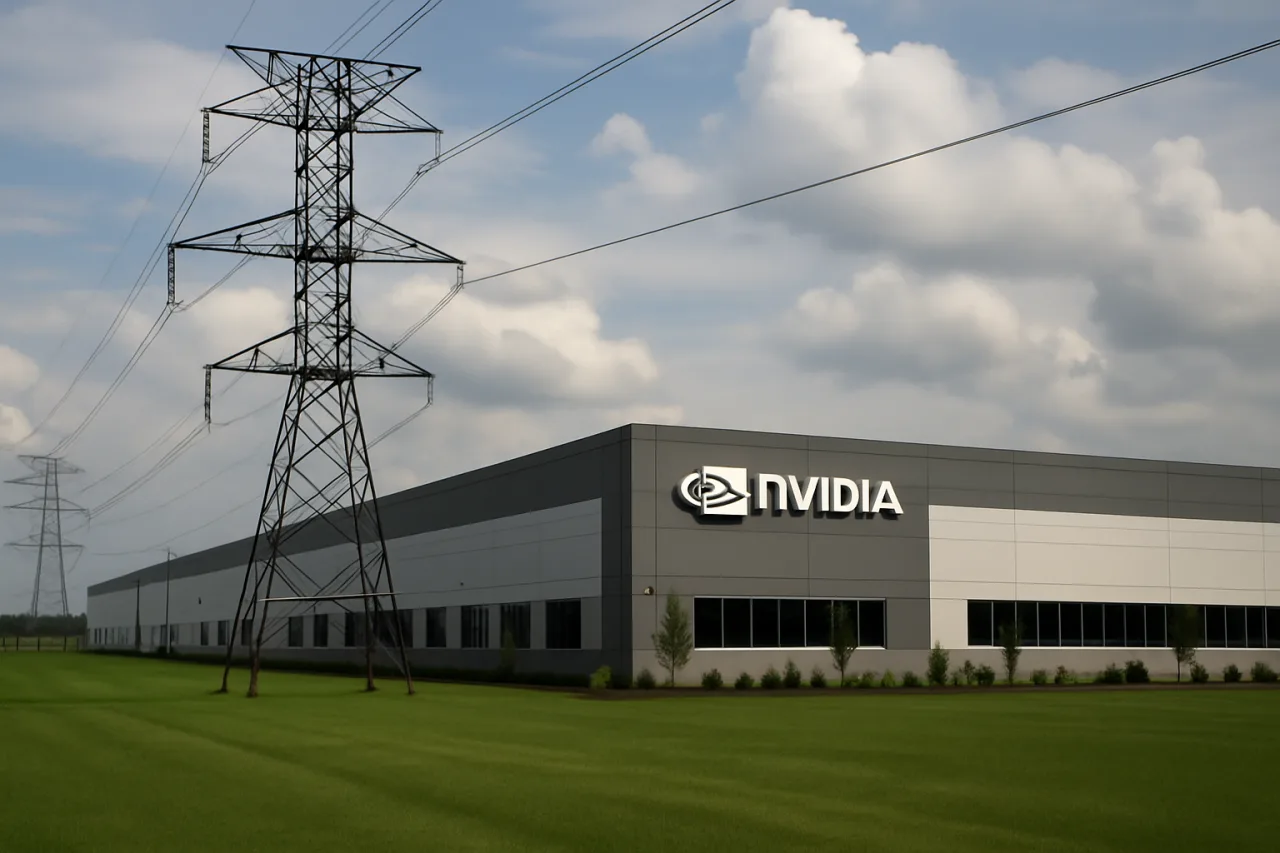
NVIDIA is spending $105 billion to secure something that does not sound like a technology problem: land, electricity, and buildings. On August 17, 2026, the company announced a partnership with SB Energy to guarantee the PORTS-Pike Technology Campus in Pike County, Ohio — a massive AI data center where OpenAI will be the 20-year tenant. The NVIDIA Ohio project is the largest single AI infrastructure investment in history. The initial deployment covers 4.25 gigawatts of AI compute capacity, with an option to expand to 8 gigawatts. That is enough electricity to power approximately six million American households. Jensen Huang, NVIDIA’s CEO, introduced a new framework for the AI era: “Land, Power, and Shell” (LPS) — the physical resources that have become the real bottleneck for AI development. The NVIDIA Ohio factory proves that the chip shortage is over. The power shortage has just begun.
Related: EUV Lithography Explained: The $200 Million Machines Behind Every AI Chip
Key Takeaway
- 🏗️ $105 Billion Guarantee: NVIDIA will provide up to $105 billion in credit support for the Ohio AI factory, making it one of the largest infrastructure financing commitments in the company’s history. OpenAI leases the site for 20 years.
- ⚡ 8 Gigawatts: The PORTS-Pike campus could reach 8 gigawatts of AI compute capacity — enough to power 6 million US homes. The initial 4.25 GW deployment could represent 1.5 million NVIDIA GPUs and $150-200 billion in revenue per generation.
- 💡 LPS Framework: Jensen Huang introduced “Land, Power, and Shell” as the new bottleneck. Chips are no longer the constraint — electricity and physical infrastructure are. SB Energy will build 10 GW of new energy generation, 9.2 GW from natural gas.
- 🇵🇭 Philippine Connection: The Philippines is a Pax Silica member, positioning it for US-led AI supply chain investment. But the scale gap is enormous — one US campus consumes 8 GW, more than many Philippine provinces. The opportunity is in semiconductor assembly, not compute scale.
- 📅 Timeline: First 800 MW phase begins construction in 2026. Computing capacity comes online in phases starting 2028. NVIDIA also invested $1.5 billion in SB Energy.
The Deal: What NVIDIA Actually Bought
NVIDIA is not buying the data center. SB Energy, a subsidiary of SoftBank Group, will build, own, and operate the facility. NVIDIA is providing credit support — up to $105 billion in conditional lease and power payment obligations — to guarantee that the land, power, and shell infrastructure gets built. In return, NVIDIA becomes the exclusive AI compute infrastructure provider at the campus. OpenAI is the customer, leasing the site for 20 years and paying only as completed capacity becomes available.
The campus is built on the site of the former Portsmouth Gaseous Diffusion Plant, a long-shuttered uranium enrichment facility near Columbus, Ohio. The project is being developed in collaboration with AEP Ohio, the US Department of Energy, and the US Department of Commerce. SB Energy and SoftBank will build at least 10 GW of new energy generation — about 9.2 GW from natural gas — and invest at least $4.2 billion in new regional grid infrastructure. OpenAI agreed to build on SB Energy’s $40 million community benefits fund with an incremental $40 million for local priorities.
The scale is unprecedented in the AI industry. Reuters reported that NVIDIA could make $600 billion in total revenue from OpenAI by 2030 by selling it 16 gigawatts of computing power, including a potential expansion of the Ohio site by 3.75 gigawatts. Each generation of NVIDIA AI factory systems deployed at PORTS-Pike could represent approximately 1.5 million GPUs and $150 billion to $200 billion in NVIDIA revenue.
Land, Power, and Shell: The New Bottleneck
Jensen Huang’s framing of “Land, Power, and Shell” is the most important strategic insight from the announcement. “AI is becoming infrastructure — the foundation for intelligence in every industry — and land, power, and shell have become vital in the age of AI,” Huang said. “We are securing long-lived infrastructure for NVIDIA compute so OpenAI can deploy the most productive AI factories that can be upgraded repeatedly with each new generation.”
The implication is that the AI race is no longer primarily about who has the best chips or the smartest models. It is about who can secure enough electricity to power millions of GPUs. The Ohio campus will consume 8 GW — roughly the output of six large nuclear reactors. This is the physical constraint that will shape the next decade of AI development. As we noted in our AI World This Week coverage, the infrastructure layer is now where the strategic competition happens.
NVIDIA’s $500 billion financing alliance, announced August 11 with Blackstone, BlackRock, KKR, and Goldman Sachs, provides the capital framework for projects like this. NVIDIA is not just supplying chips — it is helping customers find the money to build the infrastructure around them. As CNBC reported, NVIDIA was previously in discussions to provide up to $250 billion in financial backing for the Ohio data center.
The Philippine Connection: Pax Silica and the Supply Chain
The NVIDIA Ohio project underscores why the Pax Silica initiative matters for the Philippines. The US is treating AI infrastructure as a national security priority — securing land, power, and manufacturing capacity within allied borders. The Philippines became the 13th member of Pax Silica in April 2026, signing an agreement to build a 4,000-acre AI and semiconductor manufacturing hub in Luzon, as Reuters reported.
However, the scale gap is enormous. A single US data center campus will consume 8 GW — more than the entire power consumption of many Philippine provinces. The Philippine opportunity is not in matching this compute scale but in the supply chain: semiconductor assembly, testing, and packaging remain Philippine strengths. The Philippine semiconductor industry already generates $23 billion annually, and the Pax Silica hub could attract $10 billion to $70 billion in additional investment and create up to 190,000 engineering and technical jobs.
The NVIDIA Ohio project also raises questions about energy infrastructure that are directly relevant to the Philippines. SB Energy and SoftBank are building 10 GW of new power generation — mostly from natural gas — to support the NVIDIA Ohio campus. The Philippines faces chronic power shortages and high electricity costs, which limits domestic AI infrastructure investment. The Pax Silica hub’s focus on semiconductor assembly and packaging, rather than training compute, is the pragmatic positioning given these constraints. For more on how the Philippines fits into the global AI supply chain, see our coverage of the Luzon Economic Corridor.
The Global AI Infrastructure Race
The NVIDIA Ohio factory is not an isolated project. It is part of a global AI infrastructure buildout that is reshaping the semiconductor and energy industries. NVIDIA’s $500 billion financing alliance with Blackstone, BlackRock, KKR, and Goldman Sachs, announced August 11, provides the capital framework for multiple projects of this scale. The company is simultaneously investing in SB Energy, partnering with TSMC on Arizona fabs, and securing GPU supply chains that stretch from Taiwan to Ohio.
For the Philippine semiconductor industry, the NVIDIA Ohio project is a signal. The demand for chips, packaging, and assembly services will grow as more AI factories come online. Each gigawatt of AI compute capacity requires millions of GPUs, and each GPU requires semiconductor packaging — a process that Philippine firms in Laguna and Cavite already perform at scale. The NVIDIA Ohio campus alone could represent 1.5 million GPUs per generation, creating downstream demand that flows through the entire supply chain. For more on this, see our analysis of Philippine semiconductor industry and the broader AI World This Week coverage.
The race also has a geopolitical dimension. The NVIDIA Ohio investment is explicitly a US-based infrastructure play, keeping the most advanced AI compute within American borders. The US-China AI cold war, which escalated this week as Washington asked allies to choose between American and Chinese AI ecosystems, makes domestic infrastructure projects like the NVIDIA Ohio campus strategically critical. The Philippines, as a Pax Silica member and US ally, is positioned on the American side of this divide — which means Philippine semiconductor firms benefit from the supply chain shift but also face restrictions on Chinese technology partnerships.
Why This Matters for Filipino Professionals
The NVIDIA Ohio factory matters for Filipino professionals in three ways. First, the LPS framework reveals where the AI jobs of the next decade will be — not just in model development, but in power engineering, grid infrastructure, data center operations, and supply chain logistics. Filipinos already dominate the global maritime and engineering workforce; the data center buildout creates a new demand profile for Filipino engineers and project managers.
Second, the scale of investment — $105 billion for a single campus — signals that AI infrastructure spending is not slowing down. For Filipino investors, NVIDIA’s earnings report on August 26 will be a sector-defining event. Yahoo Finance analysis estimates NVIDIA can generate approximately $470 billion in free cash flow over 2026-2027, making its $70 billion investment portfolio “easily manageable.” For OFW investors, the safest AI exposure may remain diversified index funds with technology sector weight rather than single-stock bets.
Third, the Pax Silica connection means that the Philippine economy is directly tied to the success of US-led AI infrastructure. If the NVIDIA Ohio model works — NVIDIA financing the buildout, OpenAI as anchor tenant, SB Energy operating the facility — the same model could be applied at smaller scale in the Philippines through the Luzon hub. The investment opportunity is in Philippine companies that supply components, assembly services, and logistics to this supply chain. For Filipino engineers and project managers, the data center buildout creates a new demand profile that extends beyond traditional IT roles into power engineering, grid infrastructure, and facility operations — skills that many Filipino OFWs in the Middle East already possess from working on large-scale infrastructure projects. The NVIDIA Ohio factory is not just a US story. It is a signal that the global AI infrastructure buildout will require millions of skilled workers across the supply chain, and the Philippines is positioned to supply a significant portion of that workforce through both semiconductor manufacturing and engineering services.
Frequently Asked Questions
What is the NVIDIA Ohio AI factory?
The NVIDIA Ohio AI factory is the PORTS-Pike Technology Campus in Pike County, Ohio — a massive AI data center being developed by SB Energy with NVIDIA as the exclusive compute provider and OpenAI as the 20-year tenant. The NVIDIA Ohio project involves up to $105 billion in credit support from NVIDIA and could reach 8 gigawatts of AI compute capacity.
What does “Land, Power, and Shell” mean?
“Land, Power, and Shell” (LPS) is NVIDIA CEO Jensen Huang’s framework for the new bottleneck in AI development. It refers to the physical resources — land, electricity, and buildings — needed to house and power millions of GPUs. Huang argues that LPS has replaced chips as the primary constraint on AI scaling.
How much electricity does the Ohio AI factory use?
The PORTS-Pike campus could reach 8 gigawatts of AI compute capacity, which is enough electricity to power approximately 6 million US households. SB Energy and SoftBank will build at least 10 GW of new energy generation, with about 9.2 GW coming from natural gas, plus $4.2 billion in regional grid infrastructure investment.
What does this mean for the Philippines?
The Philippines is a Pax Silica member, positioning it for US-led AI supply chain investment through the 4,000-acre Luzon hub. However, the NVIDIA Ohio scale gap is large — one US campus consumes 8 GW. The Philippine opportunity is in semiconductor assembly, testing, and packaging, not in matching NVIDIA Ohio compute scale. The Pax Silica hub could attract $10-70 billion in investment and create up to 190,000 jobs.
When will the NVIDIA Ohio AI factory be operational?
The first 800 MW phase of the NVIDIA Ohio campus begins construction in 2026. Computing capacity is expected to come online in phases starting in 2028. OpenAI has a 20-year lease and pays only as completed capacity becomes available. The NVIDIA Ohio project will create 35,000 construction jobs through 2032 and 2,500 long-term positions.
How much revenue could NVIDIA generate from the Ohio deal?
Each generation of NVIDIA AI factory systems at the NVIDIA Ohio campus could represent approximately 1.5 million GPUs and $150-200 billion in NVIDIA revenue. Reuters reported that NVIDIA could make $600 billion in total revenue from OpenAI by 2030 by selling 16 gigawatts of computing power, including a potential expansion of the NVIDIA Ohio site.