Table of Contents
NVIDIA GR00T is the open foundation-model stack that quietly became the software layer of the humanoid-robot industry: announced at GTC on March 18, 2025 as the world’s first open, fully customizable foundation model for generalized humanoid reasoning and skills, upgraded to GR00T N1.5 at COMPUTEX (May 19, 2025) using synthetic training data generated in 36 hours versus the three months of manual collection it replaced, published as open weights on Hugging Face, and adopted by Agility Robotics, Boston Dynamics, XPENG Robotics, NEURA Robotics and the wider humanoid field alongside NVIDIA’s Jetson Thor Blackwell runtime. This guide explains what the stack actually is, how the “dreams” data pipeline works, who is building on it, and why an open robot foundation model changes who can afford to build one: a developer with a $4,900 humanoid and a free open-source model is now a legitimate entrant.
Every claim below is anchored to NVIDIA’s own announcements and research pages, dated and attributed — this is infrastructure reporting, not keynote enthusiasm, and the data-pipeline numbers are the part worth reading twice.
Key Takeaway
- 🧠 GR00T is the humanoid industry’s open model layer: N1 (March 2025) was the world’s first open, customizable humanoid foundation model; N1.5 (May 2025 — released via the Eagle VLM vision encoder) improved reasoning, generalization and language following — and ships as open weights (GR00T-N1-2B) on Hugging Face.
- 💭 The data problem got a pipeline: GR00T-Dreams post-trains a Cosmos Predict world model on teleoperation data, then generates videos of new tasks from a single image — cutting teleoperation capture needs by ~20x; NVIDIA Research trained N1.5 on Dreams data generated in 36 hours (vs ~3 months manual).
- 📊 Mimic built the volume math first: the GTC blueprint generated 780,000 synthetic trajectories — about 6,500 hours (nine months) of human demonstration data — in 11 hours, improving N1’s performance by 40% over real-data-only training.
- 🤝 Adoption is broad and named: Agility Robotics, Boston Dynamics, Fourier, Foxlink, Galbot, Mentee Robotics, NEURA Robotics, General Robotics, Skild AI and XPENG Robotics are adopting Isaac platform technologies; N-model early adopters include AeiRobot, Foxlink, Lightwheel and NEURA.
- ⚙️ The runtime is purpose-built silicon: Jetson Thor — Blackwell-family architecture for real-time robot inference — is the on-robot target (developer kit at $3,499), paired with the Newton open-source physics engine NVIDIA is building with Google DeepMind and Disney Research.
What NVIDIA GR00T is (plain language)
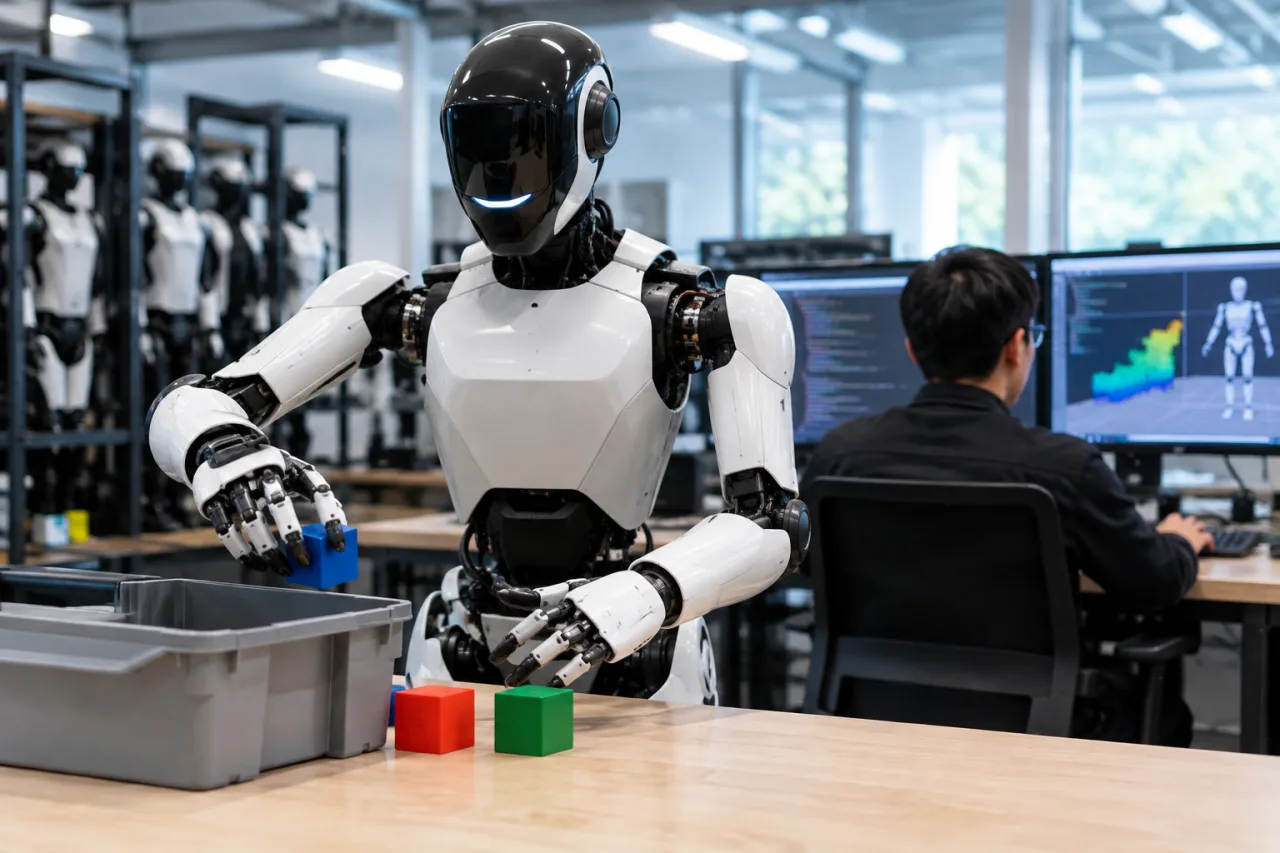
A foundation model for robots is the robot-side equivalent of an LLM: one pre-trained model carrying general skills — seeing a scene, understanding an instruction, planning a manipulation — which developers then customize to their specific robot instead of training from zero. GR00T N1 is built as a dual-system: a fast learned motor policy (System 1, trained on human demonstrations plus massive Omniverse-generated synthetic data) under a reasoning layer that interprets natural language and vision through the Eagle VLM. The openness is the strategic part — the model weights (the 2B-parameter GR00T-N1-2B) are public, the training and simulation pipelines are documented, and the customization path (post-training on your own demonstration data) is the same one the broader AI world standardized. For the software side of the argument — why open weights beat closed ones for ecosystem growth — our sovereign AI analysis covers the same logic in the cloud, and the data-generation problem itself is walked end-to-end in our robot training data deep dive.
The data problem — and the two NVIDIA GR00T blueprints that attack it
Robots have no internet-scale training corpus: demonstration data must be captured manually, at roughly a few hours of usable data per day of teleoperation, which is why robot skills historically died in data collection. NVIDIA’s answer is a two-part synthetic pipeline. NVIDIA GR00T-Mimic (GTC, March 2025): built on Omniverse and the Cosmos Transfer world model, it expands a small number of human demonstrations into large synthetic motion sets — NVIDIA used it to generate 780,000 synthetic trajectories, equivalent to about 6,500 hours (nine continuous months) of human demonstration data, in 11 hours; combining that with real data improved GR00T N1’s performance by 40% versus real data alone. NVIDIA GR00T-Dreams (COMPUTEX, May 2025): the second-generation path — post-train a Cosmos Predict world foundation model on teleoperation data for one task in one environment, then prompt Dreams with a single image plus new instructions to synthesize videos of the robot performing entirely new tasks, filtered and automatically labeled for action tokens by the Cosmos Reason reasoning model. The measured result: NVIDIA Research trained N1.5 on Dreams-generated data that would have taken nearly three months to capture manually, and the blueprint cuts manual teleoperation needs by roughly a factor of 20 — the data gap, in NVIDIA’s own framing, is the reason “let robots dream data” is not a metaphor but a cost line.
The compute layer behind NVIDIA GR00T: Jetson Thor and Newton
Foundation models need somewhere to run at 200+ Hz control rates, and NVIDIA supplies it: Jetson Thor, the Blackwell-family robot computer (developer kit at $3,499) is the designated runtime for GR00T deployment — on-robot inference and control — with the Isaac GR00T developer stack wiring the whole path from simulation to silicon. The simulation layer got its own upgrade: Newton, an open-source physics engine under development with Google DeepMind and Disney Research, built on NVIDIA’s Warp framework and compatible with MuJoCo and Isaac Lab; the accompanying MuJoCo-Warp work targets more than 70x acceleration of robotics machine-learning workloads, and Disney Research is an early adopter — its Star Wars-inspired BDX droids on the GTC stage were Newton’s first demonstration. The point of the stack is standardization: world model (Cosmos) → policy (GR00T) → runtime (Thor) → physics (Newton), with the data blueprints feeding the front and the robot builders plugging in at the back.
Who is building on NVIDIA GR00T (the named adopters)
The adopter list from NVIDIA’s Computex announcement reads as the industry’s roster: Agility Robotics (Digit), Boston Dynamics (Atlas and Spot ecosystems), Fourier, Foxlink, Galbot (the wheeled S1 working a CATL battery line — a deployment on the warehouse scoreboard), Mentee Robotics, NEURA Robotics, General Robotics, Skild AI and XPENG Robotics are adopting Isaac platform technologies; the N-model early adopters are AeiRobot (its ALICE4 runs GR00T N-models for natural-language pick-and-place workflows on factory floors), Foxlink, Lightwheel (synthetic-data validation for factory deployment) and NEURA (household-automation development). The adoption pattern matters more than the names: hardware makers attach GR00T as their reasoning-and-skills layer while investing their own differentiation in bodies, actuators and task data — the same vertical-split that made the PC industry’s software layer a commodity, reversed onto robots.
What an open NVIDIA GR00T robot model changes (the developer math)
The practical consequence is a cost structure that did not exist two years ago. A developer entry point in 2024 meant choosing an expensive closed platform or building everything from scratch; in 2026 the entry stack is a Unitree R1 EDU (shop-listed around $10,500 with ROS 2 and an optional 40-100 TOPS Orin module — our Unitree R1 guide prices the ladder) plus free GR00T weights plus free simulation frameworks. The customization workflow is standardized: capture a few demonstrations (the GR00T-Mimic pipeline expands them), post-train N1.5 for your robot’s morphology and task set via the open pipelines, validate in Newton/Isaac Lab, and deploy against Jetson Thor. For Filipino developers and university robotics labs — the audience our operator-jobs analysis and vocational-trades guide address from the career side — this is the actionable part of the embodied-AI story: the model layer is free, the simulation is free, the hardware is four figures, and the skill path is documented publicly. The competition shifts from access to data: whoever captures the best task demonstrations for their robot wins on quality, not on budget alone.
The honest limits of NVIDIA GR00T
Three caveats keep this guide honest. N1.5 is not autonomy: the model improves manipulation generalization and language following; it does not replace task-specific engineering, and factory deployments (see our warehouse deployments reality check) still ship with heavy integration, teleoperation and safety separation. The benchmark numbers are largely NVIDIA-shaped: the performance claims (40% improvement, 20x data reduction, 36-hour training) come from NVIDIA’s own research on its own benchmarks — real, dated, and self-reported; independent replication of embodied-AI benchmarks remains scarce, which is precisely why third-party verification (like the deployment boards we track) matters. The moat question: an open model also arms competitors — Unitree’s own closed-loop stack, Figure’s Helix/S0, and Boston Dynamics’ proprietary approach are all viable alternatives, which is why the market is a stack war, not a standard set. Watch the adopter list: every name that switches stacks is a dated, checkable market signal.
WorldNgayon Insight: NVIDIA GR00T just made the software layer a commodity
What changed: the humanoid industry’s intelligence layer went open-source with a complete toolchain — weights, data pipelines, simulation, physics and runtime silicon. Why it matters now: the barrier to building a capable humanoid system dropped from a research lab’s budget to a developer’s; the differentiator moved to task data. Why it lasts: the blueprints’ measured numbers (780,000 trajectories in 11 hours; 36-hour N1.5 training; 20x teleop reduction) are dated, checkable process advances that compound with every pipeline version. Who is affected: robotics startups choosing stacks, hardware makers deciding where to differentiate, developers and university programs pricing their entry. What to do: prototype on the open stack, budget data capture, and watch the adopter list for stack-switching signals. Risks, opportunities, costs, skills: the risks are NVIDIA-shaped benchmarks and the closed-stack counterweight; the opportunities are the four-figure entry path and the data-flywheel economics; the costs concentrate in teleoperation time; the skills are ROS 2, post-training and simulation. Connection to work and money: the same open-vs-closed tension governs the model layer of every AI market, and the compute behind all of it prices through the infrastructure our GPU rental guide covers.
What is NVIDIA GR00T and what does it stand for?
An open foundation model and developer stack for humanoid robots: GR00T N1 (March 2025) was the world’s first open, customizable humanoid foundation model; N1.5 (May 2025) is its improved version, released via the Eagle VLM vision encoder, published on Hugging Face as GR00T-N1-2B, and deployable on the Jetson Thor Blackwell runtime.
How does GR00T-Dreams work?
Developers post-train a Cosmos Predict world model on teleoperation data for one task, then prompt Dreams with a single image and new instructions: it synthesizes videos of the robot performing new tasks, which Cosmos Reason filters and labels into action tokens. NVIDIA says it cuts manual teleoperation needs by ~20x and trained N1.5 on 36 hours of generated data that would have taken about three months to capture.
What did GR00T-Mimic do?
The GTC 2025 blueprint generated 780,000 synthetic trajectories – about 6,500 hours (nine months) of human demonstration data – in 11 hours, and mixing that synthetic data with real data improved GR00T N1’s performance by 40% over real-data-only training.
Which companies use NVIDIA GR00T today?
Named adopters of Isaac platform technologies include Agility Robotics, Boston Dynamics, Fourier, Foxlink, Galbot, Mentee Robotics, NEURA Robotics, General Robotics, Skild AI and XPENG Robotics; N-model early adopters include AeiRobot, Foxlink, Lightwheel and NEURA.
What is the Jetson Thor robot computer?
NVIDIA’s Blackwell-family computer for real-time robot inference and control – the designated runtime for GR00T models – with a developer kit priced at $3,499. It pairs with the Isaac GR00T stack and the Newton open-source physics engine (built with Google DeepMind and Disney Research) for simulation.
Is NVIDIA GR00T free?
The model weights (GR00T-N1-2B), blueprints, simulation frameworks and Newton physics engine are open and free to use, including commercially as open-source releases; the paid part is the compute (from a $3,499 dev kit upward) and your own data capture. A developer can build on it with a ~$10,500 humanoid and free software.
Does NVIDIA GR00T make robots autonomous today?
It makes them more capable: better manipulation generalization, language-following and adaptation. Factory deployments still require heavy integration, teleoperation, and safety separation. Autonomy is improving on a measured curve – the blueprints compound – but no open model removes the need for task engineering.
Financial Disclaimer
This article is editorial analysis of publicly reported product specifications and benchmark self-reports, not investment or procurement advice, and no outcome is promised. Developer-kit prices and benchmark results change; verify current terms on NVIDIA’s official pages before decisions. Technology markets carry substantial risk.
Sources: NVIDIA Newsroom — GR00T N1 announcement (March 18, 2025: first open humanoid foundation model; Newton with Google DeepMind and Disney; Mimic’s 780,000 trajectories in 11 hours; the 40% improvement); NVIDIA Newsroom — COMPUTEX 2025 (GR00T N1.5, GR00T-Dreams, the adopter list, 36-hour training, Cosmos pipeline); NVIDIA Research — GR00T N1.5 technical page (Eagle VLM, benchmarks, open model); NVIDIA Developer — Isaac GR00T platform (Cosmos pipelines, Jetson Thor runtime); NVIDIA — Jetson Thor product page ($3,499 developer kit). Benchmark figures are NVIDIA’s own, as self-reported; the stack-adoption watch item is our own editorial frame.