Table of Contents
Key Takeaway
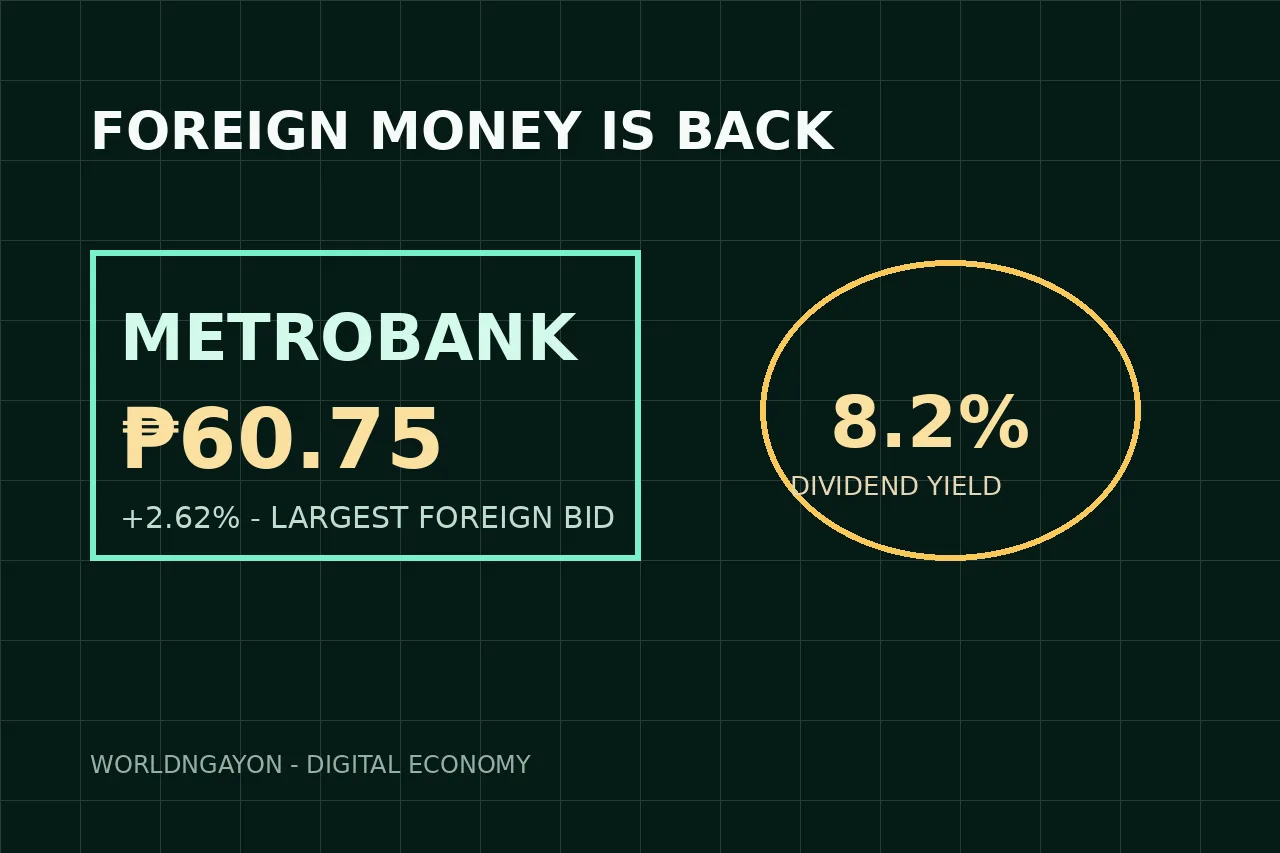
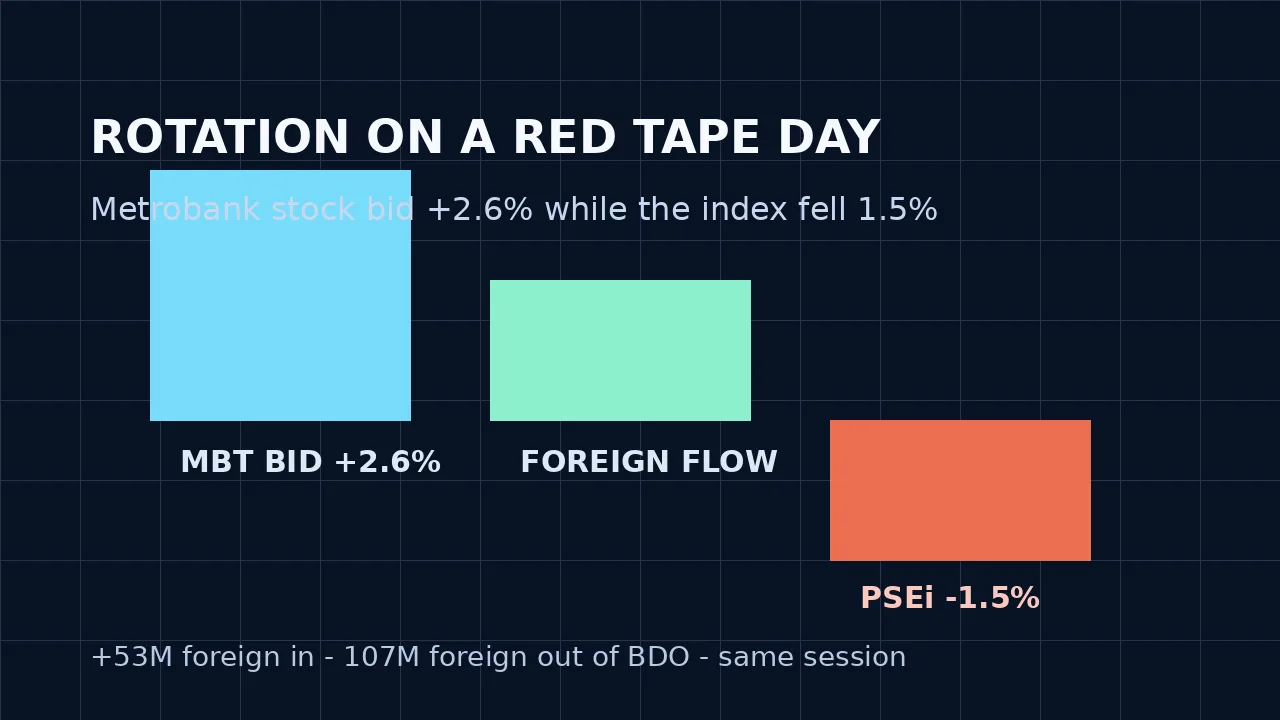
- Metrobank stock (PSE: MBT) closed Tuesday, October 14 at ₱60.75, up 2.62% — on a session when the PSEi fell 1.48% to 5,617.23 and services stocks were hammered.
- Metrobank stock took in +₱53.3 million in net foreign money, the largest inflow among the day’s gainers — while BDO ran a −₱107.2 million outflow on the same board.
- Metrobank stock pays ₱5.00/share in 2026 dividends (₱3.00 regular split across two payouts plus a ₱2.00 special) — an 8.2% yield at ₱60.75, backed by a record ₱49.7 billion 2025 profit.
- Fear is doing the rotation: the IMF cut its 2026 growth call to 3.4%, traders dumped rate-sensitive services stocks, and institutional money walked into the dividend-heavy banks.
The Session in Numbers: Metrobank Against the Tape
Tuesday was a risk-off tape with one bright corner for Metrobank stock, and the exchange’s own ledger explains why. The bellwether PSEi fell 1.48% or 84.31 points to 5,617.23 — a second straight decline as economists flagged the IMF’s latest warnings about Philippine growth. Market breadth went 103 decliners against 66 advancers. ICTSI, the top-traded stock of the day by a mile, fell 6.59% to ₱814.50 on ₱2.62 billion of turnover. Services ended as the worst sector, down 4.97%.
Then look at the financials column: the sector rose 0.99%, the best of the five. BDO Unibank gained 0.90% to ₱112. Bank of the Philippine Islands added 1.29% to ₱94.20. And Metrobank stock did both things at once — it led the peso volume among the session’s winners with ₱236,957,022 traded, and closed at ₱60.75, up from ₱59.20, per the exchange’s own Daily Quotation Report.
The Flow Signal: ₱53 Million That Matters More Than the Peso Count
PSE stamps every trade with a participant type, which is why its afternoon quotation report doubles as a foreign-flow ledger. Tuesday’s foreign line for Metrobank stock reads +₱53,314,026 — the biggest net foreign buy among all the day’s notable gainers, and more than triple GT Capital’s +₱15.7 million on its own 4.65% up-day. On the same board, BDO — a bank of similar size and dividend character to Metrobank — recorded a net foreign sale of ₱107.2 million. Same macro, same sector, same day. Two different verdicts from the same class of investor.
Zoom out and the contrast sharpens. Foreign investors have been relentless net sellers all quarter: −₱390 million on October 13 alone, ₱4.57 billion in a single early-October week, and ₱13.76 billion in August following the MSCI rebalance that trimmed the Philippines index to just nine names. Against that backdrop, a +₱53 million day does not reverse the trend — but it marks it. Foreign desks stop selling a bank when the price they can get stops being better than the story they are telling. A bid appearing in one Philippine bank, on a day the index dropped 1.5%, is what that inflection looks like in the tape.
Why Institutions Buy Banks When Economists Cut Growth
The IMF’s September Article IV team didn’t mince words — and Metrobank traded the consequences in real time: GDP growth now projected at 3.4% for 2026 — slashed from 3.9% — and 5.1% for 2027, after a second quarter that grew just 2.3% year-on-year. Mission chief Andrea Pescatori called it a “challenging conjuncture,” pointing to the Middle East war’s oil bill, stalled public construction reviews, weak private confidence and a property slowdown. Headline inflation is projected to average 5.6% this year. Risks lean to the downside.
A growth cut of that shape has a very specific market footprint. It punishes anything priced on future expansion — developers, retailers, service conglomerates — because those businesses need a growing economy to compound into.
But it is structurally kind to the country’s systemically important banks. Loan growth tracks the economy with a lag, deposit franchises sharpen as competition for funding tightens, and the dividend lane is priced on cash being paid this year — not on a 2028 recovery. With bond yields near multi-decade highs and the peso touching record lows near 62, the yield lane is suddenly the least-bad place for global money to wait out an ugly print — the same logic pulling treasuries into tokenized cash funds abroad. Tuesday’s rotation was that logic trading in real time.
The Dividend Spine: ₱5.00 and the Math at ₱60.75
Metrobank stock‘s 2026 payout is the backbone of the bull case, and it comes from primary filings, not broker chat. The board approved a total cash dividend of ₱5.00 per share for 2026: a ₱3.00 regular dividend paid semi-annually — the second ₱1.50 tranche went to holders of record September 9 and was paid September 25 — plus a ₱2.00 special dividend. Total payout: roughly ₱22.5 billion.
At ₱60.75, that ₱5.00 stream computes to an 8.2% gross yield, before the 10% withholding tax that applies to Philippine cash dividends. Net of withholding, roughly 7.4% — still multiple times the payout of a typical 12-month time deposit, and against a background of rising deposit rates, bank NIMs widen rather than compress.
The dividend’s coverage is the 2025 record: ₱49.7 billion in net income, the bank’s best year ever — the pool Metrobank stock dividends draw from — per its own disclosure. That is the whole thesis in three numbers: ₱49.7 billion earned, ₱22.5 billion paid, an 8.2% gross yield sitting on a ₱60.75 entry for Metrobank stock.
MBT and BDO: Two Banks, Two Tapes
The most instructive detail of Tuesday’s board is two large Philippine banks trading differently against identical macro. Both are PSEi top-ten weights. Both pay fat dividends. BDO closed ₱112, up 0.90%; Metrobank stock closed ₱60.75, up 2.62% with the day’s largest foreign bid on ₱237 million of turnover. For investors tracking the rotation, the spread is the message: the foreign bid is not indiscriminate — it is picking its spot, and this week the spot was Metrobank stock: the bank with the biggest volume, the freshest record profit and the fattest declared yield.
Our 2026 dividend-yield coverage flagged the wider pattern days ago: with Treasury yields at multi-decade highs globally, capital is hunting income with institutional-grade balance sheets behind it. Philippine banks are the local version of that hunt — and the tape is confirming it before the commentary is.
The Flow Plumbing Behind the Metrobank Bid
Where does a foreign bid actually come from? Not from a single decision but from plumbing: global funds that must own a minimum slice of every index they track, regional desks rebalancing after the MSCI cut the Philippines to nine large caps, and asset allocators rotating out of growth sectors into dividend screens. Metrobank stock sits prominently on those screens — the country’s largest bank by assets in several rankings, a top-five index weight, and one of the few Philippine names whose free float is deep enough for institutional size to trade without moving the print.
That last property explains the volume. ₱237 million turned over in MBT on Tuesday — among the largest non-ICTSI tickets of the day — because size can enter and exit this name.
Liquidity is the quiet precondition of a foreign bid: a fund that wants ₱100 million of exposure cannot buy it in a stock that turns over ₱5 million a day without paying a fortune in impact. This is also why the MSCI rebalance stung so visibly in August — ₱13.76 billion left the country that month — and why rebalancing arithmetic now works the other way when flows turn: fewer index names concentrate the same institutional demand onto fewer tickers, and the banks absorb most of it.
Deposit Rates, NIM and Why the Yield Gets Safer When It Rises
Banks are the rare business that benefits from the part of this macro that hurts everyone else. The BSP’s policy path has kept deposit rates elevated, and every reload of deposit pricing widens the spread a franchise lender earns on its loan book — Metrobank stock‘s dividend price rides the same arithmetic that savers feel as better time-deposit rates. Meanwhile the dividend lane competes directly with those deposits for household money: an 8.2% gross yield on a bank stock is the investable mirror of the deposit-rate story our remittance coverage tracks.
The risk side of that trade is credit. A 3.4% growth year with 5.6% inflation stresses borrowers precisely when funding is expensive. Metrobank and its peers came into this stretch with elevated capital ratios and the cleanest loan books of the post-pandemic cycle, but the property downturn the IMF flagged is the classic slow variable — real-estate exposure migrates to balance sheets with a lag of several quarters. Watch the NPL ratio print with the next earnings cycle — the same supervisory lens the BSP applies across banking (our Coins.ph license coverage shows it in action) — and where this thesis would crack first if the growth cut deepens.
What Would Break the Bid
Honesty requires the short side. A 3.4% growth year with 5.6% inflation is a bad year for asset quality: consumer loan books and SME portfolios feel a slowdown with a lag, and a protracted property slowdown — already flagged by the IMF as a drag — lands eventually on bank balance sheets through real-estate exposure.
A deeper peso slide raises imported inflation and invites rate pressure. And ₱53 million of foreign inflow is a data point, not a trend: one more selling week like the first of October and Tuesday’s bid reads as noise, not signal. The discipline is simple: watch the foreign line in each afternoon’s quotation report. Flow confirms or falsifies the thesis faster than any analyst note — and for Metrobank stock, the flow has begun agreeing.
The OFW Angle: Whose Money Is on the Other Side of That Bid
Run the corridor arithmetic one more time, because it is the reader’s own money in this story. OFW families hold savings across deposits, time deposits and a thin but growing equity slice. When systemically important banks pay 8.2% gross dividends — 7.4% net of withholding — while the deposit ladder pays less after reserve requirements and tenure lockups, the income math migrates. Not for everyone, and not as advice: equity prices swing daily, while deposits do not.
But the flow direction matters for pricing: every foreign peso bid that lands in Metrobank this quarter buys income at tomorrow’s prices, and the dividend pool it draws from was declared in February at a record profit year. The Metrobank stock tape’s message is not “buy this stock” — Metrobank stock is where the money already sits — it is that institutional money now prices Metrobank stock income as durable. Households watching remittance corridors for signals should note who just agreed.
How to Read the Next Sessions
Wednesday’s midday print showed the market catching its breath — the PSEi up 0.57% at 5,649 intraday. For Metrobank stock, the levels that matter are the ₱59.20 prior close as the floor of the move, and the ₱61.35–₱61.95 zone where Tuesday’s range topped out, per the quotation report. A close above ₱62 with positive flow would extend the story; a fade back under ₱59 with the foreign line flipping negative would end it. Everything else — the record profit, the ₱5.00 payout, the 8.2% gross yield — is context. The flow is the verdict.
Market data: PSE Daily Quotation Reports (Oct 13–14, 2026) and intraday index quotes; dividend figures from bank disclosures. This is market analysis, not investment advice.