Table of Contents
Key Takeaway
- 🧩 End of an era: The Mechanical Turk shutdown permanently closes a 21-year-old marketplace on September 30, 2026 — one that once connected more than 500,000 workers that once connected more than 500,000 workers across 190 countries with jobs paying a few cents each.
- ⚠️ The real cause: AI caught up with the work. A 2023 study by Swiss academic researchers found 33 to 46 percent of “human” tasks on the platform were already being completed by AI models — the gap Mechanical Turk existed to fill has closed.
- 🇵🇭 The Filipino angle: The Philippines became one of the world’s microwork hubs in the MTurk era, with workers in places like Cagayan de Oro annotating data for pay below minimum wage. The demand did not die — it moved to Scale AI, Mercor, and Prolific, where pay is higher but the bar is stiffer.
- 🔑 What to do now: For Filipino professionals, the Mechanical Turk shutdown is a forced upskill moment. AI data annotation, RLHF rating, and AI evaluation roles are hiring globally — but they select for demonstrated skill, not just spare time.
Mechanical Turk shutdown news did not arrive with a press conference or a farewell blog post. It arrived as a flat banner on a website Amazon had stopped investing in: “Following an assessment, we’ve made the decision to close AWS Mechanical Turk, effective September 30, 2026.” Twenty-one years after launch, the platform that Jeff Bezos once called “artificial artificial intelligence” is being switched off — and the story behind that closure explains where every Filipino online worker’s next paycheck is coming from, and where it is not.
The thesis of this piece is simple: the Mechanical Turk shutdown is not the death of online gig work. It is the death of one specific bargain — that a human being, anywhere on earth, could earn by being cheaper and more patient than a machine. That bargain made the Philippines a microwork powerhouse in the 2010s. Its replacement pays better, but it demands something the old platform never asked for: proof that you can do work AI cannot.
Why the Mechanical Turk Shutdown Is Happening Now
The timeline tells the story in three moves. On July 30, 2026, Amazon stopped accepting new Mechanical Turk customers — a signal workers on Reddit read immediately as the beginning of the end. On Tuesday, August 25, the closure banner appeared on MTurk’s homepage, with CNBC’s Annie Palmer first reporting the customer notice. And in between those dates sat the deeper cause: a market that had quietly evaporated.
Launched in 2005, Mechanical Turk matched requesters with what Amazon called Human Intelligence Tasks, or HITs — labeling data, transcribing audio, moderating content, answering surveys, each paying a few cents. The name came from an 18th-century chess “machine” that was actually a human chess master hidden inside a cabinet, and Amazon’s original use case was internal: labeling the reams of product data on its own store, as the New York Times reported in 2007. At its peak in the early 2010s, the platform counted more than 400,000 users across roughly 100 countries; Amazon’s own documentation later put the cumulative figure at more than 500,000 workers in 190 countries.
But the economics collapsed from both ends. From below, rival platforms — Scale AI, Mercor, and Prolific — began recruiting the same workers for AI training work with better curation and higher pay. From above, the tasks themselves stopped needing humans. A 2023 study by academic researchers in Switzerland, published on arXiv, estimated that 33 to 46 percent of MTurk workers were using AI models to complete text tasks. Think about what that number means: nearly half the “human intelligence” being sold on the platform was machine intelligence wearing a human mask. The product was failing its own quality test.
“We regularly evaluate our programs, tools, and services and make adjustments based on those assessments,” the notice read — corporate language that omits the one fact everyone in the industry understands: the Mechanical Turk shutdown happened because the machines no longer needed the crowd.
What the Numbers Reveal — and What They Miss
It is tempting to read the closure as the end of data work itself. The numbers say the opposite. The demand for labeled data has grown, not shrunk — every frontier model released this year was trained on human-rated data, and RLHF (reinforcement learning from human feedback) remains the core technique for aligning models like the ones Filipinos use daily. What changed is who buys the work and what they pay for.
The old HIT model priced a task at pennies because the buyer assumed no skill was required. The new market inverts that: Scale AI, which built a network of roughly 240,000 workers across the Global South with a significant concentration in the Philippines, sells curated expert annotation to AI labs; Mercor recruits professionals — lawyers, doctors, finance specialists — to train models in their own domains, often at rates measured in tens of dollars per hour rather than cents; Prolific connects researchers with verified participant panels for academic-grade data. The task did not disappear. The commodity version of the task did.
What the headline numbers miss is the human residue. Krista Pawloski, a data worker and organizer with the advocacy group Turkopticon, told CNBC that some workers still depend on the platform full time. “They’re concerned now,” she said — insurance and travel companies that still use MTurk have roughly 35 days from the announcement to migrate, and their workers move with them or not at all. Pawloski herself started “turking” in 2008 on maternity leave for supplemental income and went full time in 2012 after losing a job, describing the work as meaningful income with flexible hours, doable from a smartphone. That flexibility was always the platform’s real product. Its closure removes one of the last low-barrier entry points into online work — for every country, on the same day.
The Filipino Workers the Mechanical Turk Shutdown Leaves Behind
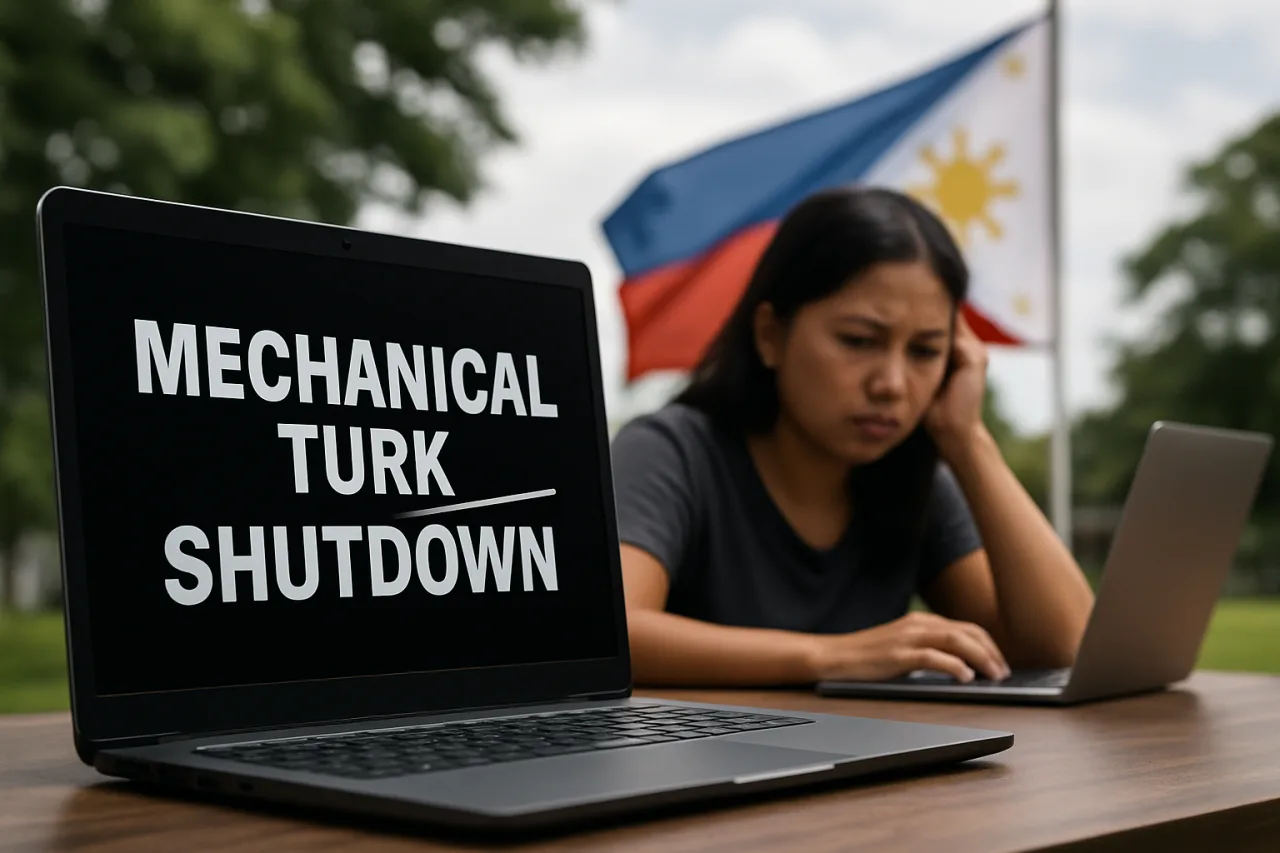
For Filipino professionals, this history is not abstract. The Philippines became a global center of microwork for reasons that mirror its BPO success: English fluency, strong internet culture, and a vast pool of people for whom even small dollar earnings matter. Reporting by Equal Times documented the reality in Cagayan de Oro, where young workers on annotation platforms put in 8 to 10 hours a day for an average of €6 — less than the legal minimum wage, with no social protection. One worker, Junbee, 22, from one of the city’s poor districts, put it plainly: “I don’t have a choice. In this part of the Philippines, there are very few jobs.”
That is the part of the Mechanical Turk shutdown story that deserves the most attention — not the Silicon Valley post-mortem, but the Cagayan de Oro arithmetic. Microwork promised the world’s opportunities at the world’s lowest barrier, and it delivered wages the world would not accept. The platform’s death closes a chapter where Filipinos learned to work for the global AI economy from a smartphone — a skill base that is now, ironically, more valuable than ever.
Because the industry that replaced MTurk hires Filipinos at every level. The country’s IT-BPM sector — the same one IBPAP has been repositioning around AI services as traditional voice work automates — sits directly on top of the data annotation supply chain. The Philippine AI Infrastructure Master Plan and the government’s push to build local AI capacity assume a workforce that can label, evaluate, and validate model outputs. The workers who spent the MTurk years learning those exact skills are not stranded. They are early.
The shift also mirrors what is happening one level up. Bill Gates published an essay this week warning that entry and mid-level jobs face the greatest AI displacement risk, and Anthropic’s Dario Amodei has projected that half of entry-level white-collar roles could disappear within a few years. The Mechanical Turk shutdown is simply the first major platform to complete that transition in public: the bottom rung of the AI labor ladder was removed by the same technology the ladder was built to serve.
The Second-Order Effect: A Global Recalibration of Gig Work
Zoom out, and the Mechanical Turk shutdown lands at a strange regulatory moment. Mechanical Turk workers sat in 190 countries, and in the European Union, the Platform Work Directive agreed in 2024 gives member states until December 2026 to implement national rules on algorithmic management and employment status. The closure arrives three months before that deadline, with Amazon offering no guidance beyond an FAQ page — a reminder of how little protection platform workers anywhere had. There is no Philippine equivalent of that directive. When a platform switches off, Filipino workers learn about it from a banner, the same as everyone else.
The second-order effect cuts the other way, too. Every displaced MTurk worker is now a candidate for the platforms that replaced it — and the filtering those platforms do is stricter than anything MTurk ever attempted. Scale AI’s successor platform for expert work screens for subject-matter skill; Mercor interviews candidates with AI-assisted assessments; Prolific verifies identity and demographics for research validity. This is gig work with a résumé requirement. For the Filipino freelancer who spent years doing HITs, that requirement is the new moat — and building it is now the whole game.
There is also a quiet quality lesson here that Filipino professionals should not miss. The platform died partly because its own workers fed AI into it, and the buyers could no longer trust what they were buying. Every freelancer pricing their services in 2026 faces the same trust test in reverse: clients now assume AI output unless proven otherwise. Demonstrated human skill — a portfolio, a verified specialty, a track record — is becoming the currency that “I can do it cheaper” never was.
What Comes Next — and What to Do Before September 30
Watch three things in the coming months. First, whether Amazon discloses how many workers were still active at closure — the 500,000-plus figure comes from its own documentation, not a recent count, and the gap between the two numbers is itself a story about platform decline. Second, whether Turkopticon-style worker advocacy follows the work to Scale, Mercor, and Prolific, where pay is better but protections remain thin. Third, whether insurance and travel companies — the last major MTurk requesters — consolidate onto one successor platform and accidentally crown a new market leader.
For Filipino online workers, the action list is concrete. Inventory your skills against the new market: data annotation experience is real experience, and it maps directly to AI training roles. Sign up and get verified on the successor platforms now, before the September 30 wave of displaced workers queues ahead of you. If you have a professional specialty — accounting, law, nursing, engineering — Mercor-style expert data work pays dramatically more than general annotation. And treat the 72-percent statistic that should worry every job seeker: most Philippine employers already screen for AI skills in hiring, which means the pivot out of commodity gig work is also the pivot employers are demanding everywhere else.
The Mechanical Turk shutdown closes the cheapest door into online work that has ever existed. What stands behind the next door is better paid and harder to enter. The workers who treat that as an invitation — not an eviction — will look back on September 30, 2026, as the day the amateur era ended and theirs began.
Frequently Asked Questions About the Mechanical Turk Shutdown
Is Mechanical Turk really shutting down?
Yes. Amazon posted a closure notice on the MTurk website on August 25, 2026, confirming that AWS Mechanical Turk will permanently close effective September 30, 2026. New customer signups were already stopped on July 30, 2026, along with the sister annotation services SageMaker Ground Truth and Amazon Augmented AI.
Why is Amazon closing Mechanical Turk?
Amazon’s official language cites only “an assessment” of its programs. The practical causes are visible in the market: AI models now perform tasks that once required humans — a 2023 Swiss study found 33 to 46 percent of MTurk workers were already using AI to complete tasks — while specialized data companies like Scale AI, Mercor, and Prolific took over AI training work with better pay and curation. Amazon had invested less in the platform for years as it declined.
How many workers used Mechanical Turk?
Amazon’s documentation says the platform served more than 500,000 workers across 190 countries at its height, and peer research from the early 2010s counted more than 400,000 users. The number of workers still active in 2026 is much smaller and has not been disclosed; the platform had been “in decline” for years, according to Turkopticon organizer Krista Pawloski.
What replaced Mechanical Turk for data work?
Scale AI, Mercor, and Prolific absorbed most of the AI training and data annotation demand, offering curated workforces and expert annotation instead of open-marketplace penny tasks. Former MTurk requesters in insurance and travel are actively migrating to alternatives before the September 30, 2026 closure.
Can Filipinos still earn from AI data work after the Mechanical Turk shutdown?
Yes — and generally at higher rates, with higher entry requirements. The Philippines remains a hub for AI data annotation, and expert-level data work (in fields like finance, healthcare, and law) pays far more than the cents-per-task HITs ever did. The requirement is demonstrated skill and platform verification, which is why workers should build portfolios and complete platform assessments now.
Was Mechanical Turk the first crowdsourcing platform?
It was the platform that defined modern crowdsourced microtasking. Launched by Amazon in 2005 and named after an 18th-century chess-playing automaton with a hidden human player, it coined the term “Human Intelligence Tasks” and inspired a global industry — including the Philippine microwork sector that followed it.