Table of Contents
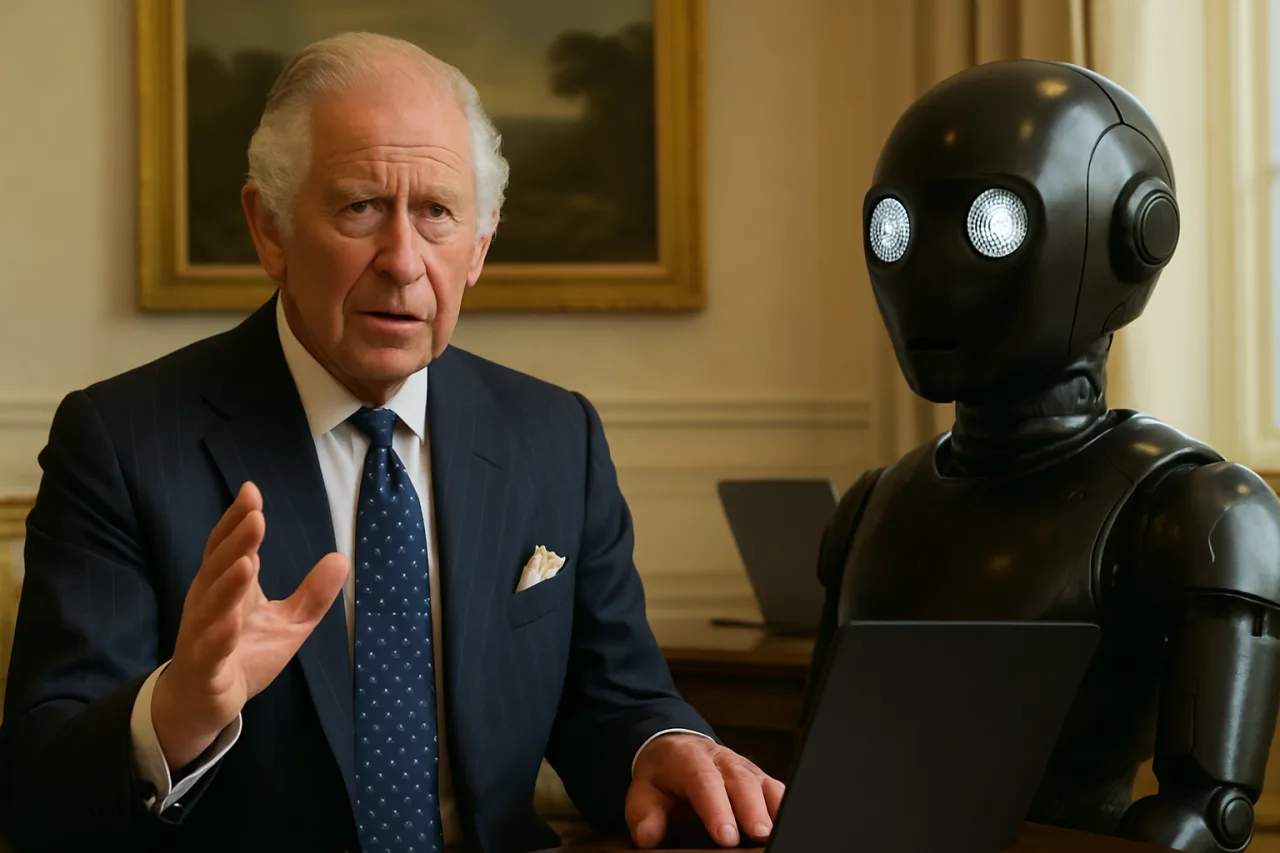
The King Charles AI summit gave the year’s defining quote when the monarch told the leaders of the AI industry — gathered in the drawing rooms of his own Scottish estate — that the world needs “sufficient means of control before it is all too late,” and in one sentence gave the year’s safety debate its most quotable line. The setting was Dumfries House in Ayrshire on September 17: Nvidia CEO Jensen Huang, Google DeepMind chair Demis Hassabis, OpenAI CFO Sarah Friar, Britain’s AI minister Kanishka Narayan, and an undisclosed Anthropic representative, convened by the Ditchley Foundation ( Decrypt’s coverage) days after the industry’s own CEOs publicly called for slowing down. No binding agreements were on the table. That was never the point. The summit was a stage (NYT, AP), and the monarch used it to ask the question this entire month has been circling: who is actually in charge of a technology that its own creators say they can no longer fully steer? The King Charles AI summit quotes from this single afternoon — royal, executive, and ministerial — will outlive the news cycle. Collected and contextualized, they form a snapshot of power negotiating with its own creation.
📌 What actually happened at Dumfries House: King Charles III hosted senior executives from Nvidia, OpenAI, Google DeepMind, and Anthropic on September 17, 2026, urging them to keep artificial intelligence “firmly in the service of humanity.”
🧭 The king’s core warning: the “existential dangers of such technologies falling into the wrong hands” demand urgent consideration — “Surely, then, we need sufficient means of control before it is all too late?”
🏛️ Who was in the room: Jensen Huang (Nvidia), Demis Hassabis (DeepMind), Sarah Friar (OpenAI CFO), AI Minister Kanishka Narayan, an Anthropic representative — the first international gathering of major AI companies since the slowdown call.
⚖️ The open question: no binding agreements were expected or reached — but the symbolism of a monarch brokering a safety conversation moved the debate’s center of gravity.
There is a reason the world’s most powerful AI executives flew to a 18th-century Scottish estate instead of holding another webinar. Soft power convenes what hard power cannot compel. King Charles III has spent his reign positioning the monarchy as a convener on global challenges — climate above all — and on Thursday he aimed that machinery at artificial intelligence, at precisely the moment the industry’s own leaders were publicly doubting their foot on the accelerator. The Ditchley Foundation-organized gathering produced no treaty, no communiqué, not even a group photo commitment. What it produced was alignment of narratives: a head of state warning about control, days after Dario Amodei’s pacing essay drew public endorsements from Sam Altman and Elon Musk, and the same week OpenAI’s policy chief confirmed weeks of quiet cross-lab safety coordination in Washington. When the constitutional monarch who cannot command asks “surely we need sufficient means of control before it is all too late?”, the question lands harder than any regulator’s subpoena — because it came from someone with no regulatory power at all, only moral standing and a room full of CEOs who accepted the invitation. That is the summit’s real product: a photograph of the AI industry standing next to the establishment it now needs.
The King Charles AI Summit Quotes That Will Define the Week
Five King Charles AI summit statements, each from a different seat of power, tell the story of September 17 in the speakers’ own words. The King, on control: “Surely, then, we need sufficient means of control before it is all too late?” — a rhetorical question aimed at men who control more compute than most governments, delivered with the one currency a crown has: permanence. He urged the executives to weigh the “existential dangers of such technologies falling into the wrong hands, and being used in potentially catastrophic ways,” and asked them to consider the “fundamental principles” that should guide AI’s development — the vocabulary of a monarch framing a constitutional question for an industry that has none. The King, on purpose: AI must remain “in the service of people and the planet” — continuity with his climate rhetoric, repurposed for a new technology. Altman, on pacing (September 12, the context that made this meeting matter): “AI progress could go very badly” and slowing it down is “well worth the cost.” Amodei, the essay that started it (September 12): “We must slow the pace at which we improve the capabilities of A.I. models. Progress will still seem fast, and we must make wise use of the time we gain.” Musk, the one-liner endorsement: “Dario is right.” Read together, the quotes trace a circle: the labs asked for time, the monarch supplied moral gravity, and the minister — Narayan, Britain’s AI minister — represented the only participant in the room who can actually legislate. That division of labor is the King Charles AI summit’s real architecture.
Why a Monarch, Why Now: The Diplomacy Behind the King Charles AI Gathering
The King Charles AI meeting’s timing is legible through three converging pressures. First, the regulatory vacuum is now embarrassing. The United States under President Trump has taken the position that AI regulation is largely unnecessary; the EU AI Act’s enforcement is grinding slowly; and no international instrument covers frontier model development. Into that vacuum stepped a monarch whose value is precisely that he represents no national regulatory agenda — a convening power without enforcement power, which makes him non-threatening to every government in the room. Second, the industry asked for exactly this. Amodei’s three-step framework called for independent safety reviewers, coordinated democratic-nation standards, and eventually global agreements — and for chips-export-style controls on countries that refuse. The UK summit is the first public instantiation of that diplomatic track: the labs said they wanted international cooperation; Dumfries House is what the request looks like when a head of state takes it literally. Third, the safety debate needed a stage bigger than Twitter. The September slowdown debate unfolded in essays and social posts; a palace, a walking photo of Huang and Hassabis flanking the King, and the King Charles AI quote “all too late” gave the debate what policy debates usually lack — an image. The NYT’s reporting noted the meeting was “not expected to produce any binding agreements” — and that is precisely the design: establish the norm that AI leaders answer to the establishment’s moral authority, before the establishment decides it needs legal authority instead. For the industry, Thursday was the cheaper option.
What the King Charles AI Summit Changes — and What It Cannot
Honest assessment cuts both ways. What it changes: the Overton window. A month ago, “slow down the frontier” was a fringe position associated with doom-clocked researchers; today it has been endorsed by the CEOs of the labs themselves, blessed by a monarch, and staffed by a government minister — the vocabulary of control is now normal, and every future negotiation starts from that baseline. The summit also continues Britain’s bid to be the diplomatic home of AI safety — after Bletchley Park in 2023, the AI Safety Institutes, and now a royal convening — a consistent national strategy of small-country-leverage. What it cannot change: physics, economics, and the clock. No communiqué re-times a training run; no royal phrase pauses a GPU cluster; the competitive dynamics that made Amodei argue for slowdowns — China’s pace, open-weight diffusion, the compute arms race — remain fully intact the morning after. The gathering’s concrete output is narrative capital, and narrative capital converts to policy only when someone spends it. The test of the King Charles AI summit is therefore not what was said in Ayrshire but what gets written in the next budget, treaty draft, or safety-framework consultation that cites it. Symbolism is a down payment; legislation is the settlement. The monarchy’s historic role — legitimizing power that already exists — is precisely what happened here, in reverse: the industry borrowed the crown’s legitimacy at the exact moment it started doubting its own.
The Philippines’ Stake in a Monarch’s AI Warning
Why should a summit in Scotland register in Manila? Because every thread that converged at Dumfries House ends in a question the Philippines is actively deciding right now. The safety-versus-speed debate that the King joined will shape the international rules that countries like the Philippines inherit rather than write — which makes the DepDev-led AI governance mandate, confirmed at last week’s Senate hearing, the local hook into this global argument. The UK’s model is instructive for a middle-power republic: Britain has no frontier lab, modest compute, and less capital than the players in the room — yet it has positioned itself as the diplomatic home of AI safety, converting values and convening power into agenda-setting influence. A country that trains its workforce on other nations’ models, deploys foreign agents in its BPOs, and debates its own Fair AI Act has exactly the stake in “fundamental principles” that the King described: the principles get baked in before the deployers arrive. The practical reading for Filipino decision-makers — in government, BPO, or fintech — is that the governance conversation the King Charles AI summit personified has moved from if to when to whose template. Dumfries House was a preview of whose template is gaining ground: the one where means of control arrive before it is all too late.
Frequently Asked Questions
What happened at King Charles’s AI summit?
On September 17, 2026, King Charles III hosted senior executives from Nvidia, OpenAI, Google DeepMind, and Anthropic at Dumfries House, Scotland, in a gathering organized by the Ditchley Foundation. He urged them to keep AI “in the service of humanity,” warned of existential dangers from the technology falling into the wrong hands, and asked whether the world has “sufficient means of control before it is all too late.” No binding agreements were expected or produced.
Who attended the Dumfries House AI meeting?
Confirmed attendees included Nvidia CEO Jensen Huang, Google DeepMind chair Demis Hassabis, OpenAI CFO Sarah Friar, and UK AI Minister Kanishka Narayan, with an Anthropic representative also present. The palace did not disclose Anthropic’s attendee, and the meeting marked the first international gathering of major AI companies since the industry’s slowdown call.
What exactly did King Charles say about AI?
Per AP and Fortune reporting, the King warned of the “existential dangers of such technologies falling into the wrong hands, and being used in potentially catastrophic ways,” and asked: “Surely, then, we need sufficient means of control before it is all too late?” He urged the executives to consider the “fundamental principles” that should guide AI development and to keep it “in the service of people and the planet.”
Why did the AI slowdown call matter for this meeting?
The summit happened days after Anthropic CEO Dario Amodei’s essay urging the industry to slow capability gains, publicly endorsed by OpenAI’s Sam Altman (“I agree with Dario that we need to pace the frontier”) and Elon Musk (“Dario is right”). The gathering was the first international industry gathering since that call, giving the debate its highest-profile stage yet.
Did the summit produce any agreements or rules?
No. The meeting was explicitly not expected to produce binding agreements. Its significance is diplomatic and symbolic — establishing that AI’s most powerful executives answer to questions of moral legitimacy and control from established institutions, at the moment the industry itself is debating the pace of its own progress.
What did the AI industry executives say in response?
The participating companies did not issue a joint statement, and no commitments were announced. The significance lay in attendance itself: Nvidia’s Jensen Huang, DeepMind’s Demis Hassabis, and OpenAI CFO Sarah Friar accepted the monarch’s invitation within days of their own CEOs publicly endorsing a slowdown — a sequence that read as coordination between industry and establishment rather than as coincidence of calendars.
What does this mean for countries outside the US and UK?
The direction of travel matters more than the communiqué: the labs are publicly embracing oversight vocabulary, the UK is consolidating its role as AI-safety diplomat, and international frameworks are forming that smaller economies will adopt or inherit. For the Philippines, whose AI governance mandate sits with DepDev while deployment accelerates, the message is to engage the emerging templates early rather than inherit them late.
This article is for general information and analysis. It is not investment or policy advice. Quotes are from AP, Fortune, NYT, and Decrypt reporting of the September 17, 2026 gathering; official positions remain those of the speakers and institutions named.
Financial Disclaimer
This article is published for general information and analysis. It is not investment or policy advice. Quotes are from AP, Fortune, NYT, and Decrypt reporting of the September 17, 2026 gathering; official positions remain those of the speakers and institutions named.