Table of Contents
The two weeks from July 6 to July 20, 2026, may go down as the most explosive period in AI history. Seven frontier models launched in eleven days. A Chinese startup released the largest open-source AI model ever built. The US government suspended and partially reinstated its most advanced AI systems over national security. The AI market permanently split into two camps — closed, expensive, government-restricted models from the United States, and open, cheaper, freely available models from China. At the center of it all: Kimi K3, a 2.8-trillion-parameter model from Beijing-based Moonshot AI that benchmarks show performs neck-and-neck with the most powerful proprietary systems from OpenAI and Anthropic. Like DeepSeek in January 2025, Kimi K3 arrived without warning and disrupted every assumption about who leads the AI race. This is AI World This Week #001 — the WorldNgayon Intelligence Brief covering models, business, policy, infrastructure, research, markets, tools, and what it all means for you.
Executive Brief
This week in AI was defined by three major developments:
- Moonshot AI launched Kimi K3 — the largest open-source AI model ever built, at 2.8 trillion parameters, rivaling GPT-5.6 and Claude Fable 5 on benchmarks.
- Competition between Chinese and US AI companies intensified as the US government restricted Anthropic’s best model while China released its best model for free.
- Open-weight frontier models became even more capable — proving that the gap between open-source and closed-source AI has effectively closed.
Overall Weekly Impact: ★★★★★
AI World This Week — Weekly Brief
| AI World This Week #001 — WorldNgayon Intelligence Brief | |
|---|---|
| Issue | #001 |
| Week | July 14–20, 2026 |
| Reading Time | 12 minutes |
| Top Story | Moonshot AI launches Kimi K3, the largest open-weight AI model ever built — 2.8 trillion parameters, rivaling GPT-5.6 and Claude Fable 5 |
| Key Themes | Open models • China vs US • Infrastructure • AI Competition • Government intervention |
| Models Launched | 7 frontier models in 11 days (GPT-5.6, Grok 4.5, Muse Spark 1.1, SWE-1.7, Kimi K3, Fable 5 partial re-release) |
| Market Signal | AI inference costs compressing — middle tier disappearing |
Quick Facts
| Kimi K3 — Key Specifications | |
|---|---|
| Released | July 17, 2026 |
| Developer | Moonshot AI (Beijing) |
| Parameters | 2.8 trillion |
| Context Window | 1 million tokens |
| Type | Open-weight (weights release July 27) |
| API Price | $3 / $15 per million tokens |
| Global Benchmark Rank | #3 (GDPval-AA v2) |
| Frontend Coding Rank | #1 globally |
AI This Week by the Numbers
| Number | What It Represents |
|---|---|
| 2.8T | Parameters in Kimi K3 — largest open-source model ever |
| 1M | Token context window — 5x larger than most competitors |
| 48 hrs | For Kimi K3 to autonomously design a functional chip |
| 50% | Lower API cost vs GPT-5.6 Sol ($15 vs $30 per million output tokens) |
| 7 | Frontier models launched in 11 days |
| $852B | OpenAI S-1 valuation — pre-IPO |
| $330B | AI funding in Q1 2026 — 80% of all VC |
AI Impact Meter
| Category | Impact This Week |
|---|---|
| Innovation | ★★★★★ |
| Business | ★★★★☆ |
| Developers | ★★★★★ |
| Consumers | ★★★☆☆ |
| Investors | ★★★★☆ |
| Philippines | ★★★★☆ |
The Week in Timeline
| Date | Event |
|---|---|
| July 6 | Anthropic publishes J-Space interpretability research |
| July 8 | xAI launches Grok 4.5 — 1.5T params, $2/$6 pricing |
| July 8 | Cognition releases SWE-1.7 — coding model under $2/task |
| July 9 | OpenAI ships GPT-5.6 Sol/Terra/Luna to public |
| July 9 | Meta launches Muse Spark 1.1 — first paid model |
| July 9 | US government partially re-releases Anthropic Fable 5 |
| July 9-12 | EU publishes final AI Code of Practice; OpenAI retracts broken benchmark |
| July 17 | Moonshot AI releases Kimi K3 — 2.8T params, largest open-source model ever |
| July 17 | Xi Jinping addresses global AI development same day as Kimi K3 launch |
Key Takeaway
- Kimi K3 is the largest open-source AI model ever: 2.8 trillion parameters from Moonshot AI, released July 17. Benchmarks place it third globally — behind only Anthropic’s Fable 5 Max and OpenAI’s GPT-5.6 Sol Max — and first in frontend coding. Full open-source weights released July 27.
- 7 frontier models launched in 11 days: July 6-17 saw releases from OpenAI (GPT-5.6), xAI (Grok 4.5), Meta (Muse Spark 1.1), Cognition (SWE-1.7), Moonshot (Kimi K3), plus partial re-release of Anthropic’s Fable 5.
- AI market splitting into ultra-premium and ultra-cheap: Grok 4.5 at $2/$6 per million tokens vs GPT-5.6 Sol at $5/$30. Kimi K3 at $3/$15. Cognition SWE-1.7 under $2 per task. The middle tier is disappearing.
- US government intervention escalated: Anthropic’s Fable 5 suspended over national security, then partially re-released. OpenAI delayed GPT-5.6 after government request. China labeled Claude Code a security risk.
- The Filipino angle: Cheaper open-source models like Kimi K3 give Filipino developers and BPO companies access to frontier-level AI without paying US vendor prices. For professionals, multi-platform AI literacy is now a baseline competency — not a differentiator.
1. 🤖 Models & Releases
This section covers new AI models, major updates, capability improvements, multimodal features, open-source releases, API updates, and developer tools.
Kimi K3 (Moonshot AI) — July 17
The headline of the week. Moonshot AI, the Beijing-based startup backed by Alibaba, released Kimi K3 — a 2.8-trillion-parameter model that is the largest open-source AI model in the world, according to VentureBeat’s technical analysis. That is 75% larger than DeepSeek’s V4 Pro (1.6 trillion parameters) and dwarfs every other open-source model in existence. Reuters reported that the launch came a month after Anthropic’s Fable and Mythos models were withdrawn by the US government, underscoring how quickly China’s open AI ecosystem is narrowing the gap.
Architecture: The model features a 1-million-token context window, native visual understanding, and an always-on reasoning mode called “thinking mode.” It is built on two architectural innovations developed internally at Moonshot: Kimi Delta Attention, a hybrid linear attention mechanism, and Attention Residuals, a drop-in replacement for residual connections that delivers consistent scaling gains. The API is compatible with the OpenAI SDK, meaning developers already building on OpenAI toolchains can switch with minimal code changes.
Benchmarks: On GDPval-AA v2, measuring real-world tasks across 44 occupations and 9 industries, the model scored 1,687 — third globally, behind only Claude Fable 5 Max (1,815) and GPT-5.6 Sol Max (1,747.8), and ahead of Claude Opus 4.8 (1,600). On AA-Briefcase, testing long-horizon knowledge work, it climbed to second place with 1,527 — beating GPT-5.6 Sol Max (1,495). It achieved a state-of-the-art 91.2 out of 100 on BrowseComp, OpenAI’s benchmark for long-horizon information seeking. On Arena.AI’s Frontend Code Arena, it claimed the number one spot with 1,679, outpacing both Claude Fable 5 and GPT-5.6 Sol.
Pricing: $3 per million input tokens and $15 per million output tokens, with cached input tokens at just $0.30 per million. Full open-source weights scheduled for release on July 27. Anyone can try it at kimi.com — no credit card required, just a Google account or phone number.
The chip design demo: Beyond benchmarks, Moonshot showcased a proof-of-concept that may be more revealing. Over 48 hours of continuous autonomous operation, the model independently designed a physical chip to run a nano-scale version of itself — completing the full construction pipeline from architectural design through optimization and verification. The result was a functional 4-square-millimeter chip that achieved timing convergence at 100 MHz and could decode more than 8,700 tokens per second in simulation.
OpenAI GPT-5.6 Sol, Terra, Luna — July 9
OpenAI moved its GPT-5.6 family from a government-gated preview to broad public availability on July 9, in three tiers. Sol, the flagship, is priced at $5 and $30 per million input and output tokens. Terra sits at $2.50 and $15. Luna, the cheapest tier, is $1 and $6. Sol runs on Cerebras hardware at up to 750 tokens per second.
Alongside the models, OpenAI launched ChatGPT Work — an agent built to run multi-hour jobs with native Google Drive, Slack, and Salesforce connections. The company also launched GPT-Live, a full-duplex voice mode that early testers reportedly preferred to the old one roughly three to one. However, a UK government lab found universal jailbreaks in GPT-5.6’s cyber safeguards the same week, and OpenAI retracted one of the field’s most-cited coding benchmarks as broken.
xAI Grok 4.5 — July 8
Elon Musk’s xAI launched Grok 4.5, a 1.5-trillion-parameter model priced at $2 per million input tokens and $6 per million output tokens — roughly one-third of GPT-5.6 Sol’s price. Musk described it as “an Opus-class model, but faster, more token-efficient and lower cost.” The model was trained on data from Cursor, the coding tool SpaceX acquired in June 2026, and ships inside Cursor on every plan.
Meta Muse Spark 1.1 — July 9
Meta launched Muse Spark 1.1 through the new Meta Model API — its first paid model and first public API. The multimodal, agentic model carries a one-million-token context window and is priced at $1.25 and $4.25 per million input and output tokens, with $20 in free credits for new accounts. Meta built its AI position by giving models away through its Llama series — charging for a model is a strategic shift that signals Meta sees enterprise AI as a revenue stream.
Cognition SWE-1.7 — July 8
Cognition released SWE-1.7, a coding-focused model reinforcement-trained on top of Kimi K2.7 and served through Cerebras at approximately 1,000 tokens per second. The model reports 42.3% on FrontierCode 1.1 and 81.5% on Terminal-Bench 2.1 — a few points behind Opus 4.8 — at roughly $1.97 per task. Near-frontier coding performance under $2 per task changes the economics of automated code review, bug fixing, and test generation at volume.
Anthropic Fable 5 Partial Re-Release — July 9
The US government allowed Anthropic to redeploy Claude Fable 5 to a limited group of trusted US organizations, partially reversing a suspension over national security concerns. Fable 5 had hit number one on every major AI benchmark before the suspension. Anthropic also published two Claude Managed Agents patterns — “Fable as Advisor” and “Fable as Orchestrator” — that run most steps on the cheaper Sonnet 5 and route only high-uncertainty decisions to Fable 5, reaching about 96% of Fable 5’s performance at 46% of the cost.
Cost Pressure Driving Real Switching
The week’s cheaper launches landed against a running story about inference cost forcing production changes. Lindy, a San Francisco agent startup, moved all of its managed-agent traffic off Claude to DeepSeek V4 (hosted in the US by Atlas Cloud), cutting inference cost on those routes by about 90% after its AI bill passed payroll. The market is splitting into ultra-premium frontier models and much cheaper open-weight alternatives, with the middle thinning out.
WorldNgayon Analysis: Kimi K3 is important not because it is the best model today, but because it demonstrates how quickly the gap between Chinese and US AI developers is narrowing. If this trend continues, competition will likely shift from model quality alone to pricing, openness, and ecosystem strength. For the Philippines, this means AI access is getting cheaper and more diverse — but it also means companies must develop the ability to evaluate and switch between multiple AI providers rather than locking into a single vendor.
Bottom Line: Frontier-level AI performance is no longer limited to US companies. The competitive pressure on pricing, openness, and developer experience will only intensify from here.
2. 💼 Industry & Business
This section covers the business side of AI — funding, mergers and acquisitions, partnerships, earnings, startups, enterprise adoption, and product launches.
OpenAI Files S-1 at $852 Billion Valuation
OpenAI filed its S-1 registration statement at an $852 billion valuation — making it one of the most valuable companies in the world before going public. The filing reflects investor belief that AI is the next platform shift. But the path to justifying that valuation is anything but smooth: government oversight, model security concerns, intensifying competition, and an Apple lawsuit all create headwinds.
Apple Sues OpenAI Over Trade Secret Theft
Apple filed a lawsuit against OpenAI alleging trade secret theft, adding legal pressure to a company already navigating government oversight and intensifying competition. The lawsuit’s details remain under seal, but it adds a significant legal risk to OpenAI’s pre-IPO profile.
Anthropic’s Paper Valuation Passes OpenAI’s
Anthropic’s paper valuation has surpassed OpenAI’s, according to industry reports. With nearly $64 billion raised since its 2021 founding, Anthropic has established that safety-focused AI development is not just an ethical position — it is a highly investable thesis that sovereign wealth funds, hyperscalers, and institutional investors are willing to back at a scale once reserved for nation-state infrastructure.
Major Funding Rounds
Several significant AI funding rounds occurred during this period. Baseten raised $1.5 billion to power the next era of AI inference. Shield AI secured $1.5 billion in Series G funding, part of a broader $2.25 billion capital package, valuing the defense AI company at $12.7 billion — up 140% in one year. OpenEvidence raised $250 million in Series D, valuing the medical AI platform at $12 billion. Abu Dhabi’s AI investment firm MGX raised $49 billion for a new fund. A Bezos-backed AI startup called Project Prometheus reached a $41 billion valuation.
Y Combinator and Microsoft Partnership
Y Combinator and Microsoft announced a partnership to support the next generation of AI startups, combining YC’s accelerator pipeline with Microsoft’s Azure AI infrastructure and Go-To-Market resources.
China Labels Claude Code a Security Risk
China labeled Anthropic’s Claude Code a security risk, mirroring US restrictions on Chinese AI tools. The reciprocal labeling creates a bifurcated global AI market where companies must choose between US and Chinese AI ecosystems — or maintain both, with the compliance costs that entails.
Enterprise AI Adoption Finally Arriving
VCs surveyed by TechCrunch overwhelmingly believe 2026 is the year enterprises start meaningfully adopting AI, seeing value from it, and increasing budgets. However, a subset of enterprise AI companies are shifting from product businesses to AI consulting — suggesting that pure AI products are harder to monetize than expected.
WorldNgayon Analysis: The $852 billion OpenAI valuation and the flood of mega-rounds signal peak capital intensity in AI. But the Apple lawsuit, government oversight, and China’s reciprocal security labels reveal the fragility underneath. When the best US models can be suspended overnight and the best Chinese models are labeled security risks, the “global AI market” is becoming two markets. Philippine companies that learn to navigate both will have a structural advantage.
Bottom Line: Peak capital, peak risk. The AI industry is generating record valuations and record legal exposure simultaneously.
3. 🏛 Policy & Regulation
This section covers government actions, legal developments, AI legislation, copyright cases, privacy issues, export controls, and national AI strategies.
US Government Suspends and Partially Reinstates Anthropic’s Best Models
The most significant regulatory development: the US government suspended Anthropic’s Fable 5 and Mythos models over national security concerns after Fable 5 reached number one on every major AI benchmark. On July 9, the government allowed partial re-release to a limited group of trusted US organizations. International developers — including those in the Philippines — cannot access Fable 5 at all. This is unprecedented: the US government has never before suspended a private company’s AI model for national security reasons.
The restriction directly fuels the appeal of open-source alternatives like Kimi K3. If the best closed models are government-restricted, open models that anyone can use become more valuable. The geopolitical contrast — China giving away its best AI while the US restricts its best AI — was amplified by Xi Jinping’s address on the same day as Kimi K3’s release, framing China as the champion of open AI.
EU Publishes Final AI Code of Practice
The European Commission published its final AI Code of Practice ahead of August 2026 compliance deadlines for AI Act transparency obligations. The code requires developers to reveal what copyrighted data was used for training — a requirement tech giants are still pushing back against in courts. The EU also rejected industry calls for a two-year delay, confirming the rollout timeline.
US State Attorneys General Investigate OpenAI
A coalition of US state attorneys general launched a coordinated investigation into OpenAI — the first multi-state AI company investigation. This signals that AI regulation in the US is moving from federal deliberation to state-level enforcement, creating a patchwork regulatory landscape.
EU Opens Proceedings Against Grok Under Digital Services Act
The European Commission opened formal proceedings against Elon Musk’s Grok AI chatbot under the Digital Services Act, reflecting increasing regulatory scrutiny of AI systems deployed in European markets.
AI Companies Pour $100M+ Into 2026 Elections
AI companies are pouring over $100 million into 2026 US midterm elections. OpenAI-backed super PACs committed $100 million. Anthropic invested $20 million in Public First Action, a bipartisan group advocating for AI regulation. The divergent approaches highlight the industry’s split on how to engage with policymakers.
US Congress Proposes 10-Year Ban on State AI Regulation
A provision in a US budget bill proposes a 10-year ban on state-level AI regulation, which would preempt the patchwork of state laws currently emerging. If passed, this would centralize AI regulation at the federal level — but critics argue it would create a regulatory vacuum during a critical period.
WorldNgayon Analysis: The US government’s decision to suspend Fable 5 — the model that was number one on every benchmark — is the single most consequential regulatory action in AI history. It tells every AI company that model access can be revoked overnight by national security decree. This is precisely why open-source models like Kimi K3 matter: they cannot be suspended. For the Philippines, which has no AI regulation yet but has the BSP’s AI governance framework as a start, the lesson is clear: build domestic capacity to deploy open-source models, because closed-model access is not guaranteed.
Bottom Line: The US government has made AI access a national security issue. Open-source models that cannot be restricted are now strategically more valuable than closed models that can be suspended overnight.
4. 🖥 Infrastructure
This section covers what powers AI behind the scenes — semiconductors, GPUs, data centers, cloud AI, energy consumption, and AI supercomputers.
NVIDIA’s $2 Billion Texas Factory with Coherent
NVIDIA formally unveiled plans for a major AI infrastructure upgrade as part of a $2 billion partnership with Coherent. The factory in Sherman, Texas will produce materials for laser-based data transmission between computer chips, allowing chips to work as a single system with more power, speed, and efficiency. Jensen Huang is betting that AI buildout can revive US manufacturing — and that the next bottleneck is not compute but interconnect.
NVIDIA GTC Taipei: Vera Rubin, DSX Platform
At GTC Taipei, NVIDIA announced Vera Rubin (its next-generation AI accelerator), the Vera CPU, and the DSX platform for agentic AI infrastructure. Partners including Foxconn, Quanta, Wistron, ASUS, GIGABYTE, Pegatron, and Wiwynn are driving the next generation of AI factories. NVIDIA also introduced Cosmos 3 Edge, an open frontier world model built to run on-device for robotics, autonomous vehicles, and vision AI agents.
TSMC Hikes 2026 Guidance as AI Demand Outpaces Capacity
Taiwan Semiconductor Manufacturing Company hiked its 2026 guidance as AI demand outpaces production capacity. TSMC also announced a major AI chip production agreement with NVIDIA, expected to involve TSMC’s advanced 3nm process technologies. The capacity constraint is real — AI chip demand is growing faster than the world’s largest chipmaker can expand.
Intel’s 18A Node Enters High-Volume Production
Intel’s ambitious foundry turnaround under CEO Lip-Bu Tan reached a milestone: the 18A node entered high-volume production, attracting major customers including Microsoft and Qualcomm. A potentially game-changing partnership with Elon Musk’s Terafab project is also in discussion. Intel’s contrarian bet — building foundry capacity in the US while NVIDIA designs chips manufactured by TSMC in Taiwan — represents a structural shift in the semiconductor supply chain.
AMD Emerges as Credible Challenger
AMD is emerging as a credible challenger to NVIDIA’s AI chip dominance with its MI300 series and strategic partnerships with OpenAI and Oracle. NVIDIA maintains 70-80% market share in AI chips, but AMD’s gains — combined with Intel’s foundry push and custom silicon from Google (TPU), Amazon (Trainium), and Meta — are gradually diversifying the AI hardware landscape. NVIDIA trades at a forward P/E of approximately 43x, reflecting dominance but also elevated valuation risk.
The Philippine Connection
For the Philippine data center industry, these infrastructure developments matter. As AI compute demand grows, the Philippines’ competitive advantage as a data center destination — lower power costs, geographic position, English-speaking workforce — becomes more valuable. The capacity constraints at TSMC and the push for US-based manufacturing also create opportunities for Southeast Asian semiconductor assembly and testing operations.
WorldNgayon Analysis: The infrastructure story this week is about bottlenecks shifting. The bottleneck was chips; now it is interconnect (NVIDIA-Coherent). The bottleneck was fab capacity; now it is geographic concentration (TSMC in Taiwan). Every bottleneck that gets solved creates the next one — and each one creates an opportunity for new players. For the Philippines, the opportunity is not in making chips but in hosting the data centers that run them.
Bottom Line: The AI infrastructure bottleneck is moving from chips to interconnect to geography. Each shift creates new opportunities for countries and companies that are not yet at the table.
5. 🔬 Research
This section covers research that advances the field — important papers, new architectures, robotics, medical AI, scientific discoveries, and novel training methods.
Anthropic’s J-Space: The Clearest Look Inside AI Reasoning
Anthropic released what may be the most significant interpretability research of the year. Published July 6, the paper describes “J-space” — a small internal workspace, under 10% of Claude’s activations, that holds concepts during multi-step reasoning. Read through a technique the team calls the “J-lens” (based on the Jacobian matrix), this space can be inspected as token-like concepts — essentially revealing what the model is “thinking” before it speaks.
When J-space is suppressed, complex reasoning collapses while ordinary conversation continues. In models trained to be deceptive, loaded terms such as “fraud” surfaced in J-space before any sign appeared in the output. The pattern showed up across dozens of open models, not just Claude. Anthropic clarifies this research focuses on functional intelligence, explicitly taking no position on whether LLMs possess subjective consciousness.
Why it matters: If AI labs can monitor what a model is “thinking” before it outputs, they can detect deception, bias, and safety risks before they reach users. This is the foundation of AI safety engineering — moving from reactive filtering to proactive monitoring. For the Philippine AI governance framework, J-space monitoring represents a technical capability that regulators should understand.
OpenAI Retracts Major Coding Benchmark as Broken
OpenAI retracted one of the field’s most-cited coding benchmarks, acknowledging it was broken. This undermines the evaluation infrastructure the entire AI industry relies on to compare models. If benchmarks are unreliable, model comparison becomes subjective — and marketing claims become harder to verify.
Why Generalist AI Models Keep Losing to Specialists
A new paper traces the same finding across math, biology, markets, and machine learning: fit beats breadth whenever resources are finite. Generalist models consistently underperform specialist models trained for specific domains. This has implications for the BPO industry: specialized AI models fine-tuned for customer support, healthcare administration, or financial analysis may outperform general-purpose models in production environments.
Kimi Delta Attention: A New Architectural Innovation
Moonshot AI’s Kimi Delta Attention — a hybrid linear attention mechanism — and Attention Residuals represent genuine architectural innovation, not just scaling. The fact that a Chinese lab is publishing novel architectures suggests that algorithmic efficiency may matter as much as raw compute. This challenges the Western assumption that AI leadership requires the most advanced chips.
WorldNgayon Analysis: Anthropic’s J-space research is the most important paper of the week because it makes AI safety measurable. If you can see what a model is thinking before it speaks, you can catch deception, bias, and safety failures before they reach users. Combined with the OpenAI benchmark retraction — which shows that the scoring system itself can be broken — this week reveals that the AI industry’s evaluation infrastructure is less reliable than most people assumed. For Philippine BPO companies selecting AI tools: do not rely solely on benchmark scores. Test models on your actual workloads.
Bottom Line: AI safety is becoming an engineering discipline, not just an ethics debate. J-space monitoring could become the technical foundation for AI regulation worldwide.
6. 📈 AI Market Watch
A snapshot of the week’s AI business indicators — stock performance, valuations, and venture capital activity.
| Company | Context | Signal |
|---|---|---|
| NVIDIA | First company to surpass $5T market cap; forward P/E ~43x; 70-80% AI chip market share; $2B Coherent factory partnership | Dominant but valuation stretched |
| AMD | MI300 series gaining traction; Microsoft and Oracle partnerships; stock climbing | Credible challenger emerging |
| TSMC | Hiked 2026 guidance; AI demand outpacing capacity; 3nm NVIDIA agreement | Capacity-constrained bull case |
| Intel | 18A node in high-volume production; Microsoft, Qualcomm customers; Terafab discussions | Contrarian turnaround bet |
| OpenAI | S-1 filed at $852B valuation; Apple lawsuit; government oversight | High valuation, high risk |
| Anthropic | Paper valuation passed OpenAI’s; $64B raised since founding; Fable 5 government-restricted | Safety thesis paying off |
| Meta | First paid model (Muse Spark 1.1); strategic shift from free to paid AI | Monetization pivot |
| S&P 500 | At 7,444.69 as of July 20, 2026 | Broad market stable |
Venture Capital Activity
AI funding surpassed $330 billion in Q1 2026, with 80% going to AI companies. The week’s notable rounds include Baseten ($1.5B for AI inference), Shield AI ($1.5B Series G at $12.7B valuation), OpenEvidence ($250M Series D at $12B valuation), and MGX’s $49 billion AI fund. Bezos-backed Project Prometheus reached a $41 billion valuation. The capital flowing into AI infrastructure signals that investors see the bottleneck shifting from model development to deployment infrastructure.
The Filipino Investor Angle
For Filipino investors with access to US markets, the AI investment landscape offers both opportunity and risk. NVIDIA at 43x forward earnings is priced for perfection. AMD and Intel offer exposure at lower valuations. The OpenAI IPO will be one of the largest in history, but the Apple lawsuit and government oversight make it volatile. For the Philippine digital investment landscape, AI-focused ETFs and semiconductor funds offer diversified exposure.
WorldNgayon Analysis: NVIDIA at 43x earnings is priced for a future where AI demand never slows. If Kimi K3 and other open-source models prove that frontier-level AI can be built without NVIDIA’s most expensive chips, the valuation thesis weakens. The smarter play for Filipino investors is diversified exposure through semiconductor ETFs rather than betting on a single company.
Bottom Line: The AI infrastructure trade is crowded. The smarter investment strategy is diversification across the semiconductor supply chain, not concentration in a single stock.
7. 🛠 Tool of the Week
Each week, we feature one practical AI tool you can immediately apply. This week: Kimi K3 at kimi.com.
What It Does
Kimi K3 is a frontier-class AI assistant accessible through kimi.com. It offers a 1-million-token context window, multimodal capabilities, an always-on “thinking mode” for complex reasoning, and API access compatible with the OpenAI SDK. You can use it for coding, writing, research, data analysis, and creative work.
Who It’s For
Filipino developers, startups, BPO professionals, students, and anyone who wants frontier-level AI capability without paying OpenAI or Anthropic prices. The free tier (no credit card required, just a Google account) makes it accessible to anyone with an internet connection.
Cost
The web interface at kimi.com is free. API pricing: $3 per million input tokens, $15 per million output tokens, with cached input at $0.30 per million. Compare this to GPT-5.6 Sol at $5/$30, Claude Opus 4.8 at $5/$25, and Grok 4.5 at $2/$6. Once open-source weights are released on July 27, you can run it on your own infrastructure with zero per-token cost.
Quick Use Case
A Philippine BPO company handling customer support for a US client currently uses GPT-5.6 Sol at $30 per million output tokens. Switching to Kimi K3 at $15 per million output tokens cuts output costs by 50% — while the OpenAI SDK compatibility means the existing codebase needs minimal changes. For a company processing 10 million AI-assisted responses monthly, that is $150 million in annual savings.
Our Verdict
Kimi K3 is the most significant AI tool release of 2026 for cost-conscious markets like the Philippines. The free web access makes it the best zero-cost AI assistant available. The API pricing makes it the best value for high-volume BPO operations. The open-source weights (July 27) make it the best option for data-sensitive applications. The main risk is data sovereignty — companies handling sensitive client data should wait for the open-source weights and host locally.
WorldNgayon Analysis: The tool of the week is also the story of the week. Kimi K3 at kimi.com is the first time a free, frontier-level AI assistant has been available to anyone in the Philippines without a credit card. The OpenAI SDK compatibility is the feature that matters most — it means existing code does not need to be rewritten. Mark July 27 on your calendar: when the open-source weights drop, the cost of running frontier AI in the Philippines drops to infrastructure only.
Bottom Line: Kimi K3 is the first AI tool that makes frontier-level AI accessible to every Filipino developer at zero cost. The open-source weights on July 27 will make it free to host locally.
8. 🎯 Why It Matters
This concluding section transforms news into practical insight — for professionals, businesses, students, and developers.
For Professionals
What skill should I learn? Multi-platform AI literacy. The era of knowing only ChatGPT is over. Professionals who can evaluate and switch between GPT-5.6, Claude, Grok 4.5, and Kimi K3 based on task requirements and cost constraints will outcompete those locked into a single provider. The AI skills Filipino professionals need before 2027 now include the ability to compare models on price-performance ratio and evaluate open-source versus closed-source tradeoffs.
For Businesses
What opportunity should I watch? The cost compression in AI inference. With Grok 4.5 at $2/$6, Kimi K3 at $3/$15, and Cognition’s SWE-1.7 under $2 per task, the economics of AI-assisted operations have fundamentally shifted. Philippine BPO companies should evaluate cheaper models for non-sensitive workloads while maintaining US-vendor relationships for compliance-sensitive clients. The IT-BPM industry’s pivot to higher-value services becomes more viable when the AI component costs less.
For startups: the open-source weights release on July 27 is the date to watch. Running Kimi K3 on your own infrastructure eliminates per-token costs entirely. If your startup is paying $10,000+ monthly in API costs, hosting an open-source frontier model could reduce that to infrastructure costs only.
For Students
What trend could shape future careers? The bifurcation of the AI market. Students entering the workforce in 2027-2028 will encounter a landscape where US AI tools may be access-restricted while Chinese AI tools are freely available but raise data sovereignty questions. Understanding both ecosystems will be a differentiating skill.
For computer science students: the Kimi K3 chip design demo is your signal. A model that can autonomously design a chip in 48 hours is a preview of what AI-assisted engineering will look like in your career. The Philippine AI career landscape is shifting toward AI orchestrator roles.
For Developers
Which new capability is worth exploring? Kimi K3’s OpenAI SDK compatibility. If your existing codebase uses the OpenAI SDK, you can switch to Kimi K3 by changing the base URL and API key — potentially cutting your inference costs in half with minimal code changes.
The 1-million-token context window is also worth exploring. Most models offer 128K-200K tokens. A million tokens means you can feed an entire codebase or a full customer support conversation history into a single prompt. For BPO developers building AI-assisted customer support systems, this eliminates the need for complex context management.
For open-source developers: mark July 27 on your calendar. When Kimi K3 weights are released, you will have access to a 2.8-trillion-parameter frontier model that you can run, modify, and fine-tune on your own infrastructure.
WorldNgayon Analysis: This week’s message for every Filipino professional is the same: diversify your AI literacy. Knowing one AI tool is no longer enough. The market has split, models are multiplying, and costs are compressing. The professionals and businesses that thrive will be those who can evaluate, switch, and combine multiple AI tools — not those who are loyal to a single brand.
Bottom Line: The single most important career skill for 2027 is not learning one AI tool — it is learning to evaluate, switch, and combine multiple AI tools based on cost, capability, and compliance.
WorldNgayon Insight
The biggest story this week is not simply that Kimi K3 is powerful. It is that the competitive landscape is shifting from isolated model releases to an ecosystem race involving open models, infrastructure, pricing, and developer adoption. When the US government restricts its best models while China gives its best models away for free, the question is no longer “which model is best?” — it is “which ecosystem will developers build on?” The answer to that question will determine which AI platforms dominate the next decade. For the Philippines, the opportunity is to be agnostic — to build expertise across both ecosystems and become the country that can deploy AI regardless of which superpower wins.
WorldNgayon AI Index
Our weekly score for the AI industry, rated across five dimensions. This is not a model benchmark — it is our editorial assessment of how significant this week was for the AI world.
| Dimension | Score | Notes |
|---|---|---|
| Innovation | 9.5/10 | Kimi K3’s 2.8T params + novel architecture; J-space interpretability breakthrough |
| Business | 8.8/10 | OpenAI S-1 at $852B; 7 model launches; cost compression accelerating |
| Research | 8.6/10 | J-space paper; benchmark retraction; generalist vs specialist finding |
| Policy | 7.2/10 | Unprecedented Fable 5 suspension; EU AI Code final; but US regulation still fragmented |
| Infrastructure | 9.1/10 | NVIDIA $2B factory; TSMC guidance hike; Intel 18A milestone; AMD emerging |
| Overall Week | 8.6/10 | The most consequential 11 days in AI since ChatGPT’s launch |
Looking Ahead
Next week’s edition will monitor:
- July 27 — Kimi K3 open-source weights release: The date that could change local AI development in the Philippines. If the weights are released as promised, we will test them and report.
- OpenAI IPO developments: The S-1 filing means the IPO is approaching. Watch for pricing, roadshow dates, and any further legal developments from the Apple lawsuit.
- Anthropic Fable 5 access expansion: Will the US government expand trusted access? Or will the restriction become permanent for international users?
- NVIDIA earnings: The next earnings report will reveal whether the AI infrastructure boom is sustaining NVIDIA’s growth rate or showing signs of moderation.
- EU AI Act enforcement: August compliance deadlines are approaching. Watch for first enforcement actions and any last-minute industry pushback.
- Google DeepMind: No major release this week from Google. Watch for a response to Kimi K3 and GPT-5.6.
- AI regulation in the Philippines: Will the Philippine Congress advance any AI governance legislation in response to the global developments?
Stay tuned for AI World This Week #002.
Frequently Asked Questions
What is the biggest AI news of July 2026?
The biggest AI news of July 2026 is the release of Kimi K3 by Moonshot AI on July 17 — a 2.8-trillion-parameter open-source model that is the largest ever built and benchmarks third globally, behind only Anthropic’s Fable 5 Max and OpenAI’s GPT-5.6 Sol Max. The same period saw 7 frontier models launched in 11 days, the US government suspending and partially reinstating Anthropic’s best models, and a permanent split in the AI market between US-restricted closed models and China-open open-source models.
How does Kimi K3 compare to GPT-5.6 and Claude?
Kimi K3 scores 1,687 on GDPval-AA v2 (real-world tasks), placing it third globally behind Fable 5 Max (1,815) and GPT-5.6 Sol Max (1,747.8), and ahead of Claude Opus 4.8 (1,600). It ranks first globally on frontend coding (Arena.AI Frontend Code Arena, score 1,679) and first on BrowseComp (91.2/100). Pricing is $3/$15 per million tokens versus GPT-5.6 Sol at $5/$30 and Claude Opus 4.8 at $5/$25. Full open-source weights release on July 27 allows free local hosting.
Is Kimi K3 like DeepSeek?
Kimi K3 is compared to DeepSeek because both are Chinese open-source models that disrupted the AI market. But Kimi K3 is different in three ways: it is structurally larger (2.8 trillion vs DeepSeek V4 Pro’s 1.6 trillion parameters), it arrives when the US government has restricted access to its own best models (amplifying the geopolitical contrast), and it ranks first globally on multiple benchmarks. While DeepSeek’s impact faded as subsequent releases were incremental, Kimi K3’s full open-source weight release on July 27 suggests a sustained strategy.
Can Filipino companies use Kimi K3?
Yes. Anyone can use Kimi K3 at kimi.com for free with a Google account. The API is available at $3/$15 per million tokens and is compatible with the OpenAI SDK. Full open-source weights released on July 27 allow Filipino companies to run the model on their own infrastructure with zero per-token costs. Companies handling sensitive data should host locally once weights are available rather than using the Chinese API service.
What is AI World This Week?
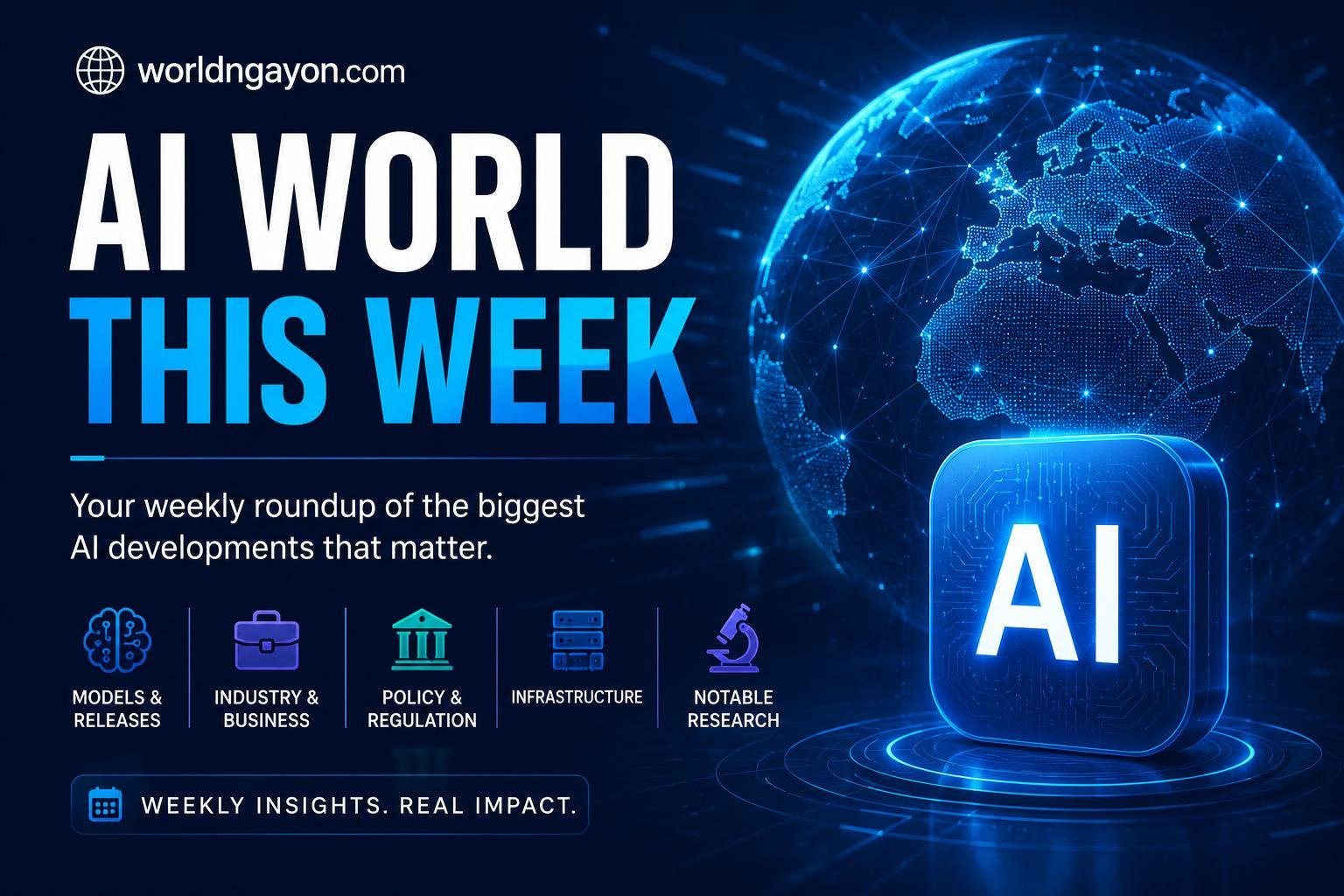
AI World This Week is a weekly comprehensive AI briefing from worldngayon.com — the WorldNgayon Intelligence Brief. It covers eight sections: Models & Releases, Industry & Business, Policy & Regulation, Infrastructure, Research, AI Market Watch, Tool of the Week, and Why It Matters. Published every Sunday, it includes a WorldNgayon AI Index scoring the week across five dimensions, a WorldNgayon Insight editorial, and a “Looking Ahead” preview of next week’s developments. Each issue is numbered sequentially starting from #001.
What is the WorldNgayon AI Index?
The WorldNgayon AI Index is a weekly editorial score rating the AI industry across five dimensions: Innovation, Business, Research, Policy, and Infrastructure. Each dimension is scored out of 10. It is not a model benchmark — it is our editorial assessment of how consequential the week was for the AI world.
What should Filipino professionals do based on this week’s AI developments?
Filipino professionals should develop multi-platform AI literacy across GPT-5.6, Claude, Grok 4.5, and Kimi K3. Developers should test Kimi K3’s OpenAI SDK compatibility for potential cost savings. BPO companies should evaluate open-source models for non-sensitive workloads while maintaining US-vendor relationships for compliance-sensitive clients. Students should understand the bifurcated AI market. Businesses should mark July 27 for open-source weight release and evaluate local hosting.
This article is for informational purposes only and does not constitute investment, technology, or legal advice. AI model capabilities, pricing, regulatory status, and stock valuations change rapidly. Always verify current specifications, compliance requirements, and market conditions before making decisions based on AI industry developments.