Table of Contents
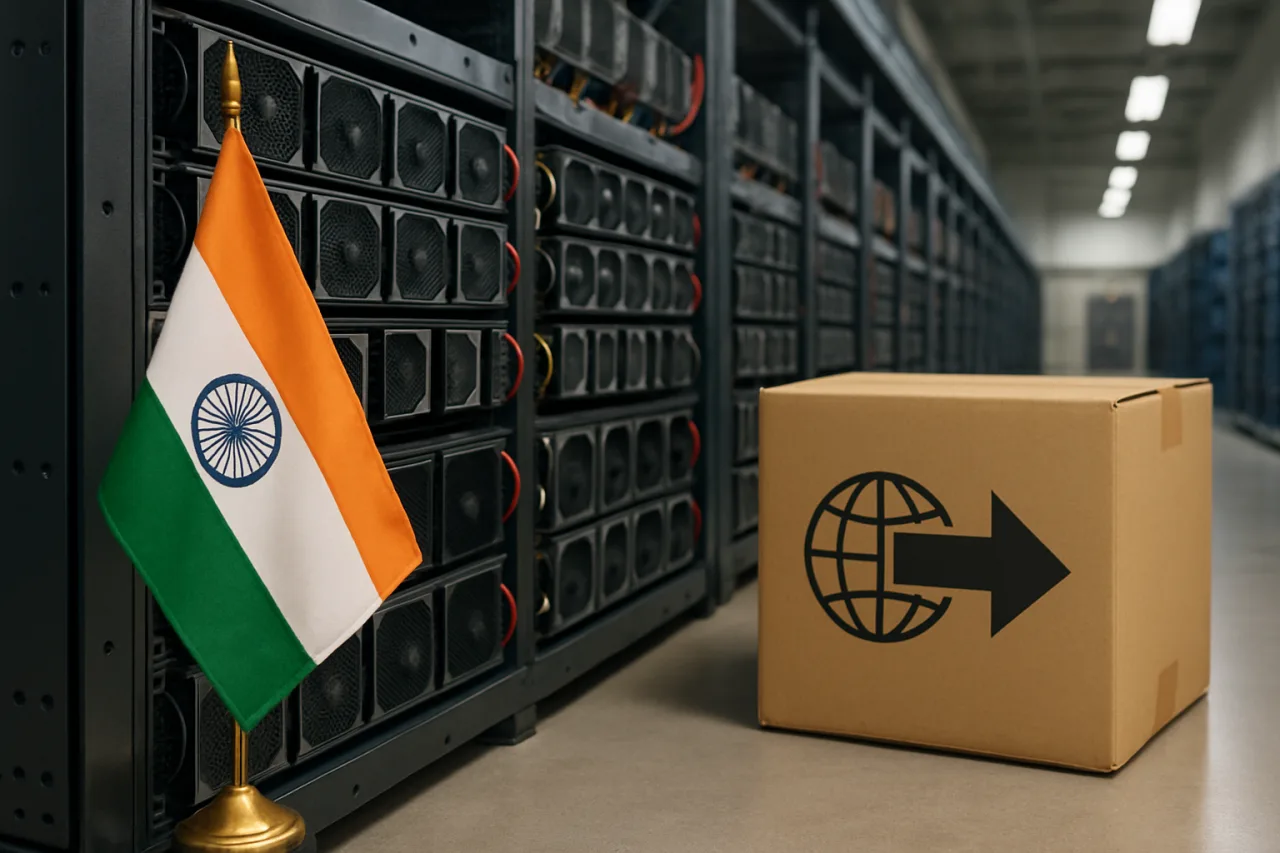
India is building one of the largest publicly supported AI compute pools on Earth — 45,000 subsidized GPUs and climbing toward 100,000 by December 2026 — and now it is preparing to sell the excess to the world. According to Moneycontrol reporting on October 12, 2026, the government is likely to let IndiaAI Mission providers offer India AI compute to overseas customers at commercial rates, because domestic demand has not yet absorbed what the state-backed program has built. That single policy shift reframes what the mission is for: not just a subsidy for Indian startups, but a bid to make India a supplier in the global AI infrastructure trade.
Key Takeaway
- 🖥️ The pool is real and big: India AI compute now spans 45,000+ subsidized GPUs under the ₹10,372-crore IndiaAI Mission, accessible at roughly ₹65 (~70 US cents) per GPU-hour — versus $2.50–$4.00 for comparable commercial cloud capacity.
- 🚢 The pivot is the story: with domestic uptake lagging, India is moving to let its 14 empanelled providers sell capacity abroad at full commercial rates — turning a subsidy program into an export business.
- ⚠️ The honest caveat: utilization data is thin (237 subsidized projects and 93.18 lakh GPU-hours by August 2026), and 45,000 GPUs remain a fraction of US hyperscaler fleets.
- 🏗️ The stack is widening: Yotta alone is deploying 20,000 Blackwell Ultra GPUs, L&T is gigawatt-scale, and the ₹1-lakh-crore RDI fund just seeded 19 fund managers to build on top.
- 🌍 Why it travels: if Indian-priced GPU hours reach Southeast Asia and the Global South through subsea-connected campuses, the geography of who can afford to train and serve AI models shifts with it.
Why India Built a Public India AI Compute Pool
The IndiaAI Mission, approved in March 2024 with a ₹10,371.92-crore (about $1.14 billion) outlay over five years, was designed on a simple diagnosis: Indian startups and researchers could not afford the compute that AI development demands. Rather than build state-owned data centers, the government empanelled private providers — Jio Platforms, Tata Communications, Yotta Data Services and others, fourteen companies in total — who own and operate the hardware, while India subsidizes the hourly rate for eligible users: startups, MSMEs, researchers, academia, and government agencies. The result is a genuine national India AI compute utility rather than a one-off grant scheme.
The pricing is the mechanism. Eligible users access the pool at roughly ₹65 per hour (about 72 US cents), a 60–70% discount against commercial rates for comparable capacity. The government’s own portal lists allocations across GPU generations — NVIDIA H100, H200, and A100, AMD MI300X, Intel Gaudi 2, and AWS Tranium — so the India AI compute pool is deliberately heterogeneous rather than single-vendor. By June 2026 the common pool had crossed 45,000 GPUs, nearly 4.5 times the mission’s original 10,000-GPU target, and in February 2026 IT Minister Ashwini Vaishnaw announced another 20,000 under what he calls AI Mission 2.0, with a 100,000-GPU public target by December 2026.
| Layer | Detail | Status |
|---|---|---|
| Mission budget | ₹10,372 crore (~$1.14B) over five years, seven pillars | Approved March 2024 |
| GPU pool | 45,000+ empaneled GPUs; +20,000 ordered; 100,000 target | December 2026 target |
| Subsidized price | ~₹65 (~$0.72) per GPU-hour, 60–70% below commercial | Live on portal |
| Providers | 14 empanelled: Jio, Tata Communications, Yotta, E2E Networks and others | Operating |
| Demand-side capital | RDI Scheme ₹1 lakh crore; first cohort of 19 fund managers, ₹7,131 crore committed (Oct 8, 2026) | Deploying |
| Flagship demand | Sarvam AI sovereign models: 3B/30B/100B parameters across 22 Indic languages, ~4,000 subsidized GPUs | Open-sourcing Sarvam-3 |
| Hardware localization | Yotta: 20,000 Blackwell Ultras; Netweb building GB200 NVL4 systems under Make in India; L&T gigawatt-scale roadmap | Announced/deploying |
The demand side is not hypothetical. Sarvam AI, the first startup selected to build indigenous foundation models, trained its Sarvam-3 family from scratch on roughly 4,000 subsidized GPUs — H100s hosted through providers like Yotta — targeting 22 Indic languages plus English math and code, and has begun open-sourcing the outputs. By August 2026 the portal recorded 237 subsidized projects consuming over 93.18 lakh GPU-hours. The pipeline logic is visible: cheap hours → more experiments → more trained models → more demand for the talent the mission’s skilling pillars produce. And that demand loop is exactly what makes India AI compute more than a subsidy line — every trained model and shipped app becomes an argument for renting the next batch of hours.
The Problem Too Much Capacity Creates
But the program has run into the same wall every subsidized infrastructure program eventually meets: usage. A senior government official told Moneycontrol the quiet part plainly — “There is not enough uptake of GPUs in India right now. It is, therefore, important that these companies are able to sell the compute for the right price to anyone globally.” Independent analysis has flagged the same blind spot: India publishes capacity numbers readily but little granular utilization data, making it hard to verify how much of the pool is actually busy, who uses it, and whether smaller startups are being crowded out by better-resourced applicants.
The economics justify the concern. GPUs are expensive to buy and expensive to keep fed — power, cooling, data center shells, and the expert staff to run them. Providers who win subsidized-rate mandates still carry commercial-rate costs. If domestic demand grows slower than the pool, either the private providers bleed capital (which chills future investment rounds) or the idle capacity becomes a dead-weight asset. MeitY’s answer has two parts. First, it changed the latest bidding round to onboard 10,000 more GPUs with the government procuring compute time over five years — a demand-guarantee that makes provider revenue predictable enough to finance. Second, it is preparing the export permission: empanelled firms selling unused capacity to overseas customers at full commercial rates, converting overhang into income.
That second part is the pivot from welfare to industry. A subsidy program that only sells to its own citizens at cost is a fiscal line item. One that can sell surplus to the world at market prices is an export sector — with everything that implies: foreign exchange earnings, pricing power, and a seat in the global AI supply chain that has so far belonged almost entirely to US hyperscalers and a handful of neoclouds. Whether the India AI compute pool can hold that seat is now one of the defining industrial-policy questions of 2027.
Who Buys Indian GPU Hours — and Why It Travels
The plausible first buyers are already defined by geography and arithmetic. Southeast Asian startups face the same $2.50–$4.00 commercial GPU pricing Indian startups do, with thinner local pools; Indonesia is pouring billions into its own capacity (Zankore’s $3.1 billion facility financing, Batam’s new 120MW green AI campus sub-2ms from Singapore), but a functioning Indian export channel adds a second regional source. Enterprises in Africa, Central Asia, and the Middle East have even less local supply. And the Indian diaspora economy — IT services firms and agencies serving clients abroad — can route AI workloads home at subsidized-adjacent costs.
The honest comparison sets the ceiling for India AI compute capacity. Forty-five thousand GPUs — even one hundred thousand — is a fraction of the fleets the US hyperscalers operate, and India is not pretending to outbuild them; as one analysis put it, the mission is a subsidy that lets domestic teams reach the starting line, not a compute arms race. The competitive edge is geographic and economic: India sells hours at the lowest public rate on Earth, owns deep subsea connectivity, runs 51% clean power capacity (per Vaishnaw), and sits inside a US trade framework that smoothed GPU imports. Whether that combination beats proximity to Silicon Valley customers is exactly the experiment the export permission will run.
What It Means for Builders Outside India
For readers deciding where to build — freelancers, agency owners, small AI product teams — three practical consequences follow, none requiring a passport to Delhi. First, price anchor: a public India AI compute pool selling at $0.72/hour, even in limited volumes, disciplines the market; watch commercial GPU pricing in your region as Indian capacity enters it. Second, talent flows: India is simultaneously running the world’s largest skilling programs (Microsoft alone has trained 5.6 million people under its ADVANTA(I)GE initiative since January 2025), which means the global market for AI-adjacent services gains competition and capacity at once — the same dynamic the IMF’s October 2026 jobs data shows concentrating skills demand in AI-exposed occupations. Third, data-residency arithmetic changes: Indian law’s data-protection framework now applies to a growing share of regional AI processing, which some regulated industries will treat as coverage and others as friction — know which you are before you route workloads.
For Filipino and Southeast Asian professionals specifically, the relevance is structural rather than abstract: the same subsea cables that land AI campuses in Batam and Singapore make Indian compute a realistic fallback for regional workloads, and India’s outsourcing-readiness score (84.55, first in the Ataraxis 2026 index against the Philippines’ 69.05, fifth) defines the competitive benchmark that regional BPO and freelance AI work now trains against.
What to Watch as the Export Era Opens
Five markers will show whether the pivot is real. One: the formal export rules — which customers qualify, how capacity is split between Indian and foreign buyers, and at what floor price. Two: the December 2026 checkpoint on the 100,000-GPU target, and whether the +20,000 order lands within its promised six months. Three: utilization transparency — project counts, GPU-hours consumed, and small-startup participation, the metrics independent analysts say should define success instead of raw capacity. Four: the second RDI cohort, which converts the fund’s ₹7,131-crore first tranche into actual deep-tech balance sheets. Five: Blackwell-generation deployment at scale — Yotta’s 20,000 Blackwell Ultras are the first real test of whether Indian AI factories run frontier-class hardware or a generation behind.
India’s India AI compute gamble, summarized: subsidize access so locals can afford to enter the race, size the pool bigger than domestic demand, then sell the surplus to the world to keep the providers solvent. If it works, 2027’s infrastructure map gains a new supplier region written in Indian rupees. If it stalls — on demand, transparency, or execution — the world still gains the clearest live experiment yet in whether mid-income countries can buy their way into the AI supply chain.
Frequently Asked Questions About India AI Compute
What is India AI compute under the IndiaAI Mission?
A government-backed pool of more than 45,000 GPUs — NVIDIA H100/H200/A100, AMD MI300X, Intel Gaudi 2, and AWS Tranium among them — empanelled through 14 private providers including Jio Platforms, Tata Communications, and Yotta. Eligible Indian users (startups, MSMEs, researchers, government) access it at roughly ₹65 per GPU-hour, a 60–70% discount to commercial rates, funded from the ₹10,372-crore mission budget.
Why is India letting providers sell AI compute to overseas customers?
Because domestic uptake has not absorbed the capacity being added. Moneycontrol reported on October 12, 2026 that the government is likely to allow empanelled providers to sell unused capacity abroad at commercial rates — industry-proposed and government-accepted — so providers can recover their investment costs while the domestic market matures. A 10,000-GPU expansion with a five-year government procurement commitment accompanies it to guarantee baseline demand.
How big is India’s AI compute pool compared to the US?
Far smaller in raw count. India’s 45,000-GPU pool (targeting 100,000 by December 2026) is a fraction of US hyperscaler fleets. India’s bet is not quantity but price and access: the lowest public GPU rate in the world, heterogeneous hardware, and deep subsea connectivity — an industrial-policy position rather than a scale race.
What has the subsidy actually produced so far?
Tangible early outputs: Sarvam AI trained its 3B/30B/100B-parameter sovereign model family on roughly 4,000 subsidized GPUs across 22 Indic languages and open-sources the results; the portal logged 237 subsidized projects and 93.18 lakh GPU-hours by August 2026. Independent analysts caution that granular utilization data remains thin, so the subsidy’s efficiency is still an open question.
Can foreign companies buy India AI compute today?
Not yet under the subsidized program — subsidies target eligible Indian users. The export permission (commercial-rate sales to overseas customers) was reported as likely in October 2026 but awaits formal rules on eligibility, allocation, and pricing. Watch the IndiaAI portal and MeitY announcements for the operational details.
How does the RDI fund connect to AI compute?
The ₹1-lakh-crore Research, Development and Innovation scheme is the demand-side compliment: on October 8, 2026 its first cohort of 19 fund managers (14 alternative investment funds plus five research organizations linked to IISc, IIT Madras, IIT Bombay, and BITS Pilani) received ₹7,131 crore in commitments to channel into deep-tech — AI, robotics, quantum, biotech, space — at Technology Readiness Level 4 and above, with each rupee expected to mobilize matching private capital.
What does India’s AI compute push mean for Southeast Asia?
Two things: a second regional supply option as SEA builds out its own capacity (Indonesia’s Zankore and Batam campuses, Malaysia’s Bitdeer expansion), and a price benchmark. If Indian commercial-rate GPU hours reach SEA via subsea cables, regional startups gain negotiating leverage against both local campuses and US hyperscalers. The Philippines’ AI-readiness gap against India — 69.05 versus 84.55 on the 2026 outsourcing index — sharpens the same point on talent.
What could stall the plan?
Three failure modes: sustained low utilization even after export permission (the pool outgrows both markets), opacity in allocation that crowds out small startups, and execution risk in the hardware pipeline — if Blackwell-class deployments slip, India sells yesterday’s GPUs at tomorrow’s prices. The five watch-markers above are the early alarms.
Financial Disclaimer
This article is general information about technology infrastructure policy, not financial or investment advice. Figures reflect government announcements and reporting cited below as of October 2026 and may change. Verify against official IndiaAI portal releases before decisions. WorldNgayon is not a financial adviser.
Sources
Program specifics: the IndiaAI Compute Capacity portal (allocation types, subsidies, GPU inventory); Moneycontrol’s October 12, 2026 report on the export permission and five-year procurement change; EE Times’ AI Mission 2.0 expansion coverage (February 2026, 20,000-GPU order, US trade framework, 51% clean power); NVIDIA’s IndiaAI Mission briefing (Yotta Blackwell Ultra deployment, Sarvam-3 training stack, Netweb GB200 NVL4 under Make in India); India Today’s RDI first-cohort report (October 13, 2026); pricing and subsidy economics per Value Add VC’s India AI policy analysis; utilization critique per IMPRI’s IndiaAI compute analysis; hyperscaler investment context per Microsoft’s India announcement and the BBC’s combined $52.5 billion Amazon–Microsoft figure. For our regional coverage, see the Southeast Asia AI infrastructure map, the AI data center power problem explained, and the freelance AI pay split for how compute economics reach working professionals.