Table of Contents
Key Takeaway
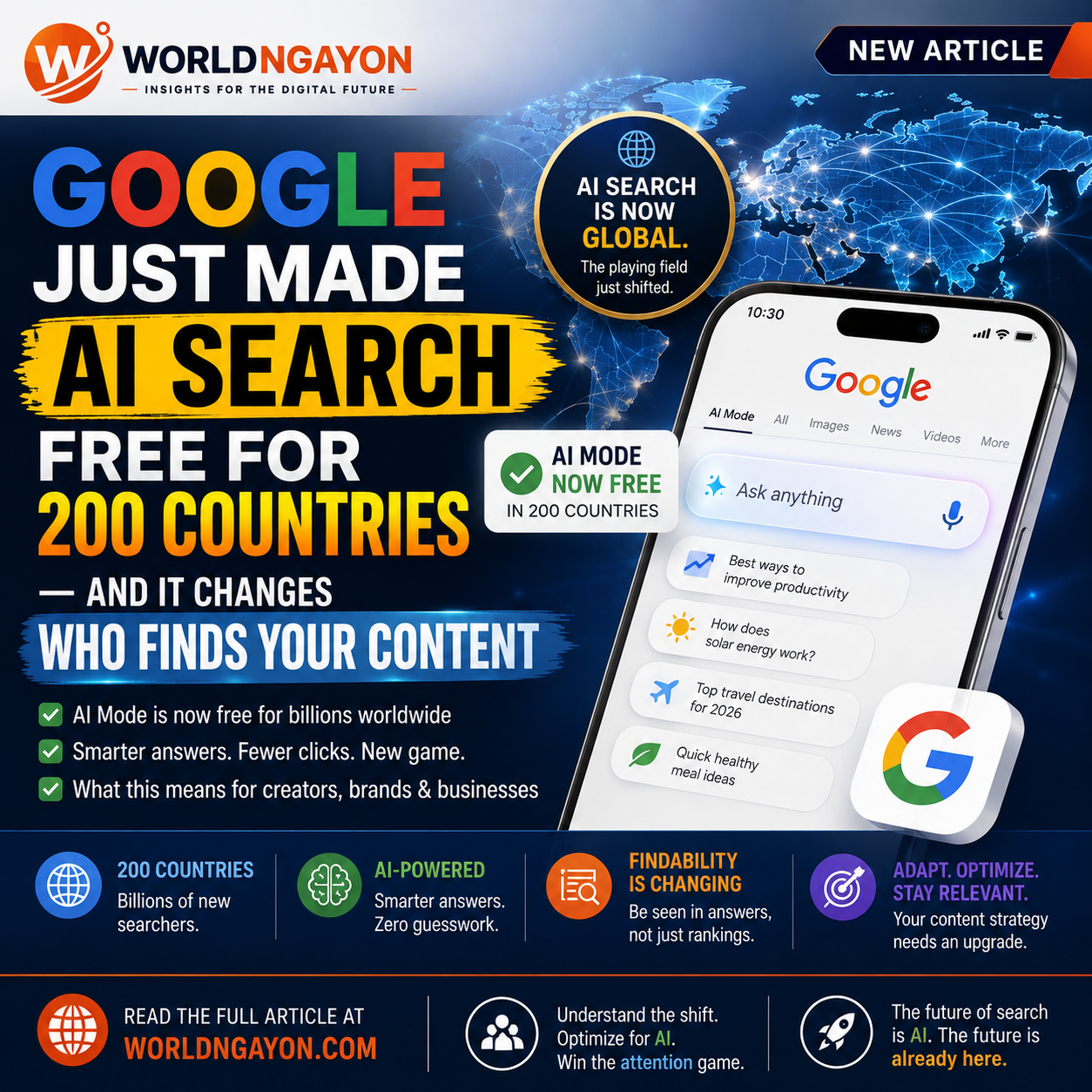
- 🌍 200 Countries: Google Search AI Mode is expanding to nearly 200 countries and 98 languages, making AI-powered search available to billions of users at no cost — no subscription required
- ⚡ Gemini 3.5 Flash: Google has designated Gemini 3.5 Flash as the default model powering AI Mode, bringing faster response times and improved reasoning to everyday search queries
- 🔗 Personal Intelligence: Users can connect Gmail, Google Photos, and soon Google Calendar to Search AI — enabling personalized answers that draw on private context without requiring a paid tier
- 🔄 Who Finds Your Content: AI Mode changes the discovery model — Google’s AI synthesizes answers from multiple sources, meaning content visibility depends on being cited in AI-generated responses, not just ranking in blue links
- 💡 Free Changes Everything: By offering AI search at no cost, Google eliminates the price barrier that limited competitors — this is a defensive moat that reshapes the entire search landscape
Everyone assumed AI search would be a premium product — a paid tier that would gatekeep intelligent answers behind a subscription wall. Google just proved that assumption wrong. By making Gemini 3.5 Flash the default model in AI Mode and expanding it to nearly 200 countries and 98 languages at no cost, Google has turned AI search into infrastructure. Free, ubiquitous, and embedded in the product that 90% of the world already uses to find information. The contrarian take is not that Google is giving away AI search out of generosity. It is that Google is defending its core business by making it impossible for paid competitors to compete on price.
The deeper story is about what happens when AI search becomes free at scale. It changes who finds your content, how they find it, and whether they ever click through to your site at all. For Google Search AI content creators, publishers, and businesses that depend on search traffic, this is not an incremental update. It is a structural shift in the economics of discovery.
The Gemini 3.5 Flash Upgrade — What Changed and Google Search AI
Google’s decision to designate Gemini 3.5 Flash as the default model for AI Mode is a technical choice with strategic consequences. Flash models are optimized for speed — they generate responses faster than full-size models, at lower compute cost, with slightly reduced reasoning depth. For a search product that handles billions of queries per day, speed and cost matter more than marginal accuracy gains. A user waiting three seconds for an AI-generated answer will abandon the query. A user waiting half a second will stay.
The Flash designation also signals that Google has solved the inference cost problem at scale. Running a large language model on every search query is expensive — as Gartner’s data on AI inference spending confirms. By using a Flash model, Google keeps inference costs low enough to offer AI search for free. This is the economic foundation of the free strategy. If inference costs were too high, Google would need to charge. Flash makes free sustainable.
For Filipino professionals, the implication is that AI search is now the default experience, not an opt-in experiment. Users in the Philippines — a market where Google holds over 95% search market share — will encounter AI-generated answers as part of their normal search flow. Content that is optimized for traditional SEO may not appear in AI-generated responses if it is not structured in ways the model can parse and cite.
The 200-Country Expansion — Why Scale Matters and Google Search AI
Expanding AI Mode to nearly 200 countries and 98 languages is the most significant part of this announcement. Until now, AI search was limited to a small number of markets and primarily English-language queries. The expansion means that a user in Manila searching in Tagalog, a user in Jakarta searching in Bahasa Indonesia, and a user in São Paulo searching in Portuguese will all receive AI-generated answers in their native language.
This has two implications. First, it dramatically increases the volume of queries that trigger AI responses — from hundreds of millions per day to potentially billions. Second, it introduces multilingual AI synthesis, where the model may draw on sources in multiple languages to construct an answer. A query about Philippine economic policy might pull from English-language news sites, Filipino-language publications, and international sources simultaneously. Search engine industry analysts at Search Engine Land have noted that this multilingual approach fundamentally changes how content is discovered across non-English markets.
For content creators, the multilingual expansion means that publishing in English alone may no longer be sufficient for global visibility. A Google blog post explained the expansion strategy, emphasizing that AI Mode is designed to work across the full diversity of languages and regions that Google serves. Content that exists only in English will compete against AI-generated answers that synthesize information from sources in dozens of languages.
Personal Intelligence — The Privacy Calculus and Google Search AI
The most strategically significant feature of the expansion is Personal Intelligence — the ability for users to connect their Gmail, Google Photos, and soon Google Calendar to Search AI. When connected, AI Mode can draw on personal context to answer questions. A user searching for “what time is my flight” can receive an answer that pulls from Gmail confirmations. A user searching for “photos from my trip to Palawan” can see results from their own Google Photos library.
This is not a minor feature. It is Google’s most powerful defensive moat. No competitor — not OpenAI, not Anthropic, not Meta — has access to the depth of personal data that Google holds across Gmail, Photos, Calendar, Drive, and Maps. By connecting this data to AI search, Google creates a personalized experience that competitors cannot replicate without similar access to users’ private information.
The privacy implications are significant. Users are trading personal data exposure for convenience. Google’s challenge is making this trade feel safe enough that billions of users opt in. The company’s track record on data privacy is mixed, and regulators in the European Union and elsewhere are scrutinizing AI-data integration closely. For a deeper look at these issues, see our analysis of AI transparency in the Philippines, which examines how regulatory frameworks are struggling to keep pace with AI-driven data integration.
Who Finds Your Content — The Discovery Revolution and Google Search AI
Here is where the contrarian thesis becomes concrete. Traditional SEO is built on a simple model: rank high in blue-link results, users click through, traffic flows to your site. AI Mode disrupts this model. When Google’s AI synthesizes an answer from multiple sources, the user may never click through to any individual site. The answer is the product. The sources are ingredients.
This does not mean SEO is dead. It means SEO is evolving. Content that is cited in AI-generated answers gains visibility even without click-through. Content that is not cited — even if it ranks well in traditional results — may become invisible if users find the AI answer sufficient. The question shifts from “how do I rank first?” to “how do I become the source the AI chooses to cite?”
For publishers and businesses, this requires a fundamental rethink of content strategy. Long-form articles that answer specific questions comprehensively are more likely to be cited than thin content optimized for keyword density. Structured data, schema markup, and clear factual claims help AI models parse and reference content accurately. Our guide to AI prompt engineering explores how the relationship between content and AI models is changing, and what creators can do to remain visible.
The shift also creates opportunities. Content that provides unique data, original analysis, or expert perspectives that AI models cannot generate from existing sources becomes more valuable, not less. If your content is the only source for a specific data point, the AI must cite you. This is the new SEO — being the indispensable source rather than the top-ranked result.
The Free Search Moat — Why Competitors Should Worry and Google Search AI
By making AI search free, Google has done something strategically devastating to competitors. OpenAI charges $20 per month for ChatGPT Plus. Anthropic charges for Claude Pro. Perplexity has both free and paid tiers. Google’s AI Mode is included in the standard search product at no additional cost. For the vast majority of users — those who are not AI power users and are not willing to pay for premium AI tools — Google’s free AI search is sufficient. It eliminates the incentive to switch.
This is a classic platform defense strategy. When a dominant player makes a previously premium feature free, it raises the barrier for competitors who need to charge to cover their costs. OpenAI, Anthropic, and others must now justify their subscription prices against a free alternative that is embedded in the product 90% of the world already uses. The value proposition shifts from “our AI is better” to “our AI is worth paying for even though Google’s is free.”
For most users, that value proposition will fail. Google’s AI is good enough for everyday queries, and free beats paid when the quality gap is small. The competitors that survive will be those that offer something Google cannot — specialized domain expertise, deeper integration with enterprise workflows, or unique data access. For a practical exploration of how to build AI systems that complement rather than compete with Google, see our tutorial on how to build an AI agent.
What Comes Next for Search and Google Search AI
The expansion of AI Mode to 200 countries is not the end of the story. Several developments will shape the next phase. First, the integration of Google Calendar into Personal Intelligence will enable time-aware search — answers that consider your schedule, upcoming meetings, and deadlines. A query like “when should I schedule the team call?” could receive an answer that checks all participants’ calendars and suggests optimal slots.
Second, the multilingual expansion will pressure competitors to invest in non-English language support. OpenAI, Anthropic, and others have historically prioritized English. Google’s 98-language expansion forces them to catch up or cede those markets entirely. For the Philippines, where English proficiency is high but Tagalog and regional languages dominate daily communication, the multilingual capability is particularly relevant.
Third, the free AI search model will likely force a shakeout in the AI search market. Smaller competitors that cannot subsidize free AI search with advertising revenue or cloud services will struggle. The market may consolidate around a few large players with the infrastructure to offer AI at scale without charging users directly.
For content creators and businesses, the strategy is clear: invest in content that AI models want to cite. Original research, unique data, expert analysis, and comprehensive answers to specific questions are the new currency of visibility. Traditional keyword optimization remains necessary but is no longer sufficient. The sites that thrive in the AI search era will be those that provide value the AI cannot synthesize from existing sources alone.
Frequently Asked Questions About Google Search AI
What is Google Search AI Mode?
AI Mode is Google’s AI-powered search experience that uses Gemini 3.5 Flash as its default model to generate synthesized answers from multiple sources. It is expanding to nearly 200 countries and 98 languages at no cost — no subscription required. Users can also connect Gmail, Google Photos, and soon Google Calendar for personalized answers.
Is Google AI Mode free to use?
Yes. Google Search AI Mode is free and requires no subscription. It is integrated into the standard Google Search product. This is a strategic decision by Google to defend its search dominance by making AI search a default, free feature rather than a premium, paid product.
What is Gemini 3.5 Flash?
Gemini 3.5 Flash is a speed-optimized version of Google’s Gemini AI model. Flash models prioritize fast response times and lower compute costs over maximum reasoning depth. This makes them suitable for high-volume search queries where speed matters more than marginal accuracy gains. Flash models also keep inference costs low enough to offer AI search for free.
How does Personal Intelligence work in Google Search AI?
Personal Intelligence allows users to connect Gmail, Google Photos, and soon Google Calendar to Search AI. When connected, the AI can draw on personal context — email confirmations, photo libraries, calendar events — to provide personalized answers. Users searching for flight times, photo memories, or schedule conflicts can receive answers that reference their own data.
How does AI Mode affect website traffic and SEO?
AI Mode changes the discovery model. Instead of users clicking through to individual websites, Google’s AI synthesizes answers from multiple sources. This means content visibility depends on being cited in AI-generated responses, not just ranking in traditional blue-link results. Content creators should focus on original data, expert analysis, and comprehensive answers that AI models want to cite.
Which countries and languages does Google Search AI Mode support?
Google is expanding AI Mode to nearly 200 countries and 98 languages. This includes the Philippines, where users can search in English, Tagalog, and other supported languages. The multilingual expansion means AI-generated answers may synthesize information from sources in multiple languages, increasing both reach and competition for visibility.
Disclaimer: This article is for informational and educational purposes only and does not constitute technology or business advice. Feature descriptions are based on Google’s public announcements. Product features, availability, and pricing may change. Readers should verify current capabilities directly with Google. WorldNgayon.com is not liable for any actions taken based on the content presented here.