Table of Contents
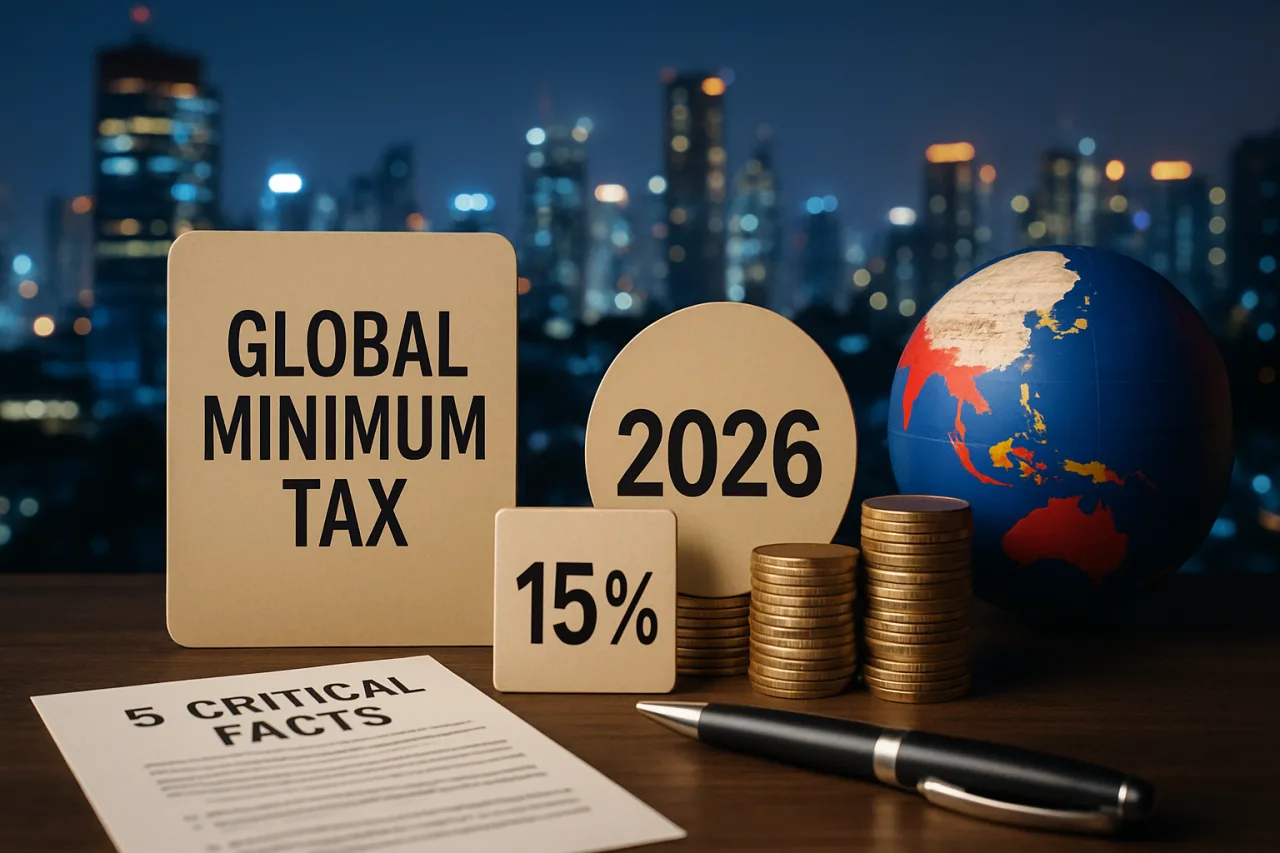
On July 7, 2026, a technical working group led by the Bureau of Internal Revenue and the Department of Finance held its first meeting to draft legislation implementing a 15% global minimum tax on large multinational enterprises operating in the Philippines. The Qualified Domestic Minimum Top-up Tax, or QDMTT, would require multinationals with global annual revenues of €750 million or more to pay an effective tax rate of at least 15% in every jurisdiction where they operate — including the Philippines. For a country that has spent the past decade building an incentive framework designed to attract foreign investment through reduced tax rates, the global minimum tax represents a fundamental shift: the Philippine government will soon tax the very income it currently exempts, and the tax incentives that helped attract companies like Singtel, Amazon, and Google may become significantly less effective.
Key Takeaway
- 📋 15% minimum tax on large MNEs: The QDMTT applies to multinational enterprises with global annual revenues of €750 million or more, requiring them to pay at least 15% effective tax in every jurisdiction. The Philippines targets implementation in 2027, with collections beginning in 2028.
- 🏛️ First TWG meeting held July 7, 2026: The BIR and DOF formed a technical working group with five subgroups covering legal framework, tax administration, capacity development, stakeholder engagement, and post-implementation monitoring.
- ⚠️ Could blunt CREATE MORE Act incentives: Companies currently paying less than 15% effective tax due to income tax holidays and other incentives will face a top-up tax bringing them to 15% — reducing the competitive advantage the Philippines offers foreign investors.
- 🌏 Philippines lags regional peers: Vietnam has already adopted the QDMTT and Income Inclusion Rule. Malaysia has posted updated Pillar Two implementation guidelines. The Philippines signed the OECD/G20 Inclusive Framework in 2023 but has not yet enacted domestic legislation.
- 💰 Tax revenue vs. investment attraction: The DOF argues that without the QDMTT, tax revenue from Philippine-based MNEs would flow to other jurisdictions. With it, the Philippines collects taxes domestically — but risks reduced foreign investment appeal.
What Is the Global Minimum Tax for the Philippines
The global minimum tax is an international agreement brokered by the Organisation for Economic Co-operation and Development and the G20 to address what tax authorities call the “race to the bottom” — the practice of countries slashing corporate tax rates to attract foreign investment. Under the OECD/G20 Inclusive Framework on Base Erosion and Profit Shifting, known as Pillar Two, multinational enterprises with global annual revenues of €750 million or more must pay an effective tax rate of at least 15% in every jurisdiction where they operate. If a country’s effective tax rate on a covered multinational falls below 15%, another jurisdiction can claim the difference through a top-up tax — unless the host country collects it first through a Qualified Domestic Minimum Top-up Tax.
The Philippines, while not an OECD or G20 member, signed onto the Inclusive Framework in 2023. Finance Secretary Frederick Go stated in June 2026 that he wants the implementing law passed within the year, targeting implementation in 2027 and collections beginning in 2028. The BIR confirmed that the technical working group held its first meeting on July 7, 2026, at the BIR National Office in Quezon City, formally commencing interagency efforts to develop the legislative and administrative framework.
For the Philippines, the stakes are significant. The country’s investment promotion strategy has relied heavily on tax incentives — income tax holidays, reduced corporate income tax rates, VAT exemptions — to attract foreign multinationals in IT-BPM, manufacturing, and digital infrastructure. The CREATE MORE Act, enacted in November 2024, enhanced these incentives, offering 4 to 7 years of income tax holiday and up to 24 or 27 years for investments exceeding ₱15 billion. But if a covered multinational’s effective tax rate in the Philippines falls below 15% due to these incentives, the QDMTT will impose a top-up tax to bring it to 15% — neutralizing the very benefit the incentive was designed to provide.
The Qualified Domestic Minimum Top-up Tax Explained
The QDMTT is one of three charging mechanisms under the OECD Pillar Two framework. Its purpose is to give the host country — the jurisdiction where the multinational operates — the first right to collect the top-up tax that brings the effective rate to 15%. If the host country does not implement a QDMTT, the difference is collected by the multinational’s parent jurisdiction through the Income Inclusion Rule, or by other jurisdictions through the Undertaxed Profits Rule.
In practice, this means that if a multinational currently pays an effective tax rate of 5% in the Philippines because of CREATE MORE Act income tax holidays, the QDMTT would impose an additional 10% top-up tax to bring the total to 15%. Without the QDMTT, that 10% would be collected by the multinational’s home country — meaning the Philippines would lose the revenue entirely.
Deloitte Philippines Tax & Legal Leader Carlo Navarro explained to BusinessWorld: “We provide tax incentives to foreign investors who want to locate in the Philippines. So, some of them are not paying any taxes at all to the Philippines because of the incentives that they are enjoying. But because of the qualified domestic minimum tax rule, the Philippines will now impose a minimum tax of 15% on that income that is incentivized by the old framework.”
Navarro warned that reducing the benefits of tax incentives could prompt some investors to reconsider: “Once you reduce the benefits derived from those tax incentives, you can already see that investors might reconsider their investment in the Philippines and look for another jurisdiction that will provide them with better tax rates.”
The TWG: First Meeting and Five Subgroups
The technical working group formed by the BIR and DOF held its first meeting on July 7, 2026, at the BIR National Office in Quezon City. Finance Undersecretary Rolando Ligon, who chairs the TWG, stated: “As a member of the OECD/G20 Inclusive Framework on Base Erosion and Profit Shifting, the Philippines must undertake the necessary policy and technical preparations for the possible implementation of the global minimum tax through appropriate domestic legislation.”
The TWG established five subgroups to prepare for implementation:
| Subgroup | Focus Area |
|---|---|
| Legal Framework | Drafting the QDMTT legislation and aligning with OECD rules |
| Tax Administration & Compliance | Auditing, taxpayer services, and enforcement mechanisms |
| Capacity Development | Training BIR personnel on Pillar Two rules and calculations |
| Stakeholder Engagement | Consultation with affected multinationals and industry groups |
| Post-Implementation Monitoring | Tracking revenue impact, investment effects, and compliance |
The TWG also identified technical priorities including administrative and systems upgrades, information technology systems interoperability, secure international data exchanges, and alignment with international reporting standards including country-by-country reporting requirements. BIR Commissioner and TWG Vice Chairman Charlito Mendoza stated: “More than drafting legislation, the work ahead involves preparing the administrative processes, digital systems, technical capabilities, and institutional arrangements needed to implement the framework effectively and provide clear guidance to affected taxpayers.”
How the Global Minimum Tax Affects CREATE MORE Act Incentives
The tension between the QDMTT and Philippine investment incentives is the core policy challenge. The CREATE MORE Act was specifically designed to attract foreign investment in IT-BPM, manufacturing, and digital infrastructure by offering enhanced tax incentives. But the QDMTT effectively caps the benefit of those incentives at a 15% effective tax rate — meaning that any incentive that brings a company’s effective rate below 15% will be topped up by the QDMTT.
This does not eliminate all incentives. Companies with effective tax rates above 15% — which includes most Philippine-domiciled companies paying the standard 25% corporate income tax rate — are unaffected. The QDMTT only applies to covered multinationals (those with €750 million+ global revenue) whose effective tax rate in the Philippines falls below 15%, typically because of income tax holidays or reduced rates under CREATE, CREATE MORE, or pre-CREATE incentive regimes.
The affected companies are precisely the ones the Philippine government has been trying to attract: large multinational technology firms, global BPO operators, and multinational manufacturers. The IT-BPM industry, already facing AI-driven restructuring with revenue targets cut by up to $15.7 billion, could face additional pressure if the QDMTT reduces the attractiveness of Philippine tax incentives for global BPO operators.
However, Navarro argued that the Philippines has no choice but to implement the QDMTT: “If the Philippines does not implement or enact a qualified domestic minimum tax legislation, somebody else will tax the income that arises in the Philippines. With the implementation of the Qualified Domestic Minimum Top-up Tax legislation, it will restore the right of the Philippines to collect these taxes.”
Philippines vs Regional Peers: Implementation Status
The Philippines is lagging behind its Southeast Asian competitors in implementing the global minimum tax — a delay that has both advantages and disadvantages.
| Country | QDMTT Status | Implementation Date |
|---|---|---|
| Vietnam | Adopted (QDMTT + IIR) | January 2024 |
| Malaysia | Guidelines issued | January 2025 |
| Singapore | Legislated | January 2025 |
| Indonesia | Legislated | January 2025 |
| Philippines | TWG drafting legislation | Target: 2027 |
Vietnam was the first ASEAN country to implement the QDMTT, adopting both the QDMTT and the Income Inclusion Rule effective January 2024. Vietnam’s experience is instructive: the QDMTT there interacts with existing corporate income tax incentives, and the Vietnamese government has had to develop supplementary investment incentive mechanisms to compensate for the reduced effectiveness of tax holidays. Malaysia’s Inland Revenue Board posted updated Pillar Two implementation guidelines in December 2025. Singapore and Indonesia both legislated their QDMTT frameworks for January 2025 implementation.
The Philippines, targeting 2027 implementation and 2028 collections, is approximately three years behind Vietnam and two years behind Malaysia, Singapore, and Indonesia. Navarro acknowledged this gap: “That’s where we stand at the moment. We’re really behind in terms of adopting some of these international rules that will help the Philippines protect its tax base.”
The delay has a silver lining: the Philippines can learn from the implementation experiences of Vietnam, Malaysia, and Indonesia, avoiding early mistakes in calculation methodologies, administrative processes, and stakeholder communication. But the delay also means that for tax years 2024-2026, the Philippines may be losing QDMTT revenue that other jurisdictions are already collecting.
What Filipino Professionals and Businesses Must Do
The global minimum tax primarily affects large multinationals, but its ripple effects touch Filipino professionals and businesses across multiple sectors.
For tax professionals and accountants: The QDMTT introduces a new layer of tax computation that requires understanding OECD Pillar Two rules, effective tax rate calculations, and top-up tax mechanics. Tax professionals serving multinational clients need to develop expertise in GloBE rules, country-by-country reporting, and the interaction between QDMTT and existing Philippine tax incentives. The BIR’s capacity development subgroup will need trained personnel, creating demand for professionals with international tax expertise.
For businesses in PEZA and ecozones: Companies registered with the Philippine Economic Zone Authority and other investment promotion agencies that enjoy income tax holidays or reduced tax rates are the most directly affected. Finance officers of these companies should model the impact of the QDMTT on their effective tax rates beginning in 2027, and consider whether their incentive-driven tax savings will survive the 15% floor.
For IT-BPM companies: Large BPO operators like those contributing to the $42.3 billion projected 2026 revenue may fall under the €750 million revenue threshold if they are part of global multinational groups. The QDMTT could reduce the tax advantage that has made the Philippines attractive for BPO investment, similar to how AI is already restructuring the industry from a different angle. Companies should assess their group-level revenue and effective tax rate position.
For investors: The QDMTT affects the investment thesis for Philippine-focused equity strategies. Companies that have benefited from low effective tax rates may see margins compress when the top-up tax takes effect. Investors should evaluate whether companies in their portfolios have effective rates below 15% and whether they have plans to manage the transition.
For government and policy professionals: The QDMTT implementation is an opportunity to redesign the Philippine investment incentive framework. If tax rate-based incentives become less effective, the government may need to shift toward non-tax incentives — infrastructure, talent development, regulatory efficiency — to maintain the country’s competitive position. This is the policy conversation that the TWG’s stakeholder engagement subgroup will need to lead.
Frequently Asked Questions About the Global Minimum Tax Philippines
What is the global minimum tax and how does it affect the Philippines?
The QDMTT, or Pillar Two framework, requires multinational enterprises with global annual revenues of €750 million or more to pay an effective tax rate of at least 15% in every jurisdiction where they operate. The Philippines is implementing a Qualified Domestic Minimum Top-up Tax that will top up any covered multinational’s effective rate to 15% if it falls below that threshold due to tax incentives. Implementation is targeted for 2027, with collections beginning in 2028.
Which companies will be affected by the QDMTT in the Philippines?
The QDMTT applies to multinational enterprises that are part of a group with global annual revenues of €750 million or more, and whose effective tax rate in the Philippines falls below 15%. This primarily affects companies enjoying income tax holidays or reduced tax rates under CREATE, CREATE MORE, or pre-CREATE incentive regimes. Companies paying the standard 25% corporate income tax rate are unaffected. The tax does not apply to purely domestic Philippine companies or to small and medium enterprises below the €750 million revenue threshold.
How does the global minimum tax affect CREATE MORE Act incentives?
The QDMTT reduces the effectiveness of tax incentives that bring a covered multinational’s effective tax rate below 15%. If a company enjoys a 5% effective rate due to income tax holidays, the QDMTT will impose a 10% top-up tax to bring it to 15%. This does not eliminate the incentive entirely — the company still pays less than the standard 25% rate — but it reduces the competitive advantage that low effective rates provide. Tax incentives that bring effective rates to 15% or above remain unaffected.
When will the Philippines implement the global minimum tax?
The Department of Finance targets legislative passage in 2026, implementation in 2027, and collections beginning in 2028. The BIR and DOF technical working group held its first meeting on July 7, 2026, and established five subgroups to handle legal framework, tax administration, capacity development, stakeholder engagement, and post-implementation monitoring. Finance Secretary Frederick Go has stated he wants the law passed this year.
How does the Philippines compare to other Southeast Asian countries on GMT implementation?
The Philippines lags behind regional peers. Vietnam implemented its QDMTT in January 2024, making it the first ASEAN country to do so. Malaysia posted updated guidelines in December 2025. Singapore and Indonesia legislated their frameworks for January 2025. The Philippines, targeting 2027, is approximately two to three years behind. Deloitte’s Carlo Navarro noted: “We’re really behind in terms of adopting some of these international rules that will help the Philippines protect its tax base.”
Why should the Philippines implement the QDMTT if it reduces investment incentives?
Without the QDMTT, tax revenue from Philippine-based multinationals whose effective rates fall below 15% would be collected by other jurisdictions through the Income Inclusion Rule or Undertaxed Profits Rule. The QDMTT gives the Philippines the first right to collect this top-up tax domestically. Deloitte’s Navarro argued: “If the Philippines does not implement or enact a qualified domestic minimum tax legislation, somebody else will tax the income that arises in the Philippines.”
What should Filipino businesses do to prepare for the global minimum tax?
Businesses in PEZA zones and other incentive regimes should model the impact of the QDMTT on their effective tax rates beginning in 2027. Tax professionals should develop expertise in OECD Pillar Two rules. Large multinational companies should assess whether their global group revenue exceeds €750 million and whether their Philippine effective tax rate falls below 15%. Investors should evaluate whether companies in their portfolios have effective rates below 15% and whether they have transition plans.
This article is for informational purposes only and does not constitute tax, legal, or investment advice. The global minimum tax rules are complex and subject to change. Always consult a qualified tax professional or legal advisor before making decisions based on tax policy developments.