Table of Contents
Key Takeaway
- 💰 The OFW Forex Opportunity: Forex trading OFW is not just about profiting from currency markets — with $43.67 billion in remittances flowing into the Philippines in 2026 and the peso hovering near ₱58-60 per dollar, every 1-peso swing means millions gained or lost for OFW families annually.
- 🛡️ Currency Protection First: Before chasing forex profits, OFWs must first protect their remittance value — timing transfers, using rate alerts, and choosing the right money transfer service can save ₱5,000-₱15,000 per year on a typical $2,000 monthly send.
- 📈 Forex as Supplemental Income: The forex market operates 24 hours, making it accessible to OFWs in the Middle East and Asia — but it carries high risk. Never trade money you cannot afford to lose, and start with a demo account before risking real capital.
- ⚠️ Regulatory Reality: The Philippine SEC has issued warnings about unlicensed forex brokers targeting Filipinos. OFWs should only use brokers regulated by the FCA (UK), ASIC (Australia), or CySEC (Cyprus) to avoid scams.
- 🎯 Smart Strategy for Beginners: The most practical forex trading approach for OFWs is not day trading — it is a combination of strategic remittance timing, dollar-cost averaging into US-denominated assets, and building a long-term investment portfolio that benefits from dollar strength.
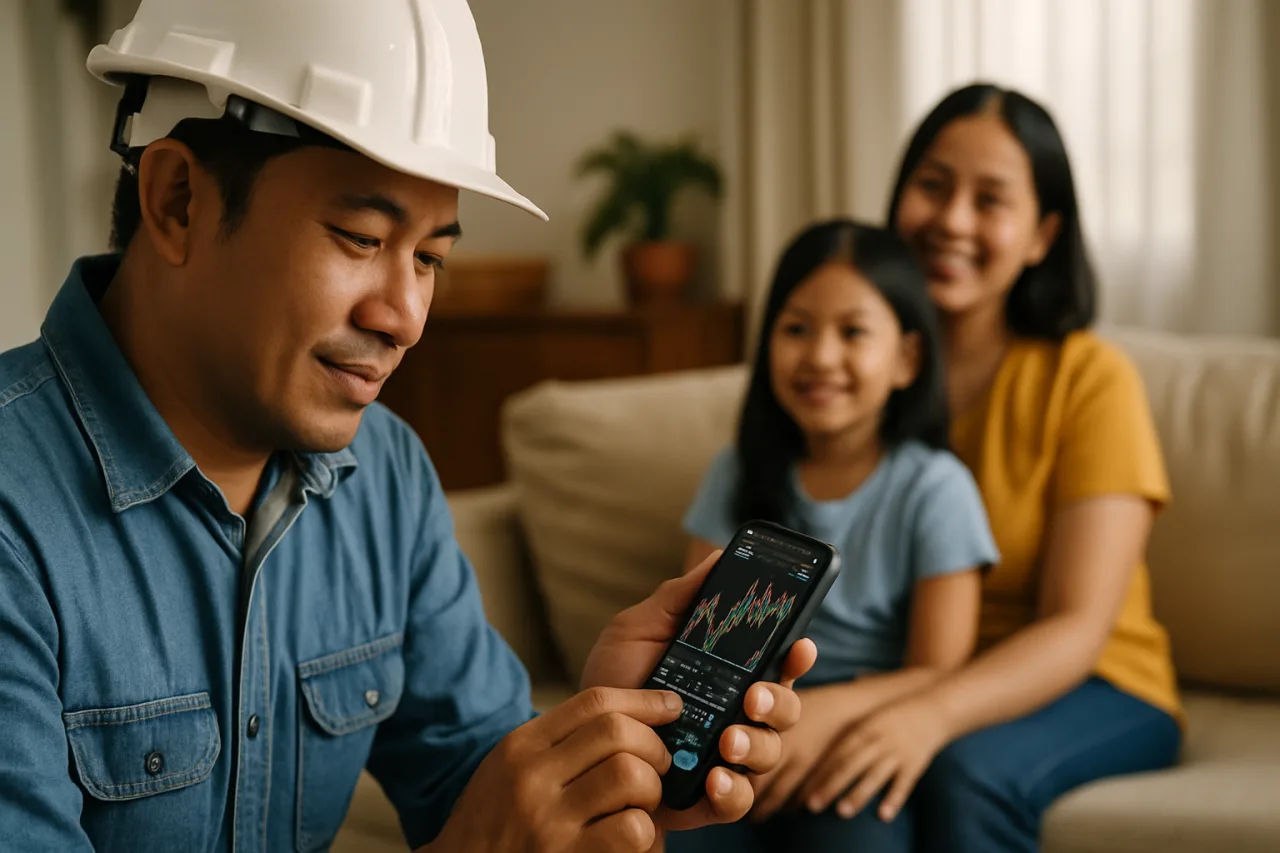
Every month, millions of overseas Filipino workers face a hidden threat that eats into their hard-earned salaries — currency fluctuation. Understanding forex trading OFW dynamics is the first step toward protecting your family’s financial future. When the Philippine peso strengthens from ₱58 to ₱56 against the US dollar, an OFW sending $2,000 home loses ₱4,000 in purchasing power overnight. Multiply that across 10 months, and that is ₱40,000 vanished — enough for a semester of a child’s tuition or a year’s worth of SSS contributions. Forex trading OFW is not just about profiting from currency markets. It is about understanding the single largest financial force that impacts every overseas Filipino family and learning how to harness — or hedge — that force. Whether you are a domestic helper in Hong Kong, an engineer in Saudi Arabia, or a nurse in the UK, forex trading OFW knowledge is essential financial literacy in 2026.
The Bangko Sentral ng Pilipinas (BSP) reported that cash remittances from overseas Filipinos reached $2.72 billion in April 2026 alone, bringing the January-April total to over $10.8 billion. For 2026, the Philippine remittances market is projected at $43.67 billion, growing at a compound annual growth rate of 5.97% to reach $58.36 billion by 2031 (Mordor Intelligence, January 2026). These numbers represent the lifeblood of the Philippine economy — and the financial foundation of millions of OFW families.
Why Forex Trading OFW Matters to Every OFW Family
Unlike stock trading or real estate investment, forex trading is not optional for overseas Filipinos. Every OFW is automatically a participant in the forex market the moment they convert their salary — whether in Saudi riyals, UAE dirhams, Hong Kong dollars, or US dollars — into Philippine pesos for their families back home. For OFW families, forex trading literacy is as essential as knowing how to send money home.
The scale of this involuntary forex exposure is staggering. According to BSP data from January to April 2026, the United States remained the largest source of OFW remittances, accounting for 39.7% of total inflows. Singapore contributed 7.3%, followed by other Asian and Middle Eastern corridors. This means the USD-PHP exchange rate is the single most important financial pair for the majority of OFW families.
As of mid-2026, the peso has been trading in the ₱58-60 per USD range, under pressure from sustained dollar demand amid global economic uncertainty and higher US interest rates (BSP, January 2026). Currency traders forecast the peso could test the ₱60 level in coming months if the US Federal Reserve maintains its hawkish stance (30rates.com, 2026). For OFWs, this means every dollar sent home buys fewer pesos than it did when the peso was at ₱52 in early 2024.
The impact is real and measurable. Consider an OFW in Dubai earning AED 8,000 per month (approximately $2,200). At ₱58 per dollar, the family receives ₱127,600. If the peso strengthens to ₱54, that same $2,200 converts to only ₱118,800 — a loss of ₱8,800 per month, or ₱105,600 per year. That is the cost of ignoring forex dynamics.
The Forex Market: What OFWs Need to Know
The foreign exchange market is the largest financial market in the world, with over $7.5 trillion traded daily (Bank for International Settlements, 2022 Triennial Survey). Unlike stock exchanges that operate during business hours, forex trading for OFWs runs 24 hours a day, five days a week — from Sunday 5 PM to Friday 5 PM Manila time. This around-the-clock operation makes forex trading OFW participation uniquely accessible, especially for those in the Middle East whose free hours overlap with the London and New York trading sessions.
Forex trading OFW involves buying one currency while simultaneously selling another. Currencies are traded in pairs — for example, USD/PHP (US dollar vs Philippine peso), EUR/USD (euro vs US dollar), or GBP/SGD (British pound vs Singapore dollar). The first currency in the pair is the “base” and the second is the “quote.” If USD/PHP is quoted at 58.50, it means one US dollar buys 58.50 Philippine pesos.
For OFWs, the most relevant currency pairs fall into three categories:
- USD/PHP: The primary pair for remittance timing and dollar-based investments.
- Local Currency/USD: SAR/USD (Saudi riyals), AED/USD (UAE dirhams), HKD/USD (Hong Kong dollars), SGD/USD (Singapore dollars) — relevant for OFWs paid in these currencies.
- Major Cross Pairs: EUR/USD, GBP/USD, USD/JPY — for OFWs interested in broader currency trading beyond the peso.
The forex market is driven by several key factors that OFWs should monitor: central bank interest rate decisions (especially the US Federal Reserve and BSP), inflation data, employment reports, geopolitical events, and trade balance figures. When the Fed raises interest rates, the dollar typically strengthens — meaning OFWs sending dollars home get more pesos per dollar. When the BSP raises rates, the peso tends to strengthen — reducing the peso value of dollar remittances.
OFW Remittance Timing: The Simplest Forex Strategy
Before diving into active forex trading, the most impactful financial move any OFW can make is strategic remittance timing. This is the foundation of forex trading OFW success — protecting your income before trying to grow it. This is not speculation — it is simply choosing when to convert and send money based on exchange rate conditions.
Here is how forex trading OFW remittance timing works in practice. Suppose an OFW in Saudi Arabia wants to send ₱100,000 equivalent home to the family each month. If the exchange rate is SAR 1 = ₱15.20 (peso rate against Saudi riyals), the OFW needs to send SAR 6,579. If the rate improves to ₱15.60 per SAR (meaning the peso weakened), the same ₱100,000 requires only SAR 6,410 — a savings of SAR 169 per month, or SAR 2,028 per year.
The reverse strategy also works. When the peso is strong (fewer pesos per dollar), OFWs can choose to send money immediately to lock in the favorable rate. When the peso is weak, some OFWs delay non-urgent transfers by a few days, hoping for a modest recovery. While this approach requires discipline and awareness, it does not require a trading account or market analysis skills.
Practical tools for remittance timing:
- Exchange rate alerts: Apps like Wise, XE.com, and Google Finance allow OFWs to set target rates. When USD/PHP hits a specified level, the app sends a notification — enabling the OFW to transfer at the optimal moment.
- BSP reference rate monitoring: The Bangko Sentral ng Pilipinas publishes daily reference rates at bsp.gov.ph. Checking these rates weekly helps OFWs identify trends.
- Forward contracts with remittance services: Some services like Wise and OFX allow OFWs to lock in an exchange rate for a future transfer, eliminating uncertainty. This is particularly useful for OFWs who know they will need to send a large amount (such as a tuition payment) in a few weeks.
According to a 2026 comparison by WorldNgayon, the best remittance services for OFWs include Wise (lowest fees, mid-market rate), Remitly (fastest transfers), Western Union (most pick-up locations), and GCash International (direct to wallet). On a ₱50,000 transfer from Saudi Arabia, the difference between the most and least expensive service can be ₱1,500-₱3,000 in fees and hidden exchange rate margins (WorldNgayon, April 2026).
Can OFWs Actually Trade Forex? The Reality Check
The forex market’s 24-hour operation and high liquidity make it attractive for supplemental income — and many OFWs are exploring forex trading. OFW communities on platforms like TikTok and LinkedIn have emerged, sharing their experiences trading from Dubai, Singapore, and Hong Kong (LinkedIn/Smartrade Philippines, June 2026). For more on investment options available to overseas Filipinos, see our guide on PSE Blue Chip Stocks for OFWs and our article about AI Side Hustles for OFWs.
However, the reality of forex trading OFW participants face requires careful consideration of several key factors:
The Opportunity
- 24-hour market: OFWs in the Middle East can trade the London session (3 PM-12 AM Manila time) and the early New York session (7 PM-4 AM) after their day jobs.
- High liquidity: Major currency pairs like EUR/USD have spreads as low as 0.1 pips, making entry and exit costs minimal.
- Leverage access: Brokers offer leverage up to 1:500, allowing OFWs to control large positions with small capital — but this amplifies both gains and losses.
- Low capital requirements: Some brokers allow accounts with as little as $10-50, making forex trading OFW entry accessible even to those with limited savings.
The Risks
- High failure rate: Studies consistently show that 70-80% of retail forex traders lose money. The market is dominated by institutional traders with superior technology, capital, and information.
- Leverage danger: While 1:100 leverage means a 1% move doubles your money, it also means a 1% move against you wipes out your entire position. Many OFWs have lost their entire trading accounts in a single volatile session.
- Scam brokers: The Philippine SEC has repeatedly warned Filipinos about unregistered forex brokers promising guaranteed returns. Many of these operate from offshore jurisdictions with no investor protection.
- Time and stress: Trading while working full-time overseas is exhausting. Sleep deprivation from monitoring charts during US trading hours leads to poor decision-making.
- Regulatory restrictions: Some countries where OFWs work have restrictions on retail forex trading for OFW residents. OFWs should verify local regulations before opening a trading account.
How to Start Forex Trading Safely: An OFW Guide
If after understanding the risks, an OFW still wants to explore forex trading OFW opportunities, the following framework provides the safest possible entry path. For broader investment strategies, also read our SSS, PhilHealth, and Pag-IBIG guide for OFWs to ensure your foundation is solid before taking market risk.
Step 1: Educate Before You Trade
Before risking a single dollar, invest at least 2-3 months in education. Free resources include BabyPips.com School of Pipsology, Investopedia’s forex tutorial, and the educational sections of major broker websites. Key concepts to master include: candlestick reading, support and resistance, trend analysis, risk management, and position sizing.
Step 2: Choose a Regulated Broker
Only open an account with a broker regulated by a top-tier authority:
- FCA (UK Financial Conduct Authority): Strictest regulation, client fund segregation, compensation scheme up to £85,000.
- ASIC (Australian Securities and Investments Commission): Strong oversight, requires transparent pricing.
- CySEC (Cyprus Securities and Exchange Commission): EU-regulated, common for international brokers.
- MAS (Monetary Authority of Singapore): Excellent for OFWs in Singapore and Asia.
Red flags to avoid: Brokers registered only in offshore jurisdictions (Vanuatu, St. Vincent, Marshall Islands), promises of guaranteed returns, pressure to deposit large amounts immediately, and brokers that do not verify client identity (no KYC process).
Step 3: Start with a Demo Account
Every reputable broker offers a demo account with virtual money. Trade on demo for at least 3 months, treating it as if it were real money. Track your results: if you cannot make consistent profits on demo, you will certainly lose real money. A good benchmark is achieving positive returns over 100+ trades with a risk-reward ratio of at least 1:1.5.
Step 4: Risk Management Rules
The single most important rule in forex trading OFW practice is never risk more than 1-2% of your trading capital on a single trade. If your account is $1,000, your maximum loss per trade should be $10-20. This means using appropriate position sizes (micro or mini lots) and always setting stop-loss orders.
Additionally:
- Never trade with money needed for remittances, bills, or emergency funds.
- Set a daily loss limit (e.g., 3% of account) and stop trading when hit.
- Avoid trading during major news releases (Fed decisions, NFP data) until you understand how volatility affects positions.
- Keep a trading journal documenting every trade, the reasoning, and the emotional state.
Step 5: Start Small and Scale Gradually
Before making any real forex trading OFW moves, start with a demo account first. Trade micro lots (1,000 units of currency) until you have at least 3 consecutive profitable months. Only then consider increasing position sizes. The goal is not to get rich quickly — it is to build a sustainable supplemental income stream over years, not weeks.
Beyond Trading: Smarter Forex Strategies for OFWs
For most OFWs, active forex trading OFW strategies are not the optimal use of their time and capital. Instead, these practical forex trading OFW alternative strategies provide benefits without the risks of leveraged trading:
Dollar-Cost Averaging into US Assets
Instead of trading currency pairs, OFWs can invest regularly in US-denominated assets — US index funds, S&P 500 ETFs, or US Treasury bonds. This approach benefits from dollar strength over time (the US stock market has historically returned 10% annually) while avoiding the pitfalls of forex speculation. Platforms like eToro, Interactive Brokers, and BPI’s US equity funds allow OFWs to invest in dollar-denominated assets with reasonable minimums.
Multi-Currency Accounts
Opening a multi-currency account (offered by Wise, Revolut, and some Philippine banks) allows OFWs to hold dollars, euros, or other currencies and convert when rates are favorable. This gives OFWs control over when they exchange, rather than being forced to convert every payday at whatever rate happens to be available.
Remittance Optimization as a “Forex Edge”
Simply choosing the best remittance service and timing transfers strategically can generate savings equivalent to a 2-4% annual return on the amount sent. For an OFW sending $2,000 per month, optimizing forex trading OFW remittance practices can save ₱30,000-₱60,000 per year.
Philippine Government Securities in Dollar Terms
The Philippine Retail Treasury Bonds (RTB) and Prem bonds offer peso-denominated returns that typically exceed inflation. While not a forex product, these government securities provide a safe peso yield that can offset the impact of peso strengthening on dollar remittances. The Bureau of the Treasury regularly offers these through banks and the Treasury website.
Common Forex Scams Targeting OFWs
The SEC and BSP have issued multiple warnings about forex scams that specifically target overseas Filipino workers. OFWs should be aware of these common schemes:
- Signal sellers charging upfront fees: Groups on Viber, Telegram, or Facebook claiming to provide “guaranteed winning forex signals” for a monthly fee. Legitimate signal providers do not charge upfront — they profit from performance.
- Signal sellers charging upfront fees: Groups on Viber, Telegram, or Facebook claiming to provide “guaranteed winning forex signals” for a monthly fee. Legitimate signal providers do not charge upfront — they profit from performance.
- Managed account scams: Individuals or companies offering to trade your account for you in exchange for a profit split. Most result in the entire account being wiped out through reckless trading.
- Multi-level marketing disguised as forex education: Schemes where the real income comes from recruiting new members rather than trading profits. If the focus is more on recruitment than trading education, it is likely a pyramid scheme.
- Unregistered offshore brokers: Brokers that accept Filipino clients without FCA, ASIC, or CySEC regulation. These can manipulate spreads, refuse withdrawals, or simply disappear with client funds.
How to verify a broker: Check the regulator’s public register — FCA Register (UK), ASIC Connect (Australia), or CySEC’s authorized firms list. If a broker claims regulation but does not appear on the official register, walk away. The SEC Philippines also maintains a list of registered and authorized entities at sec.gov.ph.
The OFW Forex Action Plan: From Protection to Growth
Here is a practical, phased approach for OFWs who want to engage in forex trading OFW strategies — from basic protection to advanced techniques:
Phase 1 — Protect (Month 1-2):
- Set up exchange rate alerts for USD/PHP and your local currency pair.
- Compare remittance services and switch to the best option for your corridor.
- Open a multi-currency account to control when you convert.
- Calculate your annual “forex cost” — the total lost to fees and unfavorable rates.
Phase 2 — Preserve (Month 3-6):
- Learn to read exchange rate charts and understand basic forex concepts.
- Start a demo trading account and practice for 3 months minimum.
- Build an emergency fund in dollars (3-6 months of expenses) to avoid forced conversion at bad rates.
- Explore US dollar-denominated investment options through your bank or broker.
Phase 3 — Grow (Month 6+):
- If demo trading shows consistent results, open a real account with a regulated broker.
- Trade only with money you can afford to lose completely — never with remittance money.
- Start with micro lots and risk no more than 1% per trade.
- Reinvest profits conservatively — withdraw 50% of profits monthly to lock in gains.
- Consider forex as one component of a diversified investment portfolio, not your primary income source.
Frequently Asked Questions (FAQ)
Q: Is forex trading legal for OFWs?
A: Forex trading is legal for OFWs in most countries, but regulations vary. Some countries require tax declarations on foreign trading income. Always check your host country’s regulations and use brokers regulated by FCA, ASIC, or CySEC for maximum protection.
Q: How much money do I need to start forex trading?
A: Many brokers accept minimum deposits of $10-50 for micro accounts in forex trading for OFW beginners. However, to trade meaningfully with proper risk management (risking no more than 1% per trade), a minimum of $200-500 is recommended. Start on a demo account first — no money required — and only fund a real account when you have proven profitability over 3+ months.
Q: Can I trade forex using my Philippine bank account?
A: Most Philippine banks do not offer direct forex trading accounts. OFWs typically open accounts with international brokers (FCA or ASIC-regulated) and fund them via bank transfer, e-wallets (Skrill, Neteller), or cryptocurrency. Some Philippine banks like BPI and BDO offer US dollar investment products that provide indirect forex exposure without leveraged trading.
Q: What is the best time to trade forex for OFWs in the Middle East?
A: The most active and liquid trading sessions overlap with Middle East evening hours. The London session opens at 3 PM Manila time (10 AM in the UAE), and the New York session opens at 7 PM Manila time (2 PM in the UAE). The overlap of London and New York (7 PM-11 PM Manila time) offers the highest volatility and best trading opportunities for OFWs who are off work by then.
Q: How do I avoid forex trading scams?
A: Only use brokers regulated by top-tier authorities (FCA, ASIC, CySEC, MAS) for forex trading OFW activities. Verify their license on the regulator’s official website. Avoid anyone promising guaranteed returns, pressuring you to deposit quickly, or operating from offshore jurisdictions with no regulation. The SEC Philippines maintains a public advisory list of reported scams at sec.gov.ph.
Q: Should I try forex trading OFW strategies or just focus on remittance optimization?
A: For the vast majority of OFWs, remittance optimization (choosing the best service, timing transfers, using rate alerts) provides more reliable financial benefit than forex trading. The potential savings of ₱30,000-₱60,000 per year from smart remittance practices are guaranteed, while forex trading carries a high probability of loss. Focus on optimization first, and only explore trading with money you can afford to lose.
Q: What happens to my peso remittances if the US dollar strengthens?
A: If the US dollar strengthens against the peso (USD/PHP rises from 58 to 60), each dollar you send buys more pesos — your family receives more. This is favorable for OFWs sending dollars home. Conversely, if the peso strengthens (USD/PHP falls from 58 to 56), each dollar buys fewer pesos. This is why monitoring the exchange rate and timing transfers matters.
Q: Can I use GCash for forex-related transactions?
A: GCash International allows OFWs to receive remittances directly into their GCash wallet and convert to pesos at competitive rates. While GCash does not offer forex trading, it provides a convenient way to hold and convert dollars to pesos. GCash also allows investment in Philippine government securities and money market funds through the app’s GInvest feature.
Q: Do I need to pay taxes on forex trading profits as an OFW?
A: Tax obligations depend on your country of residence and citizenship. In the Philippines, OFWs with Philippine-sourced income may be subject to local tax laws, but most OFWs earning abroad are exempt from Philippine income tax on foreign-sourced income under the new tax regime. However, some countries where OFWs reside may tax trading profits. Consult a tax professional familiar with OFW taxation in your specific country of residence.
Q: What currency pairs should OFW beginners focus on?
A: Beginners should focus on major pairs with the lowest spreads and highest liquidity: EUR/USD, USD/JPY, GBP/USD, and USD/CAD. These pairs have the tightest spreads (often under 1 pip), the most predictable price action, and the most educational resources available. Avoid exotic pairs (USD/TRY, EUR/ZAR) which have wide spreads and unpredictable volatility.
The Bottom Line: Forex Knowledge Is Financial Power for OFWs
Forex trading OFW success comes down to this: protecting remittance value first, building financial knowledge second, and only then considering leveraged currency trading with money you can afford to lose completely. The most important step any OFW can take today is not opening a trading account — it is understanding how currency movements affect their family’s financial well-being and taking action to minimize costs and maximize value. Learn more about opening a bank account for OFWs as your first step toward financial optimization.
With $43.67 billion in annual remittances flowing into the Philippines, the economy — and millions of OFW families — depend on getting every peso of value from every dollar earned overseas. Whether that means choosing a better remittance service, timing transfers strategically, or eventually engaging in forex trading OFW strategies with proper risk management, forex literacy is no longer optional for OFWs — it is essential.
Start with protection. Build with knowledge. Grow with discipline.
Disclaimer: This article is for educational purposes only and does not constitute financial advice. Forex trading involves substantial risk of loss and is not suitable for all investors. Past performance is not indicative of future results. Always consult a licensed financial advisor before making investment decisions. The author and publisher are not liable for any financial losses resulting from the application of information in this article.