Table of Contents
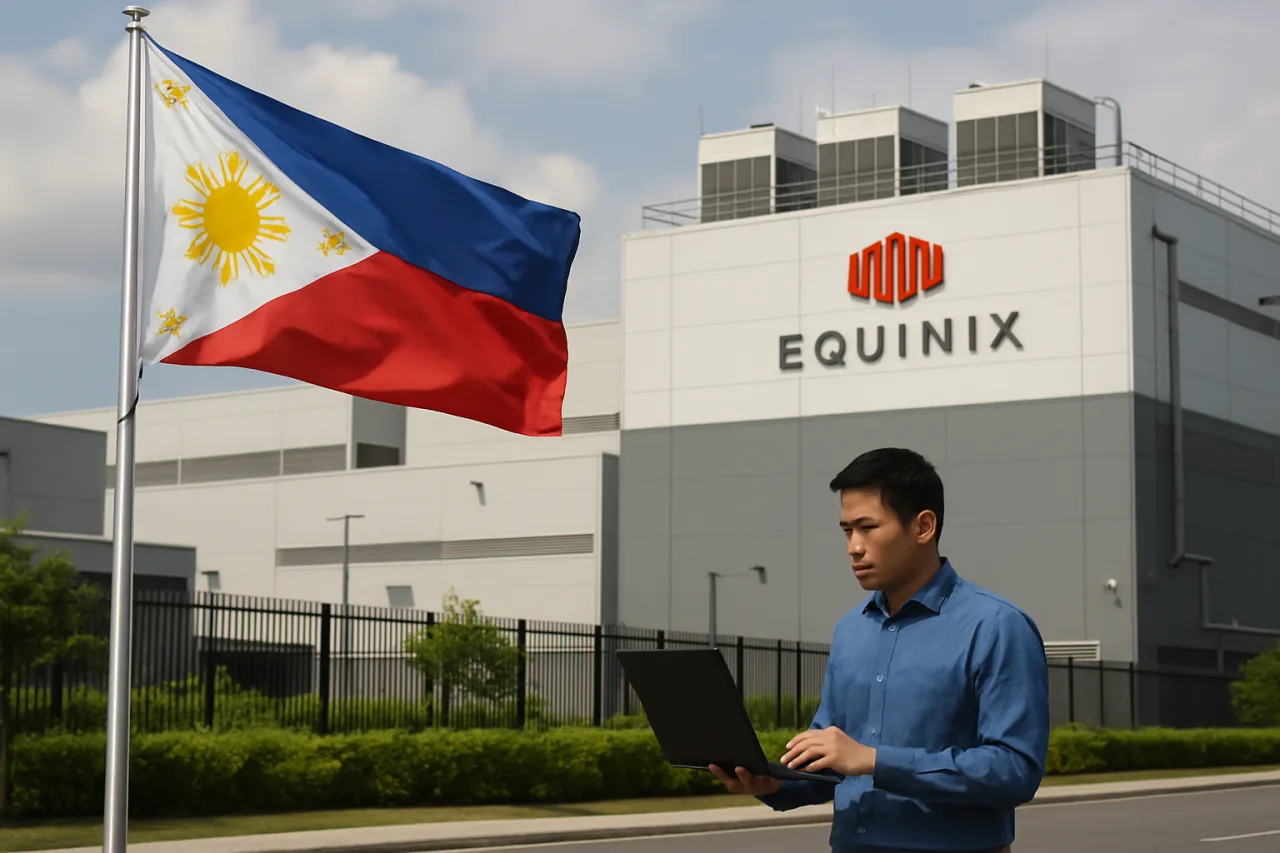
The numbers tell one story. The trend beneath them tells another. When Equinix, Inc. (Nasdaq: EQIX) completed its acquisition of three data centers in the Philippines from Total Information Management (TIM) on June 3, 2025, the deal was framed as a routine regional expansion for the world’s digital infrastructure company. But what Equinix Philippines actually represents is something more structural: the moment a Filipino digital economy valued at $45 billion in 2024 — equivalent to 8.5% of national GDP — gained direct, private-line access to the same global interconnection fabric that powers Fortune 500 clouds in Singapore, Tokyo, and Frankfurt. For Filipino professionals, this is not a story about a foreign company buying buildings in Makati and Cavite. It is a story about whether the Philippines becomes a data center hub that captures AI workloads domestically — or continues outsourcing its compute to Singapore and Hong Kong.
This raises the deeper question that matters to every engineer, cloud architect, fintech founder, and enterprise IT leader in the country: if a hyperscale-grade colocation operator is now physically present in Manila with AI-ready infrastructure and NVIDIA partnerships, what should you do differently in 2026?
Why Equinix Philippines Is Happening Now
The timing of Equinix Philippines is not accidental. The company announced its planned entry on July 22, 2024, and closed the acquisition roughly eleven months later. That window coincided with a confluence of forces that made the Philippines an unavoidable destination for any serious digital infrastructure player: the country’s digital economy had just crossed $45 billion (PhP 2.5 trillion), government initiatives like the National Broadband Plan and the Digital Philippines Campaign were accelerating demand for high-performance infrastructure, and the broader ASEAN region had drawn $230 billion in foreign direct investment in 2023 even as global FDI fell 10%. Equinix itself noted in its official announcement that the Philippines completed its Southeast Asia growth strategy, filling “a missing piece” after expansions in Malaysia and Indonesia.
For Filipino professionals, the “why now” has a practical edge. Max Parry, Equinix Vice-President for Growth and Emerging Markets in Asia-Pacific, told BusinessWorld in March 2026 that the company’s Philippine facilities hold roughly 35,000 square feet of colocation space with a combined capacity of 1,000 data cabinets — and that Equinix is ready to expand that capacity to capture rising demand. The catalysts Parry identified were not abstract: the diversity of the IT-BPO industry, the banking and financial services sector, and the telecommunications and network ecosystem. In other words, the demand that justified the acquisition is already present, and it is coming from the exact industries where Filipino professionals work.
What the Acquisition Actually Delivers — and What It Doesn’t
The three acquired facilities — designated MN1, MN2, and MN3 — are carrier-neutral and interconnection-rich, hosting four of the main internet exchanges in Manila. The newly launched MN2 alone provides 500 cabinets of capacity. According to Equinix’s official announcement, the company hosts more than 2,000 networks globally and holds a nearly 40% market share of on-ramps to major cloud service providers in the markets it operates. By plugging the Philippines into this fabric, Equinix Philippines gives local organizations direct access to more than 10,000 companies within Equinix’s global ecosystem, plus strategic AI partnerships with NVIDIA and HPE.
But here is what the numbers miss. The deal value was not officially disclosed by Equinix; industry estimates referenced a figure in the range of $180 million, but neither Equinix nor TIM publicly confirmed the transaction price. Treating an unconfirmed estimate as a verified fact would be exactly the kind of error that erodes reader trust. What is verifiable is the capacity: 1,000 cabinets and land for further expansion is modest by hyperscale standards — a single AWS or Google region can consume that in months — but it is significant for a market where the entire data center industry was valued at just $735 million in 2025. Mordor Intelligence projects the Philippines data center market will reach $2.48 billion by 2031, growing at a compound annual rate of 22.88%. Equinix Philippines is positioning to capture a disproportionate share of that growth.
There is a second-order effect here. When the world’s largest colocation operator enters a market, it does not just add capacity — it raises the infrastructure standard. Local competitors must now match Equinix’s carrier-neutral model, its private interconnection ecosystem, and its AI-ready rack designs. For Filipino cloud architects and IT decision-makers, that means the bar for what counts as “enterprise-grade colocation” just moved up.
What Equinix Philippines Means for Filipino Professionals
The practical implications divide along career lines. For cloud and network engineers, Equinix Philippines means a new option for private peering and direct cloud on-ramps that previously required routing traffic through Singapore. Lower latency to cloud providers translates to faster applications, cheaper bandwidth, and the ability to architect hybrid cloud environments without a regional hop. For fintech and banking professionals, Parry explicitly noted the diversity of banking and financial services customers already hosted at Equinix Philippines — private interconnection to exchanges and payment rails is a compliance and performance advantage that local banks have historically had to approximate through expensive leased lines.
For IT-BPO leaders, the connection is even more direct. Parry identified the IT-BPO industry as a primary catalyst for data center growth. The Philippines hosts one of the world’s largest BPO workforces, and the sector’s shift from voice support to AI-assisted digital services — from chatbot operations to data annotation to model fine-tuning — demands local, low-latency compute that does not bottleneck on a Singapore round-trip. Equinix Philippines positions the country to retain those higher-value AI-BPO workloads domestically rather than losing them to regional competitors.
For founders and enterprise IT decision-makers, the actionable takeaway is a procurement question: if your workloads are currently co-located in Singapore or Hong Kong, Equinix Philippines now offers a domestic alternative with the same global ecosystem fabric. Whether that is the right choice depends on your latency sensitivity, data residency requirements, and cost model — but the option did not exist before 2025, and ignoring it in 2026 is a missed cost and performance optimization.
The Competitive Landscape Equinix Philippines Enters
Equinix is not arriving into an empty market. The Philippines data center landscape already includes ePLDT (the PLDT Group’s VITRO facilities), NTT Global Data Centers, ST Telemedia Global Data Centres, and newer entrants like Digital Edge and DITO Telecommunity. The VITRO Sta. Rosa facility, profiled in our broader Philippines data center 2026 coverage, is positioned as the country’s first AI-first hyperscale facility, targeting a national pipeline of 500 MW to 1.5 GW. Equinix’s 1,000-cabinet footprint is comparatively modest — but Equinix’s differentiator is not raw capacity. It is the global interconnection ecosystem.
This matters because the Philippine data center market is increasingly bifurcating. On one side are hyperscale facilities built to house cloud regions for Amazon, Google, and Microsoft — the infrastructure story we covered in our analysis of the Amazon AI investment Philippines exclusion. On the other side are carrier-neutral colocation facilities built for interconnection — the Equinix model. Filipino enterprises that need to connect to multiple clouds, networks, and partners through a single physical location are the natural customer base for the latter, and that base is growing as digital transformation deepens across banking, telecom, and BPO.
The macro context reinforces this. As we documented in our Philippine digital economy 2026 overview, the country’s digital transformation is no longer aspirational — it is structural. The same Pax Silica AI hub at Clark that is drawing global semiconductor and AI investment attention creates downstream demand for the kind of interconnection density Equinix provides. The pieces are connecting.
The Risk Nobody Is Talking About: Data Sovereignty
Here is the analytical point that the press releases do not make. When a global colocation operator enters a developing market, the conversation usually centers on capacity and jobs. The quieter conversation — the one that matters to regulators, privacy professionals, and enterprises handling sensitive data — is about data sovereignty. Equinix operates under the laws of the jurisdictions where its facilities sit. In the Philippines, that means the Data Privacy Act of 2012 and the regulatory authority of the National Privacy Commission. But Equinix’s global ecosystem also means that the same physical infrastructure that hosts a Philippine bank’s core systems can, through private interconnection, route data to Equinix facilities in jurisdictions with different privacy regimes.
This is not a criticism of Equinix — carrier-neutral colocation is a legitimate and widely adopted model. It is a reminder that Filipino enterprises evaluating Equinix Philippines should ask the procurement questions that press releases do not answer: Where does interconnection traffic route by default? What are the data residency guarantees for regulated workloads? How does the NPC’s jurisdiction interact with cross-border private links? These are the questions that a competent cloud architect or compliance officer should be raising in any vendor evaluation — and Equinix’s entry makes them more urgent, not less.
What Comes Next for Equinix Philippines
Parry’s March 2026 comments to BusinessWorld signal that Equinix is in assessment mode, not build-out mode — “continually assessing,” with “every capability to support our customers’ current expansion needs in our existing data centers.” That language is consistent with a company that acquired a foothold and is now watching utilization rates before committing capital to new capacity. The Philippines data center market’s projected growth from $735 million to $2.48 billion by 2031 gives Equinix a long runway, but the company will face competition from domestic operators with land banks and hyperscale ambitions.
For Filipino professionals, the forward-looking question is not whether Equinix expands — it is whether the Philippine market develops the demand depth to justify that expansion. That demand comes from cloud adoption rates, AI workload migration, fintech infrastructure buildout, and the BPO sector’s evolution into higher-value digital services. Every professional who architects a cloud migration, deploys an AI model, or builds a fintech platform in the Philippines in 2026 is contributing to the demand signal that determines whether Equinix Philippines remains a 1,000-cabinet foothold or becomes a multi-megawatt regional hub.
The actionable read: if you work in enterprise IT, cloud architecture, or digital infrastructure in the Philippines, Equinix’s entry is a procurement option to evaluate now, not a future development to watch passively. The interconnection density it brings — four Manila internet exchanges, NVIDIA and HPE AI partnerships, direct on-ramps to major clouds — is available today. Whether you use it is a decision that should be driven by your latency, residency, and cost requirements, not by inertia toward the Singapore default that has governed Philippine cloud architecture for the past decade.
Frequently Asked Questions About Equinix Philippines
What is Equinix Philippines and when did it launch?
Equinix Philippines is the Philippine operation of Equinix, Inc. (Nasdaq: EQIX), the world’s digital infrastructure company. Equinix announced its planned entry on July 22, 2024, and completed the acquisition of three data centers (MN1, MN2, MN3) from Total Information Management (TIM) on June 3, 2025. The facilities are located in Makati and Cavite.
How much did Equinix pay for the Philippine data centers?
The deal value was not officially disclosed by Equinix or TIM. Industry estimates referenced a figure in the range of $180 million, but this has not been confirmed by either party. What is verifiable is the acquired capacity: more than 1,000 cabinets of colocation space across three facilities, with land for further expansion.
What capacity do Equinix Philippines data centers have?
As of March 2026, Equinix Philippines operates approximately 35,000 square feet of colocation space with a combined capacity of 1,000 data cabinets. The MN2 facility alone provides 500 cabinets. Equinix has stated it is ready to expand capacity to meet rising demand, according to VP Max Parry.
How does Equinix Philippines help Filipino enterprises?
Equinix Philippines provides carrier-neutral colocation with direct private-line access to major cloud providers, AI infrastructure partners (NVIDIA, HPE), and four of Manila’s main internet exchanges. This reduces the need to route traffic through Singapore for hybrid cloud architectures, lowers latency for domestic applications, and gives enterprises access to Equinix’s global ecosystem of more than 10,000 connected companies.
Is Equinix the largest data center operator in the Philippines?
No. Equinix Philippines operates 1,000 cabinets — a modest footprint. Larger domestic operators include ePLDT (VITRO facilities), NTT Global Data Centers, and ST Telemedia Global Data Centres. Equinix’s differentiator is its global interconnection ecosystem, not raw local capacity. The Philippines data center market was valued at $735 million in 2025 and is projected to reach $2.48 billion by 2031.
What industries are driving demand for Equinix Philippines?
According to Equinix VP Max Parry, the primary demand drivers are the IT-BPO industry, banking and financial services, and the network and telecommunications sector. The diversity of banking customers hosted at Equinix Philippines was specifically highlighted as a notable strength of the Philippine operation.
Should Filipino cloud architects consider Equinix Philippines over Singapore?
It depends on your workload requirements. If your applications are latency-sensitive and serve Philippine users, domestic colocation with direct cloud on-ramps can reduce round-trip latency and bandwidth costs. If your workloads require hyperscale cloud regions not yet available domestically, Singapore or Hong Kong may still be necessary. The Equinix entry gives Filipino architects a new option to evaluate — not a universal replacement for regional infrastructure.
What are the data sovereignty considerations for Equinix Philippines?
Equinix Philippines facilities operate under Philippine law, including the Data Privacy Act of 2012 and the jurisdiction of the National Privacy Commission. However, Equinix’s global interconnection ecosystem means private links can route data to facilities in other jurisdictions. Enterprises handling regulated data should evaluate default routing, data residency guarantees, and NPC jurisdiction interaction during vendor selection.
Disclaimer: This article is for informational purposes only and does not constitute investment, procurement, or legal advice. Financial figures cited are sourced from publicly available reports and company announcements as of the publication date. Readers should verify current data center pricing, capacity, and regulatory requirements directly with providers before making infrastructure decisions.