Table of Contents
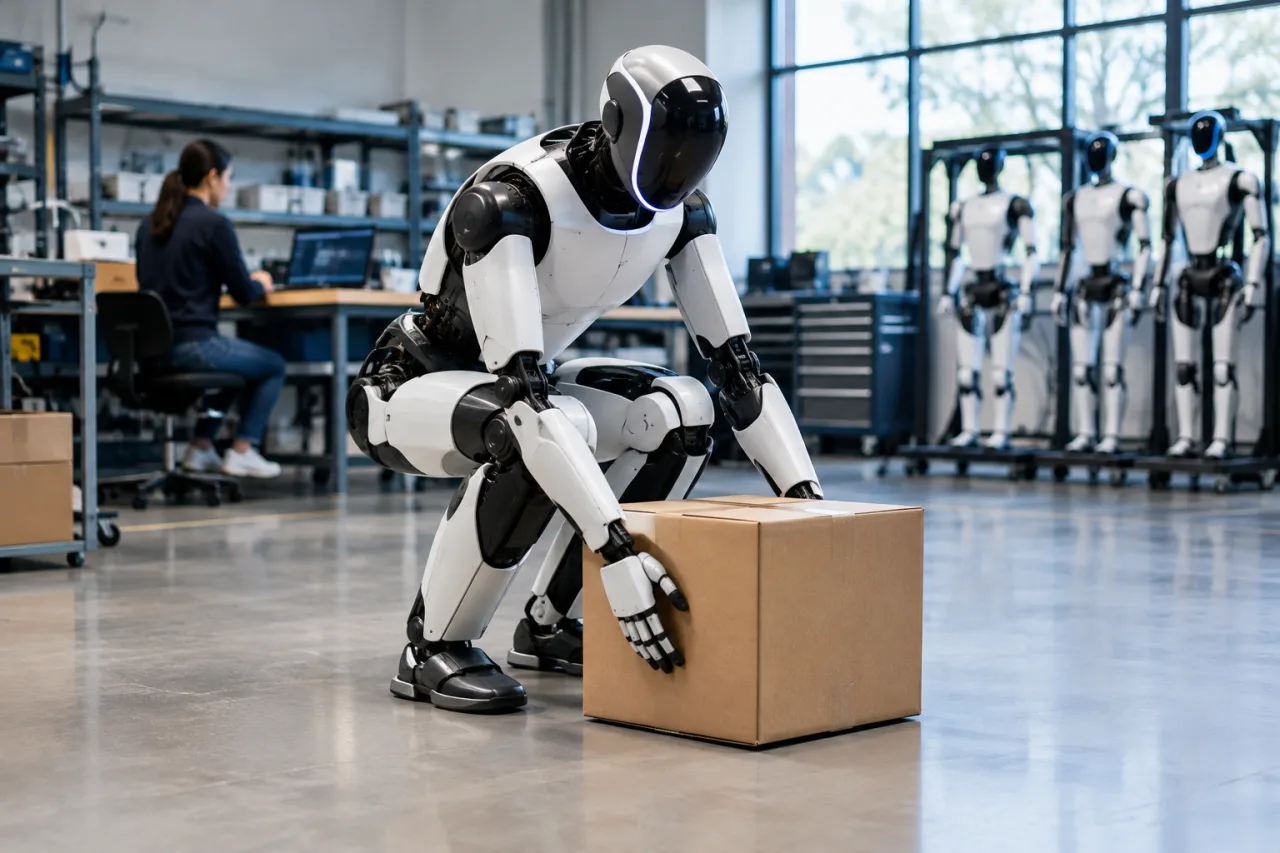
Embodied AI — artificial intelligence that acts on the physical world through a body, closing the loop between perception and action — stopped being a research concept in 2026 and became a manufacturing story: Figure’s BotQ factory now builds one Figure 03 humanoid per hour, a 24x throughput jump in under 120 days; Unitree shipped over 5,500 humanoid robots in 2025 and targets 20,000 this year, selling its R1 on an open store from $4,900; 1X put the NEO into full-scale production after booking more than 10,000 home pre-orders; and the entire field is forecast to ship more than 50,000 humanoid units in 2026. But only two bipedal humanoids — Agility’s Digit and Figure’s 02 — clear the bar of verified arms-length deployment, and this guide separates the machines that ship from the claims that don’t.
Every number in this piece comes from the makers’ own store pages, production blogs and filings, and each deployment claim is labeled by what the public record can verify — because embodied AI is the rare technology where the prices are public and most of the deployment story is not.
Key Takeaway
- 🤖 Embodied AI is intelligence with a body: models that perceive the physical world and act in it — perception-action loops, learned control, sim-to-real transfer — rather than chat interfaces. The hardware got cheap fastest: a humanoid now costs about as much as a motorcycle.
- 🏭 The manufacturing crossover is real: Figure’s BotQ went from 1 Figure 03 per day to 1 per hour (24x in ~120 days), with a 12,000-per-year line and over 350 units delivered; Unitree targets 20,000 shipments in 2026; 1X NEO is in full-scale production with 10,000+ pre-orders at $20,000 or $499/month.
- 💰 The verified price floor is $4,900: Unitree’s R1 sells openly from $4,900 (G1 from $13,500; AGIBOT X2 $24,240; H1 $90,000); Tesla Optimus and Figure 03 have no public price at all — their targets are quotes, not quotes you can pay.
- ✅ Only two deployments are verified: of everything marketed as “deployed,” just Agility’s Digit (GXO warehouses, 65,000+ production hours) and Figure’s 02 clear an arms-length public record; the rest is piloting, demoing, or unorderable.
- 🧠 The AI inside is embodied AI’s real story: open foundation models like NVIDIA’s Isaac GR00T N1.5 and Figure’s Helix/S0 stack turn each shipped robot into a data flywheel — the more units in the field, the faster the control policies improve, which is why volume and intelligence now feed each other.
What embodied AI actually is (plain language)
Embodied AI is artificial intelligence that has a body. A chatbot sees text; an embodied system sees a room, plans a grip, closes its fingers on a real object, and learns from what happened next. The field’s core loop is perception → decision → action → perception again: cameras and touch sensors feed a policy model, the policy drives motors, the motors change the world, and the changed world feeds the sensors back. Two properties separate it from software AI. First, mistakes have physical consequences — a dropped tote is inventory damage, a wrong turn is a collision. Second, training data is expensive — there is no Text Corpus of Manipulations; the training set for moving through the world must largely be generated, mostly in simulation, then transferred to real hardware (the field’s hard problem, sim-to-real).
The term covers more than humanoid robots: quadruped platforms, wheeled cobots, autonomous vehicles and fixed-arm systems all qualify when an AI closes that loop. But the humanoid form carries the strategic weight in 2026 — a machine shaped like a worker can inherit a factory built for workers, use the same doors, the same trucks and the same tools. That is why the production numbers and the price table below all track humanoids, and why the labor math at the end of this guide is written around them.
Why 2026 is the crossover year
Three curves crossed this year, and each is verifiable. The hardware curve: a competent humanoid fell to one-fifteenth of the price of the $90,000 Unitree H1 — from $4,900 (Unitree R1) to $20,000 (1X NEO) — because Chinese motor, gearbox and sensor supply chains matured and the new platforms were designed for manufacturing rather than for laboratories. The factory curve: Figure’s BotQ facility in California scaled from 1 unit per day (January) to 1 per hour (announced April 29) across dedicated module lines, over 150 networked workstations and custom manufacturing-execution software, with end-of-line first-pass yield above 80% and 9,000+ actuators produced across more than 10 SKUs; its initial line is rated for up to 12,000 units per year, with a stated 100,000-robot four-year goal and a 3-million-actuator supply chain behind it. 1X’s NEO Factory (58,000 sq ft, Hayward) began full-scale production targeting 100,000 humanoid robots per year by the end of 2027. The order-book curve: 1X booked 10,000 NEO pre-orders in the five days after opening its order page (October 2025, $20,000 or $499/month); Figure signed what it describes as the first paid commercial-scale humanoid contract — an initial fleet of 40 robots for BMW’s Spartanburg plant; Agility runs a multi-year RaaS (robot-as-a-service) deal with GXO Logistics.
The verified price table
Embodied AI’s verified price table starts with the makers’ own stores and order pages, converted only where the maker states the conversion. Two flagship machines have no published price at all — Tesla sells nothing to consumers, and Figure 03 is not orderable outside enterprise pilots; Musk’s stated $20,000-30,000 Optimus target has floated since October 2024 and remains a target, not a checkout.
| Robot | Maker | Published price | Status |
|---|---|---|---|
| R1 | Unitree | from $4,900 | Shipping (developer platform) |
| G1 | Unitree | from $13,500 | Backordered, retail-listed at $17,990 |
| Astribot T1 | Astribot | ≈$13,165 (CNY 89,900) | Enquiry form |
| NEO | 1X Technologies | $20,000 or $499/mo | Full-scale production; home deliveries committed before end-2026 |
| X2 | AGIBOT (Zhiyuan) | $24,240 | Store-listed |
| A2 Lite | AGIBOT | $44,560 | Store-listed, demoing |
| H1 | Unitree | $90,000 | Store-listed, contact-for-price |
| Optimus | Tesla | No public price ($20,000-30,000 target) | Not orderable; no verified customer delivery |
| Figure 03 | Figure AI | No public price | Enterprise pilots; 350+ units built at BotQ |
The price table explains the market structure: open-store platforms (Unitree) own the volume, subscription-billed home robots (NEO) own the consumer queue, and enterprise systems (Figure, Agility) own the warehouse floor, while Tesla owns the attention. Global projections put the humanoid market near $4.89 billion in 2025 growing past $160 billion by 2034 — a projection, not a receipt, but the direction is anchored by the factory curves above. The expanded tier-by-tier buyer math lives in our humanoid robot prices guide, the cheapest-machine story in our Unitree R1 review, the operations scoreboard in our warehouse deployments reality check, and the open model layer in our NVIDIA GR00T analysis.
The deployment bar: what can actually be verified
Marketed “deployment” and verified deployment are different things, and the gap is exactly where buyers get misled. Applying a strict public-record bar — is the robot in operation for an arms-length customer, with named sites and revenue — only two bipedal humanoids clear it as of mid-2026:
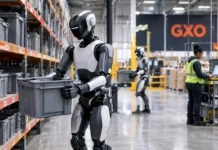
- Agility’s Digit — commercially deployed at a GXO-operated Spanx facility in Georgia under a multi-year robot-as-a-service agreement, moving totes between conveyors and mobile robots; Agility separately claims 65,000+ hours of real production experience across its fleet. Notably, GXO states Digit does not currently share space with human workers — the safety boundary is part of the deployment, not an afterthought.
- Figure’s 02 — fleet deployments including the BMW Spartanburg logistics program that matured into the first paid commercial-scale humanoid contract (the initial 40-unit fleet).
Galbot’s wheeled S1 clears a narrower bar in a CATL battery-line operation, but on two legs, the bar holds at two. Everything else in the price table above — including Optimus and most of the 2025 demo favorites — is piloting, demoing or waitlisted. This is not a knock on the technology; it is what an honest market looks like in the year manufacturing scales ahead of operations. The production numbers are the early indicator: a fleet has to exist before it can work, and the fleets are being built now.
What the AI inside actually is
The intelligence driving these machines is converging on a common architecture: a vision-language model for scene understanding, wrapped around a learned motor policy, trained heavily in simulation and fine-tuned on real fleet data. NVIDIA’s open Isaac GR00T platform — with GR00T N1.5 as its open humanoid foundation model (using the Eagle VLM to encode what the robot sees, with the Jetson Thor Blackwell-based computer as the real-time runtime) — gives any maker a starting stack for generalist robot reasoning and skills. Figure’s Helix system and its new S0 controller take the same shape one step further: S0 fuses head-camera RGB into a 3D world model fed directly into whole-body control, which is how the Figure 03 learned stairs and uneven terrain without bespoke per-stair programming.
The strategic consequence is the flywheel: every robot that ships collects task data, task data trains better policies, and better policies make the next fleet more capable. Unitree’s volume lead is therefore not just commercial — it is a data lead. The same logic that made GPU clusters the moat of software AI (our sovereign AI analysis traces that pattern) is now racing through hardware: whoever ships the most embodied AI acquires the most physical-world interaction data, and the compounding starts there.
What changes for work
The near-term work story is narrow and concrete: warehouses, where a robot’s repetitive structured tasks (tote handling, tote induction, trailer unloading support) sit between the conveyor systems that already run them and the workers who manage exceptions. GXO’s own description of its incubator model — Agility, Apptronik and Reflex prototypes trained in its warehouses — is effectively a public job description for the transition: the machines take the repetitive lane, workers take configuration, oversight, quality and the physical work robots still fail at. The adjacent hiring matters more than the replacement math: fleet operators, robot technicians, teleoperation staff and exception managers are the new roles around deployed fleets — we track the early pay data in our humanoid robot operator jobs analysis and the durable-skill picture in our AI-proof vocational trades guide. The honest read: 50,000 units shipping in 2026 is about one factory’s worth of workers, not a labor shock — but the deployment curve, not the shipment curve, is the number to watch from here.
The Philippine position on the map
The Philippines sits on the work side of this transition, not the manufacturing side, and the difference matters. China’s own buildout — the volume leader by a wide margin, with Unitree and AGIBOT shipping the majority of the world’s units — is documented in our China physical AI revolution analysis, and the jobs that industry creates on the operational side (testing, teleoperation, fleet support, integration) are exactly the lane we flagged in the operator-jobs piece. For Filipino professionals and OFWs, the realistic entry points run through skills, not through hardware: industrial automation, mechatronics, data annotation for robot learning, and the operations roles that open wherever deployed fleets land — including Singapore’s logistics sector, which is far more likely to hire regional talent than to ship robots to Manila first. The strategic takeaway for readers here: the countries that host robot fleets will need the people who keep them running, and the skills that qualify are buildable before the fleets arrive.
WorldNgayon Insight: the flywheel decides the winner
What changed: embodied AI moved from demo reels to rate-limited manufacturing — one humanoid per hour at one factory, thousands per quarter at another, an open checkout page for a third. Why it matters now: the three curves (hardware cost, foundation models, factory throughput) crossed within 12 months, and each further month compounds the leader’s data advantage. Why it lasts: the deployment bar is public and slow — two verified operators — so every new arms-length deployment is a dated, checkable event for the next two years. Who is affected: warehouse operators pricing automation, workers choosing adjacent skills, investors separating shipment curves from deployment curves. What to do: track deployments, not announcements — a named site, a named customer and revenue is the only bar. Risks, opportunities, costs, skills: the risks are overbuilt fleets chasing pilots; the opportunity is operations expertise at the moment fleets start missing their operators; the costs are falling fast enough to plan against; the skill to build now is fleet-side mechatronics and exception handling. Connection to work and money: the compute layer behind these robots rides the same infrastructure buildout as every other AI workload, which is why the data-center economics in our GPU rental guide and the power-planning in our fusion and power frontier analysis converge on this same story from below.
What is embodied AI in simple terms?
AI with a body: a system that senses the physical world through cameras and sensors and acts on it through motors, learning from the results. The core loop is perceive → decide → act → perceive again. Chatbots generate text; embodied AI generates physical outcomes — and it can fail physically too.
How much does a real humanoid robot cost in 2026?
The verified floor is $4,900 (Unitree R1, from the maker’s own store); the G1 lists from $13,500 and $17,990 at retail; 1X’s NEO is $20,000 or $499/month; enterprise platforms (AGIBOT X2 at $24,240, Unitree H1 at $90,000) sit higher. Tesla’s Optimus and Figure 03 have no public price — their targets are goals, not checkout pages.
Which humanoid robots are actually deployed and working?
Under a strict public-record bar, two bipedal humanoids: Agility’s Digit (commercial RaaS deployment at a GXO-operated Spanx warehouse in Georgia, 65,000+ fleet production hours claimed) and Figure’s 02 (enterprise fleets including the BMW Spartanburg program that became the first paid commercial-scale humanoid contract). Everything else — including Optimus — is piloting, demoing or unorderable.
How many humanoid robots will ship in 2026?
Forecasts put total humanoid shipments above 50,000 units in 2026 across Unitree, Tesla, Figure, Boston Dynamics, Agility, AGIBOT, UBTECH, 1X and others — real growth, but small next to the conventional industrial-robot market’s several-hundred-thousand annual installations. Unitree alone targets 20,000 units after shipping 5,500+ in 2025.
What is the AI that controls these robots?
Foundation-model control stacks: a vision-language model that understands the scene around a learned motor policy, trained in simulation and refined on fleet data. NVIDIA’s open Isaac GR00T N1.5 with the Jetson Thor runtime is the leading open stack; Figure’s Helix and S0 system (which added stereo vision to whole-body control, enabling stair traversal) is the leading closed one.
Why does manufacturing scale matter so much for embodied AI?
Because each shipped unit is a data-collection engine: production volume feeds model training, which improves autonomy, which drives demand, which funds more production. Figure’s jump from 1 robot/day to 1/robot per hour is therefore an AI milestone as much as a manufacturing one — the flywheel’s input rate just improved 24x.
Will embodied AI take warehouse jobs?
Not this year’s math: 50,000 units globally in 2026 is roughly one large factory’s workforce. The near-term effect is a lane split — robots take the repetitive tote-moving lane, workers take exception handling, quality and fleet-side roles (operators, technicians, teleoperation). The deployment curve, not the shipment curve, is the number to watch.
Can Filipinos and OFWs build careers in the embodied AI industry?
The realistic entry is skills-side: mechatronics, industrial automation, robot testing and teleoperation, data annotation for robot learning, and the operations roles that follow deployed fleets to logistics hubs like Singapore. The Philippines is unlikely to host early fleets, but Filipinas (and Filipinos) who certify the skills list can qualify for the fleet-support work that regional deployments create.
Financial Disclaimer
This article is editorial analysis of publicly reported prices, production claims and market projections, not investment, purchase or financial advice, and no outcome is promised. Robot prices and market forecasts change; verify current terms with the named makers. Technology markets carry substantial risk.
Sources: Figure AI — Ramping Figure 03 Production (BotQ 1-per-hour ramp, 350+ units, yields, actuator counts); Unitree official store — R1/G1/H1 published prices; Agility Robotics — Digit production-hours and GXO partnership; GXO — the warehouse incubator model (Agility, Apptronik, Reflex; Digit’s operational boundary); NVIDIA Research — GR00T N1.5 open humanoid foundation model; The Robot Report — the first formal commercial humanoid deployment (GXO/Agility); Forbes — 1X NEO full-scale production (10,000 pre-orders, 100,000/yr 2027 target); Facts & Figs — the humanoid race: what’s actually deployed in 2026 (shipment forecasts); Technology.org — humanoid robots: what is actually deployed (July 2026). Deployment claims are labeled by the public record; market projections belong to the named research trackers. Additional context: Figure 03 AI Wiki (market-size projection sourcing).