Table of Contents
Dreamforce 2026 opened in San Francisco this week with Marc Benioff doing two things in the same keynote: dismissing six months of “SaaSpocalypse” panic as “crazy nonsense,” then demonstrating why the panic exists — by showing Salesforce, the world’s most famous SaaS product, living inside Claude instead of inside its own login screen. The company put its Sales Cloud into an open beta that runs as a skill inside Anthropic’s AI assistant, reported 49,000 companies using its Agentforce digital coworker, and welcomed Dario Amodei to the main stage, where the Anthropic chief offered the keynote’s most quietly subversive line: for all the technology’s pace, there is still “so much diffusion left to do.” For the Philippine BPO sector — an industry built on operating other companies’ software — a CRM that answers to a chat prompt is not a product update. It is a job description rewrite.
Key Takeaway
- 🎙️ The quote: Benioff called the “SaaSpocalypse” — the theory that AI agents will kill traditional software — “crazy nonsense,” while proving AI agents now run his own product.
- 🤝 The deal: Salesforce-in-Claude went open beta, free to activate, with 37 prebuilt sales skills powered by the AIforce enterprise harness.
- 📊 The numbers: Slack added 100,000 new customers with 900% growth in AI users; 200,000+ Slackbot skills now save a reported 500,000 hours monthly.
- 🌏 The angle: Philippine BPO teams operate Salesforce accounts at massive scale — interface shifts of this size reprice which human skills command premium rates.
What Actually Happened at the Dreamforce 2026 Keynote
The annual San Francisco conference — Dreamforce 2026, running September 15-17 — has become the industry’s clearest window into enterprise AI reality, and the 2026 edition sharpened the pattern. Pre-show announcements set the frame: Slack Code for developers, the Claudeforce partnership with Anthropic, and the Enterprise AI Harness that connects agent systems to company data through MCP servers, APIs, and CLI tools. Then the main keynote delivered the substance. Patrick Stokes, Salesforce’s new president, opened Claude live on stage and activated the Sales Cloud in Claude skill — announcing it available in open beta immediately, at no cost. Benioff followed with the numbers that frame the agentic push: Slack as the company’s fastest-growing product with 100,000 new customers, a 900% increase in AI users, more than 200,000 Slackbot skills created by customers, a reported 500,000 hours of monthly work saved by those skills, and 49,000 companies operating the Agentforce coworker. The Dreamforce ’26 keynote, in other words, was not a vision statement — it was a usage report.
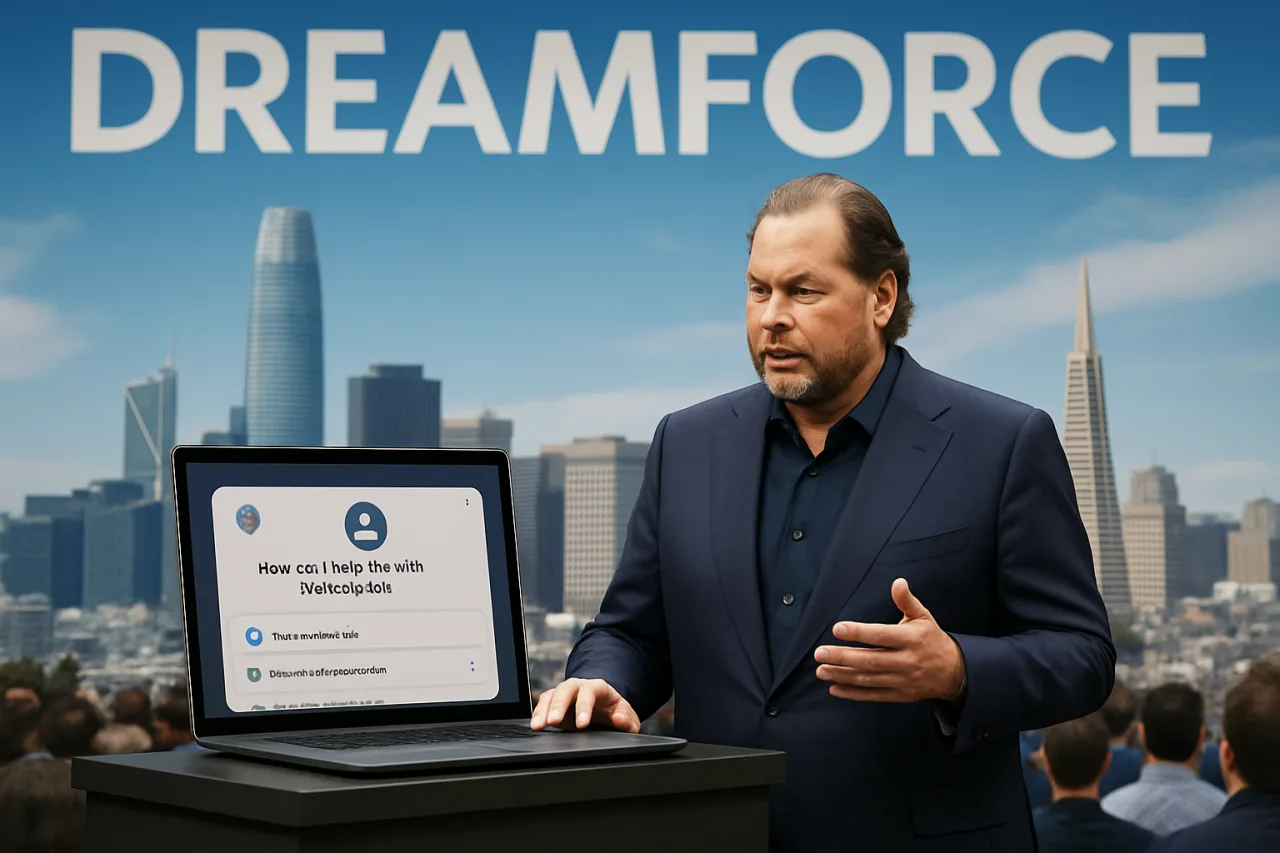
The demos carried the argument the rest of the way. The ClaudeForce demonstration showed an employee asking Claude for account context — customer history, recommended next steps — and taking authorized action without ever opening the conventional Salesforce interface. Benioff described his own executives talking to Claude using Salesforce’s data about go-to-market prospects. The interface is no longer the product; the product is the capability, surfaced wherever the work happens.
“Crazy Nonsense” — Benioff versus the SaaSpocalypse
The Dreamforce 2026 keynote’s most quotable moment was a rebuttal. For six months, analysts have run the “SaaSpocalypse” argument: if AI agents can do what software does — update records, generate quotes, route leads — then per-seat SaaS pricing collapses, and with it the valuations of every application company. Benioff’s response on stage: “We’ve been hearing crazy nonsense about the SaaSpocalypse, especially over the last six months.” His counter-evidence was commercial, not rhetorical — Slack’s growth numbers, the 4,000 sellers now offering Claudeforce, and Salesforce’s own repositioning as the “Agentic Enterprise.”
But the rebuttal contains its own confession. The most efficient way to argue that agents will not destroy SaaS is to show your SaaS product running happily inside a rival’s agent. That is what the keynote did. Salesforce is not denying that the interface layer is being eaten; it is claiming the data and workflow layer underneath — the part agents need permission to touch — as its new moat. Whether that hold is real is the trillion-dollar question the Salesforce Ben keynote analysis frames as the distance between demo and deployment, where customer-reported ROI and production cost figures remain thin. Both things are true at once: the panic is overdrawn, and the ground is moving anyway.
Amodei’s Reality Check: “So Much Diffusion Left to Do”
Dario Amodei joined Benioff at Dreamforce 2026 and delivered the counterweight to the hype cycle, per the live CX Today coverage from the venue. He said he was surprised the technology was moving at such a pace in the business world — and then added that there is still “so much diffusion left to do.” The line matters because it comes from the executive whose company supplies the model inside the demo. The technology exists; the adoption gap is the product. Amodei’s observation effectively says the enterprise AI market’s biggest cost is not capability but organizational translation — the unglamorous work of rewiring processes, permissions, and habits so agents can actually act.
That framing should sound familiar to Filipino readers, because diffusion is precisely what the country’s IT-BPM industry does for a living. The global enterprises now staring at agent platforms need partners who can map a process, clean the data underneath it, supervise the agent’s first year, and handle the exception cases nobody demos on stage. The keynote’s implicit job market is not “prompt engineer” — it is “diffusion specialist,” and the Philippines employs more people adjacent to that function than almost any country on earth.
The Numbers Behind the Agentic Enterprise
The Dreamforce 2026 keynote’s reported figures, compiled from the live blog and partner coverage, form the clearest public dataset on agentic enterprise adoption:
| Metric (Dreamforce ’26 keynote) | Reported figure |
|---|---|
| Slack new customers (current run) | 100,000 |
| Growth in Slack AI users | 900% |
| Slackbot skills created by customers | 200,000+ |
| Monthly hours saved via Slackbot (reported) | 500,000 |
| Companies using Agentforce coworker | 49,000 |
| Sellers of Claudeforce solutions | 4,000 |
| Prebuilt sales skills in Salesforce-in-Claude | 37 |
Two cautions travel with any vendor-stage number: they are self-reported, and “skills created” is not the same as “skills in daily use.” [VD — vendor-reported figures] But even discounted, the direction is unambiguous. The agentic enterprise is not a 2027 concept. Forty-nine thousand companies is a market, and markets reorganize around whoever holds the workflow.
What the Interface Shift Means for Filipino Professionals
Three practical translations from the Dreamforce 2026 keynote to a Filipino career. First, the admin layer thins. Click-path mastery of Salesforce — the skill behind thousands of Philippine BPO roles — loses scarcity value when the interface is a conversation. Second, the judgment layer thickens. Somebody must define what the agent may touch, verify what it did, and catch the 5% of cases where confident automation is confidently wrong; that verification role is the new entry point, and it rewards domain knowledge over software navigation. Third, the integration layer explodes. The AIforce harness speaks MCP servers, APIs, and CLI tools — plumbing work that Philippines-based engineering teams are already positioned to sell, given the country’s depth in enterprise integration work.
There is also a direct competitive read. Salesforce’s own AI usage is now a benchmark its BPO customers will be asked about in renewals: agents handling tier-one cases, humans handling judgment. Philippine operations that can demonstrate agent-augmented delivery — with the audit trails to prove it — will win the deals that pure-headcount competitors lose. The teams already experimenting with agent workflows, as documented in our guide to setting up Claude as a working coworker, hold a practical head start over competitors still debating whether the shift is real. And the enterprise convergence on display — platform, model, and runtime converging on one architecture — echoes the pattern we tracked in this week’s open-model analysis of Atria Dawn and the agentic frontier: the layer where value concentrates is moving, and everyone can see it move.
For individual professionals, the skills question has a concrete answer. Andrew Ng’s four-skill map for AI-era employability — documented in our breakdown of the AI engineering skills that get you hired — reads almost like a keynote commentary: application-building, data judgment, and workflow design are exactly the “diffusion” capabilities Amodei described. The Dreamforce 2026 stage showed enterprises what they need; the skills map shows individuals how to become the person who supplies it. The gap between the two is where the next decade of Philippine knowledge work will be won or lost.
What to Watch as Dreamforce 2026 Continues
The conference runs through September 17, and the sessions that matter for the diffusion argument are still ahead. Watch for three signals. Whether Salesforce publishes concrete pricing for Salesforce-in-Claude beyond the free beta — the moment monetization starts, the strategic weight of the integration becomes measurable. Whether the Dreamforce 2026 stages give real customer ROI numbers to replace the vendor-reported usage counts, since the analyst community will discount everything until a named customer discloses cost-per-outcome. And whether Benioff’s Dreamforce 2026 keynote position — agents above, data rights below — gets an architectural answer to the open question every enterprise CIO is now asking: when your CRM lives inside someone else’s AI, whose security review governs the conversation? The answers landing this week will shape procurement seasons well into 2027.
The Verdict: Hype Check on Dreamforce 2026
Strip the keynote to its verifiable core and this is what remains true: Salesforce shipped a real integration, free to activate, that puts its product inside a rival’s assistant — an act of strategic humility with few precedents this decade. The growth numbers are vendor-reported and directional, not audited. The SaaSpocalypse debate is unresolved, and Benioff’s “crazy nonsense” is as much positioning as prophecy. What the keynote proved beyond argument is the shape of the next platform cycle: data and workflow rights below, agents above, interfaces wherever the user already is. Companies that hold data and workflow permission keep pricing power even in an agentic world — which is exactly the lesson Benioff intended. The professionals who thrive through this shift will be the ones who move toward the agent-adjacent skills now, while the diffusion gap Amodei named is still wide enough to build a career inside.
Frequently Asked Questions About Dreamforce 2026
What did Salesforce announce at Dreamforce 2026?
The headline announcements: Sales Cloud in Claude entered open beta, free to activate, with 37 prebuilt sales skills running on the AIforce enterprise harness; the Claudeforce partnership with Anthropic expanded with 4,000 sellers; Slack reported 100,000 new customers and 900% AI-user growth; and the company positioned itself as the “Agentic Enterprise” with 49,000 companies using the Agentforce coworker.
What did Marc Benioff say about the SaaSpocalypse?
He called it “crazy nonsense,” arguing that fears of AI agents destroying the SaaS business model — a debate that has run for six months — ignore the usage numbers his platform is posting. His evidence: Slack’s customer growth, hundreds of thousands of Slackbot skills, and the reported 500,000 monthly hours those skills save customers.
What is Salesforce-in-Claude and how much does it cost?
It is a set of 37 prebuilt sales skills that let users operate Salesforce — account lookups, updates, pipeline actions — from inside Anthropic’s Claude interface, powered by the AIforce harness. At Dreamforce 2026 Salesforce announced the Sales Cloud skill available in open beta for free. Full commercial terms will follow the beta period; check Salesforce’s official announcements for current pricing.
What did Dario Amodei say at Dreamforce?
Speaking with Benioff on the main stage, the Anthropic co-founder said he was surprised at the pace of AI adoption in the business world, but that there is still “so much diffusion left to do” — meaning the gap between what the technology can do and how widely organizations have absorbed it remains the industry’s real constraint.
Does the agentic shift threaten Philippine BPO jobs?
It reshapes them faster than it eliminates them. Click-path administration work loses value as chat interfaces replace screens, but agent oversight, exception handling, data quality, and integration work — the diffusion gap itself — creates new demand. The BPO workers most exposed are those whose entire role is interface navigation; those who add judgment and workflow-audit skills move up the stack.
Is Agentforce actually being used, or is it hype?
Both readings have support. Salesforce reports 49,000 companies using the Agentforce coworker and hundreds of thousands of skills created — real usage at scale, even after discounting vendor-reported figures. At the same time, independent coverage notes that customer-reported ROI and production cost data remain thin, which is typical for a platform this young. Treat it as early mainstream, not mature.
Financial Disclaimer
This Dreamforce 2026 coverage is published for general information and career education. It is not investment, legal, or career advice. Keynote figures cited are vendor-reported statements from the event as of September 2026 and have not been independently audited. Readers should verify current product terms, pricing, and employment implications directly with vendors and employers before acting.