Table of Contents
Key Takeaway
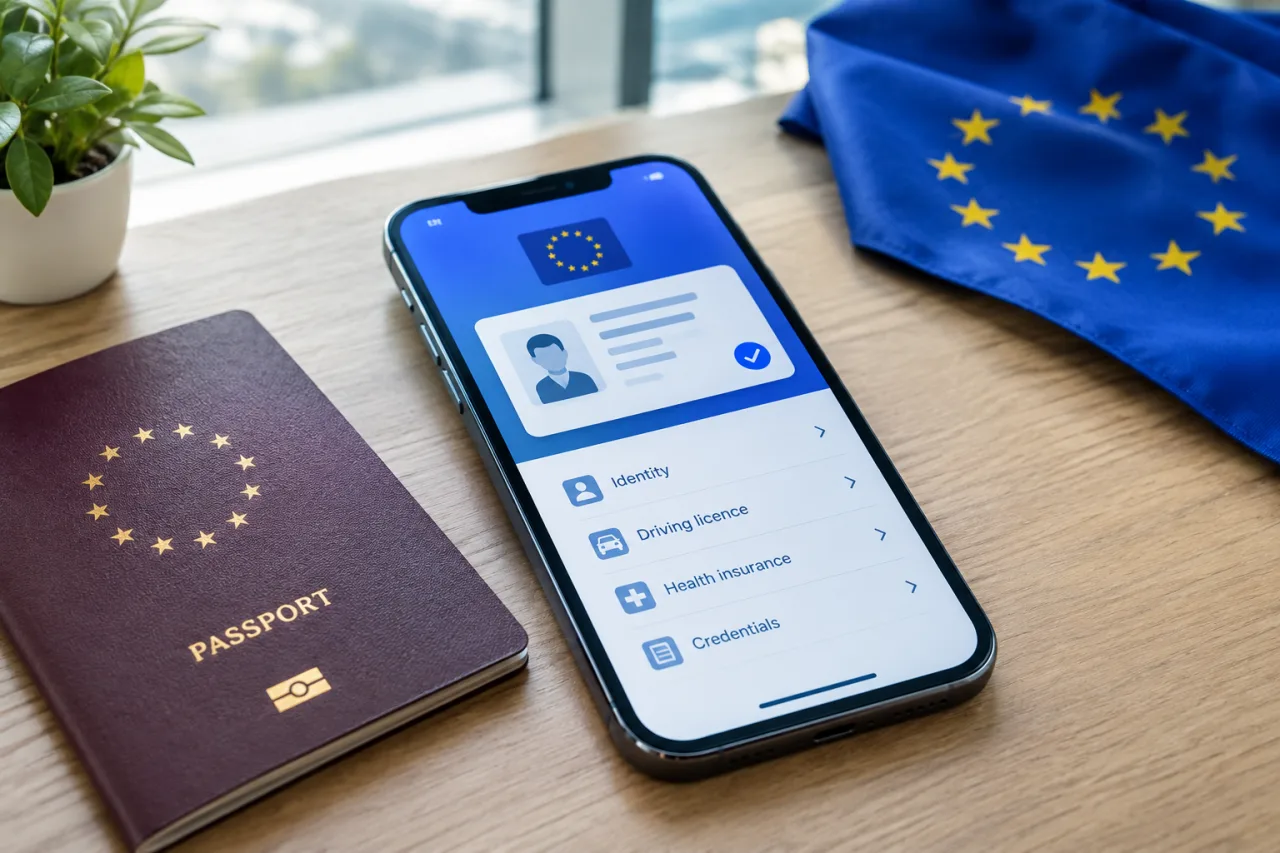
- 🏛️ The mandate: Under the EU’s eIDAS 2.0 regulation, all 27 member states must offer every citizen a certified digital ID wallet by December 24, 2026 — a state-issued smartphone app to prove identity, share documents and sign things in any of the 27 countries.
- 🤝 The second shoe: A year later — December 24, 2027 — regulated businesses (banks, airlines, exchanges, platforms) must accept the wallet when a customer offers it for login or onboarding.
- 🗺️ The rollout is uneven: Italy’s IT-Wallet and Denmark’s AltID lead; Germany’s d-you launches January 2, 2027; several countries will miss the date — for the digital ID wallet race, certification bottlenecks, not tech, are the drag.
- 💼 For freelancers with EU clients: identity verification on EU platforms is moving from passwords and uploads to cryptographic proof of identity — onboarding that once took days of document checks will run through a tap in the wallet.
Every European adult is about to get a government identity app on their phone — and every business serving them is about to be told to accept it. Under the revised eIDAS regulation (Regulation (EU) 2024/1183), all 27 EU member states must offer at least one certified digital ID wallet to citizens, residents and businesses by December 24, 2026. One year after that, regulated businesses across the bloc must accept the wallet on request. It is the largest mandatory digital-identity rollout in the world, covering roughly 450 million people and every company that verifies them — and for freelancers, sellers and platform workers who serve EU clients, it changes how onboarding itself works.
Status note: the December 24, 2026 deadline is set by the regulation’s entry-into-force timeline, not by each country’s preference. Certification of national wallets is the current bottleneck — Italy and Denmark are the most advanced national apps as of October 2026, while several members including Finland have announced later dates and a handful are rated unlikely to comply in time.
What the EU Digital ID Wallet Actually Is
Today’s EU identity infrastructure runs on national eIDs (eIDAS 1.0 from 2014), which work unevenly across borders. The revised regulation — eIDAS 2.0 — takes that idea and pushes it into every smartphone: a wallet issued and certified by a member state that stores identity data, government documents and credentials under the user’s own control. The EU’s core list of functions: electronic identification (prove who you are online), qualified electronic signatures (sign contracts with legal weight), sharing attributes and digital documents (diplomas, bank accounts, prescribed medicines), storing password-protected credentials, and access to both public and private services.
The privacy architecture is the part regulators call revolutionary: unlike handing a company your ID, the digital ID wallet is designed for selective disclosure — you prove you are over 18 without revealing your birthdate, prove you are a resident without revealing your address. For every merchant who has ever stored more of your data than their service required, the wallet sets a different default, and platforms will build KYC against it.
The Milestone Table: From Pilots to Mandatory Acceptance
| Date | What happens |
|---|---|
| Mid-2024 | Regulation (EU) 2024/1183 enters into force; implementing acts for the wallet follow |
| 2025 | Large-scale pilots and early national implementations run across member states |
| 2026 | First certified national wallets launch (Italy’s IT-Wallet, Denmark’s AltID lead the pack) as conformity-assessment bodies certify the first wallets |
| December 24, 2026 | All 27 member states must offer at least one certified EUDI Wallet |
| December 24, 2027 | Regulated businesses (relying parties) must accept the wallet on request |
The structure matters: the 2026 date binds governments (they must offer the wallet), the 2027 date binds businesses (they must accept it when offered). If your client is an EU platform, bank or marketplace, their compliance calendar — not yours — starts running first.
How the Wallet Changes Onboarding, Step by Step
The concrete change a 2027 date creates is easiest to see in one scenario: an EU customer opening an account with a bank, broker or gig platform. Today, onboarding means uploading a passport scan, waiting for manual or automated KYC to clear, and accepting that the company now stores a copy of the full document on its servers — sometimes for years, and sometimes to be revealed in the next breach report.
With a certified digital ID wallet, the same customer taps their phone, the app presents what the service actually needs — over-18, EU resident, legal name — and the customer approves the disclosure. The service receives a cryptographically signed attribute from a state certification pipeline, not a photo of a passport. Verification that took days takes seconds, the service stores only what it verified rather than the whole document, and revocation runs through the state’s credential lifecycle instead of a support ticket.
The merchant side of that flow is where the 2027 duty bites: accepting the wallet on request means building the consent screens, the verification endpoints and the data-retention logic that treat a wallet credential as the customer’s identity document of first choice — while keeping the fallback paths open for customers who never install one. That dual-path architecture is the real engineering cost of the deadline, and the companies that build it early will sell onboarding speed as a feature before the law forces it.
Who Is Ready and Who Is Late
The tracker picture as of late 2026 is a ladder, not a line. Italy’s IT-Wallet and Denmark’s AltID are the most advanced national apps, with Denmark working through certification of its full eIDAS 2.0 stack. Germany’s public wallet, d-you, launches on January 2, 2027 — a week past the deadline. France’s France Identité is live as a national ID app but not yet certified as an EUDI wallet. Finland has announced a 2027 date. An industry working assessment in April rated three countries near-certain to be available by the deadline, five very likely, eight likely with real uncertainty, seven only possible — and four unlikely to be fully compliant on time, with credible signals that some wallets, like the Netherlands’ initial release, may arrive in 2027.
The bottleneck is certification, not software — the mid-2026 status snapshot shows conformity bodies still scaling. National wallets must pass conformity assessments by designated bodies before they can carry the EUDI badge — and the process is only now scaling: November 2026 coverage flagged Signicat’s appointments to scale for EU Digital Identity Wallets and the arrival of TÜV Austria as a sole conformity-assessment body for eIDAS 2.0 compliance. Every wallet that waits its turn keeps a member state formally behind its own deadline — which is why the practical rollout is arriving country by country even as the legal deadline holds.
The day after the deadline, the practical reality is also uneven. A resident of one member state may hold a certified wallet that another member state’s services cannot yet verify, which makes cross-border recognition a live-testing exercise through 2027 rather than a flip of a switch. Travelers and cross-border workers should keep their national eIDs and physical documents working alongside the digital ID wallet until the relying-party networks catch up with the certification lists — a transition the trackers expect to run well into 2027.
Why the 2027 Business Deadline Is the One That Bites
The obligation that changes how companies operate is the second one: from December 24, 2027, regulated businesses accepting strong authentication for consumers must offer the EUDI wallet as an option when the customer requests it. For a German bank, a Spanish airline, an Estonian gig platform or a French brokerage, that means a digital ID wallet-based login and onboarding becomes a compliance feature — with the engineering starting now, amid reported delays in cross-border onboarding readiness across the industry.
For businesses the wallet cuts onboarding from document-upload days to seconds, with the legal identity data coming pre-verified by the state. The catch: integrating wallet flows means reworking KYC pipelines, consent screens and data-retention logic to match the selective-disclosure default. Early movers get onboarding conversion; late movers get a December 2027 regulatory date they scramble toward.
What It Means for Filipino Freelancers With EU Clients
The most direct reader effect: platforms serving EU customers will increasingly demand wallet-side identity verification of the EU side — which changes how a freelancer’s client, agency or marketplace verifies itself to EU regulators, not the freelancer directly. But the second-order effects land on everyone working cross-border. EU platform onboarding that once required passport uploads, proof-of-address scans and multi-day KYC will shift toward wallets for EU residents — and credential verification for non-EU workers becomes the contrast case that platforms must manage carefully.
There is also a competitive read: the global direction of travel — EU wallets by 2026, national digital-identity programs across Asia and Africa, and Philippine digital-government identity initiatives scaling domestically — is that verifiable credentials are becoming the default interface between professionals and institutions. The freelancers who get used to identity-proofing through verifiable credentials ahead of their competitors are the ones who will onboard fastest wherever the rails appear. And the security habit transfers directly: a wallet-based workflow is one more reason to treat device security as career infrastructure, the same discipline our account-lockdown playbook preaches for the payment apps you already run.
The Security Trade Worth Naming
Nobody should read the wallet as risk-free. A single app that certifies identity across banking, healthcare, travel and government services is a high-value target, exactly like the mobile-banking and e-wallet apps millions of Filipinos already guard: SIM swaps, infostealers and phishing for wallet credentials are the attack wave every national rollout must assume — the same wave our phishing coverage has tracked all year. The EU’s answer — encryption, selective disclosure, user-controlled data — reduces what leaks can do, and the credential-recovery design matters as much as the cryptography. Users everywhere, not just in Europe, should read the wallet’s security model with the same skepticism they apply to any app that holds the keys to their money: verify what reaches your device before you trust it — our guide to spotting fake government websites is the routine for exactly that moment — because the infrastructure underneath the shiny app is only ever as safe as the habits around it.
Frequently Asked Questions
Q: What is the EU digital ID wallet deadline?
A: December 24, 2026 — the date every EU member state must offer citizens, residents and businesses at least one certified EUDI Wallet under the eIDAS 2.0 regulation (Regulation (EU) 2024/1183). From December 24, 2027, regulated businesses must accept the wallet when offered by customers.
Q: What can the EUDI Wallet do?
A: Prove identity online, share attributes and documents (diplomas, bank accounts, medicines), apply qualified electronic signatures, store credentials, and access public and private services across all member states — with selective disclosure so you share only the data the service needs.
Q: Which EU countries are ready for the December 2026 date?
A: Italy’s IT-Wallet and Denmark’s AltID are most advanced; Germany’s d-you launches January 2, 2027; Finland has announced 2027; several members — by industry assessments four of them — are unlikely to be fully compliant on time, mostly due to certification bottlenecks.
Q: Does the wallet replace passwords everywhere?
A: For regulated strong-authentication scenarios in the EU, it will become an option in 2027 and a compliance expectation for many services afterward. National eIDs and traditional logins continue alongside; coverage depends on each service’s integration.
Q: I’m a freelancer outside the EU with EU clients. What changes for me?
A: Not your verification at first — the digital ID wallet is for EU residents. But EU platforms’ onboarding and KYC flows will be rebuilt around wallet verification during 2027, which changes platform behavior, data requests and possibly the credentials platforms demand from non-EU workers to fit the same compliance shape.
Q: Is the EU digital ID wallet safe?
A: It is state-certified with user-controlled, selective-disclosure architecture — a stronger default than uploading raw scans. But it centralizes identity in one high-value app, so device security, credential recovery and phishing habits decide how safe it is in practice.
The Bottom Line
December 24, 2026 turns the EU into the first regulatory bloc where a government-certified digital ID wallet is a legal right rather than a pilot, and December 24, 2027 turns it into something businesses must honor. The rollout will be uneven — certification lines, a German launch a week late, four countries rated unlikely — but the direction no longer depends on any single government’s pace. Identity proofing is moving from photocopies to cryptography across the world’s biggest single market, and every professional who works across borders inherits the consequence: the clients on the other side of that border will soon expect verification that takes a tap, not an upload. The smart move is the one that costs nothing today — get your credentials, devices and habits ready for a world where proving who you are takes seconds.
Sources: Regulation (EU) 2024/1183 (eIDAS 2.0) as implemented; national wallet trackers and certification snapshots from Didit and eIDEasy (2026); the Trinsic rollout assessment; Fintech Times and Biometric Update coverage of Signicat’s eIDAS 2.0 scaling appointments (November 2026); EU Commission wallet implementing-act timelines.
- didit.me/blog/eudi-wallet-launch-by-country — digital ID wallet
- trinsic.id/blog/europe-s-digital-identity-deadline-is-real.-but-the-r… — industry working assessment in April
- eideasy.com/blog/eu-digital-identity-wallets-july-2026 — the mid-2026 status snapshot
External sources linked in this article, in order of first mention. Spotted an error or a broken link? Tell us.
Cite this pagePublished Nov 11, 2026
Agron, E. (2026, November 11). All 27 EU Countries Must Offer a Digital ID Wallet by December 2026. WorldNgayon. https://worldngayon.com/digital-id-wallet/
Agron, Edmon. “All 27 EU Countries Must Offer a Digital ID Wallet by December 2026.” WorldNgayon, 11 Nov. 2026, worldngayon.com/digital-id-wallet/.
Agron, Edmon. “All 27 EU Countries Must Offer a Digital ID Wallet by December 2026.” WorldNgayon, November 11, 2026. https://worldngayon.com/digital-id-wallet/.
Agron, E. (2026) ‘All 27 EU Countries Must Offer a Digital ID Wallet by December 2026’, WorldNgayon, 11 November. Available at: https://worldngayon.com/digital-id-wallet/.
E. Agron, “All 27 EU Countries Must Offer a Digital ID Wallet by December 2026,” WorldNgayon, Nov. 11, 2026. [Online]. Available: https://worldngayon.com/digital-id-wallet/
@online{agron2026digitalid,
  author       = {Agron, Edmon},
  title        = {{All 27 EU Countries Must Offer a Digital ID Wallet by December 2026}},
  year         = {2026},
  date         = {2026-11-11},
  organization = {WorldNgayon},
  url          = {https://worldngayon.com/digital-id-wallet/},
  urldate      = {}
}TY - ELEC AU - Agron, Edmon TI - All 27 EU Countries Must Offer a Digital ID Wallet by December 2026 T2 - WorldNgayon PY - 2026 DA - 2026/11/11/ UR - https://worldngayon.com/digital-id-wallet/ Y2 - ER -
Cite the version you read; the page may be updated. Zotero and Mendeley can also import this page directly.