Table of Contents
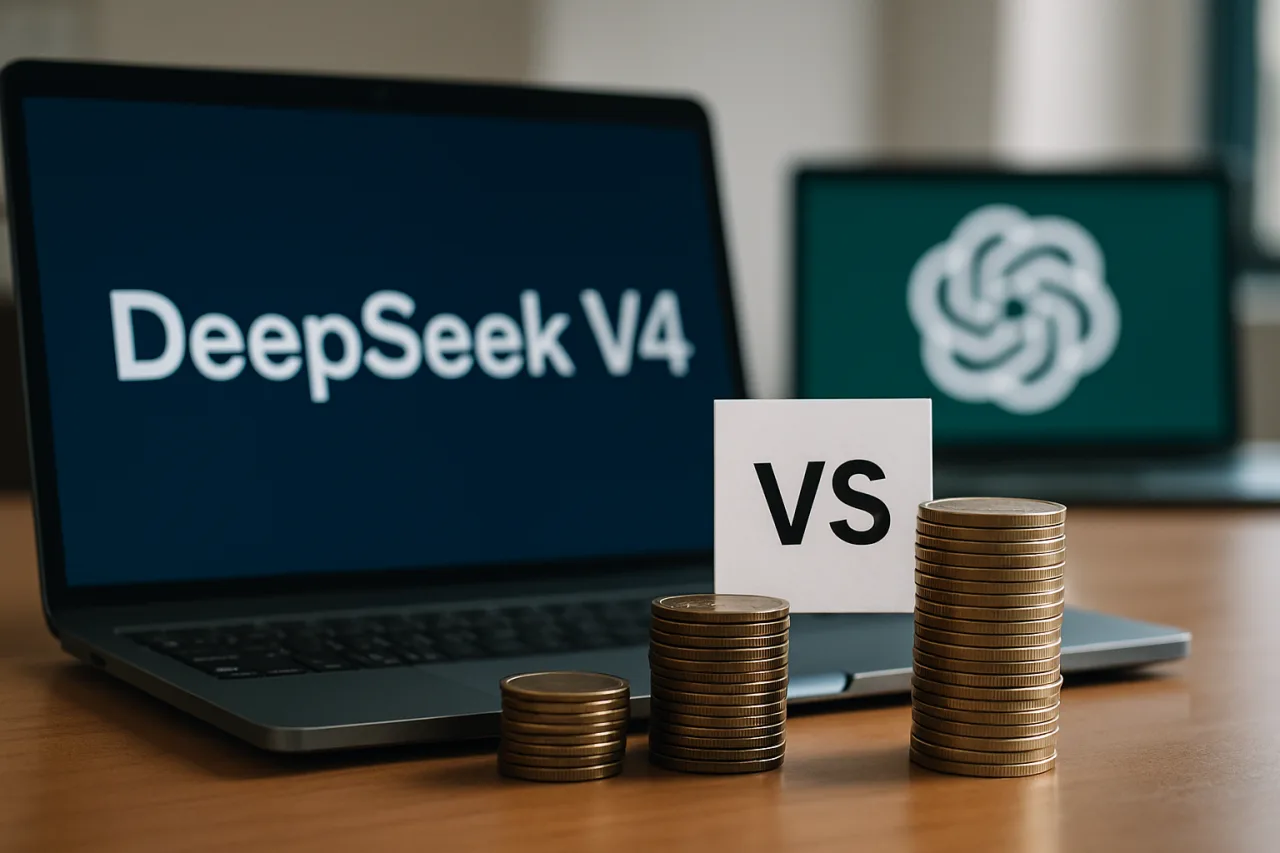
If you are a Filipino developer, student, or small business owner who has been priced out of frontier AI models, DeepSeek V4 is the model you have been waiting for. Released on August 13, 2026, DeepSeek V4 Pro carries 1.6 trillion parameters, a 1-million-token context window, and an MIT open-source license that lets you download it, run it on your own hardware, and modify it for free. DeepSeek V4 costs $0.43 per million input tokens and $0.87 per million output tokens — roughly 35 times cheaper than GPT-5.6 Sol at $4 and $20. In independent testing by Together.ai, DeepSeek V4 cost $0.24 per coding rollout versus $8.37 for GPT-5.6 Sol at maximum effort, while reaching similar task coverage. For Filipinos building AI-powered applications, writing code, or analyzing data on a budget, DeepSeek V4 is the most practical frontier-class model available today.
Key Takeaway
- 💰 35x Cheaper: DeepSeek V4 Pro costs $0.43/$0.87 per million tokens versus GPT-5.6 Sol at $4/$20. In independent testing, it cost $0.24 per coding task versus $8.37 for GPT-5.6 Sol — 35x cheaper per rollout.
- 🔓 Open Source (MIT): The model weights are available on Hugging Face under an MIT license. You can download them, run DeepSeek V4 Pro on your own servers, and modify it without paying API fees at all.
- 📏 1M Token Context: The 1-million-token context window means you can feed it an entire codebase, a full research paper, or a month of customer support transcripts in a single request.
- 🇵🇭 Filipino Practical Use: For Filipino startups and freelancers earning in pesos, the cost difference between $0.24 and $8.37 per task is the difference between a profitable AI service and a money-losing one.
- ⚠️ Trade-off: DeepSeek V4 Pro takes longer per task — a median 146 steps and 35 minutes versus GPT-5.6 Sol’s 53 steps and 17 minutes. If a human is waiting, Sol earns its premium on speed. If a queue is processing, Pro wins on cost.
What Makes DeepSeek V4 Pro Different
DeepSeek V4 Pro is a 1.6-trillion-parameter Mixture-of-Experts model. In simple terms, it has 1.6 trillion total parameters but only activates a small fraction of them for each request — making it far cheaper to run than a model that activates all its parameters every time. The architecture is similar to Kimi K3 (2.8 trillion parameters) and Qwen3.8-Max (2.4 trillion parameters), but DeepSeek V4 Pro is the only frontier-class model with both open weights and pricing under $1 per million tokens.
The model supports both thinking and non-thinking modes. In thinking mode (the default), it reasons through problems step by step before answering — similar to GPT-5.6 Sol’s reasoning capabilities. In non-thinking mode, it responds immediately without extended reasoning, which is faster and cheaper for simple tasks. You can switch between modes depending on the complexity of your request.
The context window is 1,048,576 tokens — enough to hold an entire software repository, a full-length novel, or hundreds of pages of documents in a single conversation. The maximum output is 384K tokens, which means DeepSeek V4 Pro can generate long-form content, complete coding tasks, or produce detailed analysis reports without truncation.
How to Access DeepSeek V4 Pro Right Now
There are three ways to use DeepSeek V4 Pro, depending on your needs and budget:
Option 1: Official API (Cheapest, Easiest)
The DeepSeek API is OpenAI-compatible, meaning you can use the same code you wrote for ChatGPT by changing the base URL and model ID. The API supports standard Chat Completions, the Anthropic API format, and even function calling. Pricing has off-peak and peak tiers: off-peak (outside 1-4 AM UTC and 6-10 AM UTC) costs $0.007 for cached input, $0.66 for fresh input, and $1.98 for output per million tokens. Peak hours double those rates. For Filipino users in UTC+8, the off-peak window aligns with afternoon and evening hours in the Philippines, making it naturally cost-effective.
Option 2: OpenRouter (Most Flexible)
DeepSeek V4 Pro is available on OpenRouter alongside 400+ other models. This lets you route between DeepSeek for cost-sensitive tasks and GPT-5.6 or Claude for complex ones, all through a single API. As we covered in our analysis of Stripe’s OpenRouter acquisition, multi-model routing can reduce token costs by 30-40%.
Option 3: Self-Hosted (Free, Requires Hardware)
The model weights are available on Hugging Face under an MIT license. If you have a server with enough GPU memory (multiple high-end GPUs are required for a 1.6T model), you can download and run DeepSeek V4 Pro locally with zero API costs. For most Filipino developers, this is not practical due to hardware costs, but for universities and research labs, it makes frontier AI accessible without recurring fees. For guidance on open-source AI tools, see our guide to the best AI tools for small businesses.
5 Practical Use Cases for Filipino Professionals
1. Coding and Software Development: DeepSeek V4 Pro scored 82.7 on Terminal-Bench 2.1, placing it in the frontier band for coding tasks. Filipino freelance developers can use it through the API to generate code, debug existing projects, and write documentation at a fraction of GPT-5.6’s cost. A coding task that costs $8.37 on GPT-5.6 Sol costs $0.24 on DeepSeek V4 Pro. If you handle 100 coding tasks per month, that is $837 versus $24 — a difference of $813, or roughly 47,000 pesos.
2. Document Analysis: The 1-million-token context window lets you upload entire contracts, legal documents, or research papers for analysis. An OFW reviewing an employment contract, a small business owner analyzing a supplier agreement, or a student writing a thesis can feed the full document to DeepSeek V4 Pro and ask specific questions. The model will analyze the entire document in context rather than processing it in chunks. For more on how AI tools fit into professional work, see our coverage of AI skills Filipino professionals need.
3. Content Creation at Scale: Filipino content writers, social media managers, and marketing freelancers can use DeepSeek V4 Pro to generate articles, social media posts, and marketing copy. At $0.87 per million output tokens, generating a 1,000-word article costs approximately $0.001 — less than one cent. Compare this to GPT-5.6 Sol at $0.02 per article, and the savings compound quickly for high-volume content operations.
4. Customer Support Automation: Filipino BPO companies and virtual assistants can build AI-powered customer support chatbots using DeepSeek V4 Pro’s API. The low cost per token makes it viable to deploy AI support for high-volume, low-margin clients where GPT-5.6 would be too expensive. The 1M context window means the bot can hold an entire knowledge base in context without retrieval-augmented generation.
5. Research and Data Analysis: Filipino researchers and students can use DeepSeek V4 Pro to analyze large datasets, summarize research papers, and generate literature reviews. The thinking mode allows it to reason through complex analytical problems step by step, similar to more expensive models. For students who cannot afford ChatGPT Plus, DeepSeek’s free web interface provides a capable alternative. For more on AI in education, see our guide to ChatGPT for Teens.
The Trade-off: Speed Versus Cost
DeepSeek V4 Pro is not faster than GPT-5.6 Sol. In fact, it is significantly slower per task. Together.ai’s testing found that DeepSeek V4 Pro takes a median of 146 steps and 35 minutes to complete a coding task, versus GPT-5.6 Sol’s 53 steps and 17 minutes. DeepSeek V4 Pro also generates 101,000 output tokens per task versus Sol’s 59,000 — it works through problems the long way around.
The practical implication: if a human is waiting for a response — a customer service chatbot, a real-time coding assistant, an interactive tool — GPT-5.6 Sol’s speed justifies its premium. If a queue is processing tasks in the background — batch content generation, overnight code review, document analysis — DeepSeek V4 Pro’s cost advantage wins decisively. The routing approach is to use Sol for interactive work and DeepSeek for batch work, which is exactly the multi-model strategy that Satya Nadella recommends.
Frequently Asked Questions
What is DeepSeek V4 Pro?
DeepSeek V4 Pro is a 1.6-trillion-parameter open-source AI model released on August 13, 2026. It has a 1-million-token context window, supports text and code generation, and is available through the DeepSeek API at $0.43/$0.87 per million tokens, or as open weights on Hugging Face under an MIT license.
How much cheaper is DeepSeek V4 Pro than GPT-5.6?
DeepSeek V4 Pro costs $0.43 per million input tokens and $0.87 per million output tokens. GPT-5.6 Sol costs $4 and $20 respectively. On a per-task basis, independent testing found DeepSeek V4 Pro costs $0.24 per coding rollout versus $8.37 for GPT-5.6 Sol — roughly 35 times cheaper.
Is DeepSeek V4 Pro free?
The model weights are free to download under an MIT license from Hugging Face. The API costs $0.43/$0.87 per million tokens (off-peak rates are lower). DeepSeek also offers a free web interface for basic usage. Running it on your own hardware is free but requires significant GPU resources.
Can I use DeepSeek V4 Pro in the Philippines?
Yes. The DeepSeek API is accessible from the Philippines. The off-peak pricing window (outside 1-4 AM UTC and 6-10 AM UTC) aligns with afternoon and evening hours in the Philippines (UTC+8), making it naturally cost-effective for Filipino users.
Is DeepSeek V4 Pro as good as GPT-5.6?
DeepSeek V4 Pro reaches similar task coverage to GPT-5.6 Sol in independent testing, but takes longer per task. It scores 82.7 on Terminal-Bench 2.1, placing it in the frontier band for coding. For tasks where speed is not critical, it matches GPT-5.6 at a fraction of the cost. For real-time interactive use, GPT-5.6 remains faster.
Is DeepSeek V4 Pro safe to use for business?
DeepSeek V4 Pro is open-source under an MIT license, which means you can audit and modify the code. However, it is a Chinese-developed model, and some organizations may have policies restricting Chinese AI tools. If data sovereignty is a concern, self-hosting the open weights eliminates data transmission to any third-party API. Evaluate your organization’s AI governance policy before deployment. For more on AI security, see our AI agent security guide.