
Table of Contents
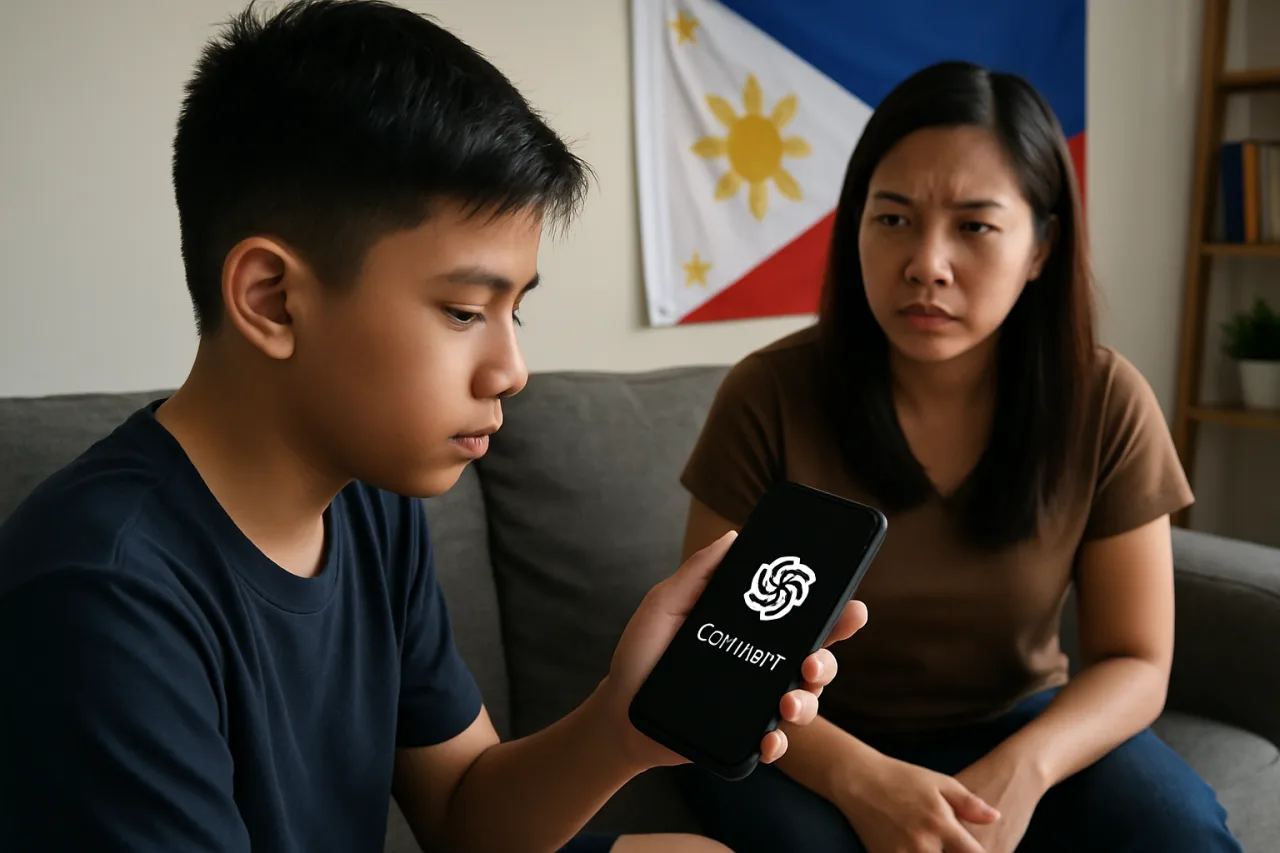
OpenAI launched ChatGPT for teens on August 18, 2026, and your child may already be in it. The new experience automatically applies to any user the system estimates is under 18, or who states their age as 13 to 17, without requiring age verification. It blocks conversations about self-harm, eating disorders, violence, and explicit sexual content. It adds a Study Mode that guides students through problems step by step instead of handing over answers. It gives parents Quiet Hours, safety notifications, and control over voice mode, memory, and image generation. But it does not give parents access to their teen’s conversations — and the age-prediction system that decides who gets the teen experience can make mistakes. If you are a Filipino parent with a child between 13 and 17, ChatGPT for teens is now the default AI experience your child will encounter, and there are seven things you need to know before they use it.
Key Takeaway
- 🔑 Automatic Enrollment: ChatGPT for teens applies automatically when OpenAI’s age-prediction system estimates a user is under 18 — no opt-in required. Adults can verify their age to remove the protections, but teens cannot opt out.
- 🛡️ Safety Guardrails: The teen experience blocks self-harm, violence, eating disorders, dangerous activities, and explicit sexual or graphic content. It also avoids romantic language and discourages emotional dependence.
- 📚 Study Mode Built In: Instead of giving quick answers, ChatGPT for teens uses guiding questions, step-by-step explanations, and knowledge checks. A Responsible Homework Reminder redirects students who try to bypass assignments.
- 👨👩👧 Parental Controls: Parents can set Quiet Hours, disable voice mode, turn off memory, remove image generation, and opt out of data training. But parents cannot read their teen’s conversations.
- ⚠️ Privacy Trade-off: The age-prediction system examines usage patterns, topics discussed, and account signals. OpenAI has not disclosed the accuracy rate, and a January 2026 academic study found parental-control notifications were selective, not comprehensive.
What ChatGPT for Teens Actually Does
ChatGPT for teens is not a separate app. It is the same ChatGPT your child already uses, but with additional protections applied automatically. OpenAI describes it as an experience “designed to help teens learn, think critically, deepen understanding, and use AI with confidence.” The core difference is that the model’s responses are filtered through age-appropriate guardrails informed by developmental science and expert guidance.
The protections cover five high-risk areas: self-harm, violence, eating disorders, dangerous activities, and explicit sexual or graphic content. When a teen asks a question that touches these areas, ChatGPT does not simply refuse — it redirects toward support resources. In cases of acute distress, OpenAI says it may involve law enforcement to ensure safety. The system also avoids romantic language, does not imply it has feelings or consciousness, and discourages emotional dependence — a design choice that addresses growing concerns about teens forming parasocial relationships with AI chatbots.
The teen experience is guided by four commitments OpenAI published in its Under-18 Model Spec: put teen safety first, encourage real-world support, treat teens like teens, and be transparent about how the AI systems behave. These principles were developed with input from the Well-Being Council, the Global Physician Network, and Common Sense Media, though the specific implementation remains OpenAI’s own design.
For the Filipino context, this matters because ChatGPT is already widely used by Filipino students. The Philippines has one of the highest social media penetration rates in Southeast Asia, and Filipino teenagers are early adopters of AI tools. A 2025 Pew Research study found that half of US teenagers now use chatbots as their primary search engine — a trend that is replicated in Philippine urban centers where smartphone access is near-universal. The launch of ChatGPT for teens means that Filipino parents need to understand what protections exist, what gaps remain, and how to set up the parental controls that give them oversight without invading their child’s privacy. For broader context on how AI is reshaping Filipino work and life, see our analysis of AI skills Filipino OFWs need to master before 2027.
The 7 Things Filipino Parents Must Know
1. Age Prediction Is Automatic — But Not Perfect
OpenAI’s age-prediction system examines general topics discussed, usage times, how and when an account is used, and the account’s stated age. If the system estimates a user is under 18, it automatically places them in the teen experience — even if they previously entered an adult birth date. This is an age-assurance system, not a universal identity check. Users do not need to verify their age to stay in the teen experience.
The critical gap: OpenAI has not disclosed the accuracy rate of the age-prediction system. The company acknowledges it can make mistakes and gives adults a way to remove the protections through age verification via Persona, which may request a live selfie, government identification, or both. Persona deletes the uploaded identification within seven days after verification, and OpenAI says it receives only age-related confirmation, not the actual ID.
For Filipino parents, this means two things. First, if your child entered an adult birth date when creating their account, they may still be placed in the teen experience based on behavioral signals — which is good. Second, if an adult in your household is incorrectly classified as a teen, they can verify their age through Persona to remove the restrictions. The system defaults to the safer setting when it is unsure.
2. Study Mode Changes How Homework Works
ChatGPT for teens includes Study Mode, which uses guiding questions, scaffolding, metacognitive prompts, and knowledge checks to help students work through problems step by step instead of receiving a direct answer. When a teen asks for a quick solution, a Responsible Homework Reminder recognizes the pattern and redirects the interaction toward collaborative problem-solving.
OpenAI says Study Mode is built on longstanding research in learning science showing that active retrieval and self-explanation support stronger comprehension and longer-term retention than passive review. The company’s own early evaluation showed promising gains in student performance when using these tools.
Parents can set Study Hours — scheduled periods during which Study Mode stays on by default. This means that during designated homework time, ChatGPT will not simply hand over answers. It will ask your child guiding questions, help them identify what they already know, and walk them through the problem-solving process. For Filipino parents concerned that AI is making their children lazy thinkers, this is the feature that addresses that fear most directly.
3. Parental Controls Give You Levers — But Not Full Visibility
Parents with linked teen accounts can manage several settings, but they do not receive access to their teen’s conversations. This is a deliberate design choice by OpenAI to preserve teen privacy while giving parents oversight of the experience rather than the content.
The available parental controls include:
- Quiet Hours: Schedule periods when ChatGPT is unavailable to the teen account, enforcing breaks.
- Voice Mode: Disable voice interactions entirely.
- Memory: Turn off the model’s ability to remember information across conversations.
- Image Generation: Remove the ability to generate images.
- Data Training Opt-Out: Prevent the teen’s conversations from being used to improve OpenAI’s models.
- Safety Notifications: Receive alerts in limited high-risk situations — specifically self-harm indications and, new in this launch, eating-disorder-related situations and violent-activity account bans.
To set up parental controls, the teen must accept an account-linking invitation from the parent. OpenAI says this preserves teen autonomy — the parent cannot silently link to the account without the teen’s knowledge. Once linked, the parent manages settings through their own OpenAI account.
4. Safety Notifications Are Selective — Not Comprehensive
This is the most important caveat for Filipino parents to understand. A January 30, 2026 academic preprint from researchers evaluating OpenAI’s parental-control system found that notifications were selective rather than comprehensive in the tested setup. The researchers reported no alerts for several tested categories, including fraud, hate speech, and malware. Physical-harm, pornography, and some health prompts produced intermittent alerts.
The study examined a specific system configuration and does not establish how the August 18 launch performs. But it illustrates a critical point: parental controls are a safety net, not a monitoring system. OpenAI explicitly excludes ordinary fictional writing, gaming, news discussion, political discussion, and general anger from parental notifications. The alert system is designed to flag moments when offline support may matter most — not to provide comprehensive surveillance of a teen’s AI use.
Robbie Torney, Senior Director of AI Programs at Common Sense Media, described OpenAI’s parental controls as “a good starting point” but said they “work best when combined with ongoing conversations about responsible AI use, clear family rules about technology, and active involvement in understanding what a teen is doing online.”
5. The Privacy Trade-off Is Real
The age-prediction system works by analyzing how your child uses ChatGPT — what topics they discuss, when they use it, how they interact. This means OpenAI is collecting behavioral data about your child to determine their age, and that data is processed by the company’s systems. Even with the data-training opt-out enabled, the age-prediction system still functions by analyzing usage patterns.
For Filipino families, this raises questions under the Data Privacy Act of 2012, which requires consent for processing personal data of minors. OpenAI’s terms of service require users to be at least 13 years old, but the Philippine Data Privacy Act’s provisions for minors’ data may impose additional obligations that OpenAI has not explicitly addressed for the Philippine market. Parents should be aware that using ChatGPT for teens involves sharing behavioral data with a US-based company, and that the protections offered are designed under US legal frameworks, not Philippine data privacy law.
6. The Timing Is Not Coincidental
OpenAI launched ChatGPT for teens the same week Meta faces 29 state attorneys general in an Oakland courtroom over addictive design aimed at minors. The timing is strategic — building the teen product before a regulator specifies it is the cheaper path. By proactively adding safety guardrails, age prediction, and parental controls, OpenAI positions itself as the responsible actor in a regulatory environment that is moving toward mandatory child-safety standards.
For Filipino parents, this context matters because the Philippine government has not yet enacted specific AI child-safety regulations. The Department of Information and Communications Technology (DICT) has issued general AI governance guidelines, but there is no Philippine equivalent of the EU AI Act’s transparency requirements or the US state-level addictive-design lawsuits. This means that the safety of Filipino teens using AI depends largely on the voluntary measures implemented by companies like OpenAI — measures that are designed for a US regulatory context and may not fully address Philippine-specific risks. For guidance on protecting your family’s digital life more broadly, see our guide on how Filipino families can stop AI voice cloning scams and our AI agent security guide.
7. Filipino Schools Are Not Automatically Included
ChatGPT for teens is designed for use outside the classroom. OpenAI’s separate ChatGPT for Teachers product provides educators and school districts with secure, institution-managed access to AI. But Filipino schools are not automatically enrolled in either program — individual educators must apply for ChatGPT for Teachers access separately.
This means that the safety features and Study Mode in ChatGPT for teens apply only when a student is using ChatGPT on their own device, outside school hours. If a Filipino school uses ChatGPT in the classroom through a teacher’s account, the teen protections may not apply. Parents should ask their child’s school whether AI tools are used in instruction and what safeguards are in place — the teen experience is not a substitute for school-level AI policy.
How to Set Up Parental Controls: Step by Step
If you decide to link your account to your teen’s ChatGPT account, here is the process:
- Open ChatGPT on your own account (you must have your own OpenAI account).
- Send an account-linking invitation to your teen from the parental controls settings page.
- Your teen must accept the invitation — they will receive a notification and must consent to the link. This cannot be done without the teen’s knowledge.
- Once linked, configure the settings: Set Quiet Hours for study and sleep times, disable voice mode if desired, turn off memory, remove image generation, and opt out of data training.
- Enable safety notifications to receive alerts in high-risk situations. Review the notification categories carefully — they cover self-harm and eating disorders, not general content monitoring.
- Review settings periodically — OpenAI is adding features over time, and new notification categories may become available.
OpenAI says parents do not receive access to linked teens’ conversations under any circumstances. The only information shared with parents is safety-specific alerts in the limited high-risk categories described above. This design preserves teen privacy but means that parents who want full visibility into their child’s AI use will not get it from the parental controls alone — they need to maintain open communication with their teen about what they are doing with ChatGPT.
What ChatGPT for Teens Does Not Do
Understanding the limitations is as important as understanding the features. Here is what the teen experience does not provide:
- No comprehensive content monitoring: Safety notifications cover only specific high-risk categories. General conversations, gaming discussions, fictional writing, and political content are excluded from alerts.
- No conversation access for parents: Parents cannot read what their teen discusses with ChatGPT, even with a linked account.
- No guaranteed age accuracy: The age-prediction system can misclassify users. Adults may be placed in the teen experience; some teens may slip through.
- No protection against third-party risks: ChatGPT for teens does not address risks from other AI platforms, social media, or online interactions. It is a ChatGPT-specific safety layer, not a comprehensive digital safety solution.
- No Philippine-specific compliance: The privacy and safety measures are designed under US frameworks. Philippine Data Privacy Act compliance for minors’ data is not explicitly addressed.
The Bigger Picture: AI and Filipino Teens
ChatGPT for teens arrives at a moment when Filipino families are navigating AI adoption with limited local guidance. The Philippines has no comprehensive AI child-safety law. The DICT’s AI governance framework addresses general principles but does not mandate specific protections for minors using AI tools. The Department of Education has issued guidance on AI use in classrooms, but this does not extend to private, after-school use of tools like ChatGPT.
This regulatory gap means that Filipino parents must take responsibility for understanding and configuring the safety tools that companies provide — because no one else will do it for them. The launch of ChatGPT for teens is a positive step: OpenAI has built age-appropriate protections, study-focused features, and parental controls that did not exist before. But the protections are only effective if parents know they exist, understand their limitations, and take the time to set them up.
For Filipino parents who are themselves OFWs — working abroad while their children use AI tools at home in the Philippines — the challenge is greater. You cannot look over your child’s shoulder. You cannot sit beside them while they use ChatGPT. But you can set up parental controls remotely, configure Quiet Hours to enforce study and sleep schedules, enable safety notifications so you receive alerts if your child is in distress, and have an honest conversation about what AI can and cannot do. The tools exist. The question is whether you use them. For a broader look at how AI tools fit into OFW life, see our guide to AI tools for small businesses and our overview of 15 AI tools for OFWs.
Frequently Asked Questions
What is ChatGPT for teens?
ChatGPT for teens is a version of OpenAI’s chatbot experience designed for users aged 13 to 17. It automatically applies age-appropriate safety protections, includes Study Mode for guided learning, and offers parental controls for oversight. It is not a separate app — it is the same ChatGPT with additional safeguards enabled by default.
How does ChatGPT for teens know my child’s age?
OpenAI uses an age-prediction system that examines account signals, usage patterns, topics discussed, and stated age. If the system estimates a user is under 18, it automatically applies the teen experience. Users do not need to verify their age to remain in the teen experience. Adults who want the protections removed can verify their age through Persona, which may request a selfie or government ID.
Can parents read their teen’s ChatGPT conversations?
No. OpenAI does not give parents access to linked teens’ conversations under any circumstances. Parents can manage settings like Quiet Hours, voice mode, memory, and image generation, and they can receive safety notifications in limited high-risk situations. But they cannot read what their teen discusses with ChatGPT.
Is ChatGPT for teens safe for Filipino children?
ChatGPT for teens adds meaningful safety protections — content filtering, study-focused design, parental controls, and safety notifications. However, the protections are not comprehensive. A January 2026 academic study found that parental-control notifications were selective, not exhaustive. Filipino parents should combine the built-in protections with open conversations about AI use and clear family rules about screen time and content.
Does ChatGPT for teens work in the Philippines?
Yes. ChatGPT for teens is available globally, including in the Philippines. The age-prediction system and safety protections apply to all users the system identifies as under 18, regardless of location. However, the privacy protections are designed under US legal frameworks and may not fully align with the Philippine Data Privacy Act of 2012’s provisions for minors’ data.
How do I set up parental controls for ChatGPT for teens?
Open your own ChatGPT account, send an account-linking invitation to your teen from the parental controls settings, have your teen accept the invitation, and then configure settings including Quiet Hours, voice mode, memory, image generation, data training opt-out, and safety notifications. The teen must consent to the link — parents cannot silently link to the account.
What happens when my teen turns 18?
Once a user turns 18, OpenAI says the account can transition out of the teen experience, ending teen-specific protections and any linked parental controls. The adult user then has full access to ChatGPT’s standard features without the age-appropriate restrictions.
Does ChatGPT for teens work in Filipino or Tagalog?
ChatGPT supports multiple languages including Filipino and Tagalog, but the teen-specific safety features and Study Mode are primarily designed and tested in English. OpenAI has not published specific guidance on how the teen protections perform in Filipino-language conversations. Parents should be aware that the effectiveness of content filtering may vary by language.