Table of Contents
Key Takeaway
- 🌊 The Philosophy: DeepSeek founder Liang Wenfeng sees AI as “a huge wave that is changing human history, a tide that no single company can ever own” — an almost Daoist vision that contrasts sharply with the monopoly-building approach of US AI labs
- 💰 The Strategy: DeepSeek ignited China’s AI price war by charging 1 RMB per million tokens — 1/7th of Llama 3’s cost and 1/70th of GPT-4 Turbo. And unlike competitors burning money on subsidies, DeepSeek is profitable
- 🔓 Open Source as Weapon: Liang insists open source is the base of the ecosystem. He believes companies that try to make very high profits will be pushed out by those willing to earn only a fair profit. “OpenAI is Not God”
- 🧠 The Real Gap: Liang says America’s AI lead comes only from compute, not talent. “Talent is spread around the world by chance, and China has no real shortage of it.” He sees Nvidia’s CUDA ecosystem wall being broken down
- ⚡ Global Implication: DeepSeek’s approach — radical innovation at the architecture level, open source, fair-profit pricing — could democratize AI access for professionals and businesses worldwide who can’t afford proprietary model API fees
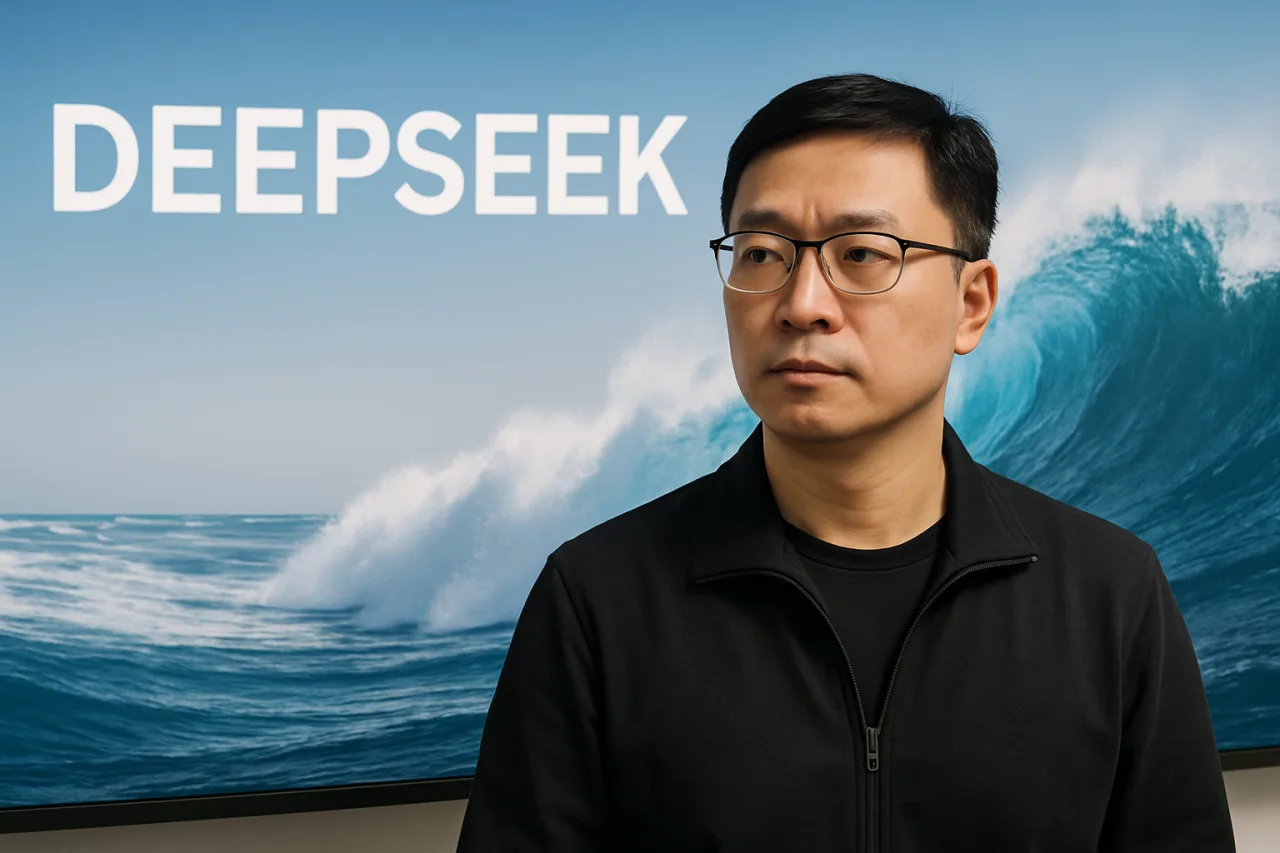
In a rare four-hour conversation with investors, DeepSeek founder Liang Wenfeng broke his silence and revealed a vision for artificial intelligence that sounds less like a Silicon Valley pitch deck and more like Daoist philosophy. He does not see DeepSeek as a company building a monopoly. He sees AI as a tide — a force of nature that no single company can own, that will lift or drown everyone regardless of who built the wave. “The future AI world will never be a pyramid controlled by one or a few giants,” he said. “It will be a system based on holding back, one where everyone gains and lives together.”
This is not the language of a typical tech CEO. It is the language of a man who made his fortune running a quantitative hedge fund, decided that money was not the point, and founded an AI lab with a mission statement that mentions neither safety nor competition nor stakes for humanity — only “unraveling the mystery of AGI with curiosity.” DeepSeek has no plans to IPO. It is fully funded by High-Flyer, Liang’s $8 billion quantitative hedge fund. It has no external investors to satisfy. And it has committed to open sourcing all of its models — a stance that puts it directly against the closed-model strategies of OpenAI and Anthropic, as ChinaTalk reported in its annotated translation of Liang’s deepest interview.
The Price War: DeepSeek’s Opening Move
DeepSeek first made global headlines not with philosophy but with pricing. In May 2024, the company released DeepSeek V2, an open-source model that offered an unprecedented price-to-performance ratio: inference costs were reduced to 1 RMB per million tokens, about one-seventh the cost of Llama 3 70B and one-seventieth the cost of GPT-4 Turbo. DeepSeek was quickly dubbed “the Pinduoduo of AI,” and the move forced ByteDance, Tencent, Baidu, and Alibaba to cut their prices in what became China’s AI price war.
Here is what made the price war remarkable: unlike major tech companies burning money on subsidies, DeepSeek was profitable. The cost reduction came from architectural innovation, not from eating losses. The company proposed a novel Multi-head Latent Attention (MLA) architecture that reduced memory usage to 5-13% of the commonly used MHA architecture. Its DeepSeekMoE sparse structure minimized computational costs. SemiAnalysis’s chief analyst called the DeepSeek V2 paper “possibly the best one of the year.” Jack Clark, former policy head at OpenAI and co-founder of Anthropic, said DeepSeek “hired a group of unfathomable geniuses” and predicted that Chinese AI models “will be as much of a force to be reckoned with as drones and electric cars.”
“OpenAI Is Not God”
Liang’s view of the competitive landscape is striking for its lack of deference to the American AI establishment. He believes the lead among top American models — OpenAI, Anthropic, Google — is cyclical and will not last. He says Anthropic’s early edge in coding agents will soon fade. When talking about the gap between China and the US, he says America’s lead comes only from computing power, not talent. “Talent is spread around the world by chance, and China has no real shortage of it,” Liang said.
His critique of the American AI business model is structural. He argues that US companies keep building bigger models because they have abundant resources, and their basic strategy is to lock up the market with closed models and high profits. “But this pursuit of very high profits is weak in terms of strategy, because it will surely be beaten by those who are happy to earn only a fair profit.” This is not trash talk. It is a competitive thesis: open-source models priced at fair profit will undercut closed models priced at premium profit, and the market will migrate to the cheaper option. The same dynamic that played out in manufacturing — where Chinese companies systematically undercut Western competitors on price while maintaining quality — will play out in AI.
The “OpenAI is Not God” framing, captured in a DeepSeek documentary, reflects a broader shift in the global AI conversation. For two years, OpenAI was treated as the unchallenged leader. DeepSeek‘s R1 model beat OpenAI’s o1 on multiple reasoning benchmarks, proving that breakthrough innovation is possible outside the largest GPU clusters. As Liang told his investors: “In the past 30 plus years of the IT wave, China basically didn’t participate in real technological innovation. We’re used to Moore’s law falling out of the sky, lying at home waiting 18 months for better hardware and software.” DeepSeek is his answer to that historical passivity.
The Daoist Philosophy of AI
Fred Gao, who translated and published the investor conversation, described Liang’s understanding of AI as “almost like Daoist philosophy.” Liang does not see AI as a tool to build a monopoly. He sees it as a wave changing human history. The best attitude, he argues, is to “hold back and be kind” — to set limits on your own gain, earn only a fair profit, and share openly to reduce pushback. The real goal is AGI. All other business wins are side products.
This philosophy translates into concrete business decisions. DeepSeek will focus on the main road to AGI: language models, chains of thought, agents, and continual learning. It will actively leave aside areas like video generation and world models, giving those opportunities to the ecosystem. “If we focus, and I believe the business interest here is already big enough — that is, if the AI era will produce many trillion-level companies, I think we’re one of them,” Liang said. The strategy is not to do everything but to do the hardest thing — foundational AGI research — and let the ecosystem build on top.
Breaking the CUDA Wall
One of Liang’s most technically significant claims is that Nvidia’s CUDA ecosystem wall is being broken down by new technology. He sees building a new ecosystem for Chinese chips as a historic opportunity. “Previously you couldn’t leave CUDA’s ecosystem, now we can abandon its ecosystem and use a simpler method,” he said, referring to TileLang, a high-level programming language that replaces CUDA with much less code. “Once the limit on how many chips can be made is overcome, the gap in basic computing power between China and the US will go away.”
This matters globally because Nvidia’s CUDA monopoly is the single biggest bottleneck in AI infrastructure. If DeepSeek and other Chinese companies succeed in breaking CUDA dependence, the cost of AI compute drops dramatically — and that cost reduction flows through to every professional and business using AI tools. The geopolitical implications are also significant: the US export controls on advanced chips are designed to maintain America’s AI lead, but if the software ecosystem becomes hardware-agnostic, the hardware restrictions matter less. Liang’s claim that TileLang can replace CUDA with minimal efficiency loss — “1% to 2%, which is acceptable” — represents a potential paradigm shift in how AI compute is provisioned globally, with ripple effects from data center economics to individual developer tooling.
What This Means for Professionals Worldwide
Liang’s vision has direct implications for professionals and businesses everywhere. If DeepSeek‘s thesis is correct — that open-source models priced at fair profit will systematically undercut closed models — then the cost of accessing cutting-edge AI drops dramatically. A developer in Manila, a startup in Lagos, or a consultant in Mumbai who cannot afford $2,000/month for OpenAI’s premium tier can access comparable capability through open-source models at a fraction of the cost. This democratizes capability in a way that Zuckerberg’s open-source vision and Liang’s fair-profit strategy both point toward, from different directions.
The competitive dynamic also accelerates innovation. When closed models dominate, progress depends on a few companies’ roadmaps. When open-source models compete on price and performance, progress comes from the entire global community. As Zuckerberg’s open-source vision and Robin Li’s agent era prediction show, the open-source AI movement is not a fringe position — it is the strategy of two of the world’s largest tech companies. DeepSeek adds a third dimension: radical architectural innovation at a fraction of the cost, proving that the path to AGI does not require a trillion-dollar GPU cluster. For professionals navigating the AI career disruption described by Huang and Ng, this matters: cheaper, open-source AI means more tools available to more people, which means the competitive advantage shifts even further toward those who learn to use these tools effectively rather than those who can simply afford the most expensive subscriptions.
Frequently Asked Questions About DeepSeek
Who is Liang Wenfeng?
Liang Wenfeng is the founder and CEO of DeepSeek, China’s most innovative AI startup. Before DeepSeek, he ran High-Flyer, a top-4 Chinese quantitative hedge fund valued at $8 billion. DeepSeek is fully funded by High-Flyer and has no plans to raise external capital or IPO.
What makes DeepSeek different from OpenAI and Anthropic?
DeepSeek commits to open-sourcing all models, charges fair-profit pricing rather than premium rates, and focuses purely on AGI research rather than commercial applications. Unlike OpenAI and Anthropic, which keep their models closed, DeepSeek’s models are freely available. Liang argues that companies pursuing very high profits will be beaten by those willing to earn only a fair profit.
What did Liang Wenfeng say about OpenAI?
Liang said “OpenAI is Not God” and believes the lead of American AI companies is cyclical. He argues that America’s advantage comes only from computing power, not talent, and that once chip production limits are overcome, the computing gap will disappear. He sees closed-model, high-profit strategies as structurally weak against open-source, fair-profit approaches.
How did DeepSeek ignite China’s AI price war?
DeepSeek released DeepSeek V2 in May 2024, charging 1 RMB per million tokens — 1/7th of Llama 3’s cost and 1/70th of GPT-4 Turbo. Unlike competitors who subsidized prices, DeepSeek was profitable due to architectural innovations (MLA and DeepSeekMoE) that dramatically reduced inference costs. The move forced ByteDance, Tencent, Baidu, and Alibaba to cut prices.
What is DeepSeek’s philosophy on AI?
Liang describes AI as “a huge wave that is changing human history, a tide that no single company can ever own.” He advocates “holding back and being kind” — setting limits on profit, sharing openly, and focusing on AGI as the primary goal. The future AI world, he says, “will never be a pyramid controlled by one or a few giants.”
Can DeepSeek’s open-source approach benefit professionals outside China?
Yes. Open-source models from DeepSeek give professionals and businesses worldwide access to cutting-edge AI at a fraction of proprietary model costs. A developer in Manila or a startup in Lagos can access comparable capability to GPT-4 through open-source models, democratizing AI capability and reducing dependence on expensive API subscriptions.
This article is for informational purposes only and does not constitute professional investment or technology advice.