Table of Contents
Key Takeaway: Canada Philippines FTA 2026
- 📅 Timeline: The 4th round of Canada Philippines FTA negotiations is set for September 2026 in Ottawa, with both countries targeting an agreement by November 2026.
- 💰 Trade volume: Bilateral trade reached $2.15 billion in 2025, with Philippine exports at $1.31 billion and imports at $840 million. PM Mark Carney set a goal to triple bilateral trade by 2035.
- 🇵🇭 First in North America: The Canada Philippines FTA would be the Philippines’ first trade agreement with a North American country — a strategic milestone as the country diversifies beyond traditional Asian markets.
- 🏭 Key sectors: Mining and mineral processing, digital infrastructure, tourism, and high-value manufacturing are the priority sectors for Philippine promotion to Canadian investors.
- 🌍 ASEAN context: The Canada Philippines FTA is expected to finish ahead of the broader ASEAN-Canada Free Trade Agreement (ACAFTA) — a priority deliverable for the Philippines as 2026 ASEAN Chair.
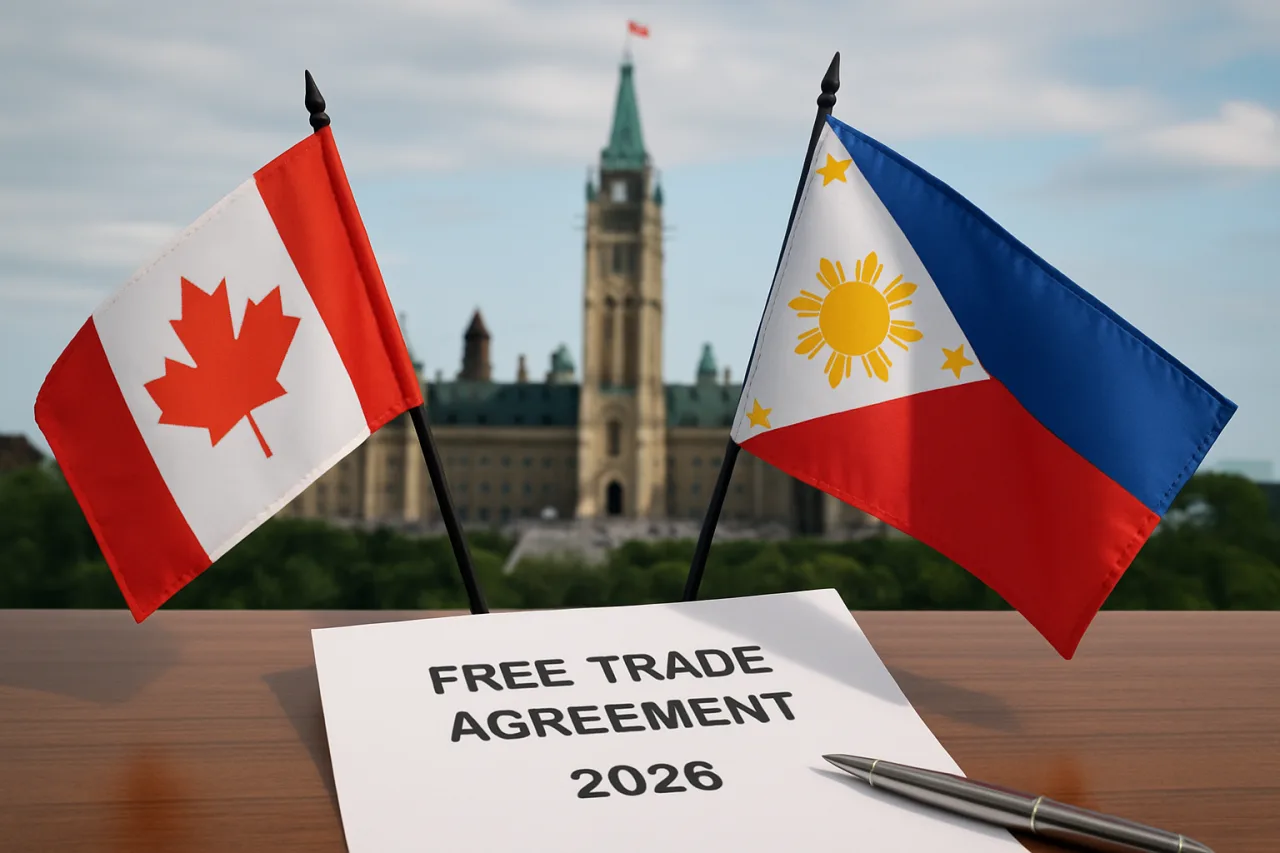
The Canada Philippines FTA is moving faster than most trade watchers expected. After three productive rounds of negotiations — the most recent concluding in July 2026 — the Department of Trade and Industry announced on August 4 that the fourth round will take place in September in Ottawa, with both countries targeting a finalized agreement by November. For Filipino professionals, entrepreneurs, and investors, the Canada Philippines FTA represents something the Philippines has never had: a bilateral trade agreement with a North American partner.
Trade Undersecretary Allan B. Gepty told BusinessWorld on August 4 that the third round of Canada Philippines FTA talks in July was “very substantive” and that both sides were able to close several chapters of the trade pact. “In terms of progress we achieved, it’s very substantive. So, I can say that we’re still on track,” Gepty said. The September round in Ottawa will focus on stabilizing the remaining text before both countries push for a November conclusion.
The Numbers Behind the Canada Philippines FTA
The economic relationship between Canada and the Philippines is already substantial, and the Canada Philippines FTA is designed to accelerate it. Canada was the Philippines’ 16th largest trading partner in 2025, with bilateral merchandise trade hitting $2.15 billion. Philippine exports to Canada amounted to $1.31 billion, while imports were valued at $840 million — giving the Philippines a trade surplus. According to Global Affairs Canada, bilateral merchandise trade reached CAD 3.2 billion in 2024, with Canada’s stock of direct investments in the Philippines standing at CAD 844 million.
As of end-February 2026, Philippine exports to Canada inched up by 0.7% to $100.39 million, while imports grew by 0.5% to $112.59 million, according to Philippine Statistics Authority data. Commonly traded products include agri-food and seafood products like wheat, pork meat, and pork products, as well as electronic goods like integrated circuits and electrical transformers. The Canada Philippines FTA would reduce or eliminate tariffs on these goods, making Philippine exports more competitive in the Canadian market.
What the Canada Philippines FTA Means for Filipino Professionals
The Canada Philippines FTA is not just about goods — it is about services, investment, and people. For Filipino professionals, the trade agreement has implications across multiple sectors, from digital infrastructure to PEZA investment zones that could attract Canadian manufacturing. The broader Philippine economic growth context makes this deal especially timely.
For entrepreneurs and exporters: The Canada Philippines FTA would provide preferential access to a high-value market of 40 million consumers with one of the world’s highest disposable incomes. Philippine agricultural products — mangoes, bananas, coconut products — currently face tariffs that make them less competitive than products from countries with existing FTAs. The agreement would level the playing field.
For tech and digital infrastructure professionals: The DTI has identified digital infrastructure as a priority sector for Canadian investment. This means opportunities for Filipino IT professionals, software developers, and digital infrastructure companies to partner with Canadian firms — and for Canadian tech companies to establish operations in the Philippines, creating jobs and knowledge transfer. The Philippines’ position as a global BPO hub, with over 1.7 million workers generating $38 billion in annual revenue, makes it a natural destination for Canadian companies seeking English-speaking tech talent at competitive costs. The Canada Philippines FTA could accelerate this trend by providing investment protections and streamlined business establishment procedures.
For the mining and mineral processing sector: The Canada Philippines FTA explicitly promotes mining and mineral processing as a key sector. Canada is a global leader in mining technology and investment. The Philippines, with its vast untapped mineral reserves — estimated at $1 trillion — needs both capital and technical expertise. The agreement could accelerate Canadian mining investment in the Philippines, creating opportunities for Filipino mining engineers, geologists, and environmental scientists.
For tourism and hospitality: Canada’s outbound tourism market is significant, and the Canada Philippines FTA could include provisions that streamline travel, investment in hospitality infrastructure, and tourism promotion. Filipino professionals in the tourism sector should watch for Canadian hotel and resort investment that typically follows trade agreements. The Marcos administration’s focus on tourism infrastructure — airports, roads, and digital booking systems — aligns with the kind of capital that Canadian pension funds and investment firms have historically deployed in Southeast Asia. A formal trade agreement would give Canadian investors the legal certainty they need to commit to long-term Philippine tourism projects.
The Marcos-Carney Vancouver Meeting
The political momentum behind the Canada Philippines FTA was reinforced at the highest level in 2026. President Ferdinand R. Marcos Jr. and Canadian Prime Minister Mark Carney met in Vancouver and committed to bolstering trade ties. Carney described the Canada Philippines FTA as “the foundation of our new Canada-Philippines strategic partnership” and set an ambitious goal: to triple bilateral trade by 2035.
Tripling bilateral trade from $2.15 billion to approximately $6.45 billion within a decade is an aggressive target, but trade agreements historically catalyze trade growth. The question is whether the Philippines can supply the goods, services, and talent that Canadian businesses need — and whether the Canada Philippines FTA includes provisions on labor mobility that would make it easier for Filipino professionals to work in Canada.
The ASEAN-Canada Connection
The Canada Philippines FTA does not exist in isolation. It is part of a broader trade architecture that includes the ASEAN-Canada Free Trade Agreement (ACAFTA), which is also under negotiation. The Philippines is expected to finish its bilateral FTA with Canada ahead of the broader ASEAN-Canada deal — a strategic advantage that gives Philippine exporters first-mover access to the Canadian market before other ASEAN competitors.
The ACAFTA is one of the priority economic deliverables of the Philippines as chairman of ASEAN in 2026. Trade Undersecretary Ceferino S. Rodolfo noted that the bilateral FTA would help the Philippines secure wider access to the Canada-United States-Mexico Agreement (CUSMA), while Canada would benefit from the Philippines’ proximity to ASEAN and regional neighbors. The ASEAN governance framework that the Philippines is championing as ASEAN Chair adds another dimension — the Canada Philippines FTA could include digital trade rules that align with the broader ASEAN digital economy agenda.
The Bigger Picture: Philippines Trade Diversification
The Canada Philippines FTA is part of a broader Philippine strategy to diversify trade relationships beyond traditional partners. The DTI has been actively pursuing multiple trade agreements simultaneously — the ASEAN-Canada deal, the bilateral Canada FTA, and ongoing discussions with other partners. Trade Undersecretary Rodolfo noted that the bilateral FTA would help the Philippines secure wider access to CUSMA, the North American trade bloc, while Canada would benefit from the Philippines’ proximity to ASEAN and regional neighbors. This positioning of the Philippines as Canada’s strategic gateway into Southeast Asia is a calculated economic diplomacy move.
For the Philippines, the timing is strategic. Global trade uncertainties — driven by US tariff policies, Middle East conflict, and supply chain disruptions — have prompted countries worldwide to diversify their trade partners. The Philippines, with its young workforce, strong macroeconomic fundamentals, and strategic ASEAN location, is positioning itself as a reliable partner for countries like Canada that want to reduce dependence on any single market. The Canada Philippines FTA would formalize this positioning and give both countries the legal framework to deepen economic ties over the coming decade.
What to Watch in the September Round
As the fourth round of negotiations opens in Ottawa, Filipino professionals and businesses should watch for several key outcomes:
1. Tariff elimination schedules: Which Philippine exports will gain immediate duty-free access, and which will face phase-out periods? The faster tariffs fall, the faster Filipino exporters benefit.
2. Investment protection provisions: Canadian mining and tech investors need legal certainty before committing capital. Strong investment protection in the Canada Philippines FTA would signal that the Philippines is open for business.
3. Labor mobility chapters: Will the Canada Philippines FTA include provisions for easier movement of professionals between the two countries? This is the section that matters most to Filipino engineers, IT workers, and healthcare professionals who want to work in Canada.
4. Digital trade rules: The DTI has identified digital infrastructure as a priority sector. Rules on cross-border data flows, digital services, and e-commerce will shape the opportunities available to Filipino tech professionals and digital freelancers.
5. Timeline for implementation: A November 2026 conclusion means ratification in 2027. The Canada Philippines FTA may not take effect until 2028 — but the strategic planning should start now.
Frequently Asked Questions
What is the Canada Philippines FTA?
The Canada Philippines FTA is a bilateral free trade agreement currently under negotiation between the Philippines and Canada. It would be the Philippines’ first trade agreement with a North American country. The fourth round of negotiations is scheduled for September 2026 in Ottawa, with both countries targeting a finalized agreement by November 2026.
How much trade is there between Canada and the Philippines?
Bilateral trade between Canada and the Philippines reached $2.15 billion in 2025, with Philippine exports at $1.31 billion and imports at $840 million. Canada was the Philippines’ 16th largest trading partner. In CAD terms, bilateral merchandise trade reached CAD 3.2 billion in 2024, with Canadian direct investment stock at CAD 844 million.
When will the Canada Philippines FTA be finalized?
Both countries are targeting a finalized agreement by November 2026. The fourth round of negotiations will be held in September 2026 in Ottawa. Trade Undersecretary Allan Gepty confirmed that the July round closed several chapters and that negotiations remain on track.
What sectors will benefit from the Canada Philippines FTA?
The DTI has identified mining and mineral processing, digital infrastructure, tourism, and high-value manufacturing as priority sectors. The agreement would also benefit Philippine agricultural exporters, electronic goods manufacturers, and service providers seeking access to the Canadian market.
Will the Canada Philippines FTA make it easier for Filipinos to work in Canada?
Potentially. The labor mobility chapter of the Canada Philippines FTA, if included, would streamline the movement of professionals between the two countries. Filipino engineers, IT workers, healthcare professionals, and skilled workers should watch for provisions on work visas, mutual recognition of qualifications, and professional licensing.
How does the Canada Philippines FTA relate to the ASEAN-Canada trade deal?
The Canada Philippines FTA is expected to conclude ahead of the broader ASEAN-Canada Free Trade Agreement (ACAFTA). This gives Philippine exporters first-mover access to the Canadian market. The Philippines is 2026 ASEAN Chair, making the ACAFTA a priority deliverable for the country.
Disclaimer: This article is for informational purposes only and does not constitute trade, legal, or investment advice. Trade agreement details, timelines, and sector provisions are based on publicly available information as of August 2026 and may change as negotiations progress. Consult with trade lawyers, DTI representatives, or investment advisors before making business decisions based on the Canada Philippines FTA.