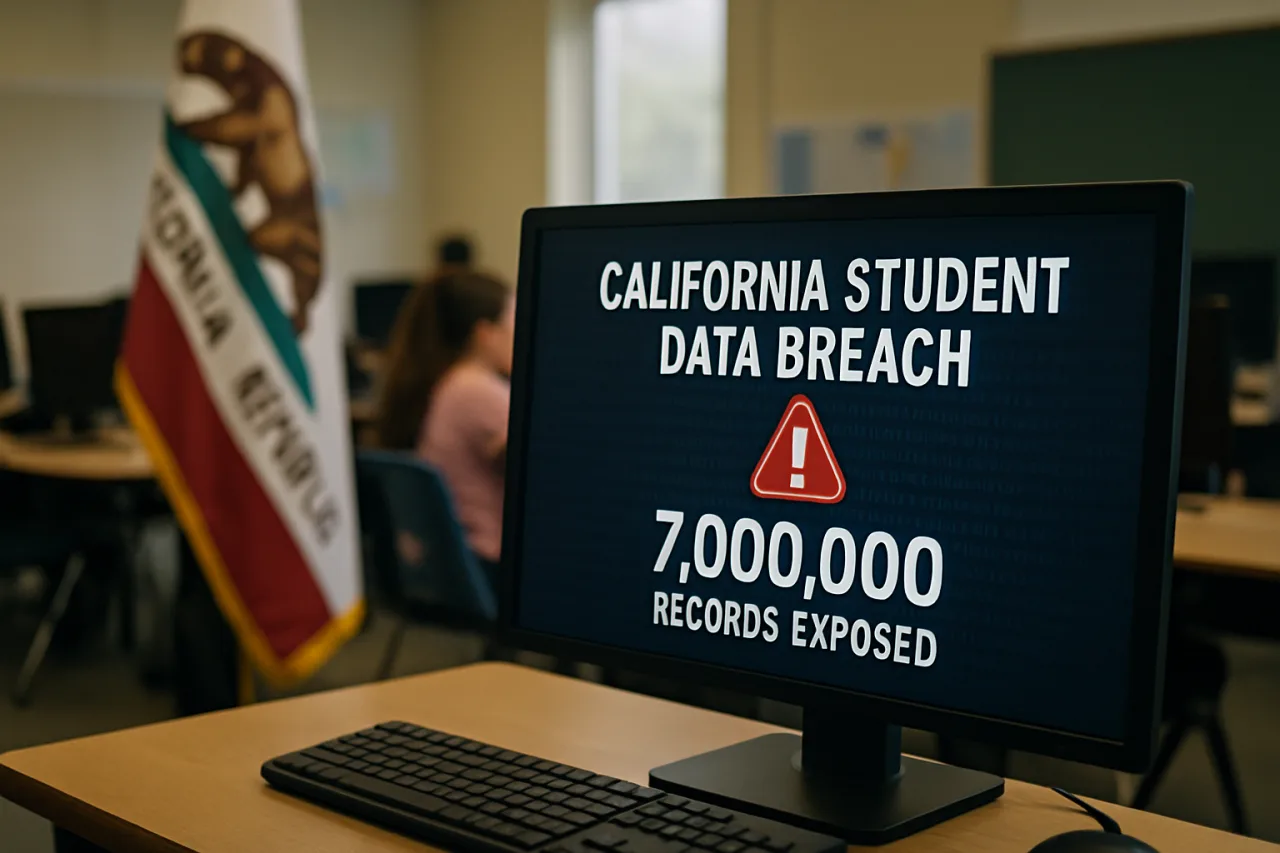
California student data breach alerts landed in mailboxes across the state on Friday, October 16, 2026, after authorities confirmed, as reported Friday, that hackers copied the personal information of nearly 7 million public school students — names, dates of birth, home addresses, demographic details and disability status — from the systems of the nonprofit that administers the state’s standardized testing. The company affected, Educational Testing Service, or ETS, runs California’s CAASPP and ELPAC assessments under contract with the state Department of Education, and announced alongside regulators that an unauthorized party used a compromised login credential to reach a file-transfer site used to exchange student data statewide — at various times from May 22 to September 18, 2026. This article explains what happened, what was taken and what was not, and gives parents one clean checklist for the next 48 hours.
Key Takeaway
- 🧾 The scale: about 7 million California public school students — everyone enrolled in the past three years — had data copied from Education Testing Service systems by an intruder using a compromised login.
- 📋 What was taken: names, dates of birth, addresses, demographics and disability status. Social Security numbers, financial details, passwords and parent information were not involved.
- 🛡️ The safety net: ETS is providing two years of identity protection through Experian IdentityWorks, and halted normal enrollment processing while systems are assessed.
- ⚠️ The real long-term risk: a child’s clean, unused credit identity is exactly what synthetic-identity fraud pays for — the danger is mostly future, not present.
- 🎯 The move: enroll in the protection offered, place a free security freeze on your child’s credit file, and lock down the minor’s identity documents — 15 minutes, listed below.
What happened: the California student data breach timeline
Put the confirmed facts in order and the California student data breach reads as a slow leak nobody smelled. The target was not the state itself but Education Testing Service, the nonprofit that administers California’s statewide K-12 assessments — the California Assessment of Student Performance and Progress and the English Language Proficiency Assessments for California — under a state Department of Education contract. On September 25, 2026, ETS identified unauthorized activity involving an SFTP site — a file-transfer service used to exchange California standardized testing information with the state. The response was fast by vendor standards: the account behind the activity was disabled, the SFTP site was taken offline, and outside cybersecurity experts were brought in.
The investigation found the mechanism the state’s notices now describe: an unauthorized party used a compromised login credential — a password that should not have worked — to reach the file-transfer site repeatedly during a window running from May 22 to September 18, 2026, copying files that contained California student information. In the days after the discovery, ETS paused normal enrollment data processing and certain testing activities, and the California Department of Education began the breach-notification process that produced this week’s announcements, along with a data-breach notice filed with the California Attorney General.
Two scale facts matter. First, coverage: the affected data spans every student enrolled in the state’s public schools across the past three years — the records describe children, not just current test-takers. Second, the population involved: the stolen information includes names combined with dates of birth and home addresses, demographics, and disability status for students in America’s largest public school system. That combination — identity anchors plus a sensitive status marker — is what makes the California student data breach more sensitive than a retail breach of the same size.
What was taken — and what was not
The notice is specific, and specificity is what parents should hold onto. Stolen or exposed: names, dates of birth, home addresses, demographic information, and disability status for students. Explicitly not involved, per the disclosures: Social Security numbers, financial account information, passwords, driver’s licenses, and parent information.
That mix matters because it defines the realistic threat model. Without SSNs, classic new-account credit fraud is harder — most US lenders still anchor approvals to SSNs. Without payment data, there is no immediate card risk. What remains valuable is exactly what was taken: a child’s full identity anchor set — the fields a criminal needs to eventually build a synthetic identity, to run phishing against families who now reveal too much about their children, to target disability-status households for benefit scams and fake aid offers. The California student data breach is, in the honest accounting, an identity-seed theft more than a money theft — and identity seeds mature slowly, which changes what parents need to do.
Why a student’s stolen record is dangerous years later
The uncomfortable truth about a stolen child’s record is the timeline. A seven-year-old whose name, birth date and address leak today presents no credit file for a criminal to attack — which is what makes the record cheap now and valuable later. Synthetic identity fraud works by combining a real minor’s identity anchors with fabricated payment behavior: the fraudster applies for credit in the child’s name, gets denied at first, then builds the synthetic identity a small step at a time — a phone plan here, a retail card there — until the file looks seasoned. By the time the student turns 18, the identity may carry years of borrowed debt before anyone notices, and the first sign is often a rejected student loan application.
This is why the security freeze — not just the credit monitoring being offered — is the move that matters. Experian IdentityWorks enrollment covers the household’s monitoring; a security freeze on the minor’s credit files does something monitoring cannot: it blocks new credit from being opened at all, in any of the three bureaus, until a parent un-freezes it. In the US, freezing a minor’s credit is free by law in every state for parents with documentation. Combined with the California student data breach’s specific exposure — names and dates of birth at minimum — the freeze is the one step that converts a stolen identity seed into a dead file. Our guide to identity-theft recovery after a data breach covers the full sequence for adults; the child version has one extra rule: the freeze is placed by the parent, with the child’s birth certificate.
The 48-hour roadmap for parents
- Step 1 — Read the notice you received: California families are receiving notifications by email and letter; the California Attorney General also posts the notice. Confirm whether your child’s school district falls inside the affected population — the state has said the affected set covers all students enrolled in public schools in the last three years.
- Step 2 — Enroll in the offered protection: ETS is providing two years of identity protection services through Experian IdentityWorks. Enroll and keep the confirmation — it is the vendor’s acknowledgment of the incident, if you ever need the paperwork.
- Step 3 — Freeze your child’s credit: request security freezes at Experian, Equifax and TransUnion in the child’s name with parental documentation. Free and reversible — unfreeze only when the child legitimately needs credit as an adult.
- Step 4 — Talk to your kids about phishing: the data includes contact details, so fraud may arrive as school-themed email, college-prep offers, disability-services pitches or scholarship bait. The family rule that beats them: no personal information by reply — ever — and verify any school-related request through the school’s own channels.
- Step 5 — Watch for the scam that asks you to fix the scam: after every large breach, copycat scams follow people who search for relief. Legitimate protection enrollment never asks for a Social Security number upfront, never asks for payment, and always matches the notice you received.
Inside the failure: a vendor credential and an old protocol
One more angle on the California student data breach deserves its own section, because it repeats every month in every sector: a contractor, a single credential, and a legacy transfer protocol. ETS is a mainstream, government-contracted education vendor — the breach did not ride in on exotic malware. An unauthorized party used a compromised login credential to walk into an SFTP site, the decades-old file transfer protocol that education, healthcare and logistics still run on because it is old and dependable. Compromised credentials — not zero-days — remain the front door of most data theft. And third-party vendors remain the corridor: the state’s own systems were not attacked; a partner’s file exchange was.
That has two lessons for every organization that moves sensitive data, school districts included. First: credential hygiene is infrastructure. Single shared SFTP logins, static passwords, and file-drop accounts with long lifetimes are the breach pattern now repeating across industries — rotating credentials, IP allow-listing, per-exchange unique accounts, and short-lived links replace them. Second: vendor risk management is data protection. A contract with a testing vendor is a contract to safeguard the identity anchors of every student in the district; the due diligence that matters is how vendor credentials are provisioned, logged, reviewed, and revoked.
What schools and vendors owe families now
Under California law, breach notifications arrived quickly — and the state’s disclosures name the services behind them: ETS halted normal enrollment data processing, paused certain testing activities while systems are assessed, and engaged outside cybersecurity experts. Beyond the statutory minimum, families are owed three things in the coming weeks: clarity on which specific students were in the copied files versus who was merely inside the affected enrollment ranges; continued transparency as the investigation resolves how the credential was compromised; and the identity-protection enrollment process functioning smoothly for millions of households at once — a scale that often strains vendor hotlines in week one.
Parent advocacy also has a concrete agenda here. Ask your district what data minimization contract terms it has with testing vendors — whether demographic and status fields are shared with the minimum required scope. Ask how the district verifies vendor security annually. And ask when — not whether — the district will move file exchange off static credentials to per-request, authenticated transfer. None of this requires technical expertise; all of it is on the record for any superintendent’s office to answer.
Global lesson for every education system, including the Philippines
American school systems are not uniquely exposed — they are uniquely documented. In the Philippines, the same pattern exists across education and government services: third-party vendors, file transfer accounts, and national-ID-adjacent data for minors. The Philippine National Privacy Commission’s breach reporting rules, like California’s, exist precisely because the vendor corridor is where student data lives. For OFW and Filipino families abroad, the practical take is the same as for California parents: know which vendors hold your children’s records, use the breach notifications you are given, and freeze early. Identity protection for minors is cheap and invisible until the day it is the only defense that worked against a California-student-data-breach class of event.
We have covered this pattern from every angle this year: how AI now writes phishing attacks, how the AI scam economy industrializes stolen identities, and the verification checklists that stop family-targeted fraud. The California student data breach sits squarely in that family of events: mundane credentials, sensitive fields, real kids, fixable defenses.
FAQ
What exactly happened in the California student data breach?
An unauthorized party used a compromised login credential to access an SFTP file-transfer site operated by Educational Testing Service, which administers California’s state assessments, at various times from May 22 to September 18, 2026 — copying files containing student data for nearly 7 million California public school students. ETS discovered the activity on September 25, disabled the account, took the site offline, and engaged outside cybersecurity experts.
What student information was stolen in the California student data breach?
Names, dates of birth, home addresses, demographic information, and disability status were taken. Social Security numbers, financial account information, passwords, driver’s licenses, and parent information were not involved per the state’s disclosures.
My child’s data is exposed — what should I do first?
Three steps, in order: enroll in the two years of Experian IdentityWorks protection the vendor is providing; place a free security freeze on your child’s credit file with Experian, Equifax and TransUnion (required documentation: the child’s birth certificate and your ID); and brief your household on the phishing wave that follows school data breaches — no personal information sent by reply, ever.
Is a security freeze the same as credit monitoring?
No — monitoring watches for identity abuse after it happens; a freeze blocks new credit from being opened at all in your child’s name. Both matter here: monitoring is provided by ETS through Experian IdentityWorks, while the freeze is the parent’s own step, free by law for minors in every US state.
Which schools were affected — and by when will we know more?
The California student data breach affects all students enrolled in California public schools over the past three years — the records describe enrolled students, not just current test-takers. Notifications are going out by district; ETS paused certain enrollment processing and testing activities during the assessment. Watch your district’s official channels and the California Attorney General’s posted notice for updates.
Could my child become a victim of identity theft from this?
Eventually, yes, if defenses are skipped — the taken fields are identity anchors valuable primarily for synthetic identity fraud that matures over years. That is why the freeze matters more than short-term monitoring: it converts a stolen identity seed into a dead file. Children whose families complete the 48-hour roadmap have effectively neutralized the record’s credit risk.
Financial Disclaimer
This article is for informational purposes only and does not constitute legal, financial, or credit advice. Figures and program details reflect public reporting available as of publication date and may change. Consult your school district, the California Attorney General’s office, or a licensed professional for guidance on your specific situation. WorldNgayon publishes security intelligence, not personalized recommendations.