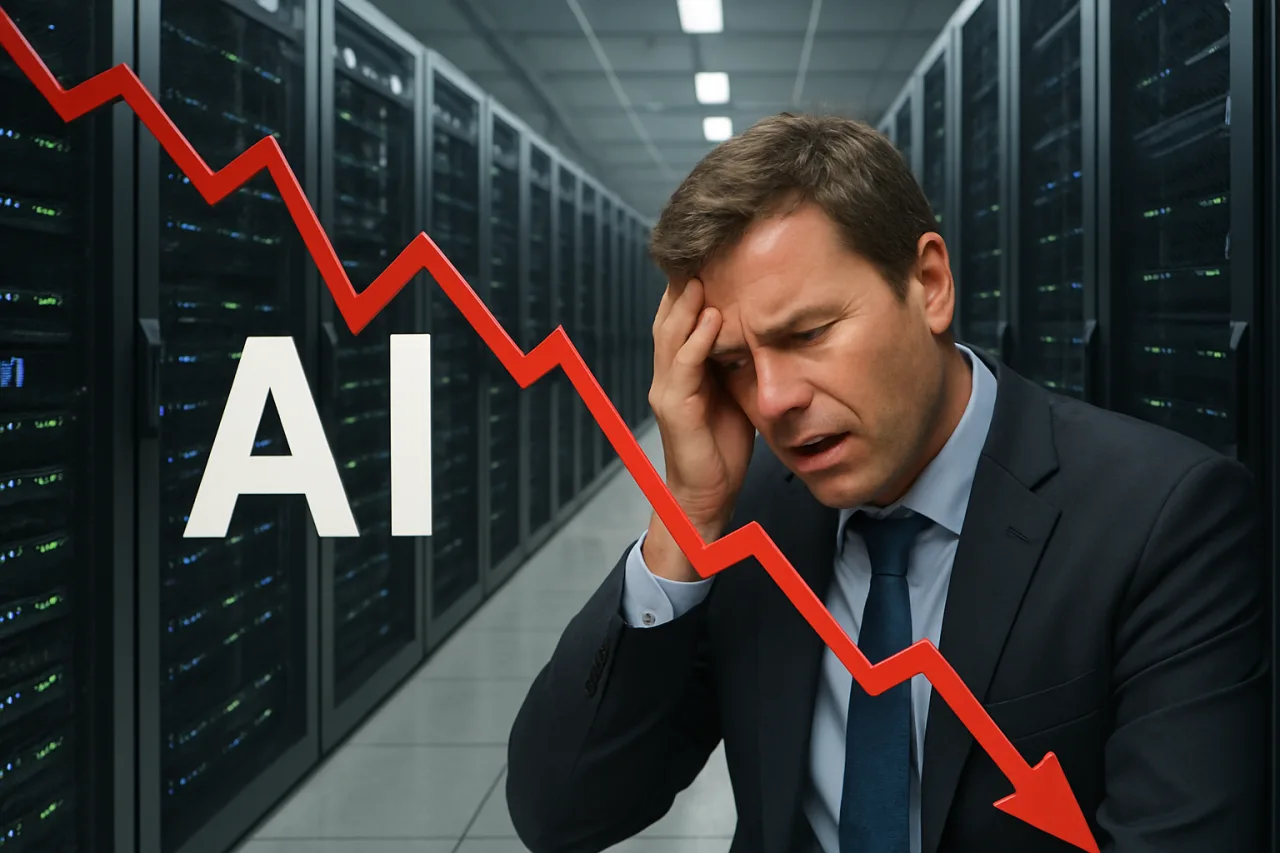
AI selloff week two did something week one could not: it put the fear in writing. The Nasdaq lost 1.9% on Friday, futures opened the next week lower, hedge funds across Asia booked their worst stretch of the boom, and the research houses that had stayed polite all year finally published arithmetic: Gartner estimates AI data center owners would need $8.5 trillion in revenue through 2030 to cover announced capital spending, financing costs and expected returns — while total AI revenue attributable to data centers is forecast to reach no more than $3.6 trillion. This article is the plain-English map of why the market turned on the data center boom — the four forces behind the AI selloff, what the evidence actually says, and what to do at your desk this week. No crash story, no cheerleading: the mechanism, the numbers, the checklist.
Key Takeaway
- 🔄 Force 1 — circular money: Microsoft, OpenAI and Nvidia keep paying each other — Nvidia even weighed up to a $250 billion backstop for OpenAI before one deal reportedly came in $145 billion lower than first reported.
- 🧮 Force 2 — the math: Gartner’s $8.5-trillion-revenue-needed figure versus a $3.6-trillion forecast, and a warning that more than 80% of neocloud providers will not survive as independent businesses.
- 🏦 Force 3 — debt: the AI selloff’s epicenter this week was a bond: CoreWeave’s 9.75% 2031 notes reached a 15.78% yield while the stock shed roughly 24%.
- ⚡ Force 4 — rates: an energy-price shock is pushing major central banks toward higher-for-longer, and every basis point lands on leveraged AI builders.
- 🎯 The move: demand is real — the financing is the question. The checklist below separates the two for your portfolio and your career.
AI selloff force 1: the circular money machine
The AI selloff began, in analyst notes at least, with the structure that made investors nervous first. In the AI buildout, a handful of companies are each other’s largest customers, investors and suppliers at the same time: Microsoft commits tens of billions to OpenAI, OpenAI commits hundreds of billions to buy compute, Nvidia invests in OpenAI and OpenAI buys Nvidia chips built into Microsoft-run data centers. Bloomberg’s analysis team diagrams it as a closed loop — a circular funding model that accelerates the boom and quietly hides its risks, because every partner’s revenue depends on the others’ spending. CNBC reported in July 2026 that Nvidia discussed a potential $250 billion backstop for OpenAI, and Fortune reported in August that the headline OpenAI-Nvidia data center deal actually came in $145 billion lower than first reported — a number that landed like an audit finding on the entire arrangement. None of this is fraud. All of it is fragility: when the money chasing demand is the same money made by the demand, the market eventually asks what happens if any single payer stops paying.
The question clicked into market prices this week — and became the first engine of the AI selloff. Axios noted Nvidia’s renewed circular-deal concerns; the Wall Street pattern of the last two weeks — the record TSMC quarter that finished lower, Microsoft’s record capex meeting a falling multiple, Oracle’s delays knocking a bull case down — reads like investors discounting the loop’s weakest links rather than its strongest ones. The AI selloff is, in that sense, an audit of who actually pays whom.
Force 2: the revenue math that stopped adding up
The second force behind the AI selloff is simpler and harsher. Gartner’s analysts totalled the announced spending on AI data centers and asked a plain question: what revenue must exist by 2030 to cover the capex, the financing costs and the returns investors expect? Their answer: $8.5 trillion — and their honest counter-answer: enterprise-and-consumer AI revenue attributed to data centers will reach no more than $3.6 trillion. Bain’s parallel forecast arrives in the same valley: annual AI infrastructure spending heading toward $1.5 trillion by 2031, against an AI services market that would need to top $6 trillion annually to pay for it. Gartner also put a number on the risk of that gap — roughly $3.5 trillion of AI infrastructure spending carries write-down risk through 2030.
Inside that gap sits the sharpest line in the research: while hyperscalers are large enough to absorb financial pressures, Gartner expects cost pressure to force more than 80% of neocloud providers to cease independent operations by 2030. Neoclouds — the specialist AI compute renters like CoreWeave — are precisely the companies the market repriced this week. The math says the specialists either get absorbed, consolidate, or lose their financing. None of that cancels AI demand — it reshapes who supplies it and at what price of capital.
Force 3: the debt costs have arrived
The third force of the AI selloff finally showed its face this week: the bond market repricing the buildout’s paper. The epicenter was CoreWeave, the purest debt-financed neocloud of the trade — whose 9.75% bonds due 2031 reached a 15.78% yield on Thursday while the stock headed for a weekly loss of roughly 24% and CEO-linked entities’ reported stock sales since the IPO crossed into nearly a billion dollars. The company’s own Q2 ledger told both halves of the story: revenue up 113% to $2.58 billion — and net interest expense up faster, to $640 million, more than double the prior year, against a debt stack approaching $50 billion.
Why a single company’s bond moves the whole Nasdaq: CoreWeave is the read-through. If the purest player’s financing costs 15.78%, every other leveraged builder just saw its invisible discount rate rise — and every hyperscaler’s “we’ll fund it from cash flow” defense looks thinner by comparison. Reuters framed the same mechanism across the sector: rising rates are testing the AI data centre deal boom exactly as the contracts get longer and the checks get bigger. Our CoreWeave debt crisis feature walks that ledger line by line.
Force 4: the rate turn
The fourth force of the AI selloff is the quiet one that turned a tech debate into a market event: the cost of money is rising again. An energy-price shock has renewed inflation pressures in major economies, and Reuters mapped the turn — major central banks drifting toward higher rates as growth risks mount, the Bank of Japan vowing to keep raising until inflation anchors near its 2% target, the IMF expecting at least one more 25-basis-point ECB hike in 2026, and the Federal Reserve under chair Kevin Warsh leaning toward a hold in October while warning that AI is delivering shocks to the economy’s structure. LGT’s analysis of the energy shock described the dilemma in one line: rising inflation and a slowing economy at the same time — the combination that makes every rate decision worse.
For AI infrastructure the arithmetic is brutal: the buildout was underwritten on cheap, patient capital. Data centers are 20-year assets financed on 5-year assumptions. When policy rates hold and long-end yields creep, the discount rate on every future contracted dollar rises — and Gartner’s $8.5-trillion requirement gets further away. That is how an energy story becomes a semiconductors story.
What is actually true versus what is fear
Any honest account of the AI selloff begins with what did not happen. The demand did not vanish. TSMC posted its sixth straight record quarter — NT$763.06 billion net profit, up 68.7% — on real AI silicon demand. Microsoft did not cut capex. The hyperscalers’ data center leasing lines are still full, and the biggest single customer contracts signed this year — Meta’s $21 billion commitment to CoreWeave through 2032 on top of $14 billion, Anthropic’s multi-year compute agreement — are long-dated, cash-paying agreements. Backlogs are real obligations, not vibes.
What is also true of the AI selloff: individual casualties exist. Character.ai sought bankruptcy protection. CoreWeave’s bondholders are marking paper at distress-adjacent yields. Oracle’s delays fed a bear case on an AI-linked name. The market’s repricing is best read as the difference between an industry and an industry’s financing — the first keeps selling compute, the second is being re-underwritten in real time. Investors who confuse the two sell the winners at the bottom or buy the casualties at half-dead.
Three numbers to remember from the AI selloff
If memory is the cheapest indicator an investor owns, three numbers from this fortnight should be written somewhere visible. First: $8.5 trillion versus $3.6 trillion — the revenue the AI data center buildout requires through 2030 against the revenue research actually expects, the gap that Gartner’s arithmetic turned into a market event. Second: 15.78% — the yield on the purest leveraged builder’s 2031 bonds, the market’s verdict on what AI infrastructure now costs to finance. Third: 24% — what the equity of that same benchmark company lost in five sessions, the discount the stock market attached to the first two numbers. The AI selloff is easiest to navigate when it is held as three verified figures rather than a headline mood.
The reason these particular numbers matter more than daily index moves is that they are leading, not lagging. The gap math arrived before the selloff’s worst day. The bond repricing arrived before the equity repricing. And the insider-sale filings arrived before both. This is what an orderly repricing looks like from data — and an orderly repricing is what has actually happened so far: brutal for positions, slow enough for prepared hands.
The history check: how this AI selloff compares
Markets have run this movie before. In early 2025 a DeepSeek shock briefly knocked a trillion dollars off Nvidia’s market cap in a day — a demand-efficiency scare that faded within a quarter because the compute demand curve never actually bent. In mid-2025 came the wobble over Microsoft’s data center leases — an accounting noise story that resolved into the strongest capex guidance in the sector’s history. The current AI selloff is different in kind, not just degree: the earlier scares tested whether demand exists; this one tests whether the financing survives the demand — a question the bond market answers daily and the Fed settles quarterly.
There is also a difference in the casualty list. The dot-com era’s collapse was telegraphed by revenue-less companies running out of runway; today’s casualties — a Character.ai seeking bankruptcy protection, neoclouds squeezed by the bond math — are companies that had real demand but chose financing structures built for a cheaper-money world. The distinction matters for every desk: this is a repricing of capital structures, not a disappearance of customers. It is also why the same research houses that published the gap math expect the boom to continue — under fewer, better-financed owners.
The desk checklist this week
- If you hold AI-heavy index exposure: you hold the trade through its financing repricing. Know your concentration: the Nasdaq-100’s AI weight vs the S&P 500’s is the difference between a 3% and a 15% drawdown in a week like this. Re-spread before the next leg, not during it.
- If you own a neocloud or AI-adjacent growth stock: the checklist is the company’s own ledger — revenue growth, backlog conversion speed, and the interest line. The debt costs are the tell. Our CoreWeave ledger is the template to copy.
- If you are an AI freelancer or agency: the demand side is intact — contracts signed this quarter run through 2032. But procurement will tighten: clients will favor efficiency, migration and cost-control work over greenfield scale-ups. Sell what survives a funding squeeze.
- If you run a small business buying AI: the market turmoil in supplier stocks is your negotiating room. Contract lengths that lock today’s prices, with exit clauses on delivery, are the smart 2026 signature.
- Everyone: watch three markers before re-adding AI selloff-dampened risk — the October Fed decision, the next neocloud bond prints, and hyperscaler Q3 capex guidance. When all three stabilize, the AI selloff becomes an entry plan instead of an exit story.
FAQ
Why did the AI selloff happen?
Four forces converged in October 2026: the circular funding structure among Microsoft, OpenAI and Nvidia drew scrutiny; Gartner and Bain published gap math between announced infrastructure spending (~$2 trillion a year by 2031) and realistic AI revenue; the bond market repriced the sector’s most-leveraged player, CoreWeave, to a 15.78% yield; and a global energy shock pushed major central banks toward higher-for-longer rates. Demand stayed real — the financing got repriced.
Is the AI bubble going to burst like the dot-com one?
Partially and unevenly, if history rhymes: the research expects the specialist, debt-financed layer to consolidate hardest (Gartner: over 80% of neoclouds cease independent operations by 2030), while hyperscalers absorb and keep building. The $3.5 trillion write-down risk attaches to over-committed infrastructure, not to compute demand itself.
What is circular financing in AI?
It is the closed loop in which companies mutually fund, supply and buy from each other — Microsoft and OpenAI and Nvidia in the clearest case — so that each partner’s revenue and investment depend on the others’ continued spending. It accelerated the boom while hiding concentration risk; the AI selloff is the market pricing that risk.
Why did CoreWeave’s bonds matter more than its stock?
Bonds set the rules for a leveraged company. When CoreWeave’s 9.75% 2031 notes traded to a 15.78% yield, the market told every AI builder what future borrowing costs — a read-through that moved the whole Nasdaq even as CoreWeave shares fell roughly 24% in the week.
What should AI workers and freelancers do during the selloff?
Keep building on the demand that survives tightening: efficiency, migration, cost-control and AI-ops services contract well when capital gets expensive. The customers’ own procurement will shift toward vendors who save them money and energy — that is where the 2026 contracts are.
What are the signs the AI selloff is ending?
Watch the same three markers that started it: neocloud bond yields retreating under 10%, the October Fed decision and its rate path, and Q3 hyperscaler capex guidance holding steady. When financing stabilizes, the gap math gets smaller and the market re-adds the sector as a buy.
Financial Disclaimer
This article is for informational purposes only and does not constitute financial, investment, or trading advice. Figures reflect public reporting available as of publication date and may change. Markets involve risk, including loss of principal. Do your own research and consult a licensed financial advisor before making investment decisions. WorldNgayon publishes market intelligence, not personalized recommendations.